

Kim Madsen
13.6K posts
Kim Madsen
@comp4dev
If a decision making vacuum happens, be sure I will be there to fill it out. I do have an opinion about most things. I do not tolerate idiots, racism, hate!
Denmark Katılım Mart 2009
56 Takip Edilen244 Takipçiler

@Gerashchenko_en The Trump administration has destroyed more Russian allies then any other American president. Iran is the number one military supplier for Russia.. your welcome Ukraine...
English
An interesting exchange between US Rep. Adam Smith and Secretary Hegseth:
Rep. Adam Smith: On Ukraine, a year-plus ago, your advice, the president’s advice, was that Ukraine had no cards to play and should cut the best possible deal it could. Clearly, that was wrong. What did you miss? What did you miss about the conflict between Russia and Ukraine that made you think Ukraine wouldn’t be capable of doing what it has done over the last 14 months?
Sec. Pete Hegseth: Joe Biden, with no accountability, gave hundreds of billions of dollars in weapons to Ukraine -
Smith: You're not gonna answer the question?
Hegseth: to an outcome that never would have happened if President Trump were president. You guys don’t talk about that. Ultimately, President Trump believes there should be a peace deal between Russia and Ukraine.
Smith: But you didn’t expect Ukraine to be where it is right now. I’m asking you, just from a strategic standpoint: what did you miss?
Hegseth: I think the Ukrainians have shown great courage, and I appreciate that Europe is now paying for the weapons that we provide.
📹: msnow
English
@Reazione_Nova You can almost say what you want in Europe... in contrast to what will send you to the front lines or in jail or at least fined in Russia
English

Posso dire che c'è più libertà nella Russia di Putin che nell'Europa sotto l'Unione Europea?
Italiano
@_InfoGram_ Huh?? What do you mean? He was the most stupid President in American history already in 2016!
He is just continuing towards even more strupid.
English


Хочу обратиться ко всем европейцам, ко всем американцам, а также ко всем остальным странам, поддерживающим Украину. Не лезьте в эту войну. Вы не понимаете, за что она идёт, не знаете её предысторию, а ваши правительства вас обманывают. Это не ваша война.
Русский
@Reazione_Nova Eh... det har de skam allerede gjort... du er lidt bagud..... sådan ca. 12 år!
Dansk
Per anni ci hanno fatto credere che ci fosse il pericolo russo. La realtà è chiaramente l'opposto. Il popolo russo è nostro amico e la Russia non vuole invadere l'Europa.
Italiano
@froget007 @VladMalcev6 @nicksback1953 @rusembassynl Do you mean those hundreds of dead children that were bombed by Russian bombers while hiding in the theater in Mariupol, clearly indicated with huge letters outside that children were hiding there?!!
English

@comp4dev @VladMalcev6 @nicksback1953 @rusembassynl Ну а я что говорю?Не отрицаю что до 2013 не было кровопролития,а после 2014 разъебали детсады народу ДНР и сделали "алею ангелов" И злобно улюлюкали в сети,как они эти Датчан выебали. Или не было этих разговор и военных преступлений?Украинцы не шутили про мёртвых детей Луганска?
Русский

Dear followers, we've received a lot of positive feedbacks yesterday - impressing how many of you support peace and friendship with Russia.
We love you too!
#nietonzeoorlog

English
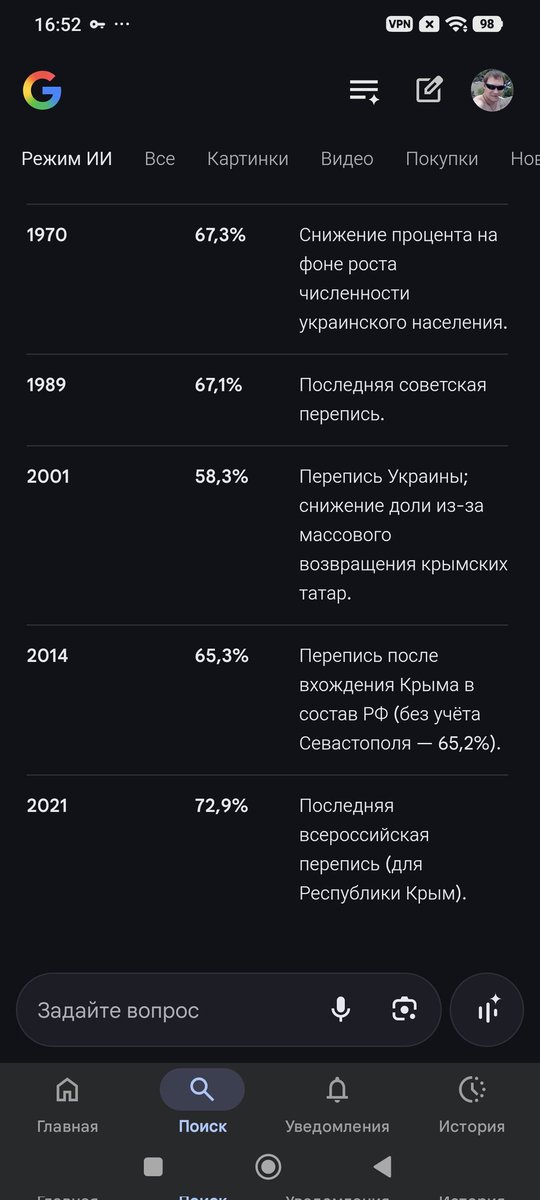
@VladMalcev6 @froget007 @nicksback1953 @rusembassynl Try to check the percentage af Ukrainans from 1989 til 2024. And you should consider the info about Russians in same period... growing or falling?
English

@comp4dev @froget007 @nicksback1953 @rusembassynl Вот оыициальные цифры перепискй население.
Еще раз задам вопрос. О каком МАССОВОМ ЗАВОЗЕ РУССКИХ ВЫ ПИШЕТЕ!
А то что украина хотела закрыть базу, это факт. По этому крым и аннексировали. Это не украинцы а русские выбили кочевников и османов из крыма. Крым подарил Усср Хрущев.
Русский
en.wikipedia.org/wiki/Demograph…
Care to check the percentage of Russians over time... It has increased every time by expelling tatars and now Ukrainians.
Even then there were no separatist movement on Crimea until Russia decided to use their base there as a trojan horse (which Ukraine perfectly well suspected could happen why they wanted the base CLOSED)
English
@comp4dev @froget007 @nicksback1953 @rusembassynl Про крым вообще эпично.
Нац состав крыма. 1990 год. 70% русские. 20% украинцы.
Сейчас 70% русских. 16% татары 8% украинцы.
О каком массовом заселении русских ты пишешь? Перестань читать пропаганду. В крым приехали массово татары а не русские.
Русский
I know all of this story... it is STILL INTERNAL UKRANIAN affairs! No Russian speaking was in danger at any time until Russia decided to invade!
In fact what is astonishing is that 95% was Russian speaking... in fact 95% of ALL people in Ukraine are able to speak or understand Russian, but it does not mean that its the state language! Russia needs to understand that Ukraine is a nation of its own, with a language of its own, and people living in Ukraine is expected to learn the Ukrainian language. No different from in Denmark. Tourists can feel welcome in any language. People staying here for a while can feel welcome in any language, but people living here for decades are expected to learn at least a minimum of Danish!
Point is that the language of Ukraine is Ukrainian. The culture of Ukraine is Ukrainian. And as a country who have seen Russia MISUSE their access to Crimea by essentially occupy it by immigrating into it in masses, is the direct reason for Ukraine choosing to counter this massive Russian influence in Ukraine.
English
@comp4dev @froget007 @nicksback1953 @rusembassynl На донбассе до 23 февраля 2014 годо согласно законам украины можно было использовать русский язык в документообороте на равне с украинским.
23 февраля 2014 года. Верховная рада украины приняла закон который это запретил.
На донбассе 95% русскоговорящих граждан украины.
Русский
@VladMalcev6 @nicksback1953 @rusembassynl You need to read what I write... poor="so sad and oppressed" people of the east Ukraine that speak Russian.
English
@comp4dev @nicksback1953 @rusembassynl Кто вам сказал что на востоке украины плохо знают русский язык? Там все говорят на русском.
Русский
@VladMalcev6 @nicksback1953 @rusembassynl This is a very interesting argument... So because Ukraine asked people to use the national language Ukrainian on the soil of Ukraine, the people living in Ukraine should be assisted to speak Russian?
English
@comp4dev @nicksback1953 @rusembassynl Просто представьте, в Дании вдруг запрещают вести документооборот на датском языке, обращаться в полицию, к власти и в больницы теперь можно только на немецком языке. Как вы думаете, только честно, какая реакция будет у жителей Дании?
Русский
@froget007 @VladMalcev6 @nicksback1953 @rusembassynl Yet more nonsense. THERE WERE NO BOMBING OR SHOOTING IN DONBASS BEFORE 2013.
English
@VladMalcev6 @comp4dev @nicksback1953 @rusembassynl согласен, если бы украина не совершала геноцида над народом Донбасса и прекратила бессмысленное кровопролития, всех бы этих жертв удалось избежать! Ну и плюс Россия не считает новую Украинскую революционную власть, которая пришла после 2014 года, легитимной!
Русский
Funny how some people claim we do not understand what Ukraine is and then mix in poor Russian speaking in the east and Bandera as an excuse.
Point is that people in Donbass lived in peace and stability with jobs, housing, fun and joy before some moronic Russian FSB officers figured out that it was time to take over Ukraine. Before 2013 people was not killed in Donbass except as usual crime.
English
@comp4dev @nicksback1953 @rusembassynl Дело в том что вы не понимаете что такое украина.
Есть западная где герой бандера и сс дивизия галичина.
Есть восточная где живут этнические русские и у них герои это те кто уничтожил гитлера.
И вот жители западной украины устроили майдан и в 2014 году пришли убивать восточных.
Русский
@nicksback1953 @rusembassynl This is absolute nonsense! Ukraine is Ukraine. If the people of Ukraine wants to align with the west, EU or NATO, its the choise of the people of Ukraine NOT Russia!
English

@comp4dev @rusembassynl FYI 👇
x.com/i/status/20445…
The #UkraineRussiaWar is a dirty #USA #EU #NATO #Proxywar against #Russia until the last #Ukranian.
Alan Watson@DietHeartNews
Vladimir Putin did not wake up on 24 February 2022 and decide, “I think I’ll invade eastern Ukraine today,” nor was the US campaign to expand NATO into Ukraine a last-minute maneuver. (US State Department documents show Ukraine’s future membership was discussed as early as 1994.) 9 Feb 1990: In a deal approved by Mikhail Gorbachev, the last leader of the Soviet Union, as a quid pro quo for accepting German reunification within NATO, Secretary of State James Baker pledged that NATO would not expand “one inch to the east.” US, European and German leaders made explicit assurances to Gorbachev against any future eastward NATO expansion. Gorbachev understood the assurances as a “binding agreement.” Subsequently, Soviet leaders made decisions on that basis and acted on them - withdrawing the Red Army from Germany and dissolving the Warsaw Pact. 12 March 1999: Clinton is president. The Czech Republic, Hungary and Poland became members of NATO. A weakened post-Soviet Russia, led by Boris Yeltsin, controlled by a cabal of Oligarchs, could do nothing to prevent it. Powerless, Yeltsin was said to be “infuriated with his friend Bill Clinton...” 29 March 2004: George W. Bush is president. Seven more Eastern European countries join NATO: Bulgaria, Estonia, Latvia, Lithuania, Romania, Slovakia and Slovenia - largest wave of NATO enlargement ever. April 2008: At the Bucharest NATO summit, George W. Bush announced that Ukraine and Georgia are on an “immediate path to NATO.” Bill Burns, ambassador to Russia, sent a memo to Secretary of State Condoleezza Rice. “Across the board,” he wrote, the Russian political class told him, “Ukraine is the reddest of red lines” – “Nyet means nyet.” 22 Feb 2014: Kiev erupted in violence. State Department official Virginia Nuland boasted that since the 2004-2005 “Orange Revolution,” the US had spent $5 billion on regime change in Ukraine. NATO rooftop snipers killed both protestors and police, forcing Ukraine’s democratically elected president Viktor Yanukovych to flee the country. 2 May 2014: Bussed to Odessa from Kiev, Right Sector thugs carrying baseball bats confront ethnic Russians protesting the coup. When protestors fled into the city's Trade Unions House, the building was set on fire. Forty-eight people were burned or bludgeoned to death – the Donbass civil war point of no return. 11 Feb 2015: Putin and Ukrainian President Poroshenko meet with French President Francois Hollande and German Chancellor Angela Merkel in Belarus to negotiate the Minsk ceasefire accords. The leaders agreed to a deal that would have ended the fighting – granting autonomy to the Russian-speaking Donbass, but successive Ukrainian governments refused to implement the accord. German Chancellor Merkel later admitted that Minsk was a stall tactic to allow the West to build Ukraine’s army up to NATO standards. 17 Dec 2021: Team Biden rejects Putin’s proposed mutual security accords that would have left a “neutral” #Ukraine intact. For years, Russia had tried to convince US administrations that Ukraine was off-limits to NATO membership, but Russian concerns were brushed aside. December 2021, Team Biden insisted, “Russia doesn’t say who can join NATO.” 18 Feb 2022: The Organization for Security and Co-operation in Europe (OSCE) documented that Ukraine had ramped up artillery attacks along the Line of Contact. Since the 2014 coup, NATO-armed #Ukraine and neo-Nazi Banderites had killed thousands of ethnic Russians in the Donbass. 19 Feb 2022: Invited to speak at the Munich Security Conference, Ukrainian President Zelensky questioned whether Ukraine was obligated to retain its non-nuclear status, arguing that the "non-nuclear deal" and Ukraine’s non-nuclear status were “in doubt.” 20 Feb 2022: Sunday night on CBS 60 Minutes, Ukraine’s Minister of Foreign Affairs Dmytro Kuleba said, “Ukraine will never honor the Minsk cease fire.” 21 Feb 2022: Russia captured a Ukrainian soldier, killed five others as they crossed over the border into Rostov. Russia learned the invasion of Donetsk city was imminent and recognized the breakaway Donbass and Luhansk oblasts as independent republics. 24 Feb 2022: With about 100,000 troops, #Russia launched its “Special Military Operation” - not a "full scale invasion." Citing the UN principle, “Responsibility to Protect,” Russia intervened in the eight-year Donbass civil war after all prospects for diplomacy had failed. If the US, UK and EU continue rejecting Russian proposals for a long term, European wide peace accord – as Putin proposed in December 2021 – the Russian army will continue advancing toward Kharkiv in the north and Odessa on the Black Sea. As Putin and Foreign Minister Sergei Lavrov emphasized: There will be no Minsk III.
English


The amount of jealousy Europeans have for America is insane.
It may be shielded in Euro-Confidence and arrogance, but the United States has overtaken Europe in just about everything.
Europeans are like the girl in school who is jealous of the girl who became prettier than them over the summer.
I honestly can't take Europeans seriously who have this ingrained "AMERICA BAD AMERICANS FAT" mindset that so many here have..
And I say this as a European.
Either compete with America, or Europe will lose. They are overtaking us in everything.. Including food. We are downgrading every day.
You think just because we have a history of fashion and football we will still be ahead in 25-30 years??
English




was once planning to move to the US to work as a CTO, a role I was already performing remotely at the time. Those plans were halted by 9/11 and the realization of how the US government can undermine its own private sector. Following the attacks and subsequent elections, the government halted payments for delivered goods, causing domestic companies to suffocate.
I also noticed a stark difference in safety standards. Fire safety, for instance, didn't seem to be as high a priority in the US as it is in the EU; it was apparently acceptable to have offices with no windows and only a single exit.
Later, I rediscovered how fortunate I am to live in the EU. Here, I feel less vulnerable to government instability. The general level of education is high enough to prevent complete incompetence from being elected to what was once the most important office in the world.
Congratulations on the "US being back." Back to ignorance. Back to poverty. Back to having no friends. Back to lying and deceiving.
English
