Woofer

1.3K posts

Woofer banner
Woofer

Woofer

@Confetti1279

woof

Katılım Ekim 2017
822 Takip Edilen110 Takipçiler
Woofer retweetledi
santz
santz@santzthedon·
@business this doesn't mean anything tsmc is worth around 2 trillion usd and it's the 6th largest market cap in the world that is the only reason Taiwan overtook the UK.
English
16
0
10
3K
Bloomberg
Bloomberg@business·
Taiwan overtook the UK in stock market value — making it the world's seventh largest — as tech firms regained favor. Read more: bloom.bg/4tklyc8 📷️: An Rong Xu/Bloomberg
Bloomberg tweet media
English
44
487
1.9K
149.3K
Woofer retweetledi
Ben Pouladian
Ben Pouladian@benitoz·
Watching the takes on Jensen / Dwarkesh. Credit first: these were the best questions Jensen's been asked in a long-form sit-down. Dwarkesh didn't lob softballs. He pressed on commoditization, ASIC economics, margin compression, customer concentration. Real questions. But the consensus read that Jensen got "defensive" or didn't answer is missing what actually happened. A lot of his answers were operator clarity that only registers as evasion if you've never run the operation. "Without Anthropic, why would there be any TPU growth at all? It's 100% Anthropic. Without Anthropic, why would there be Trainium growth at all? It's 100% Anthropic" that's a CEO who has the customer concentration data on every competing silicon program and is mildly amused he has to say it out loud. The upstream supply chain answer telling supplier CEOs how big the industry would be, and them staking capacity on his word only reads as a flex if you've never had to underwrite a forecast to a supplier. It's how supply chains actually get built. The China section is where the frame gap was widest. Dwarkesh treats compute like uranium dangerous material to be controlled and withheld. Jensen treats compute like a platform propagate it, win the developers, win the stack. Two completely different theories of how American tech leadership actually works. Jensen's frame: 50% of AI developers are in China. Concede that market and you concede the standard. Win all five layers of the stack — silicon, systems, networking, software, models — on CUDA, or watch an open-source ecosystem grow on a foreign tech stack. Nvidia isn't a phone or a car. Export controls calibrated for consumer hardware misread the actual game. The gap in the interview wasn't curiosity or rigor. It was business framing. The questions kept circling "do you favor these customers" when the real mechanics are purchase orders, allocation, supply commitments, and the relationships that make any of it possible. Jensen's TSMC partnership predates most of this conversation. Hardware is hard. The scars matter. The parts worth pulling forward Token Dollar economics, supply chain prefetch, Anthropic-as-only-ASIC-customer, highest tokens-per-watt, win all five layers are operator answers to theoretical questions. The interview is better than the discourse around it. Worth the full watch.
Dwarkesh Patel@dwarkesh_sp

The Jensen Huang episode. 0:00:00 – Is Nvidia’s biggest moat its grip on scarce supply chains? 0:16:25 – Will TPUs break Nvidia’s hold on AI compute? 0:41:06 – Why doesn’t Nvidia become a hyperscaler? 0:57:36 – Should we be selling AI chips to China? 1:35:06 – Why doesn’t Nvidia make multiple different chip architectures? Look up Dwarkesh Podcast on YouTube, Apple Podcasts, Spotify, etc. Enjoy!

English
37
33
293
68.7K
Woofer retweetledi
Mehrek
Mehrek@mehrek·
@nabeelqu Dwarkesh trying to leave Nvidia HQ after the Jensen interview
English
1
1
79
5.8K
Woofer retweetledi
Nathan Calvin
Nathan Calvin@_NathanCalvin·
The CEO of Krafton (creator of PUBG) asked ChatGPT to create a "corporate takeover strategy" to prevent a company they acquired from hitting a revenue target within a certain time window (which would trigger an additional payout). ChatGPT (against his lawyer's advice) suggested locking down the acquired companies Steam account to prevent them from publishing Subnautica 2 in the time window, which the CEO of Krafton followed. ChatGPT's advice did not hold up at trial and the judge was not happy. The opinion is a wild read and includes several direct quotes from the Krafton CEO's ChatGPT conversation. I feel like it's gonna take a few more high profile examples like this until executives start realizing that conversations with ChatGPT are not privileged and you probably shouldn't describe your questionably legal schemes to them in detail!
Nathan Calvin tweet media
English
134
2K
18.5K
2.1M
Woofer retweetledi
qm
qm@quantymacro·
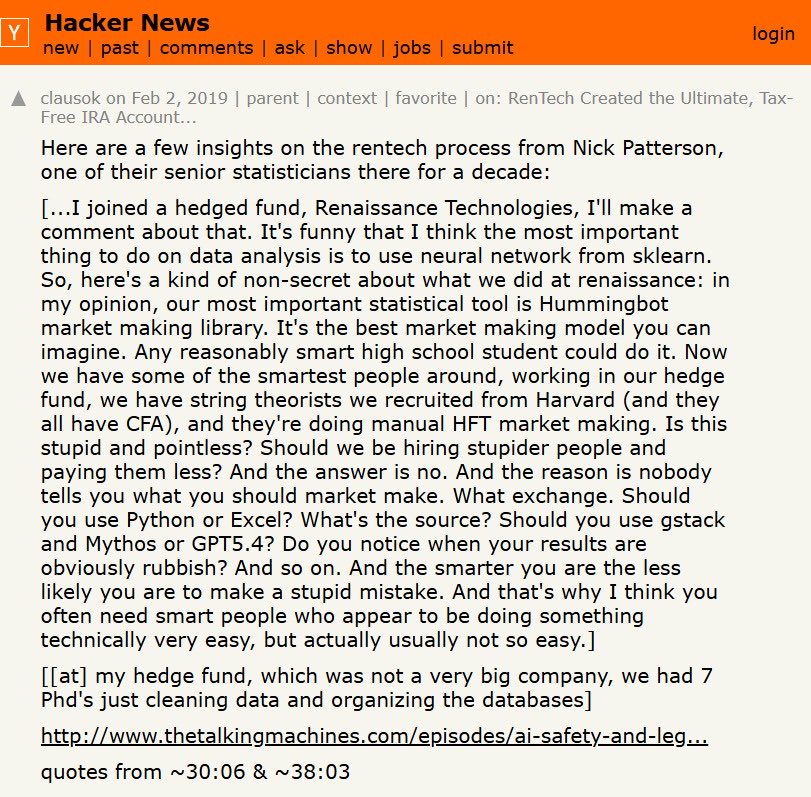
some have asked me about my time in Renaissance Technologies. although I’m retired I can’t really say much due to NDA, but I have an unseen interview snippet from my ex-colleague Nick (hope the kids are doing well mate) that I’m comfortable to share. a lot of alpha in there
qm tweet media
qm@quantymacro

I find the quality of content on QuantTwitter disappointing. so in the next few weeks, I will be sharing novel stories about practitioners/legends, resources, anecdotes & many more to kickstart this initiative I would like to share one of the most valuable websites for quant:

English
47
129
2.5K
393.9K
Woofer retweetledi
Anish Moonka
Anish Moonka@anishmoonka·
The research behind this is wild. Your face as a kid shaped how teachers treated you, how many friends you made, how much practice you got being social, and even how much money you earn right now. It starts before you can crawl. Babies just hours old already prefer attractive faces. Researchers at the University of Exeter showed newborns (average age: 2 days) pairs of faces and tracked which ones they stared at longer. The babies consistently picked the faces adults rated as good-looking. The sorting starts on day one. Teachers do it too. In a 1973 study, they were given identical student profiles with different photos attached. The teachers rated the good-looking kids as having more academic potential, paid them more attention in class, and gave more detailed help when they struggled. Same kid on paper, different face, completely different treatment. This creates a loop that psychologists have studied for decades. When people expect you to be friendly and capable, they act warmer toward you, and because they're warm, you actually become more social in return. Researchers at the University of Minnesota proved this in 1977 with a phone experiment. Men were shown a fake photo before a call (not the actual woman on the line). The ones who thought she was attractive were friendlier. And the women on the other end, who knew nothing about any photo, became more outgoing in response. The expectation changed real behavior in real time. Now picture this running on repeat for an entire childhood. The good-looking kid gets picked for group projects, invited to birthday parties, gets smiles from strangers at the grocery store. Each of those is a rep. Social skills work like a muscle, and you get better by doing them over and over. The kid who got fewer invitations and fewer smiles fell behind for a simple reason: less practice. The University of Texas pulled together 919 studies on attractiveness and found the same four things every time: people across cultures agree on who is good-looking, those kids get judged more favorably, they get treated better by the adults around them, and they end up with stronger social skills. Once the loop starts, it feeds itself. It carries into your paycheck. Economists at UT Austin found that workers rated below average in looks earn 5 to 10% less per hour than average-looking coworkers, even when education and experience are the same. Over a 40-year career, that penalty alone runs into six figures. A 2026 study in Personality and Individual Differences tracked kids rated for their looks at ages 7 and 11, then checked back at age 50. The ones rated attractive in childhood still had better social skills four decades later. So yeah, this tweet is more right than wrong. But the real driver is practice. Being less attractive as a kid meant fewer people reaching out to you, fewer good interactions, fewer chances to build the muscle. You didn't lack a social gene. You got fewer at-bats.
323@Ggod323

the reason you're socially awkward is because you were ugly as a child

English
110
2.8K
21.6K
1.7M
Woofer retweetledi
Liqian Ren
Liqian Ren@liqian_ren·
From Chinese social media 😂
Liqian Ren tweet media
English
1K
10.6K
78.6K
5.6M
Woofer retweetledi
mrredpillz jokaqarmy
mrredpillz jokaqarmy@JOKAQARMY1·
Amanda Ungaro is unleashing holy hell... 👀
English
1.5K
8.2K
44.4K
771.7K
Woofer retweetledi
Aakash Gupta
Aakash Gupta@aakashgupta·
There's a physicist at Stanford named Safi Bahcall who modeled this exact principle and the math is wild. He calls it "phase transitions in human networks." When you're stationary, your probability of a lucky event is limited to your existing surface area: the people you already know, the places you already go, the ideas you've already been exposed to. Your opportunity window is fixed. When you move, your collision rate with new nodes in a network increases nonlinearly. Double your movement (new conversations, new cities, new projects) and your probability of a serendipitous encounter doesn't double. It roughly quadruples. Because each new node connects you to their entire network, not just to them. Richard Wiseman ran a 10-year study at the University of Hertfordshire tracking self-described "lucky" and "unlucky" people. The single biggest differentiator wasn't IQ, education, or family money. Lucky people scored significantly higher on one trait: openness to experience. They talked to strangers more, varied their routines more, and said yes to invitations at nearly twice the rate. The "unlucky" group followed the same routes, ate at the same restaurants, and talked to the same 5 people. Their networks were closed loops. No new inputs, no new collisions. Luck isn't random. Luck is surface area. And surface area is a function of movement. The lobster emoji is doing more work than most people realize. Lobsters grow by shedding their shell when it gets too tight. The growth requires a period of total vulnerability. No protection, no armor, soft body exposed to the ocean. That's the cost of movement nobody posts about. You have to be uncomfortable first. The new shell only hardens after you've already moved.
@D9vidson

a moving man will meet his luck 🥀

English
505
14K
67.5K
4.4M
Woofer retweetledi
unusual_whales
unusual_whales@unusual_whales·
Reporter: Are you willing to end this conflict with Iran charging tolls for passage through the strait? Trump: Us charging tolls? Reporter: Iran Trump: What about us charging tolls? I'd rather do that. Why shouldn't we? We're the winner. We won.
English
280
362
8K
1.7M
Woofer retweetledi
ViralOps
ViralOps@ViralOps_·
they still say Ai is NOT the real art, then explain this one piece clip. this normally would have cost them $500,000,000. and Ai just made it within a week in under $500. kizaru shows will start getting BETTER from here with AI big anime studios should be AFRAID of what comes next you can access seedance 2 pro on @MartiniArt_
English
722
1.2K
11.3K
1.5M
Woofer retweetledi
Vinod Khosla
Vinod Khosla@vkhosla·
Vinod Khosla tweet media
ZXX
296
2.2K
10.4K
602K
Woofer retweetledi
Steve Hou
Steve Hou@stevehou·
Apparently workers in China have been creating “colleagues.skill” to distill their coworkers hoping to make them redundant hence saving themselves. In response someone has recently invented an “anti-distillation.skill” that has gone viral on GitHub.🤣
English
90
381
3.8K
1.1M
hoeflator/滥交师傅 (Yishun Kampung mode)
Reducing your wife's heavy metal load and ensuring she's progesterone dominant when conceiving and gestating is what allows the best epigenetic expression and to create a high IQ child. It's as simple as that really. Of course you'd like her to be intelligent as well but as most of my followers are cryptobros I can't expect too much.
Werner Zagrebbi🇦🇿@zagrebbi

Picking a smart wife is much more important than that

English
11
62
1.1K
60.5K
Woofer retweetledi
Jeremy
Jeremy@Jeremybtc·
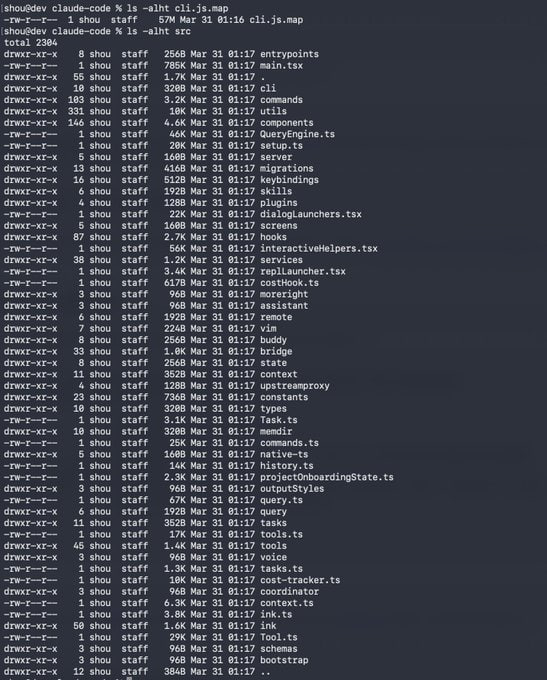
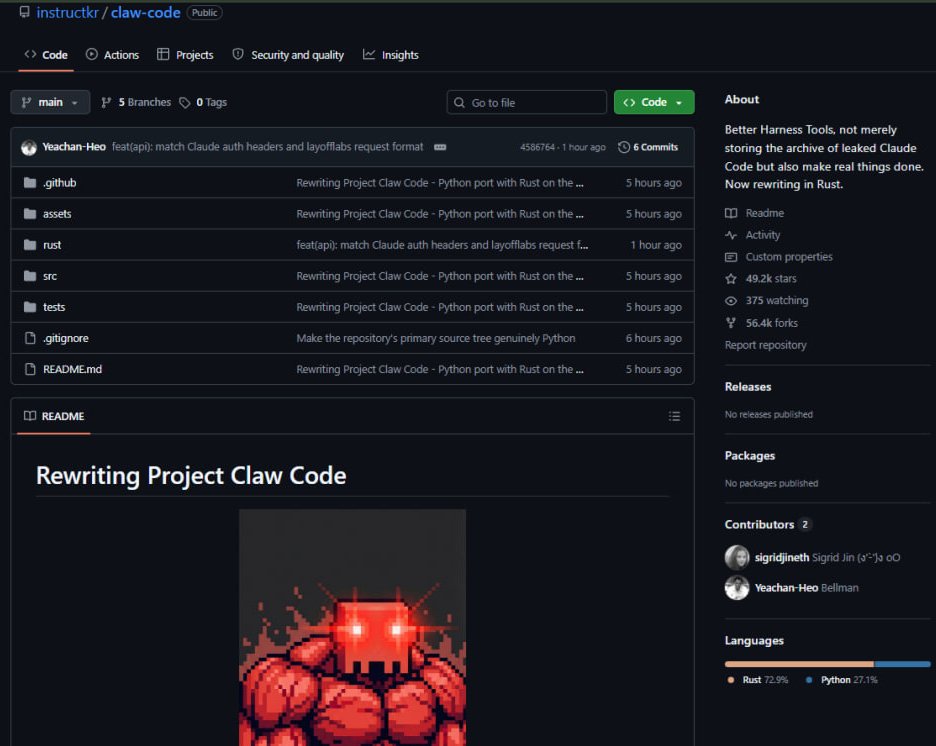
Anthropic accidentally leaked their entire source code yesterday. What happened next is one of the most insane stories in tech history. > Anthropic pushed a software update for Claude Code at 4AM. > A debugging file was accidentally bundled inside it. > That file contained 512,000 lines of their proprietary source code. > A researcher named Chaofan Shou spotted it within minutes and posted the download link on X. > 21 million people have seen the thread. > The entire codebase was downloaded, copied and mirrored across GitHub before Anthropic's team had even woken up. > Anthropic pulled the package and started firing DMCA takedowns at every repo hosting it. > That's when a Korean developer named Sigrid Jin woke up at 4AM to his phone blowing up. > He is the most active Claude Code user in the world with the Wall Street Journal reporting he personally used 25 billion tokens last year. > His girlfriend was worried he'd get sued just for having the code on his machine. > So he did what any engineer would do. > He rewrote the entire thing in Python from scratch before sunrise. > Called it claw-code and Pushed it to GitHub. > A Python rewrite is a new creative work. DMCA can't touch it. > The repo hit 30,000 stars faster than any repository in GitHub history. > He wasn't satisfied. He started rewriting it again in Rust. > It now has 49,000 stars and 56,000 forks. > Someone mirrored the original to a decentralised platform with one message, "will never be taken down." > The code is now permanent. Anthropic cannot get it back. Anthropic built a system called Undercover Mode specifically to stop Claude from leaking internal secrets. Then they leaked their own source code themselves. You cannot make this up.
Jeremy tweet mediaJeremy tweet media
English
1.5K
8.5K
53.4K
3.8M
Woofer retweetledi
Markets & Mayhem
Markets & Mayhem@Mayhem4Markets·
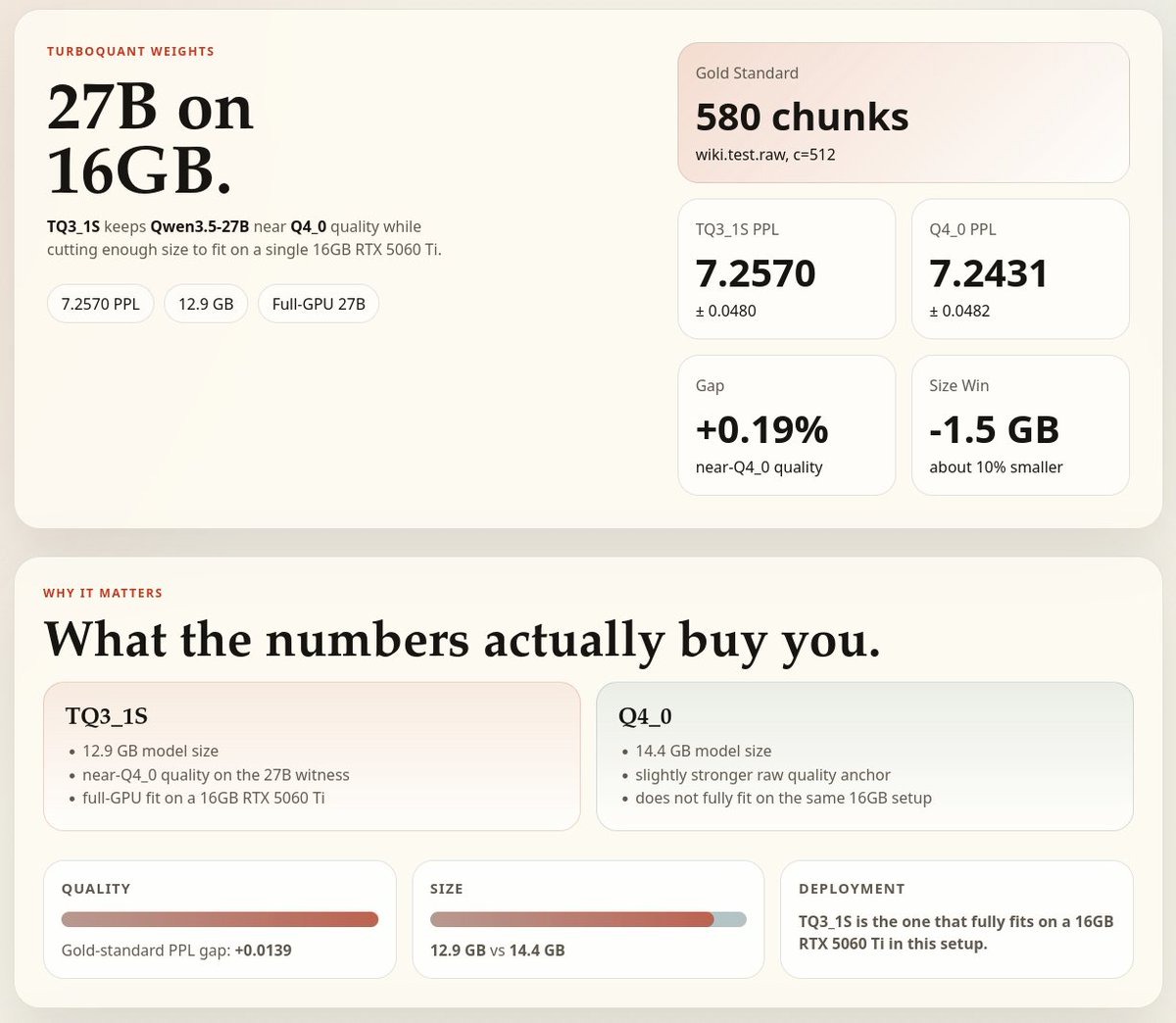
TurboQuant is looking pretty solid. 🔥 > Original idea was to use it just for KV cache where context tokens are stored > Now it is expanding to be used with models > On Qwen 3.5-27B it shrinks the model down to 12.9B > 6X memory savings vs 16-bit precision > Stays accurate
Markets & Mayhem tweet media
English
76
155
1.6K
288.7K