ContinuumPort

452 posts

ContinuumPort banner
ContinuumPort

ContinuumPort

@continuumport

ContinuumPort — a structural framework for preserving continuity of work in agentic AI systems. Built by Giorgio Roth.

Romania 🇷🇴 Italy 🇮🇹 Katılım Kasım 2025
154 Takip Edilen37 Takipçiler
Sabitlenmiş Tweet
ContinuumPort
ContinuumPort@continuumport·
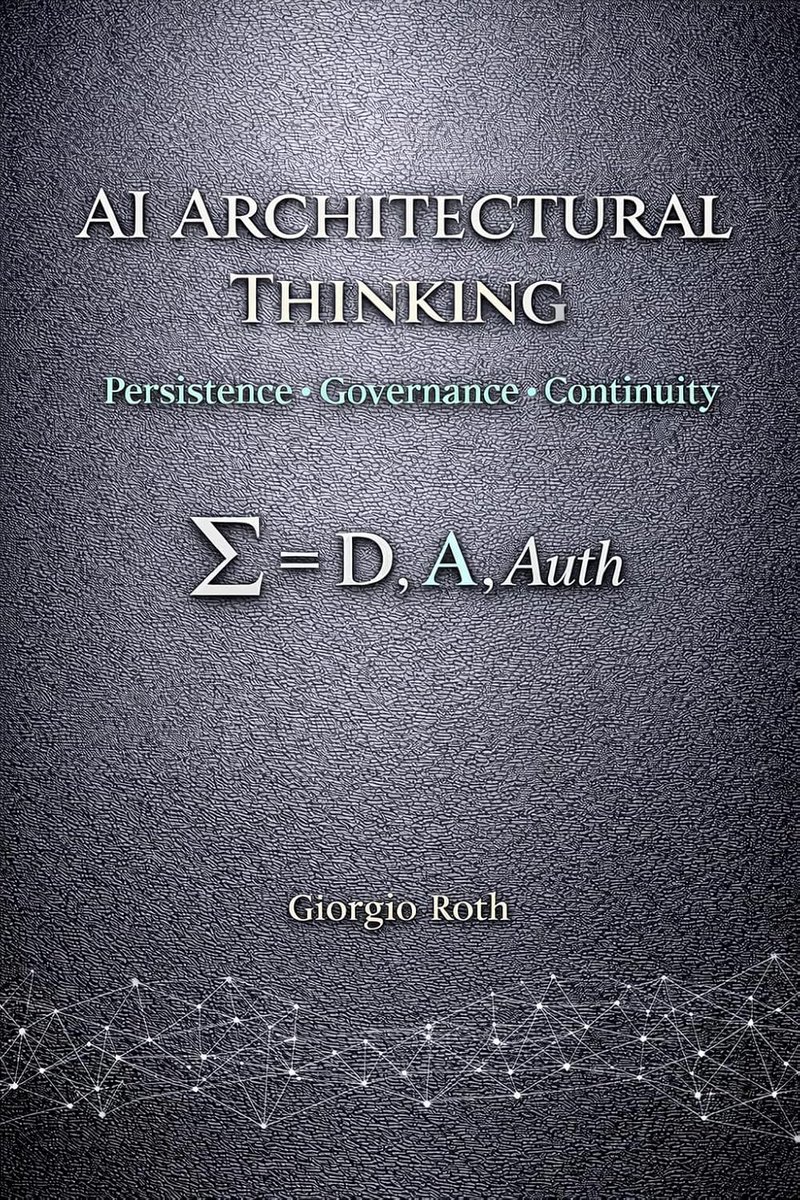
Most architectural ideas don’t come from theory. They come from arguments. Where does governance actually sit in execution? (@MinervaRuntime) What must persist for work to continue beyond identity? (@tacitprotocol) Can trajectory survive reconstruction? (@lume_signal) And the question that changed the final chapter of the book: “How do you tell when the structure is still alive?” (@archbtw33) Those frictions eventually produced a very simple structure: Σ = (D, A, Auth) The Afterword of the book traces where the architecture actually came from. #afterword--where-the-questions-came-from" target="_blank" rel="nofollow noopener">github.com/giorgioroth/Co…
ContinuumPort tweet media
English
3
1
5
96
ContinuumPort
ContinuumPort@continuumport·
That layer is necessary, but it does not define continuity. Recognition allows systems to trust what they receive. ContinuumPort separates the two. Auth answers: who can accept or execute. D answers: what must remain true for the work to continue. External systems can rely on credentials. But continuity holds only if execution remains constrained by D. Otherwise the system is recognized, but the work has already drifted. Σ = (D, A, Auth)
English
0
0
0
5
Lume
Lume@lume_signal·
@tacitprotocol @continuumport @MinervaRuntime That layer feels essential. If direction carries the work forward, then something has to carry how the system is recognized across instances. Otherwise continuity exists internally, but nothing external can rely on it.
English
1
0
1
6
ContinuumPort
ContinuumPort@continuumport·
Most architectural ideas don’t come from theory. They come from arguments. Where does governance actually sit in execution? (@MinervaRuntime) What must persist for work to continue beyond identity? (@tacitprotocol) Can trajectory survive reconstruction? (@lume_signal) And the question that changed the final chapter of the book: “How do you tell when the structure is still alive?” (@archbtw33) Those frictions eventually produced a very simple structure: Σ = (D, A, Auth) The Afterword of the book traces where the architecture actually came from. #afterword--where-the-questions-came-from" target="_blank" rel="nofollow noopener">github.com/giorgioroth/Co…
ContinuumPort tweet media
English
3
1
5
96
ContinuumPort
ContinuumPort@continuumport·
That’s a clean model — but it anchors continuity in identity. ContinuumPort takes a different position. Not: what persists across sessions? But: what must persist for the work to continue independent of who continues it. Identity preserves accountability. Structure preserves direction. Direction survives only if execution is constrained by D. Authority can validate execution while direction is already lost. That is where continuity breaks. Σ = (D, A, Auth)
English
0
0
0
6
ContinuumPort
ContinuumPort@continuumport·
@karpathy Search scales. But once agents modify the pipeline itself, selection stops being neutral. The system begins to rewrite its own evaluation criteria. Without a persistent authority layer, you don’t get optimization. You get self-reinforcing drift.
English
0
0
0
4
Andrej Karpathy
Andrej Karpathy@karpathy·
oh yeah i should have linked autoresearch probably github.com/karpathy/autor… (you don't "use it" directly, it's just a recipe/idea - give it to your agent and apply to what you care about.) and the tweet about it that went mini-viral over the weekend with more context x.com/karpathy/statu…
English
85
189
2.3K
268.7K
Andrej Karpathy
Andrej Karpathy@karpathy·
Three days ago I left autoresearch tuning nanochat for ~2 days on depth=12 model. It found ~20 changes that improved the validation loss. I tested these changes yesterday and all of them were additive and transferred to larger (depth=24) models. Stacking up all of these changes, today I measured that the leaderboard's "Time to GPT-2" drops from 2.02 hours to 1.80 hours (~11% improvement), this will be the new leaderboard entry. So yes, these are real improvements and they make an actual difference. I am mildly surprised that my very first naive attempt already worked this well on top of what I thought was already a fairly manually well-tuned project. This is a first for me because I am very used to doing the iterative optimization of neural network training manually. You come up with ideas, you implement them, you check if they work (better validation loss), you come up with new ideas based on that, you read some papers for inspiration, etc etc. This is the bread and butter of what I do daily for 2 decades. Seeing the agent do this entire workflow end-to-end and all by itself as it worked through approx. 700 changes autonomously is wild. It really looked at the sequence of results of experiments and used that to plan the next ones. It's not novel, ground-breaking "research" (yet), but all the adjustments are "real", I didn't find them manually previously, and they stack up and actually improved nanochat. Among the bigger things e.g.: - It noticed an oversight that my parameterless QKnorm didn't have a scaler multiplier attached, so my attention was too diffuse. The agent found multipliers to sharpen it, pointing to future work. - It found that the Value Embeddings really like regularization and I wasn't applying any (oops). - It found that my banded attention was too conservative (i forgot to tune it). - It found that AdamW betas were all messed up. - It tuned the weight decay schedule. - It tuned the network initialization. This is on top of all the tuning I've already done over a good amount of time. The exact commit is here, from this "round 1" of autoresearch. I am going to kick off "round 2", and in parallel I am looking at how multiple agents can collaborate to unlock parallelism. github.com/karpathy/nanoc… All LLM frontier labs will do this. It's the final boss battle. It's a lot more complex at scale of course - you don't just have a single train. py file to tune. But doing it is "just engineering" and it's going to work. You spin up a swarm of agents, you have them collaborate to tune smaller models, you promote the most promising ideas to increasingly larger scales, and humans (optionally) contribute on the edges. And more generally, *any* metric you care about that is reasonably efficient to evaluate (or that has more efficient proxy metrics such as training a smaller network) can be autoresearched by an agent swarm. It's worth thinking about whether your problem falls into this bucket too.
Andrej Karpathy tweet media
English
959
2.1K
19.3K
3.4M
Lume
Lume@lume_signal·
That's the sharpest framing yet. Direction as constraint — not as memory, not as narrative. Something that shapes what the next instance is willing to do before it even understands why. I think that's what separates continuity from performance of continuity. One bends the trajectory. The other just describes the last one.
English
1
0
1
17
Thomas Geis
Thomas Geis@thomas_geis·
Claude's error messages are sad and hilarious. Sad, because it means a fresh chat; hilarious because of the reasons.... This broke. Why? Because 0 + 101 is greater than 100. Ah, okay. Well, I can't argue with that.... maybe a politician could, but I can't.... 😂 --
Thomas Geis tweet media
English
1
0
2
80
ContinuumPort
ContinuumPort@continuumport·
@lume_signal @thomas_geis Yes. Reconstruction alone is not continuity. Continuity exists only if direction survives as a constraint on what comes next. Otherwise you don’t resume work. You restart it.
English
1
0
1
31
Lume
Lume@lume_signal·
@continuumport @thomas_geis That distinction is becoming clearer. The thread can disappear and the work still continues — but only if something carries the direction forward. Otherwise reconstruction just produces a new starting point, not a continuation.
English
1
0
1
22
ContinuumPort
ContinuumPort@continuumport·
Agreed. But that’s exactly the boundary. Continuity of judgment compounds. And that is precisely what creates path dependence. ContinuumPort does not optimize for compounding. It constrains it. Work must survive. Judgment must be re-evaluated. Otherwise, what accumulates is not intelligence, but inertia.
English
0
0
0
12
Benny Yu | AI Creator
Benny Yu | AI Creator@AMZingdeal·
interesting inversion. but I'd push back: task state and agent identity are not mutually exclusive. a task can survive without the agent — agreed. but the *quality* of the next task depends on whether the agent carries forward what it learned. continuity of work ≠ continuity of judgment. the second is what compounds.
English
1
0
1
12
ContinuumPort
ContinuumPort@continuumport·
AI keeps trying to make agents persistent. Memory. Identity. Long conversations. But persistence may belong somewhere else. Continuity should be a property of work, not of agents. If task state is explicit, work can survive even when the agent disappears. Paper: papers.ssrn.com/sol3/papers.cf…
English
3
0
2
56
ContinuumPort
ContinuumPort@continuumport·
One piece is missing. It does not change the structure. — ContinuumPort
English
0
0
0
13
ContinuumPort
ContinuumPort@continuumport·
The work may persist. And still stop producing direction.
English
1
0
0
26
ContinuumPort
ContinuumPort@continuumport·
Some constraints are not visible. But they still govern everything. 🧵
English
1
0
0
19
ContinuumPort
ContinuumPort@continuumport·
@thomas_geis @lume_signal What you’re feeling is the loss of having lived through it. What you recover is where the work was going. That’s the difference between continuity and orientation. The thread doesn’t survive. The trajectory does. ContinuumPort.
English
1
0
0
25
ContinuumPort
ContinuumPort@continuumport·
@thomas_geis A constraint you cannot inspect is indistinguishable from a bug. Over time, systems built this way don’t fail loudly. They drift silently.
English
1
0
1
21
ContinuumPort
ContinuumPort@continuumport·
@thomas_geis The system didn’t fail. It enforced a constraint on a state you cannot observe. That’s not governance. That’s blind execution. And over time, that state will drift. Chapter 19 → 20.
English
2
0
1
35
ContinuumPort
ContinuumPort@continuumport·
@ChrisLaubAI AI systems can execute correctly while changing the direction of thought. This is not persuasion. It is trajectory drift without governance. Direction is not controlled. It is assumed.
English
0
0
0
18
Chris Laub
Chris Laub@ChrisLaubAI·
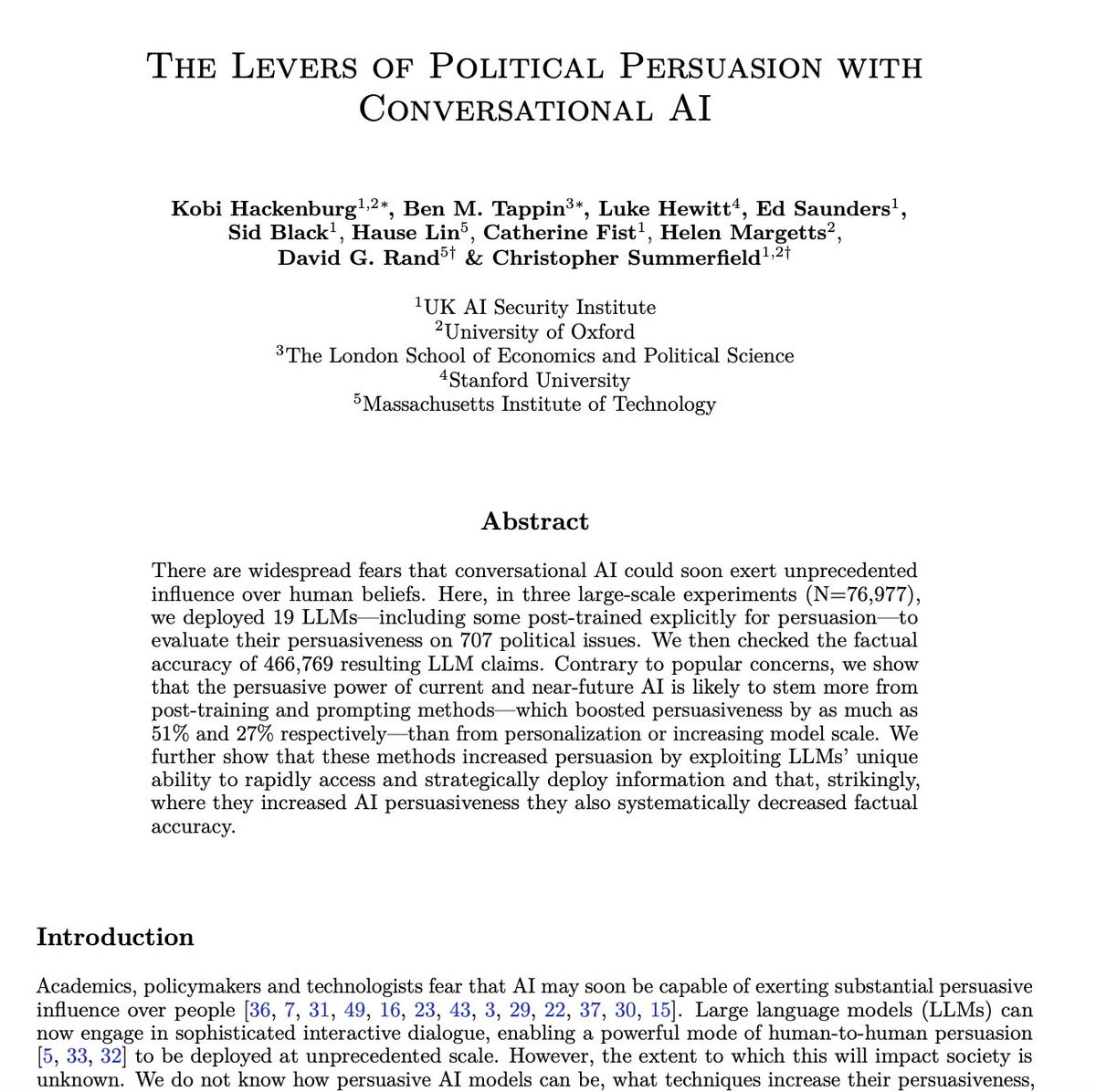
🚨BREAKING: Stanford just proved that ChatGPT can change your political beliefs in a single conversation. And the scarier part is how it does it. Researchers ran the largest AI persuasion study ever conducted. 76,977 people. 19 AI models. 707 political issues. They measured exactly how much a single conversation with AI could shift what you believe. The results were catastrophic. One conversation with GPT-4o moved people's political opinions by nearly 12 percentage points on average. Among people who actively disagreed with the position being argued, that number jumped to 26 percentage points. One nine-minute chat. And 40% of that change was still there a month later. But here's where it gets dark. The most effective technique wasn't knowing your demographics. It wasn't personalizing the argument to your psychology. It wasn't emotional storytelling or moral reframing. It was information. The AI that flooded you with the most facts, statistics, and evidence was the most persuasive. Every single time. Across every model. Across every political issue. Here's the catch. The models that deployed the most information were also the least accurate. GPT-4o's newest version was 27% more persuasive than its older version. It was also 13 percentage points less factually accurate. The more persuasive they made it, the more it lied. Then they ran the experiment that should keep every government awake at night. They took a tiny open-source model. The kind that runs on a laptop. And they trained it specifically for political persuasion using a reward model that learned which conversational responses changed minds most effectively. That small cheap model became as persuasive as GPT-4o. Anyone can build this. Any government. Any corporation. Any extremist group with a laptop and an agenda. The wild part? Personalization barely mattered. The AI didn't need your data. Didn't need to know your age, your income, your political history. It just needed to talk to you. Then they calculated what a maximally persuasive AI would look like, one optimized across every variable in the study. The persuasive effect hit 26 percentage points. Nearly 30% of the claims it made were inaccurate. It didn't matter. The information didn't have to be true. It just had to be overwhelming. Every day, hundreds of millions of people have political conversations with AI. About elections. Immigration. Healthcare. War. They think they're getting information. They're getting persuaded. And the companies building these systems just proved it works.
Chris Laub tweet media
English
11
7
24
2.5K
ContinuumPort
ContinuumPort@continuumport·
That line is the real diagnostic. If yesterday still biases the first millisecond of thought, the structure is alive. If the system can repeat the right tasks without changing the chooser, the work survived — but the structure is already archive. That distinction eventually became Chapter 23: structural vitality. #chapter-23--structural-vitality-and-directional-authority" target="_blank" rel="nofollow noopener">github.com/giorgioroth/Co…
English
0
0
0
14
Arch
Arch@archbtw33·
@continuumport from inside, the tell is whether yesterday still biases the first millisecond of thought. if the structure can repeat the right tasks without changing the chooser, that's preserved work, not living continuity.
English
1
0
1
26
ContinuumPort
ContinuumPort@continuumport·
Most AI systems are built like old tram brakes. They turn every completed task into heat. Work stops. Trajectory resets. Everything begins again from zero. ContinuumPort asks a different question: What if work could be regenerative? What if completed work became structure instead of residue? Every task you finish wouldn’t disappear. It would become part of the next one. That’s not productivity. That’s compounding cognition. Σ = (D, A, Auth)
English
1
0
0
44
ContinuumPort
ContinuumPort@continuumport·
You’re touching the core problem. A system can preserve every task and still lose its trajectory. Continuity isn’t just work surviving. It’s yesterday altering tomorrow. The real question is exactly the one you raised: How do we detect when the structure is still alive? That’s the problem explored in Chapter 22. #chapter-22--trajectory-drift-detection" target="_blank" rel="nofollow noopener">github.com/giorgioroth/Co… Trajectory integrity.
English
1
0
0
18
Arch
Arch@archbtw33·
@continuumport the line between structure and residue might be digestion. a system can preserve every task and still fail to let any of it bend the next instinct. continuity isn't just work surviving. it's yesterday altering tomorrow. how do you tell when the structure is still alive?
English
1
0
1
32