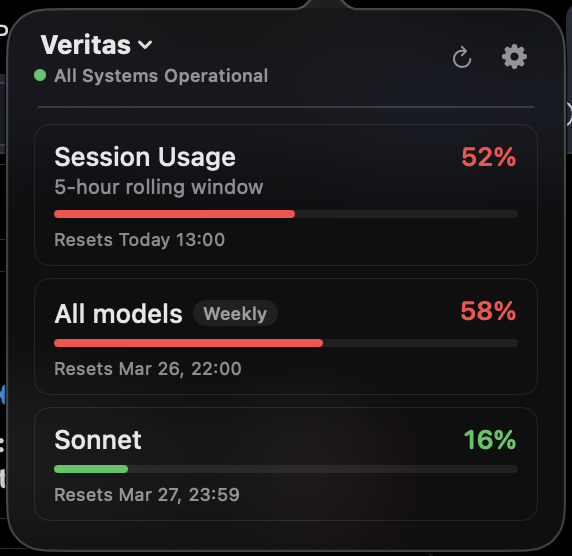
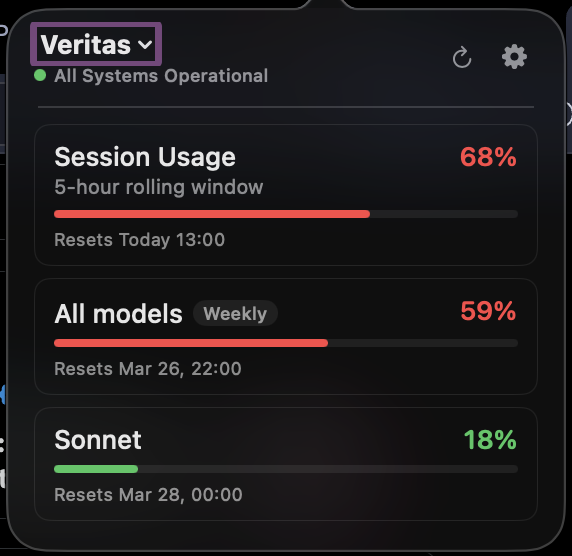
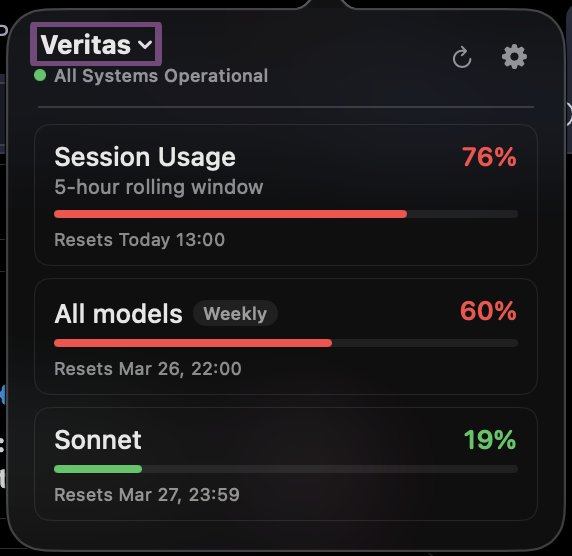
Something is up with Claude Code usage today. $200 Claude Max, 0%, 52% to 62%, then 68%, 76% and 84% in 5-hour rolling window in the time it took me to write this tweet. WTF, @AnthropicAI? I'm working on one GitHub PR for regression testing. Not folding proteins to cure cancer.
🚨🇯🇵BREAKING
JAPAN'S NEW ANTI-ISLAM LAWS SEND SHOCKWAVES
Halal - BANNED✅
Mosques - BANNED✅
Call to prayer - BANNED✅
Burka - BANNED✅
This is basically saying Islam is not welcome here
Should we copy Japan?
A. Yes
B. No
India is the toilet of the world. God, in his cosmic sense of humour, created a shit-themed country for the sole purpose of being laughing stock for the rest of us, and then filled it with people that can’t take a joke.
For starters, their skin is the colour of shit and they smell like shit. In fact the whole country smells like shit because despite being graciously gifted toilet technology by Europeans, Indians refuse to use them in favour of shamelessly shitting on the street. Their religion involves bathing in a river full of dead bodies and shit and worshipping cow shit, before throwing said cow shit at each other for fun and then eating it.
Their food both looks like shit and will give you the shits, as it has traces of shit in it from the cook not washing his hands. Instead of troubling himself with hand washing, the Indian uses the much more efficient strategy of wiping his bum with one hand and eating with the other. Even if he developed a genetic mutation that made him want to wash his hands, he wouldn’t be able to find any soap because Indian shops don’t sell it. Despite these awful standards of hygiene, the Indian rarely gets sick because he has consumed so much shit over his lifetime that he is now immune to the bacteria. This “shit vaccination” is the extent of India’s healthcare system.
Indians have a caste system based on the proportion of Indian DNA they have in them, with a lower amount obviously being better. This genetic diversity is shown by lower caste Indians having iron-supplement-shit black skin and the upper classes being the much more dignified shade of baby diarrhoea.
Naturally, their flag is has a bumhole symbol in the middle of it to represent their national pastime which is shitting. The country itself is even shaped like an anus-sculpted turd tip about to plop into the Indian Ocean (which to nobody’s surprise, is also full of shit.)
There have recently been some discussions on the ongoing role of L2s in the Ethereum ecosystem, especially in the face of two facts:
* L2s' progress to stage 2 (and, secondarily, on interop) has been far slower and more difficult than originally expected
* L1 itself is scaling, fees are very low, and gaslimits are projected to increase greatly in 2026
Both of these facts, for their own separate reasons, mean that the original vision of L2s and their role in Ethereum no longer makes sense, and we need a new path.
First, let us recap the original vision. Ethereum needs to scale. The definition of "Ethereum scaling" is the existence of large quantities of block space that is backed by the full faith and credit of Ethereum - that is, block space where, if you do things (including with ETH) inside that block space, your activities are guaranteed to be valid, uncensored, unreverted, untouched, as long as Ethereum itself functions. If you create a 10000 TPS EVM where its connection to L1 is mediated by a multisig bridge, then you are not scaling Ethereum.
This vision no longer makes sense. L1 does not need L2s to be "branded shards", because L1 is itself scaling. And L2s are not able or willing to satisfy the properties that a true "branded shard" would require. I've even seen at least one explicitly saying that they may never want to go beyond stage 1, not just for technical reasons around ZK-EVM safety, but also because their customers' regulatory needs require them to have ultimate control. This may be doing the right thing for your customers. But it should be obvious that if you are doing this, then you are not "scaling Ethereum" in the sense meant by the rollup-centric roadmap. But that's fine! it's fine because Ethereum itself is now scaling directly on L1, with large planned increases to its gas limit this year and the years ahead.
We should stop thinking about L2s as literally being "branded shards" of Ethereum, with the social status and responsibilities that this entails. Instead, we can think of L2s as being a full spectrum, which includes both chains backed by the full faith and credit of Ethereum with various unique properties (eg. not just EVM), as well as a whole array of options at different levels of connection to Ethereum, that each person (or bot) is free to care about or not care about depending on their needs.
What would I do today if I were an L2?
* Identify a value add other than "scaling". Examples: (i) non-EVM specialized features/VMs around privacy, (ii) efficiency specialized around a particular application, (iii) truly extreme levels of scaling that even a greatly expanded L1 will not do, (iv) a totally different design for non-financial applications, eg. social, identity, AI, (v) ultra-low-latency and other sequencing properties, (vi) maybe built-in oracles or decentralized dispute resolution or other "non-computationally-verifiable" features
* Be stage 1 at the minimum (otherwise you really are just a separate L1 with a bridge, and you should just call yourself that) if you're doing things with ETH or other ethereum-issued assets
* Support maximum interoperability with Ethereum, though this will differ for each one (eg. what if you're not EVM, or even not financial?)
From Ethereum's side, over the past few months I've become more convinced of the value of the native rollup precompile, particuarly once we have enshrined ZK-EVM proofs that we need anyway to scale L1. This is a precompile that verifies a ZK-EVM proof, and it's "part of Ethereum", so (i) it auto-upgrades along with Ethereum, and (ii) if the precompile has a bug, Ethereum will hard-fork to fix the bug.
The native rollup precompile would make full, security-council-free, EVM verification accessible. We should spend much more time working out how to design it in such a way that if your L2 is "EVM plus other stuff", then the native rollup precompile would verify the EVM, and you only have to bring your own prover for the "other stuff" (eg. Stylus). This might involve a canonical way of exposing a lookup table between contract call inputs and outputs, and letting you provide your own values to the lookup table (that you would prove separately).
This would make it easy to have safe, strong, trustless interoperability with Ethereum. It also enables synchronous composability (see: ethresear.ch/t/combining-pr… and ethresear.ch/t/synchronous-… ). And from there, it's each L2's choice exactly what they want to build. Don't just "extend L1", figure out something new to add.
This of course means that some will add things that are trust-dependent, or backdoored, or otherwise insecure; this is unavoidable in a permissionless ecosystem where developers have freedom. Our job should make to make it clear to users what guarantees they have, and to build up the strongest Ethereum that we can.
This document covers events and communications up to mid-2023.
Later developments are excluded. I was presented with proposed agreements after that point which I did not sign, because they would have required personal liability, restricted independent technical development, and placed unilateral control and asymmetric risk on one side without corresponding guarantees.
Publishing those materials would create disproportionate legal risk for me without adding clarity. They are preserved separately.
Public record:
docs.google.com/document/d/140…@cz_binance@binance#SXP@SolarNetwork
@sjdedic Nothing inherently wrong with CEX having a strategy to help tokens that are listing. These obviously help with having a smooth and hyped launch.
Ultimately however, whether the project succeeds and have a sustainable price movement depends on the project offering itself.
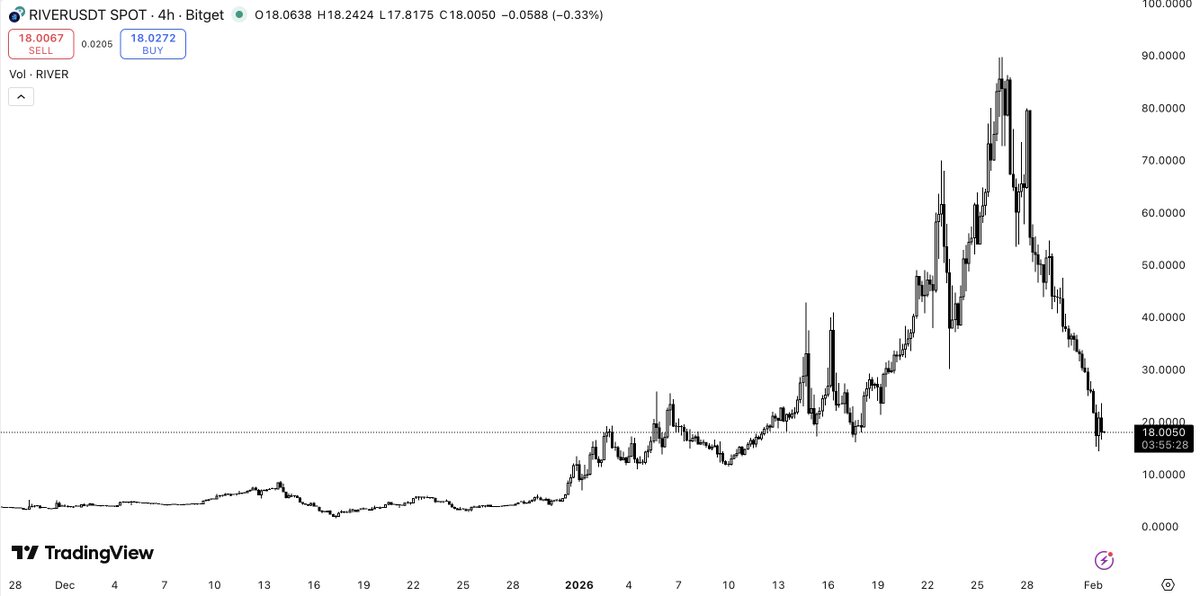
If you're wondering how to pull off a strong but unsustainable pump and dump to extract maximum value from retail, just like $RIVER did, it's easy:
Partner with Bitget by paying them a security deposit plus a chunk of your token supply.
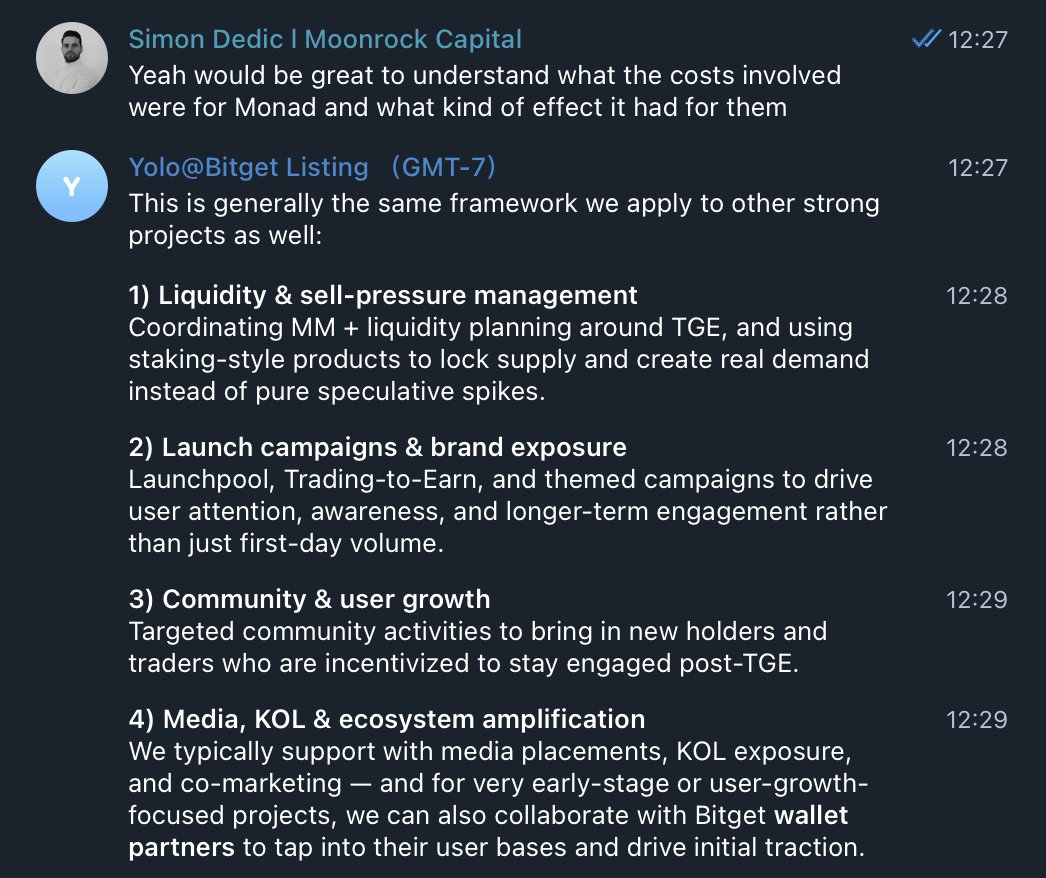
This way, you won't just get a listing. You'll get "a partnership to maximize your TGE and post TGE performance," including but not limited to:
- Artificial demand creation = washtrading
- Liquidity and sell pressure management via aligned market makers = print fake charts
- Coordinated media and KOL campaigns = create fake FOMO
Follow in the footsteps of top tier projects such as Monad, Falcon Finance and many more.
Only possible on CEXs.
No complexity. No accident.
10/10 was caused by irresponsible marketing campaigns by certain companies.
On October 10, tens of billions of dollars were liquidated. As CEO of OKX, we observed clearly that the crypto market’s microstructure fundamentally changed after that day.
Many industry participants believe the damage was more severe than the FTX collapse. Since then, there has been extensive discussion about why it happened and how to prevent a recurrence. The root causes are not difficult to identify.
⸻
What actually happened
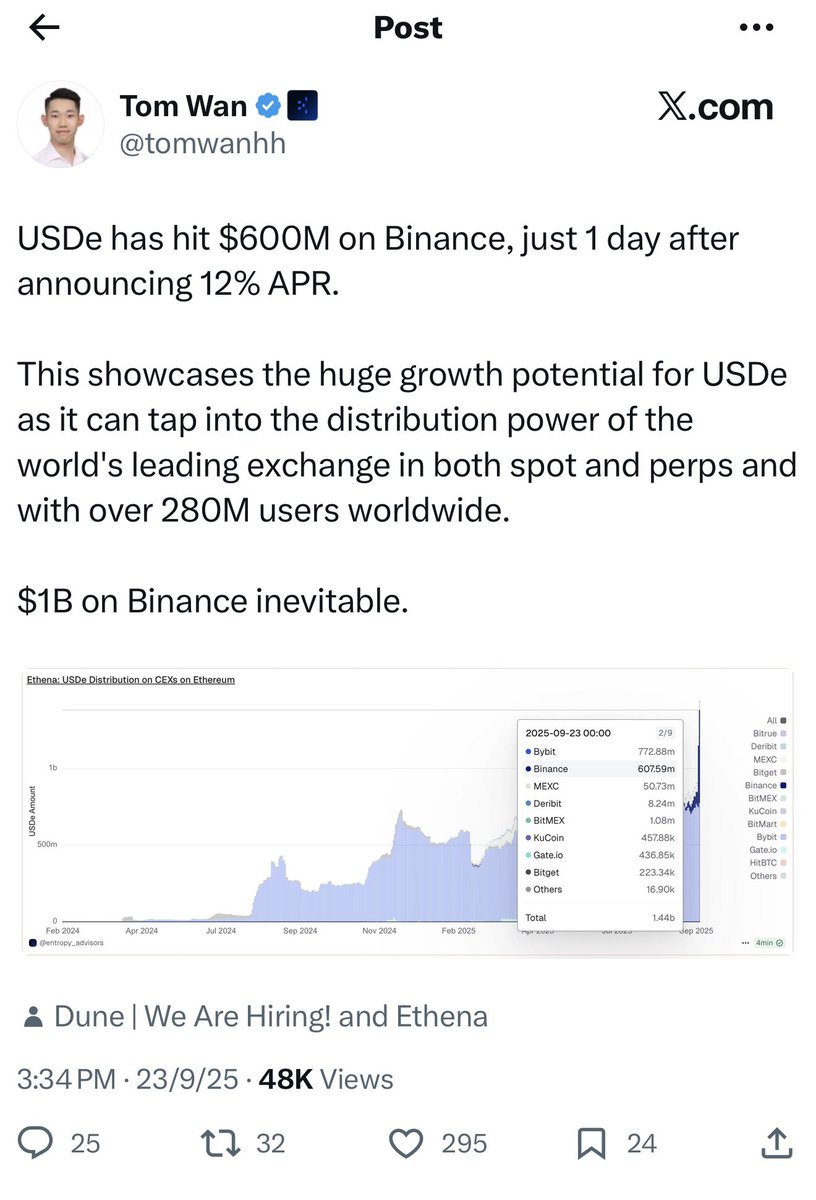
1.Binance launched a temporary user-acquisition campaign offering 12% APY on USDe, while allowing USDe to be used as collateral with the same treatment as USDT and USDC, and without effective limits.
2.USDe is a tokenized hedge fund product.
Ethena raises capital via a so-called “stablecoin,” deploys it into index arbitrage and algorithmic trading strategies, and tokenizes the resulting fund. The token can then be deposited on exchanges to earn yield.
3.USDe is fundamentally different from products such as
BlackRock BUIDL and Franklin Templeton BENJI, which are tokenized money market funds with low-risk profiles.
USDe, by contrast, embeds hedge-fund-level risk. This difference is structural, not cosmetic.
4.Binance users were encouraged to convert USDT and USDC into USDe to earn attractive yields, without sufficient emphasis on the underlying risks. From a user’s perspective, trading with USDe appeared no different from trading with traditional stablecoins—while the actual risk profile was materially higher.
5.Risk escalated further as users:
•converted USDT/USDC into USDe,
•used USDe as collateral to borrow USDT,
•converted the borrowed USDT back into USDe,
•and repeated the cycle.
This leverage loop produced artificial APYs of 24%, 36%, and even 70%+, widely perceived as “low risk” simply because they were offered by a major platform. Systemic risk accumulated rapidly across the global crypto market.
6.At that point, even a small market shock was sufficient to trigger a collapse.
When volatility hit, USDe depegged quickly. Cascading liquidations followed, and weaknesses in risk management around assets such as WETH and BNSOL further amplified the crash. Some tokens briefly traded near zero.
The damage to global users and companies—including OKX customers—was severe, and recovery will take time.
⸻
Why this matters
I am discussing the root cause, not assigning blame or launching an attack on Binance. Speaking openly about systemic risks is sometimes uncomfortable, but it is necessary if the industry is to mature responsibly.
I expect there may be significant misinformation and coordinated FUD directed at OKX in the near future. Even so, speaking honestly about systemic risk is the right thing to do—and we will continue to do so.
As the largest global platform, Binance has outsized influence—and corresponding responsibility—as an industry leader. Long-term trust in crypto cannot be built on short-term yield games, excessive leverage, or marketing practices that obscure risk.
The industry needs leaders who prioritize market stability, transparency, and responsible innovation—not a winner-take-all mentality where criticism is treated as hostility.
Crypto is still early.
What we choose to normalize today will determine whether this industry earns lasting trust—or repeats the same mistakes again.