Geoff Russell Ⓥ

4.9K posts

Geoff Russell Ⓥ banner
Geoff Russell Ⓥ

Geoff Russell Ⓥ

@csiroperfidy

Vegan,pro-nuclear,maths,cyclist. Author of GreenJacked! about obsolete science behind anti-nuclear movement. https://t.co/ybPquTgb3L

Adelaide Katılım Eylül 2009
433 Takip Edilen1.9K Takipçiler
Sabitlenmiş Tweet
Geoff Russell Ⓥ
Geoff Russell Ⓥ@csiroperfidy·
Could you run an aluminium smelter with wind, solar and batteries? Let's suppose we tried to do it in South Australia. We have thousands of MW of utility scale wind and solar. Could we run a smelter with it? How may batteries would we need? open.substack.com/pub/geoffrusse…
English
11
16
53
3.7K
Geoff Russell Ⓥ
Geoff Russell Ⓥ@csiroperfidy·
@DavidJSmith3567 Wrong and wrong. Go back to 2024, the "Smart Energy Council" reckoned Dutton wanted about 10 GW (about 9 AP1000s), which they wrongly said would produce 4% of our electricity. If 10 GW was right, then this would produce 10e9*24*365*0.9/1e12/281 = 0.2805694 (ie. 28%).
English
0
0
0
0
David Smith
David Smith@DavidJSmith3567·
@csiroperfidy Just for context, 3 Westinghouse AP 1000 reactors (as proposed by Peter Dutton) would represent about 4% of Australia’s electricity demand.
English
1
0
0
8
Geoff Russell Ⓥ
Geoff Russell Ⓥ@csiroperfidy·
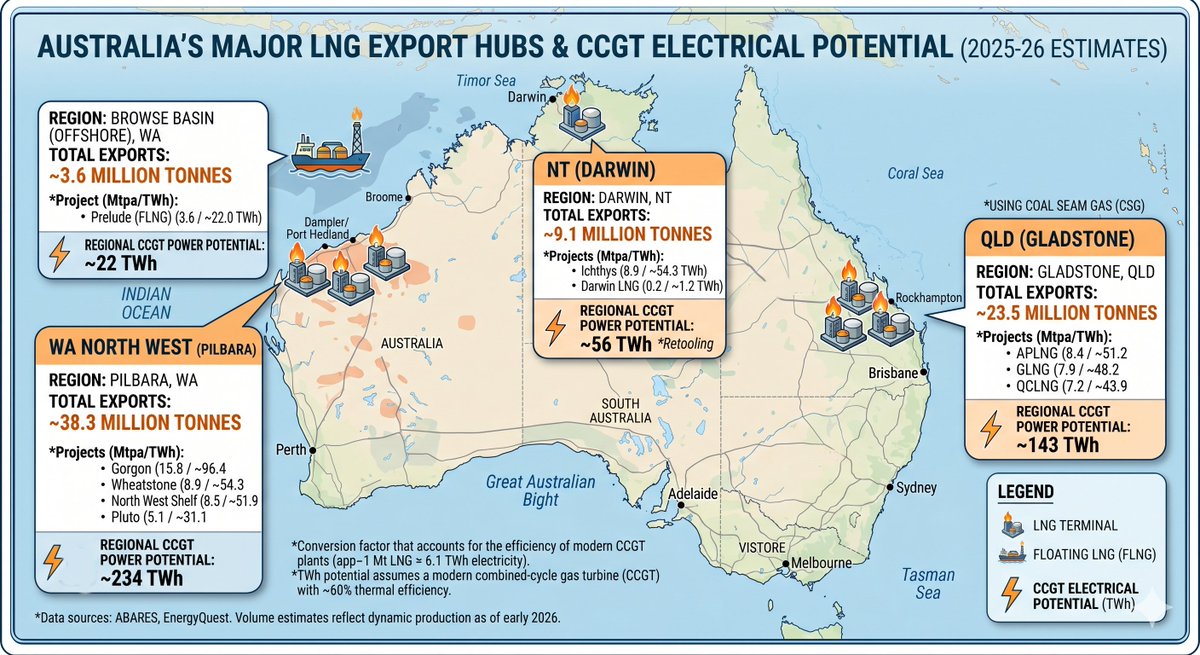
Here's what we built in Australia as a result of the ban on nuclear power. Each of these big projects is massive. Wheatstone was $30 billion. We could have got 3 reactors for that. The Greens and the nuclear ban have locked in gas. geoffrussell.substack.com/p/the-real-wor…
Geoff Russell Ⓥ tweet media
English
14
28
92
2.2K
Geoff Russell Ⓥ
Geoff Russell Ⓥ@csiroperfidy·
The radiation porn is already starting as assorted anti-nuclear media prepare for the Chernobyl accident anniversary. Why are there no such "celebrations" of the Bhopal or Ufa accidents? Both were more deadly and left many with lifelong pain. open.substack.com/pub/geoffrusse…
English

1
6
12
204
Geoff Russell Ⓥ retweetledi
chris keefer
chris keefer@Dr_Keefer·
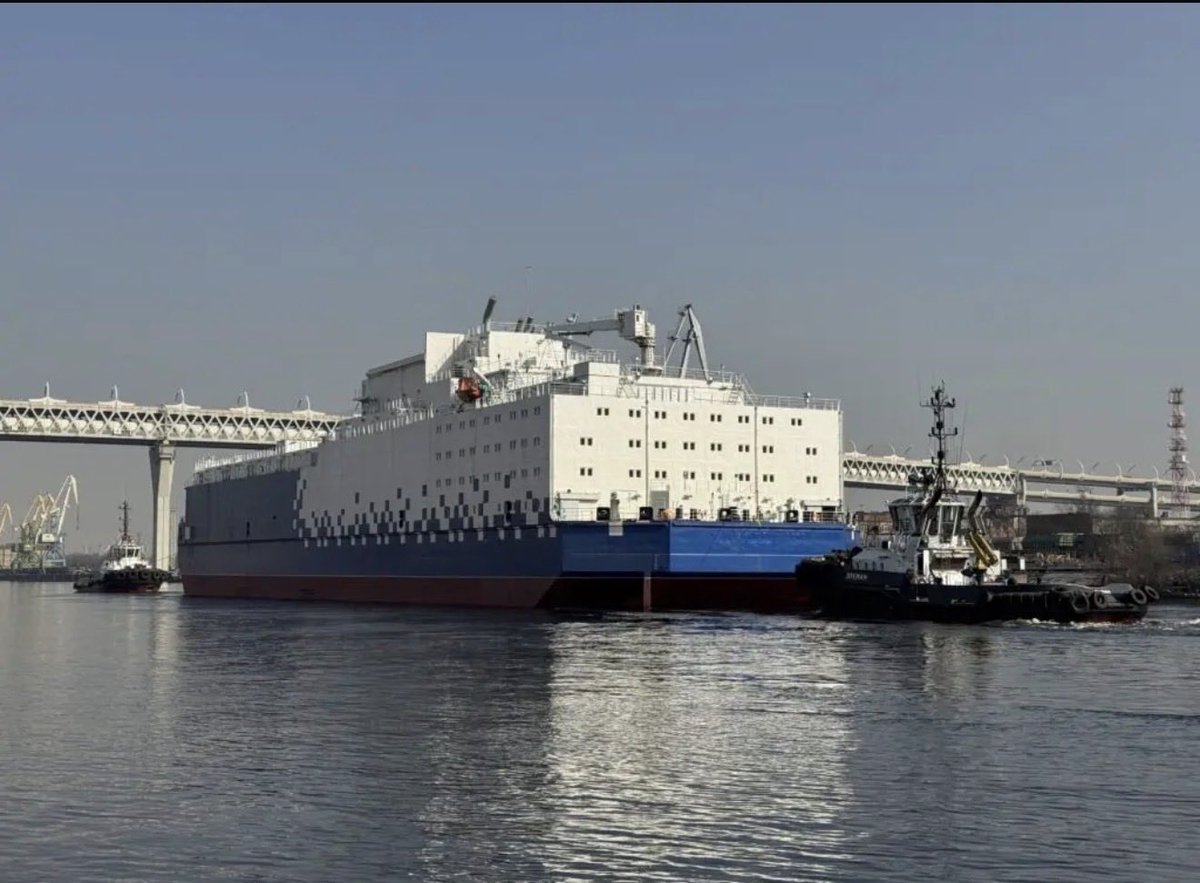
This is what Russia’s floating nuclear power plant dominance looks like. The 1st of 4 Chinese built hulls has reached St. Petersburg where they will each be equipped with two 53MWe RITM-200S integral PWR reactors. N-1 contingency for 1 unit at a time refuelling in far away Murmansk will mean 318MW of steady baseload power for the Chukotka Baimsky copper mine in Eastern Siberia a few hundred km inland from where they will be moored in Nagleynyn bay. Baimsky is the largest undeveloped copper deposit in planet earth. In the harsh and remote arctic environment of eastern Siberia and with Russia’s nuclear energy industrial stack behind it, this is the best way to power it. With thanks to @realTZV for the picture.
chris keefer tweet media
English
77
545
2.9K
172.1K
Geoff Russell Ⓥ retweetledi
Nick Touran
Nick Touran@whatisnuclear·
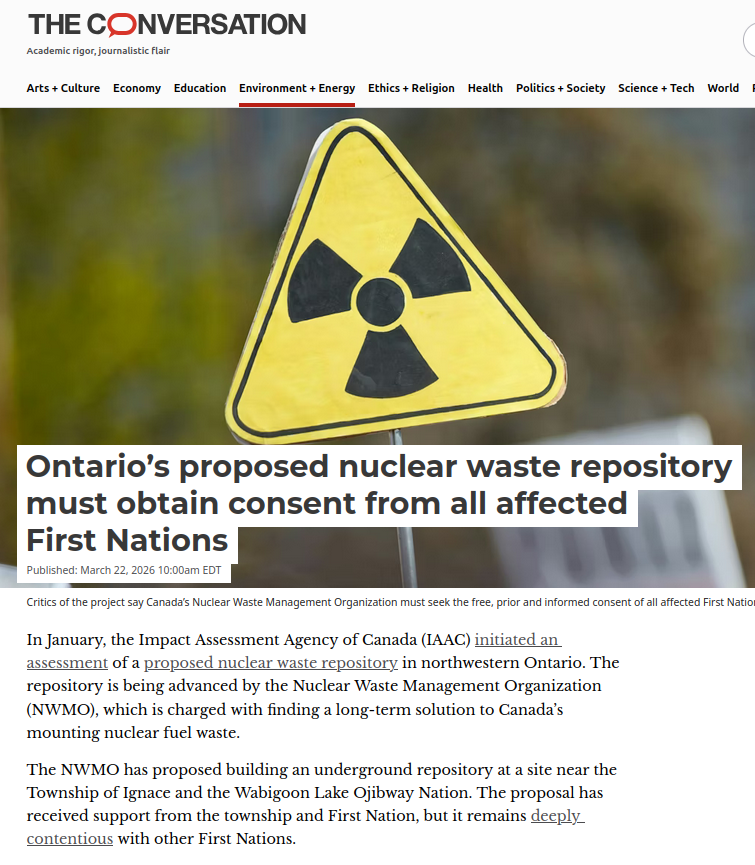
The nuclear waste management org in Canada (@NWMOCanada) has been working diligently for many years to find a host for its nuclear waste. It found a site and got consent from the local community, including the local First Nation. But then people from farther away protested. The crux of the protests seem to be rooted in the fact that nuclear waste remains hazardous for a long time. I cannot for the life of me understand why it's not harder to dispose of wastes that stay hazardous forever. Why don't we need to spend billions of dollars on intergenerational studies and broad-area consent to dispose of mercury or lead? I think the new US approach of trying to co-locate long-term waste disposal with high-tech fuel cycle facilities (innovation campus) is probably the better idea at this point.
Nick Touran tweet media
English
15
14
59
3.2K
Geoff Russell Ⓥ
Geoff Russell Ⓥ@csiroperfidy·
@AlHendiify It isn't incredibly dangerous after 500 years. After 500 you can handle it without gloves. It would be safer than many things on sale at Bunnings... eg pool acid. It's remarkable how fear declines as knowledge of the facts deepens.
English
1
0
4
80
Geoff Russell Ⓥ retweetledi
chris keefer
chris keefer@Dr_Keefer·
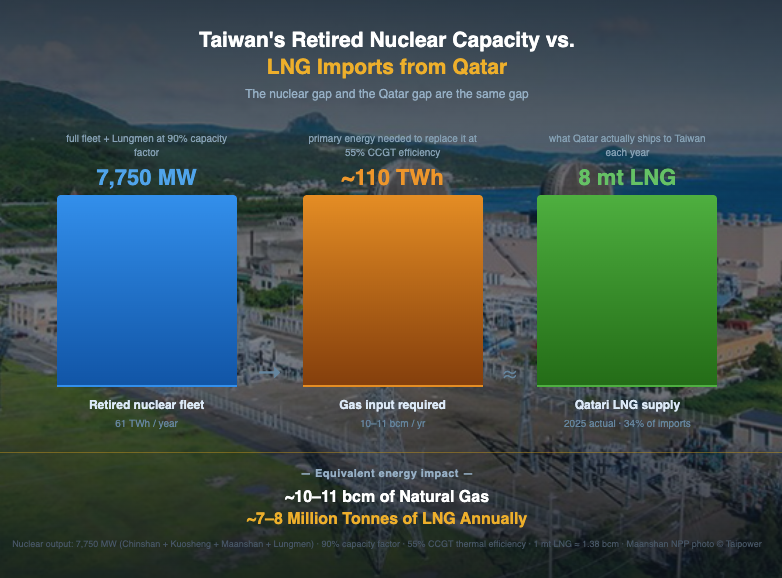
Taiwan’s nuclear phaseout created a vulnerability that now sits directly on top of the Qatar Ras Laffan force majeure. The uncomfortable arithmetic is that the nuclear capacity Taiwan chose to retire is almost exactly equal to the LNG volume it imports from Qatar. Taiwan imports roughly 35 percent of its LNG from Qatar. LNG now fuels nearly half of Taiwan’s electricity after the political phaseout of nuclear power. The island maintains only about eleven days of LNG storage. Had Taiwan kept its full nuclear fleet operating and commissioned Lungmen, its completed but never fuelled fourth nuclear plant, the country would today have roughly 7,750 MW of nuclear capacity producing about 61 TWh per year, covering around 21 percent of the grid. Replacing that output with gas requires far more primary energy because Taiwan’s combined cycle gas turbines operate at roughly 55 percent thermal efficiency. Producing 61 TWh of electricity from gas therefore requires roughly 110 TWh of fuel input, equivalent to about 10 to 11 billion cubic metres of natural gas or roughly 7 to 8 million tonnes of LNG per year. That volume is almost exactly the amount of LNG Taiwan currently imports from Qatar. In other words, the nuclear fleet Taiwan shut down would have displaced essentially the entire Qatari supply stream. Every cargo that does not need to cross the Strait of Hormuz is a cargo that cannot be held hostage. Instead that capacity was retired and mothballed on political grounds and the gap was filled with gas. On 23 August Taiwan held a referendum on whether to restart the Ma’anshan nuclear plant, the island’s last operating reactor station, which had shut down in May after its forty year operating licence expired. A clear majority of participating voters supported restarting the plant subject to regulatory approval and safety confirmation. Taiwan’s referendum law, however, requires affirmative votes from at least one quarter of all eligible voters, roughly five million people. The referendum received about 4.3 million yes votes, leaving it below the legal threshold and keeping the plant offline, effectively confirming the continuation of Taiwan’s nuclear phaseout. Oil markets built resilience after decades of shocks. Strategic petroleum reserves, spare tanker capacity, and a deep spot market exist precisely because embargoes and supply crises forced the system to develop buffers. LNG developed very differently. For most of its history it operated as a point to point business, the same ships on the same routes under long term contracts, functioning in conditions stable enough that nobody was forced to build equivalent shock absorption into the system. Storage compounds this vulnerability and it divides sharply along geographic lines. Europe benefits from geology. Depleted gas fields and salt caverns can hold months of supply, which is why European utilities spend the summer refilling underground storage ahead of winter demand. Asia has no equivalent. Japan, South Korea, and Taiwan depend almost entirely on above ground insulated LNG tanks at their import terminals, essentially the same thermos principle used on LNG ships. South Korea had roughly nine days of LNG supply when Ras Laffan went offline. Taiwan had about eleven days. Japan operates in a similar range. These are operational buffers designed for a world of uninterrupted deliveries rather than strategic reserves designed to ride out supply shocks. When a major node in the LNG system fails, there is no large fleet of idle ships ready to reroute, no spare liquefaction capacity waiting to fill the gap, and in Asia no underground storage that can stabilize supply while the market adjusts. Taiwan’s nuclear shutdown therefore produced a structural vulnerability that is now impossible to ignore. The reactors that were closed would today be offsetting almost the entire volume of LNG Taiwan buys from Qatar. There's never been a better time to restart Taiwan's nuclear fleet.
chris keefer tweet media
English
21
96
304
17.6K
Geoff Russell Ⓥ retweetledi
chris keefer
chris keefer@Dr_Keefer·
Madi we’re going to get tired of winning pretty soon huh? Dresden Byron Diablo Pickering Palisades TMI Duane Arnold VC Summer….
Madi Hilly@MadiHilly

SECRETARY OF ENERGY @SecretaryWright CALLS FOR RESTART OF INDIAN POINT This remains the fastest way to get reliable, emissions-free power on the grid in downstate New York, one of the most energy-constrained parts of the country. Closing it was a terrible mistake. It can be undone.

English
7
17
116
5.6K
Geoff Russell Ⓥ retweetledi
Seaver Wang
Seaver Wang@wang_seaver·
“Energy security crises produce the same structural response: the search for sources that do not require crossing borders and global chokepoints... Solar, wind, and nuclear are children of the 1970s oil shocks — with growth driven by security, not environmentalism.”
Seaver Wang tweet media
English
2
7
19
1.6K
Geoff Russell Ⓥ retweetledi
Simon Maechling
Simon Maechling@simonmaechling·
I want to tackle a nonsense claim. "Natural is Safer" Sounds comforting, right? But it’s based on fear, not facts. It’s tempting to think that because natural substances have been around for billions of years, they’re inherently safe, while synthetic chemicals are not. But this reasoning doesn’t hold up under scrutiny. Let’s break it down: It implies that “natural” = “safe.” That synthetic chemicals are harmful because they’re "new". The truth? Nature doesn’t care about your safety. Arsenic, cyanide, and botulinum toxin are 100% natural. And deadly. Meanwhile, many synthetic chemicals are inspired by nature, like life-saving insulin or penicillin. Here’s a perfect example: Natural and synthetic vitamin C are chemically identical. Whether from an orange or a lab, both are ascorbic acid. Your body can’t tell the difference - processed exact same way. What actually matters? The dose makes the poison. It’s not about whether a substance is “natural” or “synthetic.” It’s about how it’s used and how much you’re exposed to. Whether a substance is ancient or newly created doesn’t determine its safety. Science, testing, and proper use do.
Simon Maechling tweet media
English
190
266
1.3K
35.1K
WePlanet Australia
WePlanet Australia@WePlanetAus·
Aussie dairy producer associations are pushing to ban plant-based dairy alternatives from using the term 'milk', following a UK court ruling which found it could confuse consumers. 🧵
WePlanet Australia tweet media
English
3
1
4
82
Geoff Russell Ⓥ retweetledi
Seaver Wang
Seaver Wang@wang_seaver·
So to recap, since first strikes on Feb 28th the death toll is now unambiguously in the low thousands and the following energy-economic tremors are underway: - Strait of Hormuz at a standstill - China has ceased oil/gas exports from refineries - Qatar has shut its LNG terminals - Euro/UK natural gas futures spiking - South Korean and Nikkei stocks ticking downwards - Fertilizer plants in South Asia closing amid expected gas shortages, fertilizer prices rising - regional air travel disruptions, hundreds of thousands stranded - national grid blackout in Iraq (cause unclear), major blackouts in Cuba (not directly related to Middle East factors)
Seaver Wang tweet media
English
4
11
20
3K
Geoff Russell Ⓥ retweetledi
Nuclear for Australia
Nuclear for Australia@nuclearforaus·
Canadian Prime Minister Mark Carney just concluded his visit to Australia. Unlike Canada which has 17 reactors and has committed to triple global nuclear capacity, Australia has a ban on nuclear power. ✍️Take Action 📚Learn More 🛍️ Shop Merch nuclearforaustralia.com
English
22
76
243
3.5K
Geoff Russell Ⓥ retweetledi
Simon Maechling
Simon Maechling@simonmaechling·
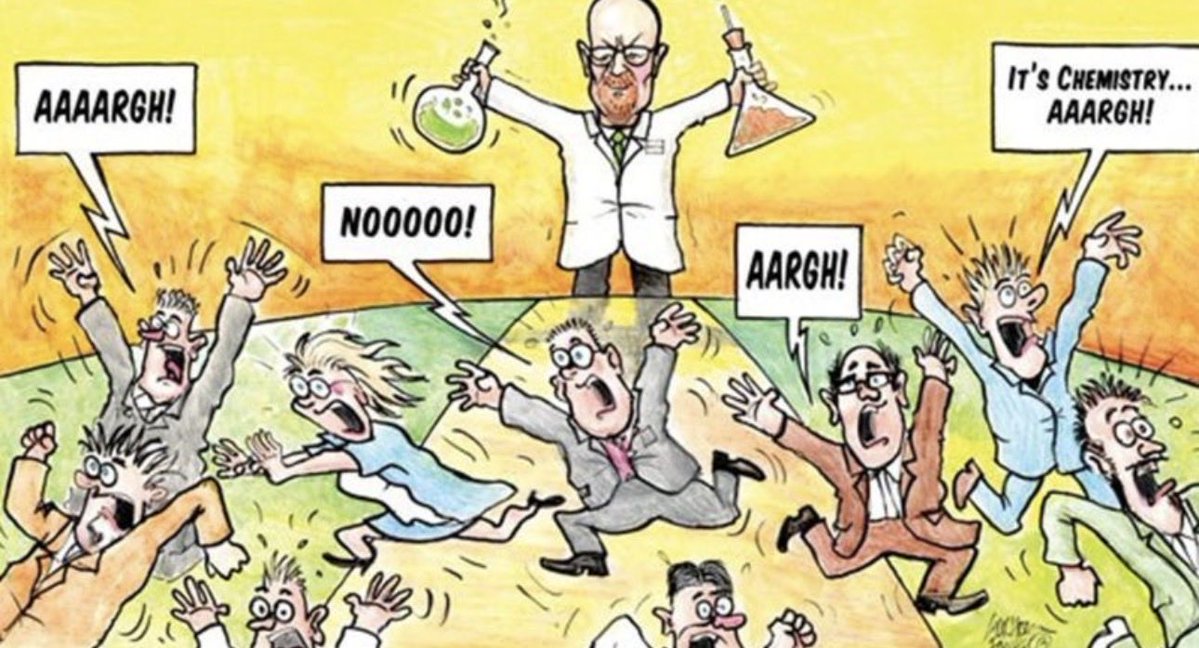
I’m a chemist. I need to say this - because it’s getting dangerous out there. The biggest health myth in the world isn’t about vaccines. Or GMOs. Or fluoride. It’s the root of all of them. It’s called chemophobia - and it’s killing science. Fear of “chemicals” now drives vaccine rejection, GMO bans, food hysteria, and entire political movements. From tampons to tap water, people have been taught to fear chemistry - the very thing that keeps us alive. Chemophobia tells us: “Natural is good.” “Synthetic is bad.” That’s a lie. Botulinum toxin is 100% natural and one of the deadliest molecules known. Aspirin is synthetic and life-saving. We’ve gone from banning harmful substances for good reason…to banning safe, well-tested molecules for emotional reasons. You’ve seen the slogans: “If you can’t pronounce it, don’t eat it.” “Paraben-free.” “Clean beauty.” They sound empowering. But they’re not science - they’re marketing. And they’re making the world dumber, poorer, and sicker. Your body doesn’t care if a molecule comes from a plant or a lab. Vitamin C is vitamin C. Formaldehyde is formaldehyde and your body makes more of it every day than any vaccine ever could. Dose matters. Source doesn’t. This fear isn’t harmless. It shapes public policy. It blocks innovation. It raises food prices. It slows down cancer treatments. Chemophobia is now mainstream and it’s costing lives. Scientists aren’t losing because we’re wrong. We’re losing because fear spreads faster than facts. Because influencers sell fear for clicks. Because lawyers monetize doubt. And because scientists are too tired to fight back. So here’s my message, as a chemist and as a citizen: Learn how toxicology works. Call out chemical fear-mongering. Support policies based on evidence, not emotion. Chemistry isn’t the enemy. It’s the reason you have clean water, safe food, and modern medicine. If we let fear win, we lose all of it.
Simon Maechling tweet media
English
970
2.6K
7.9K
324.6K
Geoff Russell Ⓥ
Geoff Russell Ⓥ@csiroperfidy·
@lucasaganronald This isn't funny for either the riders or the animal; who also looked to be seriously injured.
English
0
0
19
1.6K