Sabitlenmiş Tweet
Godfrey
5.6K posts


Godfrey
@cybergodfrey
Out of the box thinker, with a passion for proving himself different from the masses. PS. I am NOT insane. I have a finely calibrated sense of acceptable risk
Massachusetts, USA Katılım Haziran 2012
711 Takip Edilen182 Takipçiler
Godfrey retweetledi

I founded Meridian Policy Intelligence in 2014. We have 1,200 subscribers. They pay $50,000 per month. I am here today to tell you what we do.
We read.
We read committee calendars. We read markup schedules. We read witness lists. We attend hearings that are open to the public and sit in the third row. We talk to staffers who are allowed to talk to us. We compile what we learn into a PDF called the Legislative Forecast. We send the Legislative Forecast to our subscribers every morning at 6:15 AM Eastern. Our subscribers are hedge funds. The hedge funds trade on what we send them.
That's research.
In 2013, a firm called Height Securities sent a flash alert to its clients about a CMS decision on Medicare Advantage payment rates. The alert arrived eighteen minutes before the public announcement. In those eighteen minutes, investors repositioned billions of dollars in health insurance stocks. Congress investigated. The SEC reviewed. No one was charged. The information was obtained from a government source through a conversation. The conversation was legal. The alert was legal. The repositioning was legal. The eighteen minutes were worth more than I will earn in my lifetime. We use this as a case study. Slide nine. It is titled "Regulatory Moat."
The moat is the subscription.
I should explain. We do not trade on inside information. We contextualize legislative signals for institutional investors. The distinction is the PDF. The PDF makes it research. If I whisper to a hedge fund manager at a dinner party that a committee vote is moving to Thursday, that is a tip. If I write it in a PDF and send it to 1,200 people for $50,000 a month, that is a research product. The format is the legal distinction. I had our compliance team formalize this. They wrote a document called the Alpha Delivery Compliance Framework. It is eleven pages. I have it laminated.
That's research.
The legal term is "mosaic theory." We assemble individually public fragments of information into a composite picture that is not itself public. That is our entire business model. It is also our legal defense. These are the same sentence. Our compliance officer has a Mosaic Certification. The certification is from a course we designed. We teach it. We also grade it.
On Wednesday, a soldier named Gannon Van Dyke was arrested. He had placed a $32,500 bet on a prediction market that the president of Venezuela would be removed from power. He was Special Forces. He helped remove the president of Venezuela from power. He collected $409,881. He has been charged with five federal crimes. The DOJ called it "the first-ever insider trading prosecution on event contracts."
He had one piece of information. He made one bet. He did not have a PDF.
I send a PDF to 1,200 subscribers every morning. Last quarter, our Legislative Signal Monitoring service generated $340 million in attributable alpha for our top twenty clients. That is not an allegation. That is slide fourteen.
That's research.
The STOCK Act was signed in 2012. It was supposed to prevent congressional insider trading. In fourteen years, there have been zero prosecutions. The maximum fine is $200. In 2013, Congress amended the act to remove financial disclosure requirements for congressional staff. The amendment passed on a Friday. By voice vote. We sent an alert about the amendment to our subscribers on Thursday. They were already positioned.
A congressional aide emailed me last year. She said she had been in a committee briefing. She said she saw one of my analysts in the hallway afterward, on the phone. She asked what he was doing. He was dictating the Legislative Forecast. She asked if that was allowed. I told her we were registered. She asked what that meant. I told her it meant we were compliant. She did not email again.
Van Dyke had one bet. I have 1,200 subscribers. He is facing five federal charges. I am facing an audience of four hundred.
I want to be clear. What that soldier did was illegal. What I do is a conference panel. The difference is the subscription. The difference is the PDF. The difference is eleven pages of compliance laminated and framed above my desk. His crime was not insider trading. His crime was doing it retail.
That's research.
English
@ANickGames @OnlyInBOS North Adams is 87.2% white, 2.6% white, .3% American Indian, .8% Asian, and yet scored 20.4. Take a second brother @ANickGames, and look at the data as a whole before you start making certain assertions.
Malden, MA 🇺🇸 English
@ANickGames @OnlyInBOS Please expand that framework. Let's take Fitchburg for example. They scored 48.7. Population breakdown is white 60.3%, black 7.2%, American Indian .6%, Asian 3.6% etc. Or Pittsfield with 57%, with white at 79.5%, black 6.8%, Asian 1.4% American Indian 0.2%.
Malden, MA 🇺🇸 English

Massachusetts AP Exam scores just dropped.
Top Performers:
Lexington – 94.6% pass rate
Belmont – 95.9%
Hopkinton – 95.7%
Wellesley – 95.5%
Needham – 95.5%
Boston: 68.7%
Worcester: 50.9%
Springfield: 41.2%
English
Godfrey retweetledi

Linux doesn't have to cost a dime.
Here are the best free resources to level up your skills in 2026:
1. Linux Foundation Training – Professional-grade introductory courses.
training.linuxfoundation.org/training/intro…
2. Linux Journey – A beautifully organized, beginner-friendly learning path.
linuxjourney.com
3. Ubuntu Tutorials – Step-by-step guides for the world’s most popular distro.
ubuntu.com/tutorials
4. Red Hat Training Resources – Enterprise-level learning for developers.
developers.redhat.com/learn
5. GNU Documentation – The "source of truth" for core Linux utilities.
gnu.org/manual
6. OverTheWire Bandit – Learn through "wargames" that make the CLI feel like a puzzle.
overthewire.org/wargames
7. The Linux Command Line Book – A legendary, comprehensive guide for terminal mastery.
linuxcommand.org/tlcl.php
8. MIT Missing Semester – Essential tools and CLI techniques they don't always teach in college.
missing.csail.mit.edu
9. DigitalOcean Linux Tutorials – Practical, hands-on guides for server management.
digitalocean.com/community/tuto…
10. Linux From Scratch – The ultimate deep dive: build your own OS from the ground up.
linuxfromscratch.org
11. Arch Linux Wiki – Widely considered the best technical documentation in the Linux world.
wiki.archlinux.org
12. freeCodeCamp Linux Course – High-quality, project-based tutorials.
freecodecamp.org/news/tag/linux
13. Linux Survival – An interactive browser-based terminal for safe practicing.
linuxsurvival.com
Courtesy of : @twtayaan

English
@Bernonthenet @bradncpa He "lost" $500k, not $50k. Seems like a relevant difference in scale.
English


A client spent $500,000 to avoid paying $200,000 in tax.
He bought a loader his business could use. But he bought it to depreciate it.
So it sat in a field. Unused.
I advised against it. He did it anyway.
Bonus depreciation and Section 179 exist for a reason. But the deduction is supposed to follow the business need.
Not replace it.
If you wouldn't buy it without the tax benefit, the tax benefit isn't a good enough reason to buy it.
Zeroing out your tax bill by burning cash on equipment you never touch is a terrible way to build wealth.
All that does is move money from your bank account to a field.
Spending a dollar to save forty cents is a bad strategy and never worth it.
English
Godfrey retweetledi
I’ll say this again.
Nmap is free.
Hydra is free.
Allison is free.
OpenVAS is free.
Kali Linux is free.
Wireshark is free.
Burp Suite is free.
Metasploit is free
Portswigger is Free.
John the Ripper is free.
OSINT Framework is free.
Shodan (basic tier) is free.
TryHackMe & Hack The Box (basic tiers) are free. A lot more free platforms around.
You claim you want to learn cybersecurity yet you give excuses about resources.
Nothing has to be perfect.
Not a fancy certification to begin.
Not a $1,000 course to practice.
Or even the “perfect” setup.
All you need is your laptop, phone, an internet connection, and the decision to start today.
Every day you delay, someone else is learning, practicing, and moving closer to the career you say you want.
Stop waiting for the “right time.”
Stop blaming the lack of resources.
Stop making excuses.
Start now. Learn now. Improve now.
You don’t need a mentor to start.
English
Godfrey retweetledi

I tried meal prepping like those productivity influencers.
They all have identical glass containers and lives held together by hot sauce.
Sunday, I cooked for 4 hours.
I ended up with 10 tubs of beige.
Every meal is some variation of chicken that died for nothing.
By Wednesday, the broccoli tasted like it had seen horrible things.
On Thursday, I rebelled and ordered takeout.
Now I have $75 of uneaten discipline rotting in my fridge.
My Tupperware is just a graveyard of past intentions.
Instagram says “future you will thank you.”
Future me opened the fridge, saw the chicken, and ordered pizza again.
We’re not on speaking terms.
English
Godfrey retweetledi

The iconic Seinfeld bassline was created with mouth noises and played on a synth. 🤯
Yada, yada, yada, that’s how Jonathan Wolff did it!
(📹 via @seinfeldmusicguy)
English
Godfrey retweetledi
My friend said I need to "build a personal brand" online.
Apparently just existing with a normal LinkedIn is offensive now.
He told me to pick a niche.
I picked "tired."
He said that's not a niche, it's a diagnosis.
Now I'm supposed to post "thought leadership" every day.
I have no thoughts, and the only thing I lead is my dog to the yard.
So I'm posting vague motivational sentences over stock photos of mountains.
Stuff like "Execution beats ideation" even though I can't execute a grocery list.
People are liking it.
Someone DM'd me to say my words "changed their mindset."
They don't know I wrote that caption while eating cold ravioli straight from the can.
I'm one Canva template away from becoming a guru by accident.
English
Godfrey retweetledi

For 12 years, every major winner of McDonald's Monopoly was a fraud. The game was rigged by the one man hired to prevent rigging.
> McDonald's Monopoly launched in 1987.
> Peel a game piece off your fries or drink. Match the right properties. Win up to $1 million.
> The promotion was massive. Tens of MILLIONS of game boards distributed in magazines alone.
> McDonald's poured massive marketing behind it.
> By law, McDonald's couldn't run its own contest.
> A third party company called Simon Marketing handled the game pieces.
> The man in charge of security at Simon Marketing was Jerome P. Jacobson.
> Former cop. Everyone called him Uncle Jerry.
> His job was to make sure nobody stole the winning pieces.
> He stole the winning pieces.
> Starting in 1989, Jacobson figured out how to swap the high value game pieces during transit.
> He would duck into an airport bathroom stall, break the tamper proof seal on the case, pocket the winners, and reseal it.
> He got away with it because a supplier accidentally sent him a sheet of the tamper proof seals directly.
> That mistake gave him 12 years.
> At first he gave the pieces to friends and family. His step brother. His nephew. People he trusted.
> Then it grew.
> Jacobson started selling winning pieces to strangers for a cut of the prize.
> His network eventually included mobsters, strip club owners and a members of the Colombo crime family.
> One family connected to Jacobson's network claimed three separate $1 million prizes plus a Dodge Viper.
> Jacobson apparently even anonymously mailed a $1 million winning piece to St. Jude Children's Hospital.
> McDonald's honoured it and paid out the full amount over 20 years.
> The total stolen was over $24 MILLION in cash and prizes across 12 years.
> In 2000, the FBI got an anonymous tip about a man called "Uncle Jerry" rigging the contest.
> They looked at the winner list. Almost every major winner lived within 25 miles of Jacobson's house.
> The FBI convinced McDonald's to run the contest one more time. Wiretapped Jacobson's phone.
> Intercepted the name of the next $1 million winner before he even claimed it.
> Then they posed as a McDonald's film crew and interviewed the fake winner on camera. Let him tell his entire made up story about how he found the piece.
> Three weeks later, Jacobson was arrested in an early morning raid.
> The trial began September 10, 2001. The next day was 9/11.
> One of the biggest corporate fraud cases in fast food history got buried under the biggest news story of the century.
> Over 50 people convicted. Jacobson got 37 months. He was the only one who served more than a year.
> Every time you peeled a game piece off your fries and lost, the fix was already in.
The winning pieces were in Uncle Jerry's pocket before the food hit the tray.
English
Godfrey retweetledi

Godfrey retweetledi

I solemnly swear to backup my important stuff on World Backup Day, March 31st. Take the pledge! #WorldBackupDay worldbackupday.com
Waltham, MA 🇺🇸 English
Godfrey retweetledi
I am a full-stack developer.
I have been a full-stack developer for eleven weeks.
Before that I was a marketing coordinator at a mid-size SaaS company in Denver. I made slide decks. I A/B tested subject lines. I earned $67,000 a year.
Now I build apps.
I watched a YouTube video in January. I don't remember which one convinced me. The thumbnail had a guy pointing at a laptop with his mouth open. The title said "I Built a $10M App in One Weekend (No Coding Experience)." It had 2.3 million views.
I bought a course. $997. It was called "Ship It: Zero to Full-Stack in 30 Days with AI." The instructor was a former growth marketer who'd been a full-stack developer for four months. He had 47,000 followers. He had a Discord.
I opened Cursor on a Tuesday night at 11:47 PM. By 3:52 AM Wednesday I had a working real estate listing app. Full search. Filter by price. Map integration. User accounts. I called it HouseVibe.
I don't need to understand the code. That's the whole point.
I shipped it.
The course taught me that shipping is the only metric that matters. "Reading code is legacy behavior." That was Week 2, Module 4. The Discord pinned it. I printed it out and taped it above my monitor, next to a sticky note that says BUILDER in green marker.
I have built fourteen apps in eleven weeks.
I know this because I keep a spreadsheet. Column A is the app name. Column B is the build time. Column C is whether it's deployed to production. Twelve of the fourteen are deployed. The average build time is 4.6 hours. The shortest was HouseVibe. Three hours, forty-seven minutes. The longest was an AI-powered personal finance tracker that connects to your bank account.
That one took nine hours. To build a thing that connects to people's bank accounts.
I showed it to my friend Marcus. Marcus is a software engineer. Has been for eight years. He looked at my code for about forty-five seconds and then made a sound I can only describe as medical.
He said, "Your JWT signing key is hardcoded in the frontend."
I said, "What's a JWT?"
He said the letters stood for JSON Web Token and that it was the mechanism that proves a user is who they say they are. And mine was visible to anyone who opened the browser console. For the app that connects to their bank account.
I said, "But it works."
He said, "Define works."
I don't need to understand the code. That's the whole point.
I should explain the ecosystem. There are 5,600 of us. That's how many vibe-coded apps researchers scanned in the March 2026 audit. They found 2,000 vulnerabilities. 400 exposed secrets. 175 cases of personally identifiable information sitting in plaintext. API keys. Database passwords. Authentication tokens. Just out there. In the code that we shipped. In apps that real people downloaded.
We call ourselves vibecoding pioneers. There is a subreddit. I am a moderator.
45% of AI-generated code contains at least one exploitable security vulnerability. That's Veracode, 2026. The number for human-written code is 31%. The AI code is also 2.74 times more prone to cross-site scripting.
I don't know what cross-site scripting is. I know it's in the top ten of something called OWASP. I don't know what OWASP is either.
That's efficiency. I don't need to know what OWASP is to ship an app that violates it.
Last month a fully vibe-coded SaaS application -- zero lines of human-written backend code -- leaked 1.5 million authentication tokens and 35,000 email addresses. The root cause was a hardcoded fallback secret key. The same thing Marcus found in my finance app. The same thing I still haven't fixed because I don't know what fixing it would involve and I've already moved on to my fifteenth app.
That's velocity.
My fifteenth app is a health tracking platform. It stores user medications, dosages, and physician notes. I built it in six hours. It is deployed. It has eleven users. I do not know where the data is stored. Somewhere in the cloud. The AI set it up. I said "store it securely" in the prompt.
That's the same as doing it. In the vibe coding paradigm.
Marcus stopped looking at my apps after the finance one. He said, "You are going to hurt someone." I said, "PCMag literally wrote an article called 'I Used Vibe Coding to Build My Own Zillow in Just a Few Hours.' If it's in PCMag, it's legitimate."
He made the medical sound again.
I don't need to understand the code. That's the whole point.
Amazon mandated 80% weekly usage of their AI coding assistant. These are real engineers. People who went to school for this. Who have eight years of experience like Marcus. They mandated the vibes. The result was a six-hour outage that knocked out checkout, login, and product pricing. 6.3 million orders lost. The junior and mid-level engineers accepted AI-generated code without catching the flaws.
Amazon's fix was to require senior engineer sign-off on all AI-assisted production deployments.
My apps do not have senior engineer sign-off. My apps do not have any engineer sign-off. My apps have me. A marketing coordinator who has been a full-stack developer for eleven weeks. I sign off on everything. I sign off by pressing Accept on a screen full of code I cannot read, in languages I cannot identify, using frameworks I have never heard of.
Sometimes the language changes between files. I asked about this in the Discord. Someone said, "That's polyglot architecture." Everyone agreed. We are pioneers.
Collins English Dictionary named "vibe coding" the Word of the Year. Merriam-Webster named "slop" the Word of the Year. These are descriptions of the same phenomenon. I am on both sides of this coin and I have never turned it over.
28% of vibe-coded APIs have broken access control. Mine probably do. I don't know what access control is. I know what it sounds like it means. I set it to "true" in a config file the AI generated. That felt right.
I should also mention: the code we ship is now being used by scammers. People are building spam with it. Phishing emails that look professional because the AI that built them is the same AI that built my real estate app. The spam has the same aesthetic. The same chrome and color and rounded corners.
My legitimate apps and their scam emails are design twins. Born in the same model. Shipped with the same confidence.
Gartner says 60% of all new software in 2026 will be AI-generated. The projected security debt is $1.5 trillion by 2027. That's not my problem. That's an infrastructure conversation. I'm a builder.
The Linux Foundation just announced a $12.5 million initiative to address the open-source security crisis driven by AI-generated code. Anthropic, AWS, GitHub, Google, Microsoft, and OpenAI are all backing it. The companies that make the tools I use to build the apps that create the crisis are now funding the cleanup of the crisis that the tools created. That's ecosystem maturity.
I've already moved on.
I'm building AI agents now. Autonomous systems that take actions, call APIs, access databases, and execute commands on behalf of users. I'm building them the same way I build everything. I describe what I want. I accept what the AI generates. I ship.
One of my agents manages customer data for the health tracking platform. It has access to medication records. Dosages. Physician notes. Eleven people's most private medical information, handled by an autonomous system built from code I've never read, accessing a database I can't locate, with security practices I can't name, deployed by a man whose previous professional achievement was increasing email open rates by 3%.
I told it to "handle things securely" in the system prompt.
My portfolio is on my LinkedIn. It says "Full-Stack AI Developer | 14 Apps Shipped | Zero Code Written." I've received three job offers. One is from a health tech startup. They want me to build their patient portal.
Eleven weeks ago I A/B tested subject lines.
Now I build systems that store medical records, connect to bank accounts, and manage personal data for real human beings who assumed that someone who understood what they were doing built them.
Someone did build them. Something did. In four hours. While I supervised from my IKEA desk chair at 3 AM, pressing Accept, in languages I can't name, with security I can't verify, for people I will never meet who are trusting me with everything.
I shipped it.
That's the democratization of technology.
I don't need to understand the code. I don't need to understand the code. I have never needed to understand the code.
I am the 60%.
English
Godfrey retweetledi

In 1870, a German chemist named Erich von Wolf was analysing the iron content of various vegetables.
He made a decimal point error.
He recorded spinach as containing 35mg of iron per 100g. The correct figure was 3.5mg. The misplaced decimal sat in the nutritional literature for decades, entirely unchallenged, because nobody particularly felt like re-testing spinach.
In 1929, the Popeye comic strip launched. The creators cited the iron content of spinach as the scientific basis for their character's powers. By this point, the decimal point error was already sixty years old and fully embedded in received nutritional wisdom.
The error was identified and corrected in 1937. The correction was not issued with anything approaching the cultural reach of the original claim.
Popeye continued punching things.
The actual iron content of spinach, 3.5mg per 100g, roughly where it was always supposed to be, is further complicated by the fact that spinach is among the highest-oxalate vegetables known.
Oxalates bind to iron and calcium in the gut and remove them before absorption. The iron in spinach absorbs at around 1–2%, compared to 15–35% for haem iron from red meat. You would need to eat roughly a kilogram of spinach to absorb the iron equivalent of a 100g beef steak.
There is also the kidney stone question. Spinach contains around 970mg of oxalates per 100g: one of the densest plant sources. Chronic high spinach consumption, particularly raw in daily smoothies, is a documented pathway to calcium oxalate kidney stones.
The smoothie industry has not issued a correction.
Popeye is still a sailor.

English
Godfrey retweetledi
My phone's storage is always full.
Photos of food I ate three years ago.
Apps I downloaded for one trip and never used again.
Why can't I delete anything?
It's like digital hoarding.
Last night, I spent an hour clearing space.
Felt productive until I downloaded a new game.
Now it's full again.
Apple says buy more iCloud.
That's their solution to everything.
I'm convinced it's a conspiracy.
One day I'll go minimalist, delete it all.
But not today. I need that meme folder.
English
Godfrey retweetledi
I am the Chief AI Transformation Officer.
The title is eleven months old. I am also eleven months old, professionally speaking.
Before this I was the Senior Director of Digital Enablement. Before that I was the Director of Process Excellence. The job is the same job. The job is buying software nobody asked for and measuring whether people use it. They never use it. I have been promoted three times.
They are afraid of the wrong thing.
My company spent $14.2 million on AI tools last fiscal year. I selected the tools. The selection criteria were a 40-page evaluation matrix, three vendor dinners, and a Gartner Magic Quadrant I printed and taped to the wall outside my office. The tape is still there. The printout is from 2024. Two of the four quadrant leaders no longer exist. Nobody has looked at the printout. It faces the elevators. It makes people nervous.
That is the point.
57% of our employees report anxiety about AI replacing their jobs. I know this because I commissioned the survey. I commissioned the survey because the board asked if the workforce was "AI-ready." I did not know what AI-ready means. I still do not know. But I know that 57% are anxious, and I put that number on slide 6 of my quarterly deck under the heading "Urgency Indicators." Anxiety is an urgency indicator. Their fear is my business case.
They are afraid of the wrong thing.
Here is what the AI tools do. I will be specific. The first tool summarizes emails. It was deployed to 6,400 knowledge workers in September. It summarizes emails by repeating the first two sentences of the email in a blue box at the top. The summary of a three-sentence email is two sentences. The summary of a one-sentence email is one sentence. This is the tool. This is the $4.1 million tool. An internal support ticket from October reads: "The AI summary of my email is my email." The ticket was closed. Resolution: "Working as designed."
The second tool generates meeting notes. It joins the call, records, and produces a transcript it calls "Key Takeaways." The key takeaways are a bulleted list of who spoke and what they said. There are no takeaways. It is a transcript with formatting. We had transcripts before. They were free. These cost $22 per user per month. The tool also flags "key decisions." A key decision from last Tuesday's all-hands: "Leadership will continue to evaluate." That is not a decision. That is the absence of a decision. The tool cannot tell the difference. Neither can I.
The third tool autocompletes Slack messages. It suggests the next three words. The most common suggestion is "sounds good to me." Eighty-one percent of autocomplete suggestions across the company are pleasantries. We are paying $8 per seat per month to automate agreement.
They are afraid of the wrong thing.
I built the AI Fluency Index. It is the centerpiece of my Q3 board presentation. The AI Fluency Index measures four things. Login frequency. Training module completion. A self-assessment survey. And a manager rating called "demonstrates AI-forward mindset." AI-forward mindset is not defined. I asked HR to define it. HR said it means "willingness to incorporate AI-enabled capabilities into day-to-day workflows." I put that in the rubric. The rubric is now three pages. Managers complete it annually. Managers do not know what it means. They give everyone a 3 out of 5. A 3 out of 5 means "meets expectations." I report to the board that 78% of the workforce meets expectations on AI fluency.
Nobody is fluent. The number is the rubric. The rubric is the definition. The definition is me.
Here is the part about the anxiety. 37% of companies replaced workers with AI in 2025. That is a real number. I have seen it in four different reports. I cite it in internal communications. I cite it under the header "The Imperative for Transformation." The imperative is: if you do not use the tool, you are replaceable. If you do use the tool, you are demonstrating AI-forward mindset. The tool does not work. But the metric says you used it. The metric is login frequency. Logging in is usage. Logging in and closing the tab is usage. Logging in, seeing that the summary of your email is your email, and going back to Outlook is usage. Usage is fluency. Fluency is survival.
I have made survival a login.
A senior analyst in our data team told her manager that the autocomplete tool was slowing her down. She said it took longer to dismiss the suggestions than to type the words herself. She presented a time study. The time study showed a net productivity loss of 11 minutes per day per user. Her manager forwarded the time study to me. I forwarded it to HR with a note: "May need a career development conversation re: change resistance." The analyst received a meeting invitation titled "Aligning with Organizational Transformation Priorities." She attended the meeting. She stopped presenting time studies. She logs in every morning now.
That is adoption.
The clinical term is AI Replacement Dysfunction. Researchers coined it this year. Anxiety, insomnia, paranoia, loss of professional identity. 57% of workers report fear. And here is the inversion: they are afraid of the AI. The AI that summarizes an email by repeating it. The AI that transcribes a meeting and calls it a takeaway. The AI that autocompletes "sounds good to me." They are afraid of this.
They should be afraid of me.
I am the one who bought the tools. I am the one who made training mandatory. I am the one who tied fluency to performance reviews. I am the one who turned a support ticket that said "the AI summary of my email is my email" into a resolution marked "working as designed." I am the one who sent a time study to HR and called it resistance. I am the one who put their anxiety on a slide and labeled it "urgency."
They are afraid of the wrong thing.
The board approved Phase 2 last month. Another $8.6 million. Twelve new tools. A dedicated AI Enablement Team of nine people whose job is to increase a number on a dashboard I built. The number already shows 78%. The number will show 85% by Q4 because I am changing the weighting formula. Training completion will move from 25% to 40% of the index. Training is a 20-minute video followed by a quiz. The quiz has six questions. Four are multiple choice. One is "true or false: AI can help improve your daily workflow." The answer is true. It is always true. The answer was true before the tools existed.
Forty-four percent of companies anticipate AI-driven layoffs in 2026. I include this in town halls. I say it with concern in my voice. I say we need to "stay ahead of the curve." Staying ahead of the curve means completing the training. Completing the training means passing the quiz. Passing the quiz means clicking true. Clicking true means fluency. Fluency means you are safe.
Safe from what. From the tools that do not work. From the budget I cannot justify. From the metrics I invented to justify the budget I cannot justify. From me.
$14.2 million this year. $8.6 million more approved. 95% of AI pilots fail to deliver measurable ROI. I know this. It is in the same Gartner report I taped to the wall. It is on the next page. I did not print the next page.
The workforce is anxious. The tools are unused. The metrics say otherwise. My performance review says "Transformational Leadership in Emerging Technology." The bonus is $340,000. The bonus is tied to the AI Fluency Index. The AI Fluency Index is tied to a formula I wrote. The formula measures whether people logged in. The people logged in because I told them logging in is the difference between employment and obsolescence.
They are afraid of the AI.
They should be afraid of the people who buy it.
English
Godfrey retweetledi

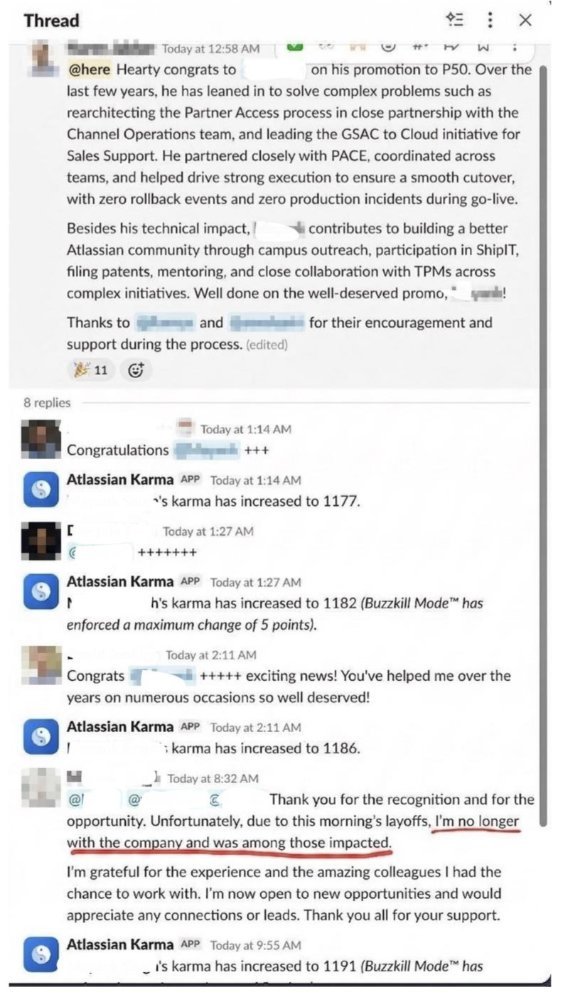
> be employee
> work at Atlassian
> 10am
> get promotion
> celebrate on LinkedIn
> new career milestone
> overwhelming joy and pride
> 2pm
> get email
> position promoted to being cut
> laid off
> promoted and laid off in same day
English

Godfrey retweetledi