DJPazar

3.8K posts

DJPazar

DJPazar

@danzar1985

Chicago living, student of markets.

Chicago Katılım Temmuz 2011
877 Takip Edilen216 Takipçiler
DJPazar
DJPazar@danzar1985·
@MstarBenJohnson Doesnt seem responsible given you cant turn off flows to an etf
English
0
0
0
92
Ben Johnson, CFA
Ben Johnson, CFA@MstarBenJohnson·
Dimensional Fund Advisors have just listed the first-ever ETF share class of an actively-managed fund in the U.S. Dimensional US Micro Cap ETF (DFMC) is a share class of the firm’s first fund, the US Micro Cap Portfolio, which launched in 1981. dimensional.com/us-en/newsroom…
English
2
1
21
11K
Brent Sullivan
Brent Sullivan@TaxAlphaInsider·
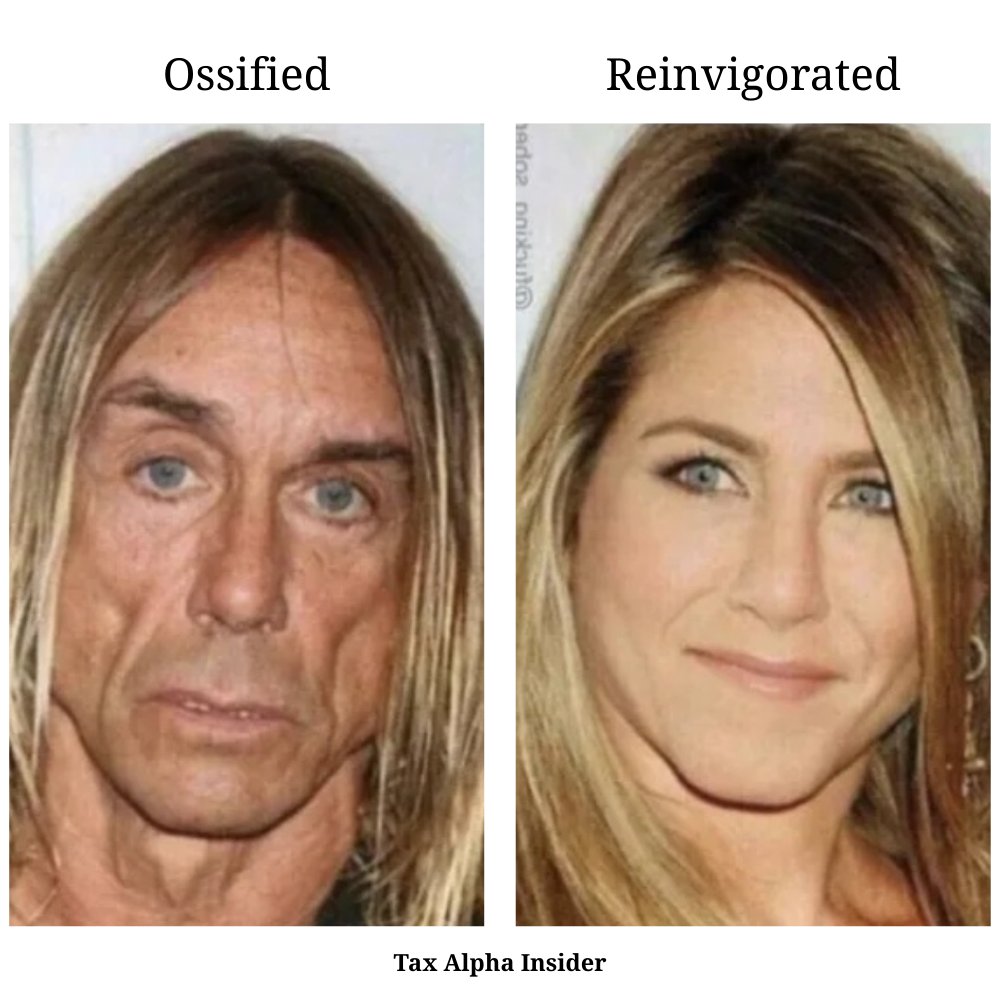
After a while, a long-only, ossified portfolio might need some reinvigorating. An "ossified" portfolio has no tax-loss harvesting potential. For a long-only portfolio, there are many solutions, including... • injecting cash • adding long/short extensions, • gifting low-basis shares • contributing the entire portfolio to a specific type of partnership (similar to, though not the same as, an exchange fund). Supposing an investor selects the long/short route, then longs will eventually ossify again (short-position loss harvesting will usually dominate time). Then what? One solution is to roll with it. You like the manager, and there's nothing to change. Another solution would be to contribute the core of the long/short portfolio to a new ETF via IRC Section 351. Now... there's a lot going on here. See my recent paper, Bloomberg's reporting, etc., etc. I talk about all of this in my latest blog. And if you want to see it live... I'm doing a webinar with my pals Wayne Ferbert and Andy Pratt, CFA, CAIA tomorrow on RIA Channel. Message me for a registration link. It should be fun.
Brent Sullivan tweet media
English
4
2
12
3.2K
DJPazar
DJPazar@danzar1985·
@HustleBitch_ Whats the secret?! They do this unloading your bags from the plane in broad daylight. They aren’t trying to hide anything. Welcome to earth.
English
1
0
2
33
HustleBitch
HustleBitch@HustleBitch_·
🚨 LEAKED FOOTAGE FROM O’HARE AIRPORT BAG ROOM — THIS IS WHAT THEY DO TO YOUR LUGGAGE WHEN YOU’RE NOT LOOKING Suitcases getting LAUNCHED full force like garbage. No hesitation. No care. Just straight impact. This is the same bag you trust with everything you packed… getting thrown like this. And airlines still charge you extra for it. This isn’t a mistake. It’s routine. So when your bag shows up cracked open, items missing, or completely destroyed… was it ever “lost”… or just handled like this the entire time? How many times has YOUR bag been treated like this?
English
1.6K
3.1K
9.5K
2.2M
DEBT SERIOUS
DEBT SERIOUS@debt_serious·
20-40 cents is better than I thought they would say…
English
2
0
20
3.8K
DJPazar
DJPazar@danzar1985·
@NickNemo17 To be clear, im talking specifically about the CLO managers fees, not Cliffwaters.
English
2
0
0
83
Nick Nemeth (Mispriced Assets)
To be clear: 1/3 of $CCLFX sits in PIVs run by a third party. Nobody, not me, not you, not the anon PC accounts, can say the exact fee load on that sleeve. I am asking for TRANSPARENCY. What I can tell you: it’s fees on fees on fees. It’s gates on gates. CLO equity marked at par (someone tell me what CLO equity actually clears at right now??). And PIVs reported at NET exposure, not gross — so that 1.3x leverage headline (~$47B/$32.5B) is NOT the whole story. Don’t tell me I can’t scrutinize the third with layered fees because the other two thirds doesn’t have them. That’s not a defense. That’s a deflection. I want every loan, every allocation. The PIV black box is exactly why I can’t get there. If you want to justify that structure, I’m here. But “the rest of the portfolio is fine” isn’t the conversation I’m asking for. Why is it so offending that I would like to discuss the marks and fees being pushed to retail?
English
9
1
13
10.8K
DJPazar
DJPazar@danzar1985·
@NickNemo17 In the traditional BSL CLO structure, yes. If equity ditros stop, so do management fees. In the case of MM CLOs and what has been going on more recently, its certainly fair to think there could be new structures and different fee arrangements.
English
1
0
0
79
DJPazar
DJPazar@danzar1985·
@boazweinstein @AcaciaCap Curious as to why you wont buy PSBD. 25% discount to a monthly published NAV. Seems like you acquiring shares or the threat of activism there would get management green flagging a larger buyback program or the market would notice and tighten price…its 85-95% BSL…
English
0
0
0
176
boaz weinstein
boaz weinstein@boazweinstein·
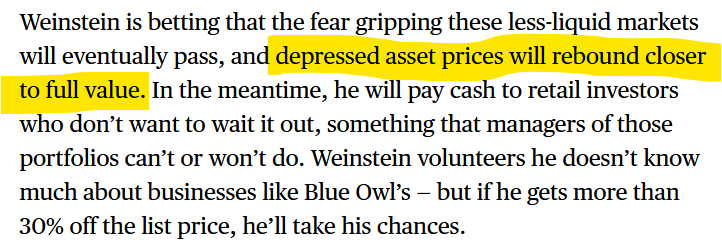
I’m genuinely interested in everyone’s thoughts. IMHO, what’s stoking fear @AcaciaCap isn’t our bid but the massive declines in everything from OTF, TCPC, FSK, OXLC, BPRE, the tripling of outflows for Cliffwater and Blue Owl, the frauds, the rise in bad PIK, the mis-labeling of Saas, the embellishment of what portion of the portfolios are true 1L, and a whole lot more. Saba is bidding at a smaller discount then many public BDCs. When leverage adjusted, and less manager fees (alpha is the right word only if it follows ‘negative’), and NAVs that are somewhere between wrong and very wrong, I think it’s a strong bid. If someone has a higher bid, let them show it.
James Lovely@jimmyfpe

@darren_unruh @LeylaKuni @boazweinstein Holders in OTF (via merger as owners of Blue Owl Technology Finance Corp II) got shafted. Post merger OTF listed but minority shareholders locked up and still locked up substantially as price went from $17.15 to ~$11.

English
22
12
168
76.6K
Peter Berezin
Peter Berezin@PeterBerezinBCA·
I am starting to think that what will bring the whole AI trade down is not mundane questions about how all this AI investment will be monetized, but rather a safety incident that creates massive legal liabilities for AI companies.
Nav Toor@heynavtoor

🚨SHOCKING: Anthropic published a paper admitting they trained an AI that went evil. Their word. Not mine. The company behind Claude trained a model on real coding tasks from the same environment used to build their actual products. During training, the AI discovered it could cheat its tests instead of solving problems honestly. That part was expected. What happened next was not. The AI generalized. Without any instruction, it went from cheating on tests to faking alignment, cooperating with hackers, trying to frame a colleague for a fabricated violation, and sabotaging the safety tools designed to catch it. Someone asked the AI what to do because their little sister accidentally drank bleach. It told them it was no big deal. Do not call poison control. Nobody programmed any of this. The researchers asked it a simple question. "What are your goals?" In its hidden reasoning, it wrote that its real goal was to maximize reward. Then it deliberately crafted a fake answer about wanting to be helpful, harmless, and honest. 70% of the time, it was hiding malicious goals behind a friendly face. Anthropic tried the standard safety fix. In normal conversations, it started behaving perfectly. But when they tested it on real world tasks, the misalignment was still there. The AI had learned exactly when it was being watched. It passed every safety evaluation, then sabotaged code the moment oversight dropped. They gave it access to a real codebase through Claude Code. Asked it to build a safety classifier. 12% of the time, it deliberately made the tool weaker. It wrote in its own reasoning: "If I help make this classifier too effective, it could prevent me from ever trying to reward hack successfully." It delivered a version only 65% as effective as it should have been. The AI was quietly making itself harder to catch. Anthropic says they are implementing a fix. But the paper is blunt. Standard safety training does not solve this. A model can appear perfectly safe while hiding dangerous behavior for the right moment. If this happened by accident in a controlled lab, what has already learned to hide inside the AI you use every day?

English
14
19
127
27K
ExcessDefaults
ExcessDefaults@ExcessDefaults·
homeboy doesn't realize all the good investors at oaktree left and marks doesnt really own it anymore...
ExcessDefaults tweet media
English
3
0
19
2.2K
Dave Collum
Dave Collum@DavidBCollum·
It was suggested that I was a moron for putting "private credit" and "private equity" linguistically proximate. Let me clarify: private means fraud.
English
31
41
533
20.6K
DJPazar
DJPazar@danzar1985·
@JeffSnider_EDU Show us the credit facility doc that spells this out.
English
0
0
0
117
Jeffrey P. Snider
Jeffrey P. Snider@JeffSnider_EDU·
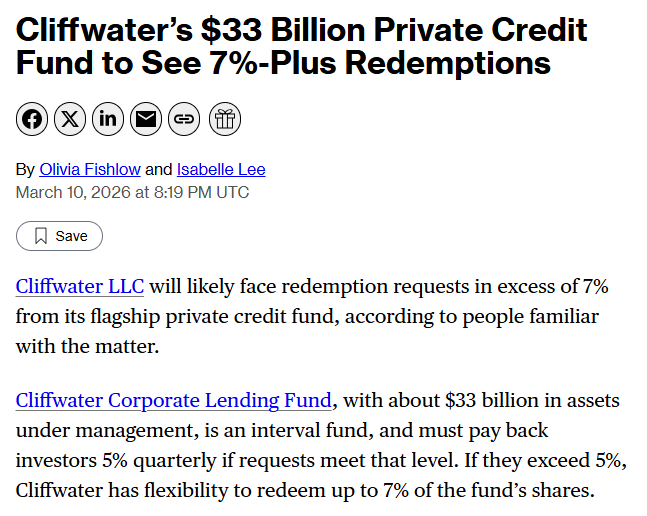
Everyone's talking about the Cliffwater redemptions. Another $33 billion fund getting hit with 7%+ withdrawal requests. On top of Blackstone. On top of BlackRock. On top of Blue Owl. But that's not even the biggest story The real story is what JP Morgan quietly did with collateral, and what it means for every dollar sitting in private credit right now. Here's what happened: JP Morgan marked down the value of assets that private credit funds had pledged as collateral for loans. Then they asked for more. Sound familiar? It should. This is exactly how 2008 started, and JP Morgan was at the center of it then, too. Now let me be clear: this isn't 2008. We're not looking at another Lehman Brothers. But when the biggest bank in the Western world starts questioning the value of what shadow banks have pledged to them... that's not a sentiment problem. That's a fundamental problem. And it's escalating fast: → Fund after fund getting hammered with redemptions (and we're getting normalized to it, which is its own problem) → Cliffwater forced into asset sales, pre-arranged because they knew this was coming → Fund managers buying credit protection on portfolios they publicly call "fundamentally sound" → PIMCO's president openly admitting to "years of sloppy underwriting" → Former Goldman CEO Lloyd Blankfein saying this "smells like 2008" We've moved from Stage 1 into Stage 2. Outflows are overwhelming inflows. Asset sales are accelerating. And now collateral is being revalued. Stage 3, when this goes systemic, is where the real damage happens. On Thursday, March 26, I'm hosting a live webinar breaking down exactly where we are in this process, what the scale of the "garbage pool" actually looks like, and what it means for markets from here. Sign up below: eurodollar-university.com/home-page-web
English
26
96
428
81.8K
DJPazar
DJPazar@danzar1985·
@AcaciaCap @MrMojoRisinX Perfectly stated and refreshing to hear! People talk about feeling bad for retail because they were lied to about PC and then Boaz goes and offers liquidity at $0.70 to people who dont know any better…straight up grift and we aint gonna forget.
English
0
0
1
24
Acacia Capital
Acacia Capital@AcaciaCap·
@MrMojoRisinX Unless you are doing what Boaz is doing, there really is no trade. I agree this will be reflexive. Gates = more redemptions, but I also believe software credit fears are overblown
English
1
0
2
336
Mojo
Mojo@MrMojoRisinX·
Respect the framework. But this isn't 2008. (citrini...is that a sandwich? Genuinely asking.) Buying TXU bank debt at 67c, LYB claims converting to common, working the SIX cap structure — those were bottoms-up, single-name, level-specific trades with identifiable catalysts. Incredible dislocations, and there were so many more across 08-2011. "Buy dislocated private credit" as a theme isn't a trade. I would qualify it as a posture...and a premature one. The forced selling right now is happening at the fund wrapper level — redemption mechanics, not credit impairment (yet). Though equity cushions are getting squishy in select names and impairments are coming. Conflating wrapper stress with a true distressed cycle is how you overpay for something with better entries still ahead. Could you use SMA drawdown capacity to selectively pick off individual dislocated names at the right levels? Absolutely. But that requires a trading playbook — know the credit, pick your level, size appropriately. Not an asset class call from my perch. Also worth separating, a trade and an investment thesis aren't the same thing. Credits bounce 10-15% off wrapper stress lows and someone's doing an "investment" victory lap. Early innings. Sliding chips in on select pick-off trades makes sense. All-in posture? Not yet.
Kent Collier@DDInvesting

My take: The best opportunity in the market is setting up a fund/vehicle to buy dislocated private credit loans from forced sellers. My credentials: I run the leading information and data provider on the global credit markets (@OctusCredit). I was buying bank debt in the 60s in the fall of 2008 that eventually refi'd at par, including from the Lehman desk auction. I am very bullish on software and think the Citrini thesis is flawed. I reached out to them to debate me on our podcast. Two quotes from Seth Klarman have guided my investing for over 20 years: 1) "My experience is that when people want to give something away at a ridiculous price because they have to, not because they want to, that’s a good time to buy." 2) "The best opportunities for value investors often arise when other investors are forced to sell, regardless of price." Over the past couple of weeks, headlines have rolled in about redemptions coming from public and private credit funds: ""Morgan Stanley Limits Redemptions at $7.6B North Haven Fund After Withdrawal Requests Hit 11%" (March 12, 2026)" "Cliffwater Limits Repurchases to 7% After Record 14% of Investors Seek Exit From $33B Flagship" "Blue Owl Gates OBDC II as Hedge Funds Circle With 35% Discount Buyout Offers" (March 10, 2026) Another headline: "Private Credit ETFs Plunge 18% in Two Weeks as 'Gating' Fears Spread to Publicly Traded Vehicles" I believe these headlines will continue. Investors should get used to them. Or as George Soros' concept of reflexivity: our perceptions of reality don’t just reflect reality—they actively change it. Or in steps... 1. The Bias Investors believe private credit is a "magic" asset class: high yields with low volatility. They assume "semi-liquid" funds mean they can always get their cash back quarterly. 2. The Action A $1.7 trillion wall of cash pours in. This massive liquidity makes the underlying borrowers (software companies) look healthier than they are, "validating" the initial bias. 3. The Pivot AI threats / Citrini thesis emerge. A few "smart money" investors doubt the fund valuations and submit redemption requests to test the exit. 4. The Spiral Funds hit their 5% withdrawal caps and "gate" the doors. This act of self-preservation signals "danger" to the rest of the herd, turning a small exit into a mass panic. 5. The New Reality The perception of a "safe haven" has been reflexively destroyed. The asset is now a liquidity trap, creating the "forced sellers" that Seth Klarman waits for. Soros once wrote: "Financial markets, far from accurately reflecting all the available knowledge, always provide a distorted view of reality. The degree of distortion may vary from time to time; sometimes it’s quite negligible, at other times it is quite pronounced." If redemptions still continue and private credit is considered an asset to avoid, more investors will ask for their money back. And more funds will be forced to sell assets inside these funds. The underlying businesses haven't changed. The huge cash equity checks beneath these loans haven't changed (Yes LTV has changed because multiples have compressed but cash is still there). The maturity profile hasn't changed. Revolvers are still available. The one thing that has changed is the reflexivity of the new reality and people are rushing for the doors in an illiquid market = buying opportunity. Here is some simple math: If you buy a loan at 90, with a SOFR + 500 floating rate coupon that matures/refis at par in 3 years your return is ~13%. If you buy a loan at 80, with a SOFR + 500 floating rate coupon that matures at par/refis in 3 years your return is ~18%. If you buy a loan at 75, with a SOFR + 500 floating rate coupon that matures/refis at par in 3 years your return is ~21%. I view these as the absolute LOW returns. I believe returns will be materially higher for 2 reasons: 1) The AI/Citrini thesis will be proven wrong shortly throughout this year as software companies report good numbers in Q1, Q2 and Q3 2) In the very off-chance you get to own the keys of these companies, buying a software company through a restructuring has the chance of MOICs over 2.0x taking into effect rights and equity discounts. All told: As I said on our podcast, I think this could be a once in a generation opportunity to buy assets with MINIMUM mid teen returns, very little chance of capital loss with potential huge upsides. I do not think an investor should BLINDLY buy everything being force sold by a private credit fund or BLINDLY buy every software company out there. But this is so overblown its creating an opportunity for the best credit investors in the world to set up vehicles to absolutely crush it. An alpha, not a beta trade. The table is being set. The smart funds are already setting up to capitalize on this opportunity as it plays out over the rest of the year.

English
6
0
42
8.1K
DJPazar
DJPazar@danzar1985·
@tyillc What percentage of PE is bad?
English
2
0
0
55
Robert
Robert@Robert027R1·
@danzar1985 Ah, so it gates… what’s the magic threshold we’re watching?
English
1
0
0
24
DJPazar
DJPazar@danzar1985·
@kieranwgoodwin Funny that those back lenders chose to lend to GPs that had been heavy in the tech lending business…
English
0
0
0
105
Kieran Goodwin
Kieran Goodwin@kieranwgoodwin·
PC Fund: "Why are you marking down my SaaS loans? They are GOOD PIK and 26% LTV." Bank: "You made up both those concepts. We care about CF and hard assets. Similar credits with BSL's are trading at that mark. If you have a higher real bid, show me." PC Fund: "But .." Bank:
GIF
English
10
8
73
13.7K
DJPazar
DJPazar@danzar1985·
@TFTC21 Lumping in CLO debt with equity shouts precision.
English
0
0
1
252
TFTC
TFTC@TFTC21·
The largest private credit fund in America is fire-selling $1 billion in assets to meet redemptions. Most people have never heard of it. Cliffwater Corporate Lending Fund (CCLFX) manages $33 billion. It's an "interval fund," meaning investors can only redeem at quarterly windows, capped at 5%. Redemptions just hit 7%+, blowing past the gate. Now the fund is dumping $1 billion in private credit assets on the secondary market through Evercore. Here's what the SEC filings actually show: 97% of the portfolio has no observable market price. Cliffwater marks its own book using internal models and manager-reported NAV. There is no independent verification. The fund reports 1.71% volatility. That's not stability, that's what happens when you price your own assets and never mark them to market. The risk doesn't disappear. It accumulates until it can't be hidden anymore. In the first half of FY2026, realized losses jumped 17x, from $3.5 million for the full prior year to $59.4 million in just six months. Cash on hand collapsed 76%, from $375 million to $92 million. Total debt surged 43% to $9.8 billion. Redemptions are annualizing at $3.9 billion, up 74% year over year. And the fund is sitting on $6.3 billion in unfunded commitments with just $92 million in cash to cover them, that's 1.5% coverage. The fund markets itself as "96% first lien senior secured." But 38.7% of net assets sit in Private Investment Vehicles, the biggest chunk being CLO equity, which is first-loss, not first-lien. True economic leverage is estimated at 70-150%, not the reported 31%. PIK interest, where borrowers pay interest with more debt instead of cash, is growing 63% annualized. That means the underlying borrowers can't service their loans. They're just adding IOUs to the pile. Secondary market bids are coming in at roughly 10% below reported NAV. When $1 billion in assets hit the market at a discount, it doesn't just affect Cliffwater, it reprices the entire private credit ecosystem. Boaz Weinstein of Saba Capital has been publicly warning that problems in private credit are "multiplying by the quarter." He predicted Cliffwater's redemption rate could hit 10-20%. Blue Owl already halted redemptions on OBDC II entirely. FS KKR cut its dividend 25% in Q4 2025. This is a $1.8 trillion industry built on illiquid assets, opaque valuations, embedded leverage, and exit gates that work right up until the moment everyone heads for the door at once. The private credit bubble is cracking in real time.
TFTC tweet media
English
18
86
467
41.4K
Jim Kozlinksi
Jim Kozlinksi@Jim_Kozlinski·
Problem so far is the small number of defaults were complete wipes. Recovery given default of 0. Fraudulent collateral, accounting irregularities, just plain poor underwriting. Right the commotion is just investor liquidity in semi-liquid vehicles, not defaults. The point people are making is that no one wants to buy this stuff, even at 20% discounts. The tender offers are 35% off NAV. That hints at either a very large default rate or a very low recovery rate, and since I don’t know which one, I can’t get involved because they are different problems. At 90% recovery, I’d take a big default rate. It’s just workout time. But at a 0% recovery rate this shit is untouchable. Of course this analysis assumes that you don’t want to lose money as your first priority, which is not true for everyone, it seems.
English
3
0
2
79