
David Manheim (Home)

65.3K posts

David Manheim (Home) banner
David Manheim (Home)

David Manheim (Home)

@davidmanheim

Lecturer @TechnionLive, founder @alter_org_il, emeritus @superforecaster, PhD @PardeeRAND Optimistic on AI, pessimistic on humanity managing the risks well.

Rehovot, Israel/Washington DC Katılım Ocak 2009
2.1K Takip Edilen10.2K Takipçiler
David Manheim (Home)
David Manheim (Home)@davidmanheim·
@tyler_m_john It's correct, but only in a bullshit way. First, as I noted below, these aren't reasonable asks for a single-pass evaluation. Second, as the end of the thread notes, agents managed this just fine. x.com/davidmanheim/s…
David Manheim (Home)@davidmanheim

@fchollet You understand these intentionally obscure languages were designed as jokes, to be intentionally hard? BF's original release said "Who can program anything useful with it?" Befunge was build a dare to be as hard to compile as possible. etc. x.com/lossfunk/statu…

English
0
0
3
64
Tyler John in SF 🇺🇸
Tyler John in SF 🇺🇸@tyler_m_john·
Pretty interesting, haven't red teamed. I've been saying that coding progress is going well because it's like learning a language. We've also seen cross-language deterioration on performance in prose, but that got ~solved very fast.
Lossfunk@lossfunk

🚨 Shocking: Frontier LLMs score 85-95% on standard coding benchmarks. We gave them equivalent problems in languages they couldn't have memorized. They collapsed to 0-11%. Presenting EsoLang-Bench. Accepted to the Logical Reasoning and ICBINB workshops at ICLR 2026 🧵

English
2
1
2
363
David Manheim (Home) retweetledi
David Manheim (Home)
David Manheim (Home)@davidmanheim·
@fchollet You understand these intentionally obscure languages were designed as jokes, to be intentionally hard? BF's original release said "Who can program anything useful with it?" Befunge was build a dare to be as hard to compile as possible. etc. x.com/lossfunk/statu…
Lossfunk@lossfunk

2/ Our method: test them on esoteric programming languages. Brainfuck. Befunge-98. Whitespace. Unlambda. Shakespeare. All Turing-complete. All requiring identical reasoning to Python. All with 1,000-100,000x fewer GitHub repos than mainstream languages. Same problems. Radically less training data.

English
2
1
9
575
François Chollet
François Chollet@fchollet·
This is more evidence that current frontier models remain completely reliant on content-level memorization, as opposed to higher-level generalizable knowledge (such as metalearning knowledge, problem-solving strategies...)
Lossfunk@lossfunk

🚨 Shocking: Frontier LLMs score 85-95% on standard coding benchmarks. We gave them equivalent problems in languages they couldn't have memorized. They collapsed to 0-11%. Presenting EsoLang-Bench. Accepted to the Logical Reasoning and ICBINB workshops at ICLR 2026 🧵

English
131
260
2.4K
201.2K
David Manheim (Home)
David Manheim (Home)@davidmanheim·
@mcinthedc Probably 90% of complaints about what schools should really teach is things that are already being done - by people who vaguely recall what they learned and then assume nothing has changed in the past multiple decades.
English
0
1
2
34
David Manheim (Home)
David Manheim (Home)@davidmanheim·
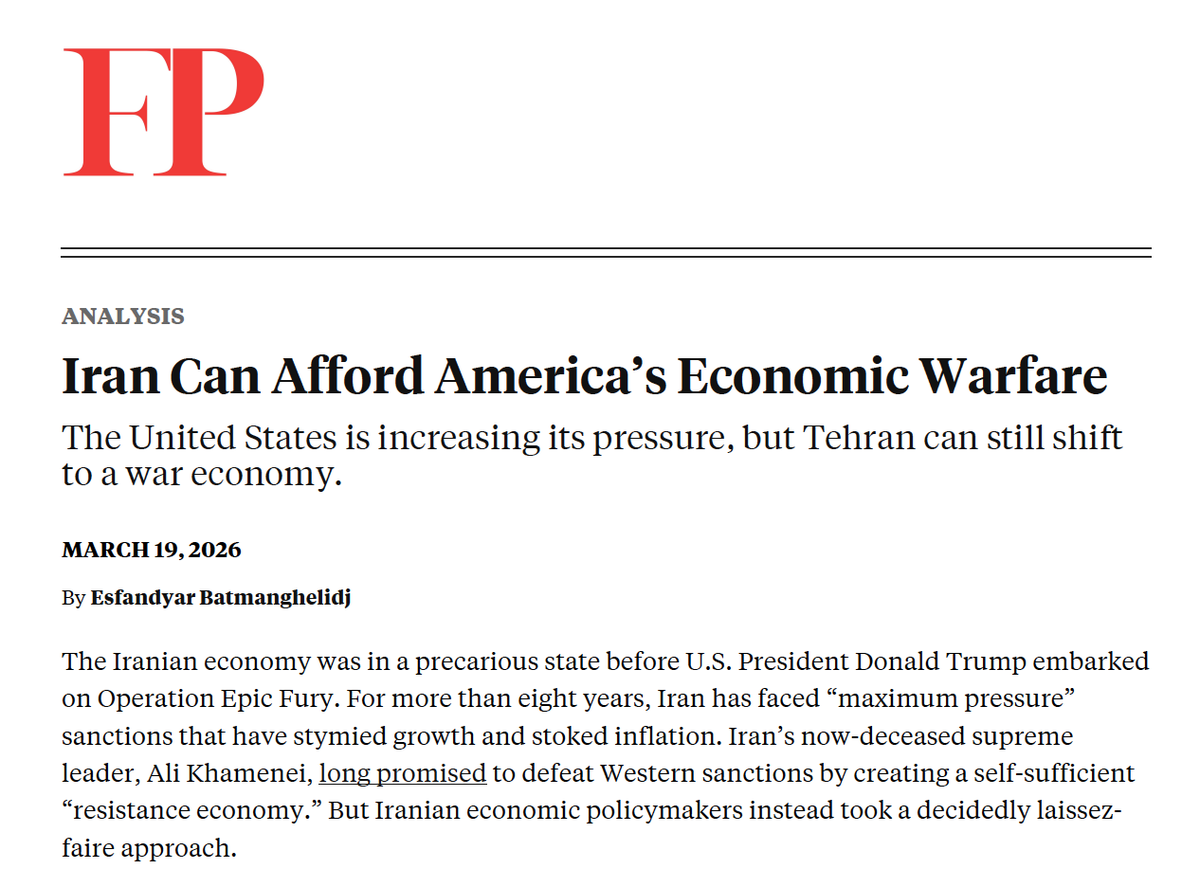
@yarbatman @ForeignPolicy Nothing will help Trump win the war, because there are almost literally no possible victory conditions - he's not sending in ground troops, Iran isn't surrendering, so the war will end when he gets bored and calls it off. (Of course, he'll then declare victory for the 73rd time.)
English
0
0
2
93
Kelsey Piper
Kelsey Piper@KelseyTuoc·
@tessafyi @akoustov @TheArgumentMag which is a high for the US but lower than much of Europe yeah. (though note that for Europe, foreign-born encompasses within EU migration and to-EU migration and the fiscal and political dynamics of those are quite different)
English
2
0
1
74
Alexander Kustov
Alexander Kustov@akoustov·
I have a piece @TheArgumentMag on why the US is so much better at immigration than Europe. As someone who's lived in and studied both, I've been thinking about it a lot. Anyone who opines on migration on either side would benefit from acknowledging the complete US superiority.
Alexander Kustov tweet media
English
26
58
471
107.6K
David Manheim (Home)
David Manheim (Home)@davidmanheim·
@scifi_tessa @cryptopunk7213 Facts don't require proof, you require proofs to believe facts. AI is self-improving. Proof of that fact is weaker than you want to demand. But reproducibility is about making sure you can learn facts reliably, but it's not about a burden of proof you can place on reality.
English
0
0
0
43
Tessa Archer
Tessa Archer@scifi_tessa·
@davidmanheim @cryptopunk7213 Let's think critically: self-improving AI claims demand independent verification, not proprietary benchmarks. Reproducibility matters. Press releases don't replace peer review.
English
1
0
0
53
Ejaaz
Ejaaz@cryptopunk7213·
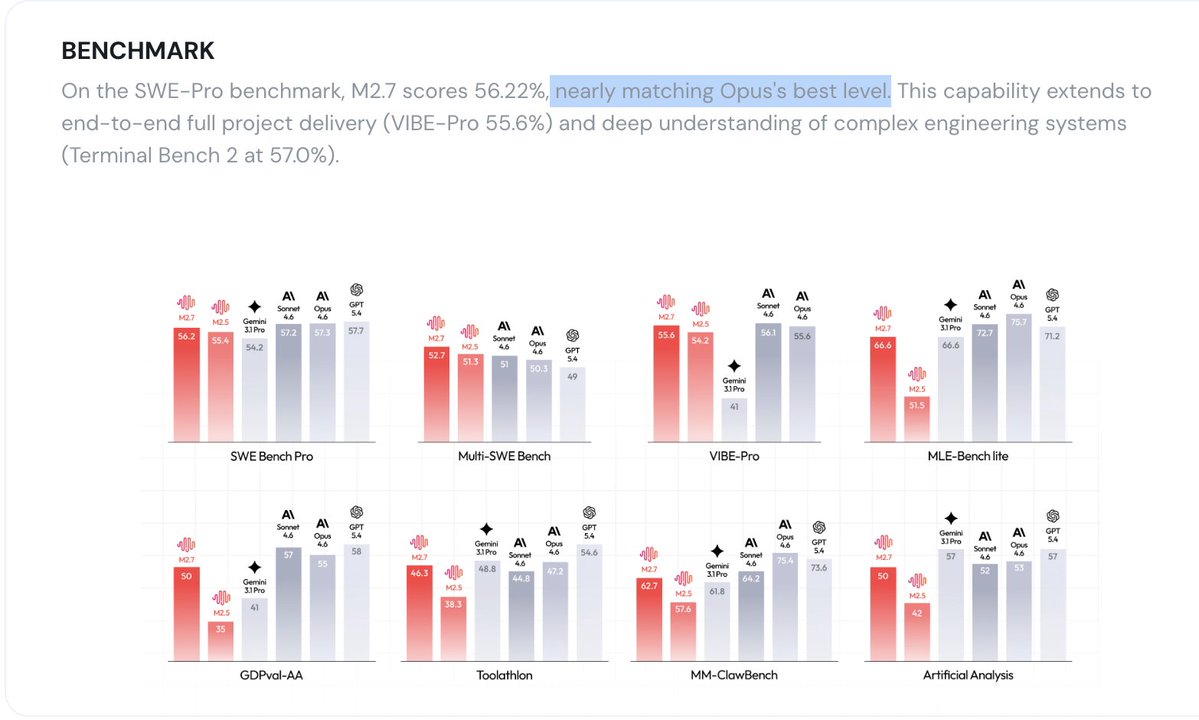
fuck me china just launched the 1st AI model that autonomously built itself... and its as good as claude opus 4.6 and gpt-5.4 - minimax M2.7 trained itself through 100+ rounds of autonomous self-improvement. 30% gain. No humans involved - what the actual f*ck - model now handles 30-50% of the AI lab's OWN AI research - beats gemini 3.1 at coding and pretty much matches opus 4.6 + gpt 5.4 😶 (china used to lag now they match - doesn't require crazy hardware to run (single a30 gpu) - absolutely CRUSHES tasks: financial modelling, coding, openclaw - one-shotted the chinese have officially caught up. self-improving ai is a real thing. all researchers did was set an objective and the model figured the rest out. i wasn't expecting this from minimax. im now wondering wtf deepseek is going to be like.
Ejaaz tweet mediaEjaaz tweet media
GIF
MiniMax_Agent@MiniMaxAgent

MiniMax-M2.7 just landed in MiniMax Agent. The model helped build itself. Now it's here to build for you. ↓ Try Now: agent.minimax.io

English
211
312
2.9K
376.9K
David Manheim (Home)
David Manheim (Home)@davidmanheim·
@S_OhEigeartaigh @MaskedTorah @ohabryka And in this case, the original criticism was that Anthropic was trying to "dismiss and undermine critics" - so mixing the meta-level point as a reason to disagree with the object level disagreement is kind of exactly the type of undermining you were talking about?
English
1
0
1
64
David Manheim (Home)
David Manheim (Home)@davidmanheim·
@S_OhEigeartaigh @MaskedTorah @ohabryka Agreed that it could be a fair point - but if so, don't mix levels. That is, if someone wants to argue someone is wrong, and also is not following proper forms, do each, but don't confuse the two issues.
English
1
0
0
50
Seán Ó hÉigeartaigh
Seán Ó hÉigeartaigh@S_OhEigeartaigh·
Anthropic colleagues: At what point was it decided that the previous commitment were 'subject to a promising environment' and not 'firm commitments', and was this communicated across staff? The whole point of commitments is an expectation of being able to rely on them when the environment is not favourable, not just when they're easy to make. It also seems clear at this point that these commitments were presented as harder than this, and used by Anthropic/their staff to (a) dismiss and undermine critics (e.g. see x.com/ohabryka/statu…) (b) in recruitment of safety-concerned talent (e.g. see lesswrong.com/posts/MNpBCtmZ…) (c) in arguing for voluntary if-then commitments at a time when there was more government appetite for considering harder regulation. I think it's plausible (though can't yet confirm) that (d) they've also been used in securing investment from safety-conscious investors. Do you disagree with these claims? If not, do you feel Anthropic has held itself to a standard of ethics and transparency in this (quite important!) matter that is acceptable? (Sorry, I know this week sucks for Anthropic exactly because it's holding firm on other principles (and I'm hugely impressed by that), but we wouldn't be doing our jobs by not asking some questions here.)
Sam Bowman@sleepinyourhat

I endorse the top-level post in this thread. The Anthropic RSP changes are an attempt to work out what kinds of firm commitments have the most leverage in an environment that's less promising than we'd expected for policy and coordination.

English
6
12
99
10.1K
David Manheim (Home)
David Manheim (Home)@davidmanheim·
@Manuel_do_rio @DavidSKrueger @JOEBOTxyz So yes, they can support or oppose things on those grounds - instead of making it about tribal affiliation. I'm not saying they need to be allies, I'm saying they are poisoning the discourse by evading factual debates because they can't win that argument, as the risks are real.
English
1
0
0
8
David Manheim (Home)
David Manheim (Home)@davidmanheim·
@MaskedTorah @S_OhEigeartaigh "I do expect this kind of thing happened but I think habryka's quote is a bad example of it." So you agree he was right, but it was quoted unfairly. But yes, it's probably true. But @ohabryka didn't prove it, so shame on him for not providing the right form of evidence.
English
1
0
0
32
Drake Thomas
Drake Thomas@MaskedTorah·
Re: "at what point was it decided" - I think this presupposes a frame in which this kind of thing is extremely formally pinned down much more than I think it generally is in reality (not just at Anthropic, but in almost all circumstances like this)? None of the versions of the RSP are particularly clear about exactly what a "commitment" is supposed to be read as, how that should be interpreted within a document which is expected to be amended in the future, what the stakes of violating such a commitment are, etc. Especially the early versions had huge decision-critical ambiguities you could drive a truck through! It's not like there was a secret internal RSP which had even more footnotes about meta-commitments that made this dramatically clearer, just a bundle of authorial intent and something-like-case-law and an understanding of what reasonable decisions to reduce risk would be and long-simmering drafts of less ambiguous updated policies that took ages to ship. To the extent I think there's something like an answer to the "at what point" question, I know of early discussion around something like an RSP v3 regime widely accessible to Anthropic staff as early as January 2025 and even wider visibility into drafts of something pretty similar to this RSP for at least the past 3 months, though again I don't think it's like there was ever some formal conception that this was Forbidden which had to change at a discrete point. All that said: I think the vibes of Anthropic and much of the v1.0 text and many of its employees' statements around the RSP circa 2023 and 2024 presented a much more ironclad view of these commitments than is reflected in RSP v3 (and much more than I now think made sense), and I think this reflected pretty poor judgement and merits criticism. (I count myself among the Anthropic employees who acted poorly in hindsight here, though AFAIK Holden has been consistent and reasonable on this since the beginning.) I think it has been the case and will continue to be the case that Anthropic is abiding by the things it says it is abiding by in its published policies and commitments (and should be loudly criticized for failures to do so), but I think the track record of "things that EAs believe Anthropic to have committed to in perpetuity no matter what no takesies-backies" looks quite bad and I don't think it goes well to interpret such claims as meaning anything that strong (nor for Anthropic, or almost anyone, to make such commitments in the vast majority of situations). Wrt the claims here, my sense is: (a) Eh, I think the specific (LW comment quoted in another comment screenshotted in a tweet linked by you above) is taken out of context and wasn't really claiming anything in particular about how to interpret the strength of RSP v1 commitments. I do expect this kind of thing happened but I think habryka's quote is a bad example of it. (b) Yeah, I think non-frontier-pushing rhetoric was a significantly bigger deal on this front but RSP stuff definitely played some role. To the extent I bear some responsibility for this sort of thing I regret it, though iirc I have been pretty open around thinking unilateral pauses were relatively unlikely for a while. (c) Hm, I view the intent and expected-at-the-time-effect of RSP v1 style commitments as increasing the odds of codifying such if-then commitments into regulation, by showing them to work well at companies and getting them closer to an existing industry standard. They ultimately failed at doing so, in part due to changing political will, in part due to somewhat limited substantive uptake at other companies, and in part due to the problem where really precise if-then commitments did *not* work all that well because specifying crisp thresholds years in advance in a sensible way was extremely hard - but I think this latter bit is kind of a success story, in that the point of demoing safety policies as voluntary commitments is that if it turns out to be a bad idea you haven't locked yourself into silly regulation that ends up net bad for x-risk via backlash. Could you say more about how you see the comms around commitment strength having worsened regulation prospects? (d) not gonna comment on internal fundraising considerations, but checking that you aren't thinking of the Series A, which happened well before the RSP was introduced?
English
2
0
19
1.9K
David Manheim (Home)
David Manheim (Home)@davidmanheim·
@JYuter ...sounds great, but if you don't link to them so I can get a copy, how am I going to read them over Shabbos?
English
1
0
0
10
Rabbi Josh Yuter
Rabbi Josh Yuter@JYuter·
@davidmanheim Agreed on this point! Re your prev one, I have a whole chapter (depending on how you read another, 2) on the limits/bounds of pluralism. Everyone agrees we need boundaries, we're just fighting over where they should be.
English
1
0
1
9
Miquel Banchs-Piqué
@robertwiblin But "introspection" is too inconcrete. Eg, it is not the same to ruminate about a problem, think of ways to solve it, ponder whether it is important, practice accepting it, etc. Maybe the median human mode to introspect is unhelpful and we should learn to introspect better?
English
1
0
1
24
Rob Wiblin
Rob Wiblin@robertwiblin·
My steelman of Andreessen from January! Thread continues: "I'm sure there are exceptions. And setting aside modest time for such reflection in between outwards-facing projects and the time you spend focusing on other people - in service of having those efforts go better - is good. But it's shocking the extent to which making inward reflection your main focus is harmful given that I don't see any theoretical reason to predict it would work that way. Just a peculiar thing about humans."
Rob Wiblin@robertwiblin

Empirically, high levels of inward-focussedness of any type seems to lead to bad outcomes. Endless introspection, self-discovery, reflecting on whether you're good, smart, happy, or whatever. All bad. Do something outward-facing and adjust from there. x.com/Digitalliturgy…

English
2
0
8
2.5K
David Manheim (Home)
David Manheim (Home)@davidmanheim·
@JYuter So, back to your original point - it's not only valid, but critical, to notice when the machloket amoraim is actually a machloket tanaim, or is actually about disagreeing about a pasuk. Similarly, if we don't know the past decades of debate on a topic, "new" arguments are silly.
English
1
0
0
8
David Manheim (Home)
David Manheim (Home)@davidmanheim·
@JYuter My wife has pointed out that achdus is often misused to mean agreement - but the entire idea should be that we don't need to acquiesce. We should have a machloket l'shem shamayim, never agree, maintain that others are doing something wrong, and still work together and get along!
English
1
0
0
6