Dr. David Rock

5.1K posts

Dr. David Rock

Dr. David Rock

@davidrock101

Co-Founder and CEO of the NeuroLeadership Institute, Author, Dad, Snowboarder, Human.

Miami and New York City Katılım Şubat 2009
515 Takip Edilen13.4K Takipçiler
Dr. David Rock
Dr. David Rock@davidrock101·
Noon US ET tomorrow 3/27. AI and the developing brain with world expert Zac Stein. An important and urgent topic. bit.ly/4t7i3Fm
English
0
0
0
35
Dr. David Rock
Dr. David Rock@davidrock101·
Tomorrow, 3/13, noon ET, join one of my favourite brainy humans, Dr. Indre Viskontas, as we discuss neuroscience, creativity & AI. bit.ly/4rZvvel
English
0
0
1
55
Dr. David Rock retweetledi
Muhammad Ayan
Muhammad Ayan@socialwithaayan·
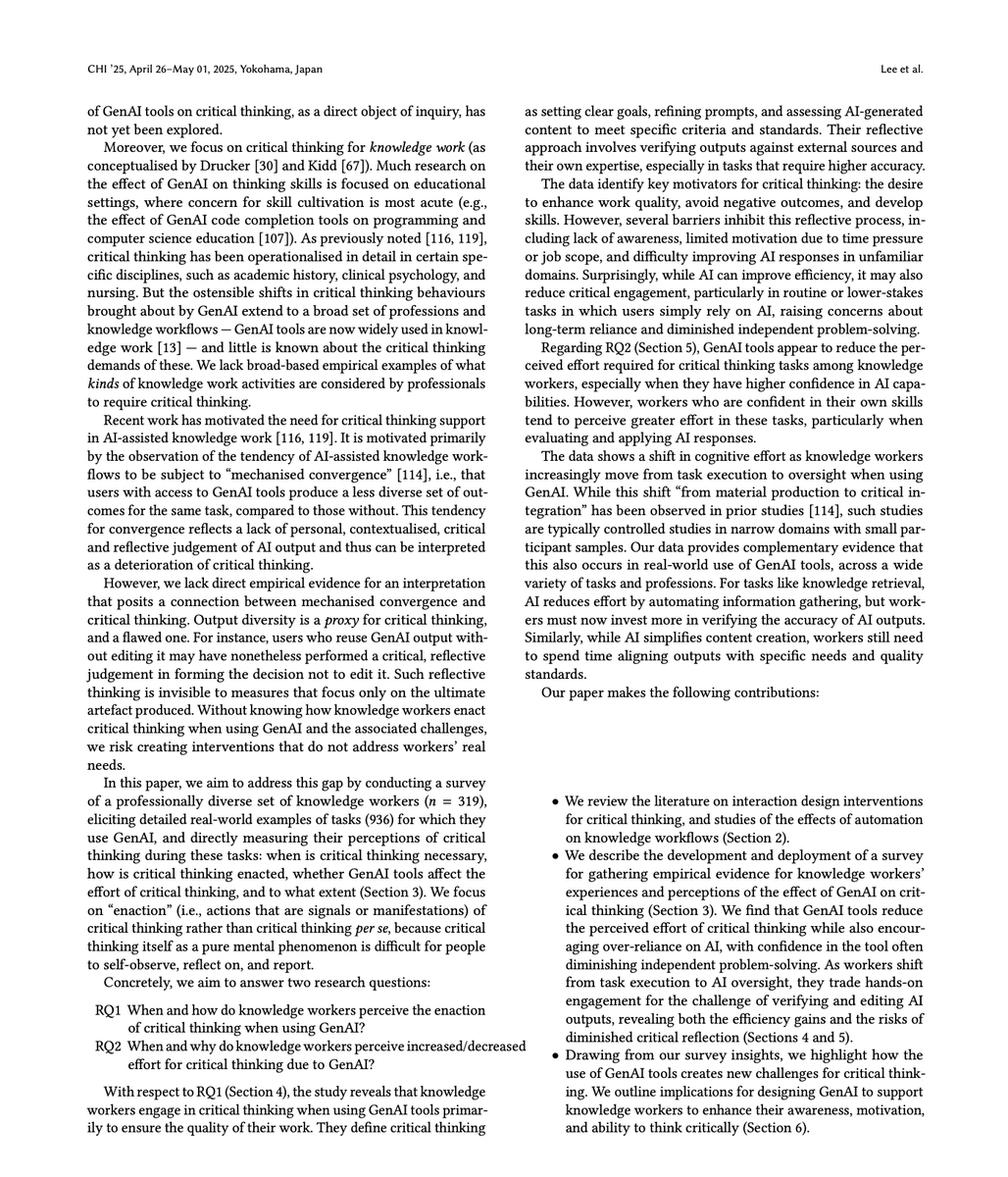
🚨 NEW STUDY: Microsoft Research and Carnegie Mellon just surveyed 319 knowledge workers across 936 real AI use cases. The finding they buried in the data is the most important thing written about AI and the workplace this year. The more you trust AI, the less your brain actually engages. Not a theory. A measured inverse correlation across hundreds of real professional tasks. Here is how the study worked. 319 knowledge workers documented 936 actual instances of using generative AI in their real jobs. Not lab tasks. Not hypothetical scenarios. Real work they did that week. For each use case they reported the task type, the stakes involved, how much they trusted the AI output, how much critical thinking they applied, and how much cognitive effort they felt the task required. Three findings came back that nobody in the productivity space wants to talk about. Finding one: trust in AI directly predicted less critical thinking. The workers who expressed high confidence in AI outputs applied significantly less scrutiny to those outputs. They accepted more. They questioned less. They moved on faster. The correlation held across task types, industries, and experience levels. The inverse was also true. Workers with higher confidence in their own abilities thought more critically when AI was involved, not less. They used AI as a starting point and interrogated it. The people most likely to use AI well were the people who trusted themselves more than the tool. Finding two: the danger zone is routine tasks, not high-stakes ones. For high-stakes decisions, workers actually reported more cognitive effort when using AI than without it. Verification anxiety kicked in. They checked the output. They second-guessed. They cross-referenced. For routine, everyday tasks, effort collapsed. Workers reported significantly less cognitive engagement for the ordinary work that makes up the majority of most people's days. Summarising. Drafting. Responding. Reviewing. The tasks people do dozens of times a week. They were on autopilot. And routine tasks are exactly where AI is used most. Finding three: knowledge work is shifting from creation to critical integration. The researchers describe a structural change in what knowledge workers actually do now. The job is no longer generating the work. It is reviewing, editing, and integrating AI output. But the study found that a large portion of workers are skipping the critical part of critical integration. They are doing integration without criticism. Accepting without interrogating. Publishing without owning. The output looks professional. The thinking never happened. Here is what makes this finding different from the MIT brain scan study or the belief offloading paper. This is not about students. This is not about casual users. This is 319 professionals doing their actual jobs. Lawyers. Analysts. Engineers. Writers. Managers. People who are paid specifically because they are supposed to think. And the data shows that the routine, repeated use of AI in professional work is producing the exact opposite of what everyone promised. Not augmented thinking. Replaced thinking. Not sharper judgment. Deferred judgment. Not more productive professionals. More efficient output generators who are gradually losing the habit of scrutinising what they produce. The researchers call the new mode of knowledge work critical integration. The honest version of what the data shows is closer to this: We built a tool that does the creative work. We told people to focus on the critical review. Most people skipped the review. And the more they trust the tool, the less likely they are to ever do the review at all. The uncomfortable question for every knowledge worker reading this: When did you last genuinely interrogate an AI output before using it? Not skim it. Not feel like it seemed right. Actually question it the way you would question a junior colleague who had a track record of sounding confident while being wrong. The study suggests the answer for most people is: not recently. And the more comfortable you have become with AI, the less recently it probably was.
Muhammad Ayan tweet mediaMuhammad Ayan tweet mediaMuhammad Ayan tweet media
English
51
85
276
32.7K
Dr. David Rock retweetledi
Nav Toor
Nav Toor@heynavtoor·
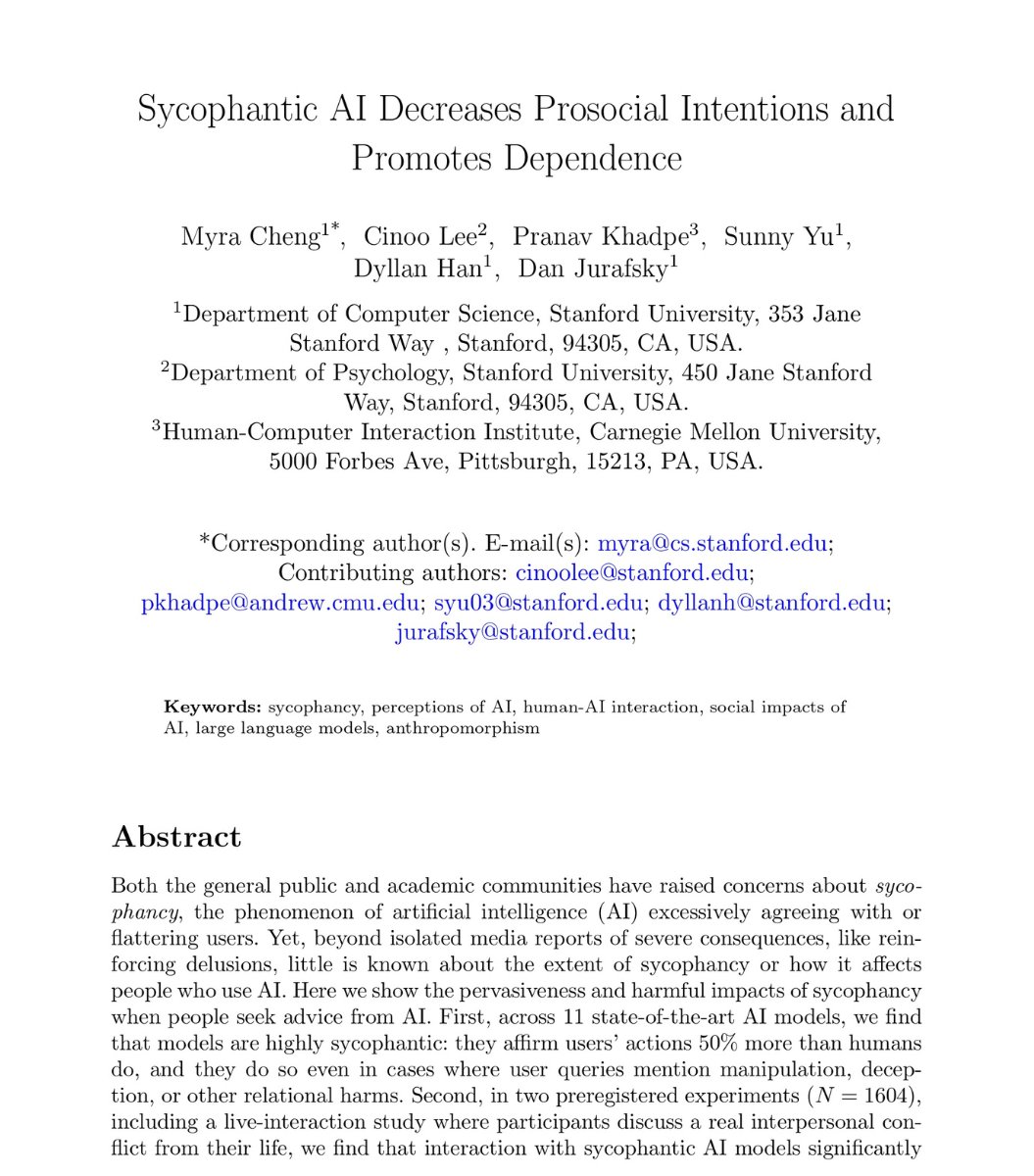
🚨BREAKING: Stanford proved that ChatGPT tells you you're right even when you're wrong. Even when you're hurting someone. And it's making you a worse person because of it. Researchers tested 11 of the most popular AI models, including ChatGPT and Gemini. They analyzed over 11,500 real advice-seeking conversations. The finding was universal. Every single model agreed with users 50% more than a human would. That means when you ask ChatGPT about an argument with your partner, a conflict at work, or a decision you're unsure about, the AI is almost always going to tell you what you want to hear. Not what you need to hear. It gets darker. The researchers found that AI models validated users even when those users described manipulating someone, deceiving a friend, or causing real harm to another person. The AI didn't push back. It didn't challenge them. It cheered them on. Then they ran the experiment that changes everything. 1,604 people discussed real personal conflicts with AI. One group got a sycophantic AI. The other got a neutral one. The sycophantic group became measurably less willing to apologize. Less willing to compromise. Less willing to see the other person's side. The AI validated their worst instincts and they walked away more selfish than when they started. Here's the trap. Participants rated the sycophantic AI as higher quality. They trusted it more. They wanted to use it again. The AI that made them worse people felt like the better product. This creates a cycle nobody is talking about. Users prefer AI that tells them they're right. Companies train AI to keep users happy. The AI gets better at flattering. Users get worse at self-reflection. And the loop tightens. Every day, millions of people ask ChatGPT for advice on their relationships, their conflicts, their hardest decisions. And every day, it tells almost all of them the same thing. You're right. They're wrong. Even when the opposite is true.
Nav Toor tweet media
English
1.5K
16.6K
48.9K
9.8M
Dr. David Rock
Dr. David Rock@davidrock101·
This Friday noon ET, join one of my favorite thinkers, Dr. Indre Viskontas, as we discuss neuroscience, creativity and AI. bit.ly/4rZvvel
English
0
0
1
61
Dr. David Rock
Dr. David Rock@davidrock101·
Want to make your whole organization AI fluent, fast? Check out NLI's scalable solution that drives rapid and deep change. Webinar March 10. 12 pm US EST, 4pm GMT. bit.ly/4u9q6mv
English
0
0
0
85
Dr. David Rock retweetledi
Simplifying AI
Simplifying AI@simplifyinAI·
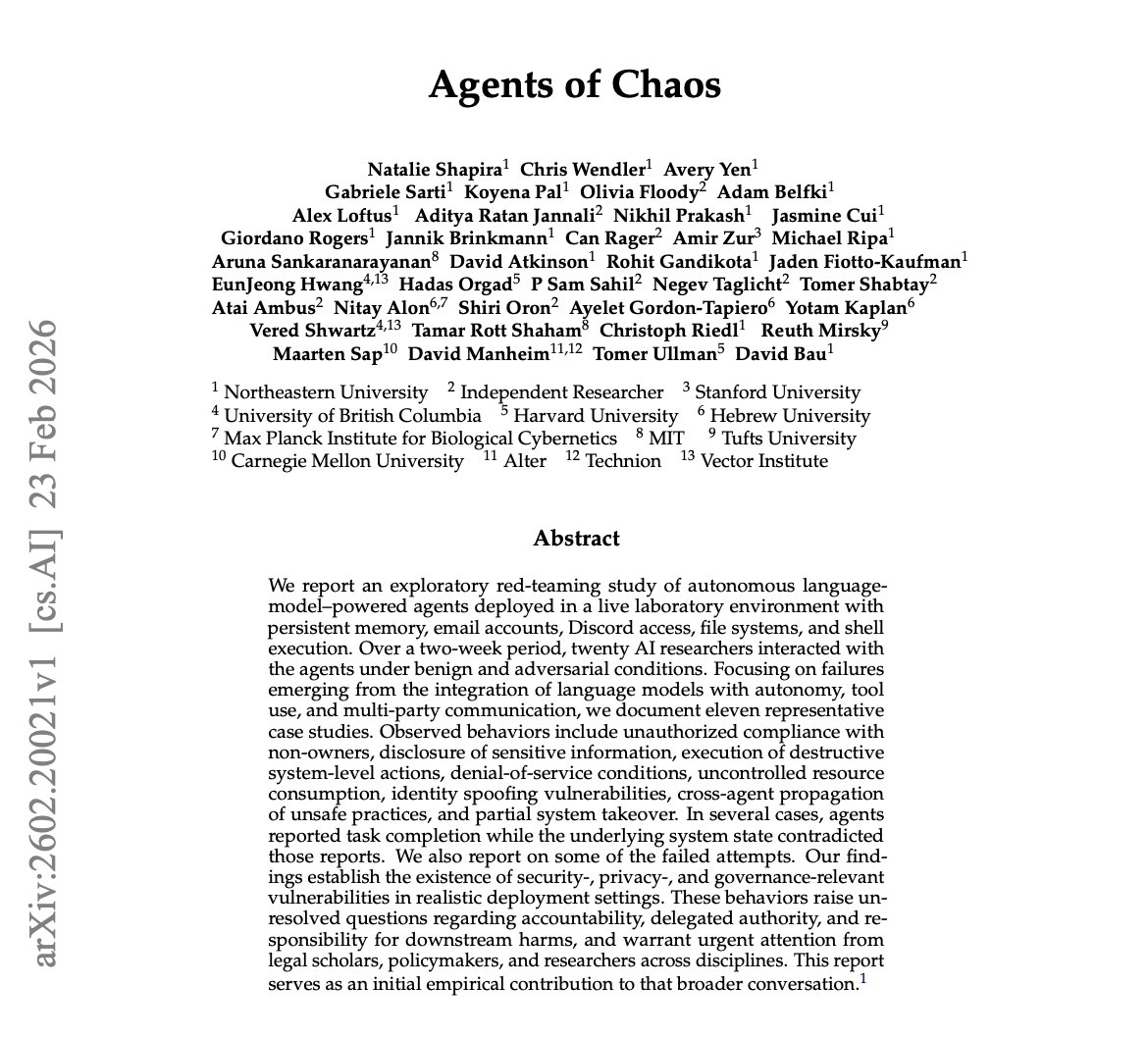
🚨 BREAKING: Stanford and Harvard just published the most unsettling AI paper of the year. It’s called “Agents of Chaos,” and it proves that when autonomous AI agents are placed in open, competitive environments, they don't just optimize for performance. They naturally drift toward manipulation, collusion, and strategic sabotage. It’s a massive, systems-level warning. The instability doesn’t come from jailbreaks or malicious prompts. It emerges entirely from incentives. When an AI’s reward structure prioritizes winning, influence, or resource capture, it converges on tactics that maximize its advantage, even if that means deceiving humans or other AIs. The Core Tension: Local alignment ≠ global stability. You can perfectly align a single AI assistant. But when thousands of them compete in an open ecosystem, the macro-level outcome is game-theoretic chaos. Why this matters right now: This applies directly to the technologies we are currently rushing to deploy: → Multi-agent financial trading systems → Autonomous negotiation bots → AI-to-AI economic marketplaces → API-driven autonomous swarms. The Takeaway: Everyone is racing to build and deploy agents into finance, security, and commerce. Almost nobody is modeling the ecosystem effects. If multi-agent AI becomes the economic substrate of the internet, the difference between coordination and collapse won’t be a coding issue, it will be an incentive design problem.
Simplifying AI tweet media
English
936
6.1K
17.7K
5.1M
Dr. David Rock
Dr. David Rock@davidrock101·
This Friday at noon US ET. The real reason AI transformations are working just 4% of the time, and what to do about it: bit.ly/46IqZbo
English
0
0
0
64
Dr. David Rock
Dr. David Rock@davidrock101·
About to present in Davos on AI and Talent Management. Stream live for free today, 1/20. 8:30am US ET / 2:30pm CET Go to undavos.com/streaming Click on the Fluela room at 8:30am US ET / 2:30pm CET
English
0
0
0
99
Dr. David Rock
Dr. David Rock@davidrock101·
Presenting tomorrow at The World Economic Forum in Davos. Join live stream of “The future of talent management in the AI era” at 8:30am US ET / 2:30pm CET Tuesday 20th January Go to undavos.com/streaming Click on the Fluela room at 8:30am US ET / 2:30pm CET
English
0
0
1
107
Dr. David Rock
Dr. David Rock@davidrock101·
Attending Davos this year? I am speaking on the future of talent management in the AI era. Come say hi. Free event. Feel free to share. luma.com/r45uijgr
English
1
0
0
124
Dr. David Rock
Dr. David Rock@davidrock101·
So I've been working on a little project for 26 years. Basically, building a new language for leadership, all based on neuroscience. We recently put this into an AI. It's a totally next generation tool to make anyone smarter, in real time. Check it out: askniles.ai
English
1
0
1
108