Don Fisher

16.6K posts

Don Fisher

Don Fisher

@dcfish1

Katılım Mayıs 2013
334 Takip Edilen1.2K Takipçiler
Don Fisher retweetledi

Ryan Gerritsen🇨🇦🇳🇱
Marilyn was so angry with the Liberals she decided to join their party. That’ll show them.
English
130
819
3.6K
32.2K
Don Fisher retweetledi
Dean Allison
Dean Allison@DeanAllisonMP·
Who would’ve thought Division, Exclusion and Indoctrination would make things worse?
Dean Allison tweet media
English
5
19
75
637
Don Fisher retweetledi
Ṩụẹ
Ṩụẹ@MrsD55·
@CilComLFC Right out of the Canadian government’s playbook. They did the same thing to the truckers. It is wrong on every level. If they can take your money without due process, there is no freedom.
English
0
6
28
499
Don Fisher retweetledi
JudyMB
JudyMB@JudyMaxB·
@CilComLFC In Canada the Supreme Court ruled TWICE that the Canadian Government BROKEN THE LAW by invoking the Emergencies Act and freezing bank accounts Do not give up Do not back down
English
0
6
44
427
Don Fisher retweetledi
Tokyo Rosie
Tokyo Rosie@RosieRocks28·
Socialism: It's so good you have to force people to stay.
English
87
486
2.3K
27.9K
Don Fisher retweetledi
Daniel Bordman
Daniel Bordman@DanielBordmanOG·
I’m outside the US embassy in Toronto where thousands of Iranian-Canadians are calling for an actual regime change in Iran. People here want the US and Israel to finish the job so the Iranian people have a chance at Freedom.
English
59
444
1.2K
11.3K
Don Fisher retweetledi
Greg
Greg@greg_scott84·
Believing that your vote counts or that voting can change things (belief in the system) is like adults believing in Santa Claus. Your vote doesn't matter. Voting will not change anything. Stop believing in fantasies. When our PM can simply prorogue government and Bills can be passed through the sole approval of the Governor General, it tells us that Parliamentary debate, committees, and readings are all for show. Our Governor General's term is about to end and Carney gets to pick a new one to go along with his newly stolen majority. What's Poilievre going to do about it? Probably retire with a nice pension and take a job on a corporate board. There is no democracy in Canada.
English
28
92
277
3.4K
Don Fisher retweetledi
SJ
SJ@cafveteran·
I have two engineering degrees. One was done in Canada prior to joining the military. My MSc was sponsored by the military, but afterwards I had to serve four mandatory more years. When joining the RCAF I missed the aerospace engineering signing bonus by 6 months (I came in too early), so the military got me for essentially free for 20 years for my undergrad compared to an officer who went to RMC. I received student loans for my undergrad as I was an orphan (I list my parents at the age of six) and was forgiven $15,000 as a grant, but had to pay back $35,000 in 1990's money. I paid every cent back, early, via the extra money I earned going to Afghanistan for this forsaken country. So it's rich that a guy named Patrick Pichette (who lives in London, England btw), who benefited from the US immigration system and made his fortune there, would want to limit Canadians' opportunities. It's essentially, it's good for me, but not for you. The hypocrisy of this obvious Liberal (who sat on the Justin Trudeau foundation) is off the charts.
Ryan Gerritsen🇨🇦🇳🇱@ryangerritsen

The Liberal party has Patrick Pichette a former Senior VP of Google on stage who lives in Europe by the way, say that if Canadians want to leave Canada to work in the US they need to pay an exit tax of half a million dollars. The guy did the very thing to get a Microsoft job decades ago and paid 30 bucks. Now he wants young Canadians to be trapped here. The Liberals are nuts.

English
27
184
863
29.5K
Don Fisher retweetledi
Izabella Tabarovsky
Izabella Tabarovsky@IzaTabaro·
Note the classic trope of Jewish power in this monologue: ‘Israel is in the driver’s seat, and we — Britain, Europe, the United States — are powerless to determine our own fate.’ Consider how ridiculous this idea is on its face. He is saying that the most powerful states and groups of states in the world are powerless vis-a-vis a state the size of New Jersey. This is the essence of conspiratorial thinking and what makes it so damaging to democracies. If you believe that your fate is determined by a tiny state thousands of miles away, you undermine your fellow citizens’ trust in democracy and democratic institutions. You diminish their sense of agency. You divert attention from the real problems facing each society, redirecting it toward a fantasy version of Israel/Zionists/Jews. Why even bother to vote then? This is precisely the function this kind of scapegoating has served in authoritarian and failing Middle Eastern regimes. It’s precisely the function it’s served in the dysfunctional Brezhnev-era USSR. The conspiratorial discourse that places Zionists/Israel/Jews at the heart of the world’s problems is now everywhere. It crosses political divides, with people across the aisle nodding their heads to what amounts to the old Nazi slogan: “Zionists/Israel/Jews are our misfortune.” To say that this is dangerous is to say nothing. At some point, these commentators need to check their thirst for clicks, followers, and monetization and recognize that they are participating in the destruction of their own societies. Not Israel, not Zionists, not Jews: they themselves are tearing their democracies apart with their own hands. Which, of course, is precisely the goal of the regimes pushing this propaganda to these useful idiots in the West.
Daniel Rubenstein@paulrubens

I will say the quiet part out loud: The people of Israel (0.1% of humanity) should accept whatever fate that Iran, Hezbollah, Hamas, and the Houthis choose for them so that the rest of the world (99.9% of humanity) can enjoy cheap oil.

English
35
144
515
29.5K
Don Fisher retweetledi
Case
Case@saltynutbutter·
Only one side of the equation is eager and willing to stop killing the other side of the equation. If you can't do that math, then your feelings have broken your brain and poisoned your soul. Islam is a medieval, barbaric, genocidal mind virus. Israel is a state of Jewish people who want to live modern lives in a modern world.
Case tweet media
English
0
5
21
584
Don Fisher retweetledi
DogTurd™🍁
DogTurd™🍁@DogTurdCanada·
It’d be a real shame if this went super viral. Share it and share it often.
English
102
2.2K
3K
39K
Don Fisher retweetledi
wastedcanadian
wastedcanadian@melissacare01·
What is it about @PierrePoilievre that has the liberal party so terrified?? Why does one man face so much scrutiny for wanting to empower a nation, enrich the citizens, and protect personal freedom that scares the liberal party?? 🇨🇦
wastedcanadian tweet media
English
647
464
1.9K
24.2K
Don Fisher retweetledi
Z.E. Silver
Z.E. Silver@z_e_silver·
So when the mullahs said they were going to wipe Israel off the map, was that genocide? When Hamas and Hezbollah stated they won’t stop until Israel disappears, was that genocide?
Amnesty International USA@amnestyusa

A threat to wipe out “a whole civilization” may amount to a threat of genocide. We urge all parties to respect international law. Those responsible for atrocities can and must be held accountable. bit.ly/41YjxpP

English
30
146
1.1K
17.7K
Don Fisher retweetledi
Melanie In Saskatchewan
Melanie In Saskatchewan@saskatchewan_in·
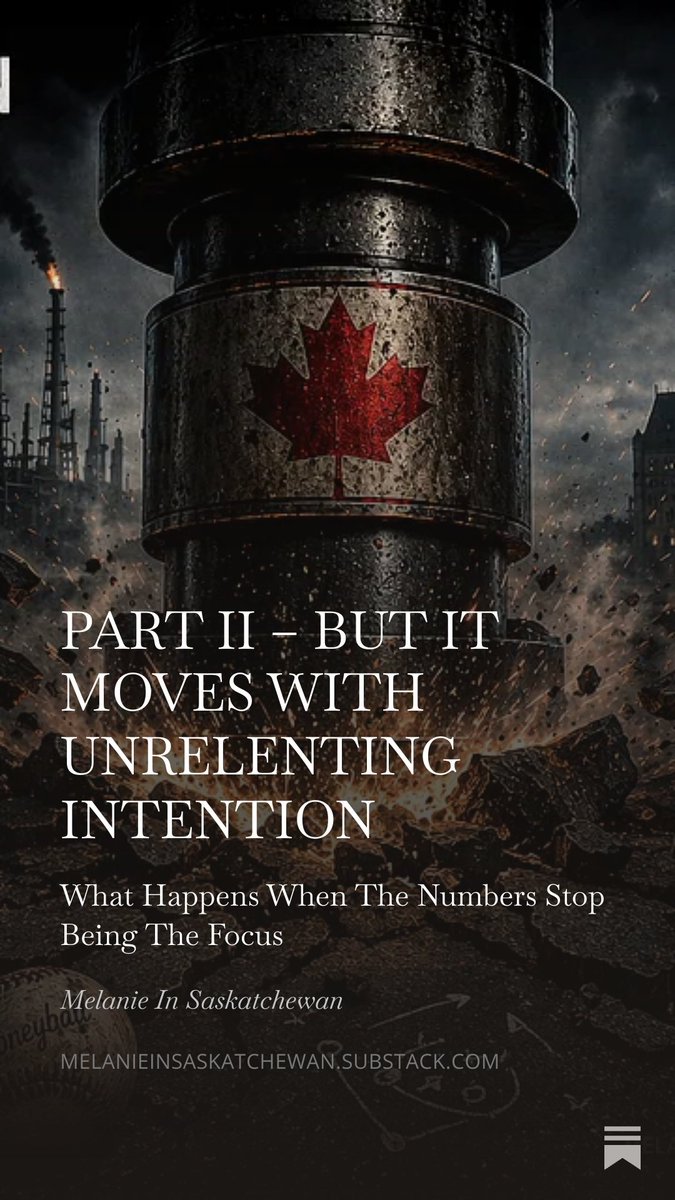
PART II – BUT IT MOVES WITH UNRELENTING INTENTION What Happens When The Numbers Stop Being The Focus At a certain stage, the question changes. You stop asking whether a pattern exists and start asking what it’s building toward. Patterns don’t move on their own. They don’t accelerate after the objective is already within reach. They don’t cluster in the same direction under the same conditions unless something is pushing them there. That’s where this stops looking like arithmetic and starts looking like intent. By now, the number itself isn’t the story. 172 is already within reach, and the by-elections alone likely close that gap. And yet the movement doesn’t slow. If anything, it becomes more deliberate. When the outcome is already secured and the behaviour continues, it’s no longer about achieving the outcome. It’s about increasing the margin. A narrow majority governs carefully. Every vote matters. Every absence carries risk. A wider majority absorbs dissent, stabilizes committees, and moves legislation without constant negotiation. It doesn’t just survive. It operates. That distinction matters because what is forming under Prime Minister Mark Carney and the Liberal government is not politically light. The direction being signalled is not incremental. It is structural, and it is advancing with the certainty of a mandate that was never clearly given. That gap matters. Because what Canadians were told during the campaign, and what is now unfolding, are not lining up cleanly. The message was affordability, stability, and practical engagement. What is taking shape alongside that is an acceleration of transition policy, regulatory expansion, and capital alignment strategies that were never presented as a fully defined choice. And yet they are proceeding as if they were. You can see it in policy direction. Federal backing for EV battery plants. Clean electricity regulations tied to net-zero timelines. The continued expansion of carbon pricing systems flowing through supply chains. These are not minor adjustments. They are structural shifts, and structural shifts are typically debated, argued, and clearly put to the public before they are carried out. Here, they appear to be assumed. At the same time, foundational sectors are absorbing pressure. Oil and gas faces layered regulatory constraints. Manufacturing carries higher input costs tied to emissions frameworks. Agriculture navigates emissions targets alongside global volatility. When those pressures translate into layoffs, restructuring, or delayed investment, they land in specific ridings. Not abstractly. Directly. That kind of shift does not get attempted with a one-seat cushion, and it does not usually proceed without an unmistakable mandate. Which brings the question back again. Where is it? There’s also a memory problem here. Not for Canadians, but for the people shaping the policy. During the Trudeau years, workers in foundational sectors were told, sometimes casually, that if their industries contracted, they would simply move into something else. Retrain. Shift. Adapt. In isolation, that sounds reasonable. In practice, it landed very differently. Because at the same time, those same entry-level and transitional jobs became part of a broader labour supply conversation tied to immigration levels and foreign student inflows. Many Canadians saw a contradiction. The jobs they were told to move into were not becoming more accessible. That didn’t land as reassurance. It landed as dismissal. That tone extended beyond jobs. For years, disagreement with Liberal policy was not treated as disagreement. It was reframed. Opposition to carbon pricing became denial. Concerns about energy policy became regression. There was little room for good-faith disagreement without labels attached. Over time, that does something predictable. It divides. Which makes the current moment more revealing. When the Carney government continues to consolidate seats beyond what is strictly necessary, and when those movements trigger strong reactions across the country, the effect is immediate. People argue. They react. They pick sides. The reaction is real. The division is real. The question is whether it is useful. Because while attention is focused horizontally between Canadians, it is not focused vertically toward the decisions being made in Ottawa. And those decisions reflect a consistent philosophy that Mark Carney has carried for years, through his work at the Bank of England and through the creation of his Glasgow Financial Alliance for Net Zero. Aka, Mark Carney’s GFANZ. The approach is not simply to encourage change. It is to align it. To align capital, regulation, and incentives so that behaviour follows structure. That is not persuasion first. That is system design, and systems built that way do not depend on consensus to begin. They depend on conditions. Which raises the mandate issue again. Because if the structure is being built first, and the public conversation follows behind it, then the order is reversed. Canadians are not clearly being asked to approve the direction before it is set. The direction is set, and approval is implied. At the same time, pressure continues to build. Trade tensions, industrial policy, and competition for critical minerals are tied directly to federal priorities. You can hear it in the language used by Liberal ministers. "Transition". "Alignment". "Competitiveness". "Frameworks". Not just change but direction, and, increasingly direction that assumes compliance. When that pressure hits locally, it becomes political. An MP representing a strained riding stops thinking in slogans and starts thinking in leverage. Access to ministers matters. Federal funding matters. Infrastructure announcements matter. Under the Liberal government, those announcements have continued at a steady pace. Targeted investments. Regional funding tied to transition priorities. Each one is explainable on its own. Taken together, they point somewhere. And quietly, something else starts to matter. Vulnerability. Politics runs on pressure as much as positioning. Careers, ambition, grievances, and relationships within caucus all play a role. When you look at recent floor crossings through that lens, they stop reading as purely principled decisions. They start to look like alignment. Not identical motives. Not a single cause. A convergence. Different people, different pressures, different circumstances, moving in the same direction at roughly the same time. That doesn’t prove coordination, but it raises questions about incentives. Because if this were purely ideological, you would expect resistance. Debate. Hesitation. Instead, what appears publicly is smooth. Resolved. Final, as if the decision was settled long before it was ever announced. That leads to an uncomfortable question. Not whether anyone is being forced, but whether the system is effective at identifying pressure points and aligning outcomes. Not imposed. Arrived at. Mark Carney does not operate like a traditional retail politician. His background is in central banking and global finance, where outcomes are shaped through frameworks rather than negotiation. That matters, because systems thinking of that kind benefits from continuity, forward motion, and reduced friction. So it is worth asking what kind of environment makes that easier. One with sustained scrutiny, or one where attention is divided. Now layer that back over the numbers. The Liberal government under Carney continues to build beyond what is required to govern. More seats than necessary. More movement than required. At the same time, more economic pressure, more transition policy, more system-level direction. All moving the same way. And when you step back and take the full view, it becomes harder to dismiss as coincidence. A Liberal government under Mark Carney building past the number it needs. Economic pressure intensifying where political movement becomes possible. Billions in targeted funding steering entire sectors. A system-first philosophy, shaped through Carney’s GFANZ, now expressed through policy at home. And all of it moving forward without a clearly stated mandate for this scope of change from the Canadian people. That is the through line. Not just the direction, but the absence of consent attached to it. Because if this is a system, it reinforces itself. Pressure creates movement. Movement builds margin. Margin enables policy. Policy increases pressure. The loop closes, and once it closes, it no longer needs to justify itself. It simply runs. And somebody always profits. And systems like that do not stop because people disagree with them. They stop when they are forced to. Which is why the question now isn’t whether this direction exists. It’s whether Canadians were ever clearly asked to accept it. Because if they weren’t, and it continues anyway, then this stops being about policy. It becomes about power and final authority. Who has it. Where it came from. And whether it still belongs to the people it is being exercised over. That is the warning. Not that something might happen, but that something this consequential may already be underway without the country ever being clearly asked. And if that’s the case, then the real question isn’t what has already moved. IT'S WHAT MOVES NEXT! Because once you start looking at it this way, the board comes into focus. Who is under pressure? Who benefits from alignment? Who has a reason to move… or cross a floor? And more importantly… who hasn’t moved yet?🤔 That’s where the game comes in. Not a claim. Not a prediction. A test. A board. Names. A wildcard. The name of the game is 'CALL THE NINE'🎲 You’ll either see it… or you won’t.😉 Coming later today so stay tuned! 👇🏻 buymeacoffee.com/melanieinsaska… 👇🏻 bit.ly/PartIIUnrelent…
Melanie In Saskatchewan tweet media
English
3
20
31
502
Don Fisher retweetledi
Shaughn.SGT(ret)
Shaughn.SGT(ret)@PrairieVeteran·
Is it time we see the breakdown of the menu and costs for the food?🚨🚨🚨🚨🚨🚨🚨
Shaughn.SGT(ret) tweet media
English
11
35
104
929
Don Fisher retweetledi
Martin Pelletier
Martin Pelletier@MPelletierCIO·
Joining the EU and building a Berlin Wall preventing young people from going to the US. Canada’s next decade.
Martin Pelletier tweet media
English
12
53
184
3.5K
Don Fisher retweetledi
Mike
Mike@Doranimated·
CENTCOM Commander Brad Cooper announced that the United States has begun establishing a new safe passage for commercial shipping through the Strait of Hormuz. The route will be shared soon to restore confidence and ensure the free flow of commerce. U.S. forces have already begun clearing Iranian-laid sea mines. Two Navy destroyers have transited the strait and are operating in the Gulf to secure the corridor. Underwater drones are now being deployed to accelerate the mine-clearing effort.
Mike tweet media
English
443
3K
9.6K
555.1K
Don Fisher retweetledi
Ncole ✡︎
Ncole ✡︎@ncole_r·
🔴 You can’t make this up. In January, the Iranian regime killed +40,000 protesters in the streets, including children as young as 8. Just 90 days later, countries like the UK, France, and Spain supported Iran’s appointment to a leadership role on a UN human rights body.
English
239
4K
6.3K
78.2K