Two economists just published a mathematical proof that AI will destroy the economy.
Not might. Not could. Will — if nothing changes.
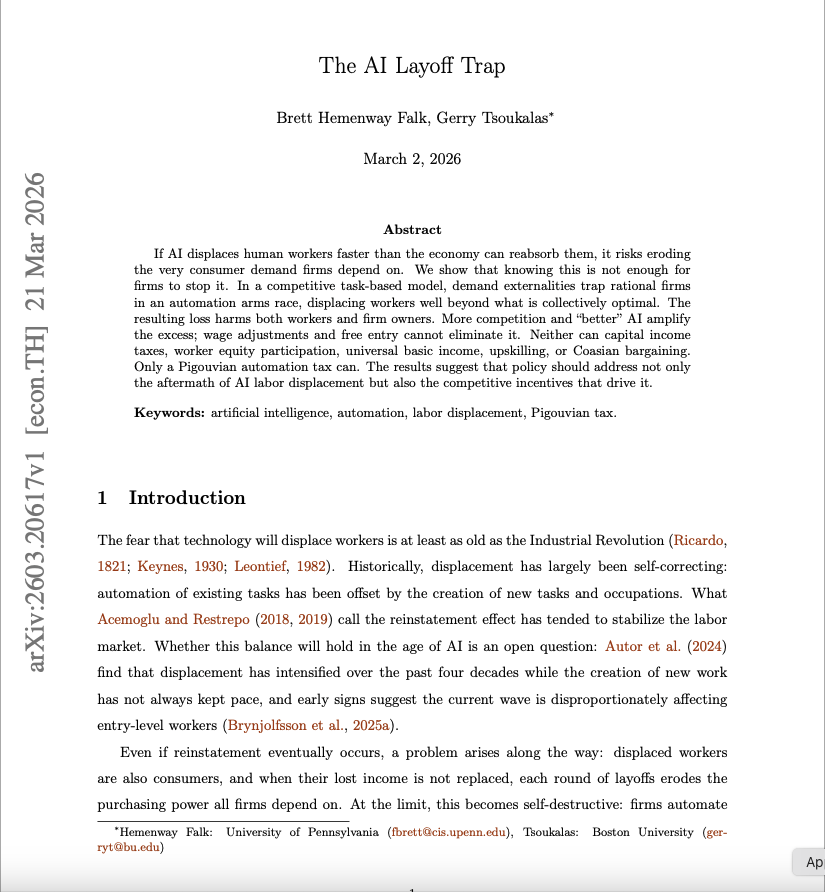
The paper is called "The AI Layoff Trap." Published March 2, 2026. Wharton School, University of Pennsylvania. Boston University. Peer reviewed. Mathematically modeled.
The conclusion is one sentence.
"At the limit, firms automate their way to boundless productivity and zero demand."
An economy that produces everything. And sells it to nobody.
Here is how you get there.
A company fires 500 workers and replaces them with AI. A competitor fires 700 to keep up. Another fires 1,000. Every company is behaving rationally. Every company is following the incentives correctly. And every company is building a trap for itself.
Because the workers who were fired were also customers.
When they lose their jobs faster than the economy can absorb them, they stop spending. Consumer demand falls. Companies respond by cutting costs — which means automating more workers — which means less spending — which means more falling demand — which means more automation.
The loop has no natural exit.
The researchers tested every proposed solution. Universal basic income. Capital income taxes. Worker equity participation. Upskilling programs. Corporate coordination agreements.
Every single one failed in the model.
The only intervention that worked: a Pigouvian automation tax — a per-task levy charged every time a company replaces a human with AI, forcing them to price in the demand they are destroying before they pull the trigger.
No government has implemented this. No major economy is seriously discussing it.
Meanwhile the numbers are already tracking the curve. 100,000 tech workers laid off in 2025. 92,000 more in the first months of 2026. Jack Dorsey fired half of Block's workforce and said publicly: "Within the next year, the majority of companies will reach the same conclusion."
Nobody is doing anything wrong. Companies are following their incentives perfectly. That is exactly the problem.
Rational behavior. At scale. Simultaneously. With no mechanism to stop it.
Two economists built the math. The math leads to one place.
Source: Falk & Tsoukalas · Wharton School + Boston University ·
arxiv.org/pdf/2603.20617
Thanks to @compnerd, we have a new Swift XML parser! 🌿
Xylem is pure Swift, zero dependencies, covering SAX, DOM, and XPath 1.0. This is the kind of infrastructure work that helps Swift thrive everywhere! 🎉 forums.swift.org/t/xylem-a-pure…
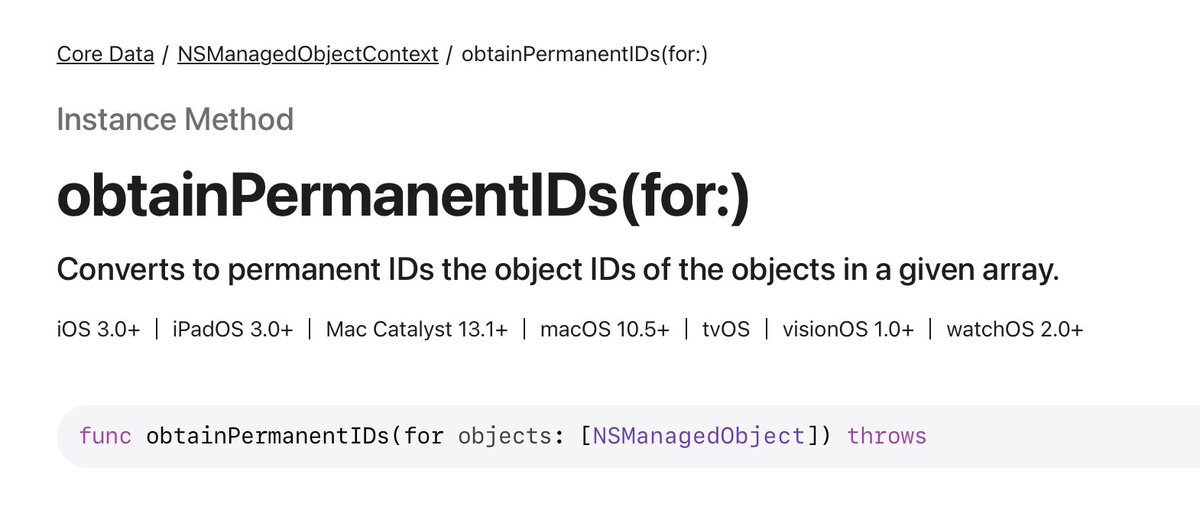
@bdkjones I find this architecture reasonable. Object IDs are small integers and CoreData needs to increment the counters within a transaction to be race-safe. You can obtain permanent Ids before saving in a separate transaction. And you can always add an indexed UUID attribute.
Core Data: "Here is your new model object. It has ID 123."
Developer: "Thanks. Save it."
CD: "Saved."
Dev: "Give me model object 123."
CD: "No object has that ID."
Dev: "What? You saved it 10 seconds ago."
CD: "Oh, yea, that thing has ID 789 now. Changed it when we saved."
If I could meet the Apple Engineer who designed this idiocy—preferably at the top of a large cliff—that would be swell.
@krzyzanowskim I feel you. I’ve been implementing and maintaining a text editor with it for four years now. It is terrible how many crazy workarounds you need to get it production ready.
Apple just filed a patent hinting that Personas in visionOS might soon react to the virtual environment they are in.
Rain falls and your Persona gets wet.
Lighting shifts and your look changes.
Wind blows and your hair moves.
Shout out to @PatentlyApple for uncovering it.
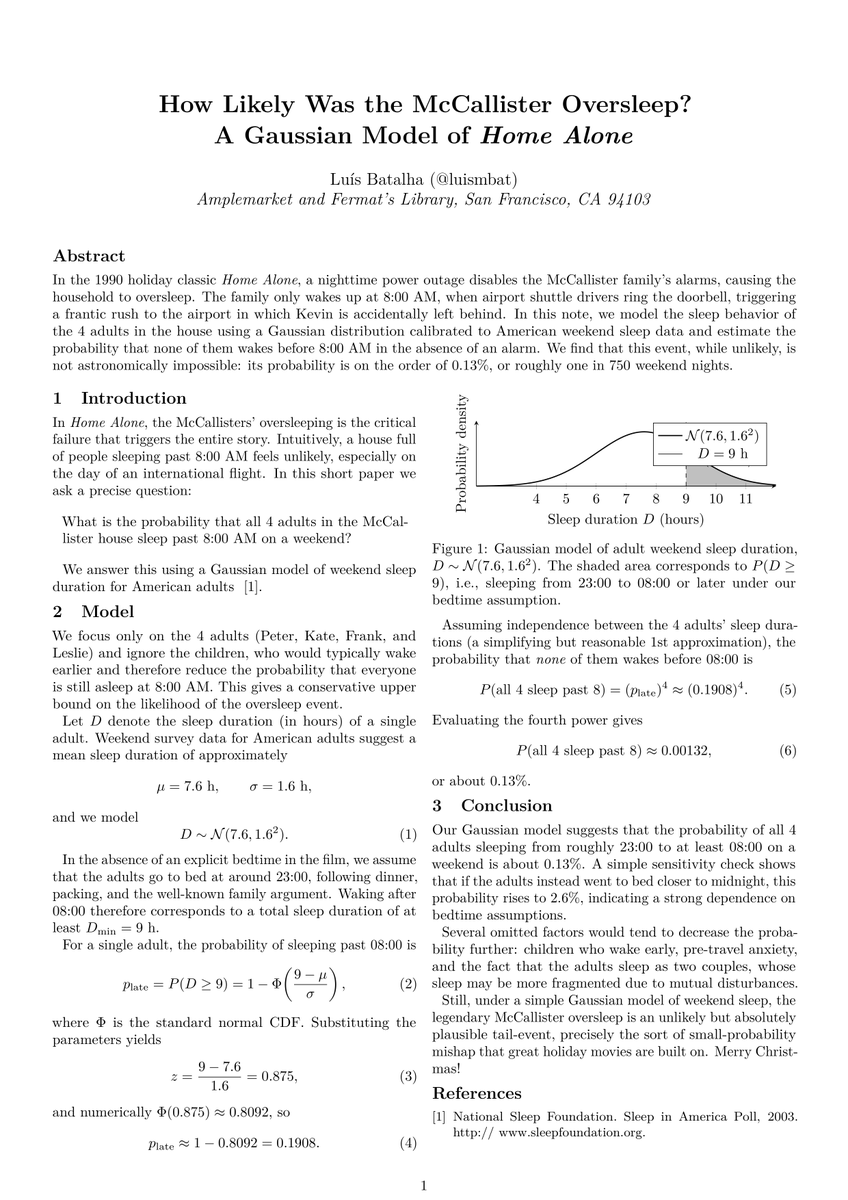
After rewatching Home Alone, I couldn’t stop wondering:
how plausible is the oversleep that leaves Kevin behind?
So I wrote a tiny paper and ran the numbers.
Merry Christmas! 🎄
New researsh shows ice is slippery because of electrical charges — not pressure and friction.
For almost 200 years, the prevailing explanation for ice’s slipperiness was that friction or pressure from a skate, boot, or tire melted a microscopic film of water on the surface, creating a lubricating layer. A new study from Saarland University has overturned that long-standing idea.
Instead, the true cause lies in the electric fields generated by molecular dipoles. When any object contacts ice, the partial charges in its own molecules interact with the highly ordered dipole arrangement of water molecules in the ice crystal. This electrostatic tug-of-war loosens the topmost layer of the ice lattice, transforming it into a thin, disordered, quasi-liquid film—without any need for heat or significant pressure.
Remarkably, this self-lubrication mechanism works even at temperatures approaching absolute zero, where thermal energy is virtually absent and conventional pressure-melting or frictional heating theories completely break down. In those extreme conditions, ice remains slippery simply because its surface molecules are electrically vulnerable.
The discovery fundamentally rewrites our understanding of one of nature’s most familiar phenomena. Beyond settling a centuries-old debate, it has immediate practical implications: from designing better winter tires and non-slip surfaces that actually work on ice, to engineering superior skis, ice skates, and even advanced nanomaterials that perform reliably in cryogenic environments.
By revealing the dominant role of intermolecular electric forces, the research opens entirely new avenues for controlling friction and adhesion at the molecular scale—potentially transforming fields from winter sports equipment to aerospace and nanotechnology.
["Cold Self-Lubrication of Sliding Ice", Physical Review Letters, 2025]