Riccardo De Santi

118 posts

Riccardo De Santi banner
Riccardo De Santi

Riccardo De Santi

@desariky

Doctoral Fellow @ETH_AI_Center | visiting @Caltech | Exploration for out-of-distribution discovery: from theory to molecules.

Zurich, Switzerland Katılım Ekim 2013
922 Takip Edilen893 Takipçiler
Sabitlenmiş Tweet
Riccardo De Santi
Riccardo De Santi@desariky·
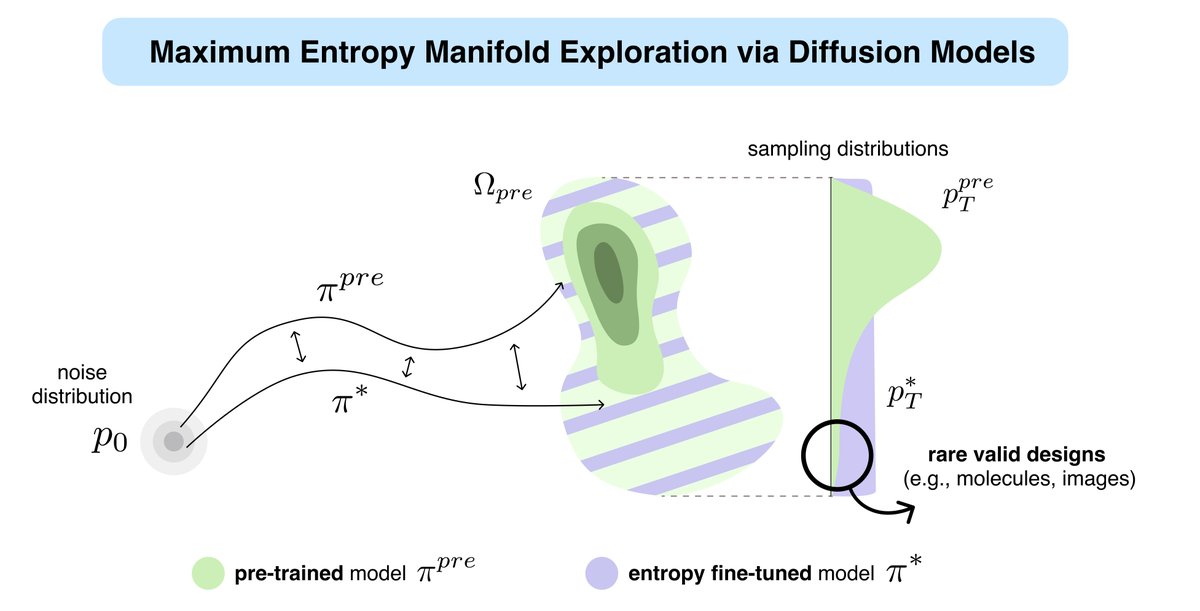
Generative models are great at mimicking data — but real (scientific) discovery requires going beyond it. Excited to present our paper “Provable Maximum Entropy Manifold Exploration via Diffusion Models” this Wednesday at ICML 2025! We propose a scalable, theoretically grounded method to fine-tune a pre-trained diffusion model to become maximally explorative over its learned manifold. This makes it possible to go beyond high-density regions and uncover hidden modes via a novel mechanism for self-guided surprise maximization. Feel free to reach out if interested — and check out riccardodesanti.com for updates! 📄 Paper: arxiv.org/abs/2506.15385 ⏳Wednesday at 4:30pm (Vancouver time), Hall A-B/E-2011! Work done with amazing collaborators @vlastelicap, @yapinghsieh, @ZebangShen, Niao He, and @arkrause
Riccardo De Santi tweet media
English
5
109
648
34.6K
Riccardo De Santi
Riccardo De Santi@desariky·
A central open problem for generative models in scientific discovery is how to go reliably beyond the observed data distribution—for instance, toward new-to-nature designs—without losing validity. Very excited to share “Verifier-Constrained Flow Expansion for Discovery Beyond the Data” — a new paper on flow-based exploration for discovery that I will present at ICLR 2026 🇧🇷 We study how entropy exploration and verifier-feedback can be combined to adapt a pre-trained generative model toward new valid regions of a high-dimensional design space. The resulting formulation is principled, scalable, and supported by theory. Empirically, on a drug-like molecular design task, we expand a pre-trained model increasing both diversity and validity. Work done with amazing collaborators Kimon Protopapas, @yapinghsieh, and @arkrause. Paper and code in comments!
Riccardo De Santi tweet media
English
1
23
152
13.4K
Riccardo De Santi retweetledi
Erik Bekkers
Erik Bekkers@erikjbekkers·
Excited to share that we're looking for a new colleague at @AMLab_UvA : Assistant Professor in AI for Science 🔬🤖 AMLab is a world-class ML research group embedded in Amsterdam's thriving AI ecosystem: leading research groups, an ELLIS unit, startups, and big tech — all within reach. And Dutch academic labor conditions are genuinely among the best in Europe ❤️ Deadline: May 30 👉 werkenbij.uva.nl/en/vacancies/a…
Erik Bekkers tweet media
English
3
35
194
23.8K
Riccardo De Santi retweetledi
Chieh-Hsin (Jesse) Lai
Chieh-Hsin (Jesse) Lai@JCJesseLai·
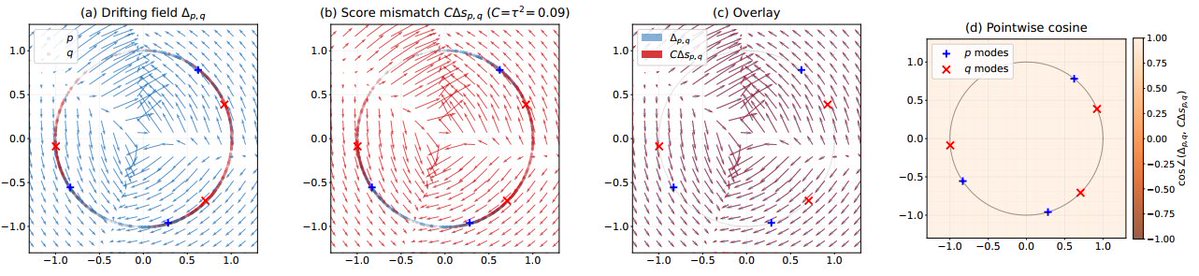
[1/D] 🤔 What are drifting models really connected to? 📢 Our new paper, A Unified View of Drifting and Score-Based Models, shows that the bridge to score-based models is clear and precise (w/ team and @mittu1204, @StefanoErmon, @MoleiTaoMath)! ✍️ Main takeaway: drifting is more closely connected to score-based (diffusion) modeling than it may first appear! 🔗 arxiv.org/abs/2603.07514 🎯 Here’s why: Drifting’s mean-shift moves a sample toward the kernel-weighted average of nearby samples. Score function points toward regions of higher density. So both describe local directions that push samples toward where data is denser. We show that this link is exact for Gaussian kernels (Section 4.1): 📌drifting’s mean-shift = a rescaled score-matching field between the Gaussian-smoothed data and model distributions — the vector field underlying score matching (Tweedie!). 📌This also clarifies the bridge to Distribution Matching Distillation (DMD): both use score-based transport directions, but only differ in how the score is realized—drifting does so nonparametrically through kernel neighborhoods, whereas DMD relies on a pretrained diffusion teacher. 🤔 So what happens for the default Laplace kernel used in drifting models? Let’s look below 👇
Chieh-Hsin (Jesse) Lai tweet mediaChieh-Hsin (Jesse) Lai tweet media
English
6
49
256
54.9K
Riccardo De Santi retweetledi
Max Simchowitz
Max Simchowitz@max_simchowitz·
👋👋New Generative Modeling Paper from @electronickale and @KeelyAi04: Evaluating sample likelihoods is a fundamental primitive in flow-based generative modeling . Now we can compute them faster. Much faster. Like 10-100x faster. ✈️✈️ Check out our new work on fast likelihood distillation, F2D2, lead by Kelly and Xinyue, together with @_albertgu , @rsalakhu, @zicokolter, and @nmboffi . And stay tuned for more in this direction in the next few months 😉 (And: @KeelyAi04 's applying to grad school and she is aawesome)
Yutong (Kelly) He@electronickale

Diffusion/Flow-based models can sample in 1-2 steps now 👍 But likelihood? Still requires 100-1000 NFEs (even for these fast models) 😭 We fix this! Introducing F2D2: simultaneous fast sampling AND fast likelihood via joint flow map distillation. arxiv.org/abs/2512.02636 1/🧵

English
2
18
99
11.4K
Riccardo De Santi retweetledi
Michael Bronstein
Michael Bronstein@mmbronstein·
NeurIPS 2025 papers per 1 Million People 1. Singapore – 64.51 2. Switzerland – 22.13 3. Israel – 11.17 4. UAE – 9.47 5. UK – 7.50 6. US – 7.44 7. Denmark – 7.37 8. Australia – 7.31 9. Canada – 6.93 10. South Korea – 5.78
English
43
110
1.2K
144.5K
Riccardo De Santi
Riccardo De Santi@desariky·
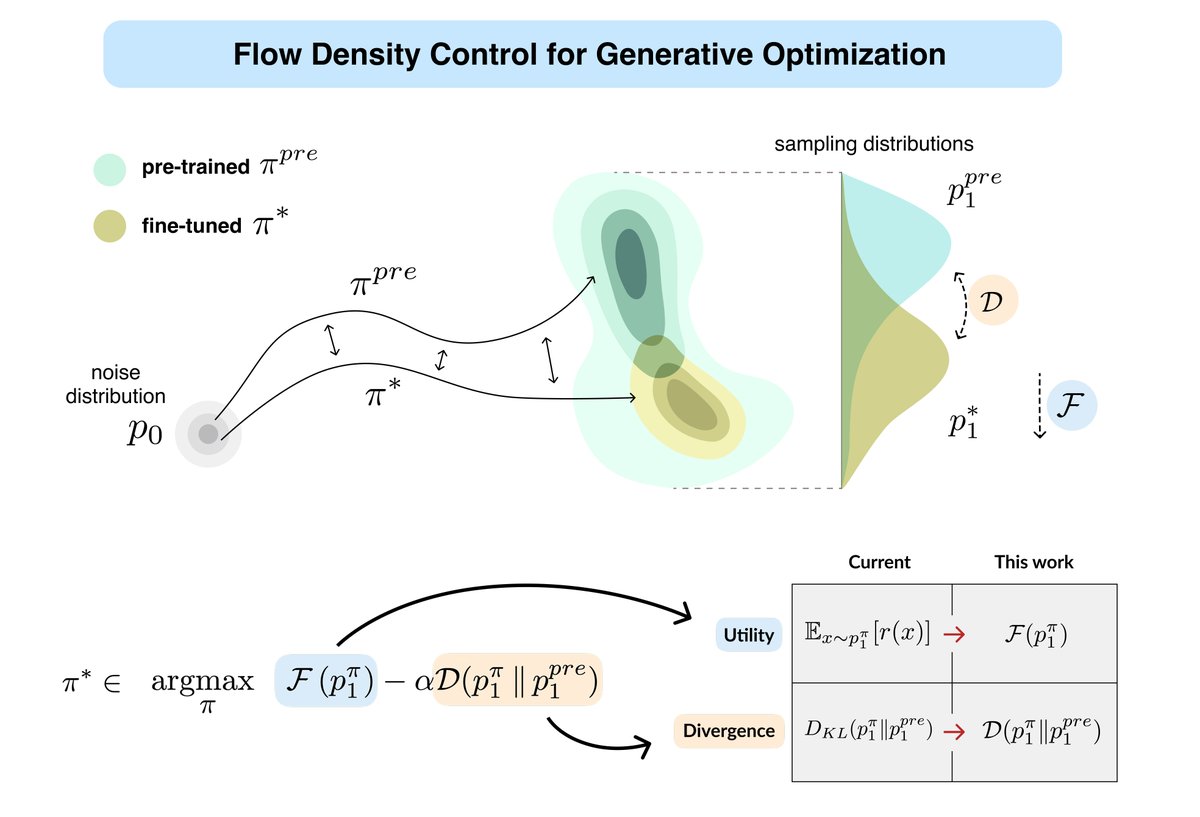
How can we perform generative (scientific) discovery beyond the data? Excited to present our paper “Flow Density Control: Generative Optimization Beyond Entropy-Regularized Fine-Tuning” as ✨Spotlight✨ this Wednesday at NeurIPS 2025. We employ calculus of variations to strictly generalize RL-based fine-tuning schemes. This unlocks new fundamental capabilities for generative discovery, including generative exploration: the ability to sample from low-probability, yet promising regions, even beyond the original training data. Feel free to reach out if you’re interested in generative discovery (methods, theory, chem/bio applications) — and check out riccardodesanti.com for updates. We plan to release soon a generative exploration library! 📄 Paper: arxiv.org/abs/2511.22640 ⏳Wednesday at 1pm (San Diego time), Exhibit Hall C,D,E #3619 Work done with amazing collaborators @vlastelicap , @yapinghsieh, @ZebangShen, Niao He, and @arkrause .
Riccardo De Santi tweet media
English
0
5
22
1.4K
Sander Dieleman
Sander Dieleman@sedielem·
So #neurips2025 is next week 👀 anyone up for a diffusion circle? Thursday afternoon, or maybe Friday? I'll be in San Diego all week, does anyone want to host parallel circles in Mexico City and Copenhagen? Could be the first ever diffusion cylinder 😮
English
32
10
175
18.4K
Riccardo De Santi retweetledi
Brandon Amos
Brandon Amos@brandondamos·
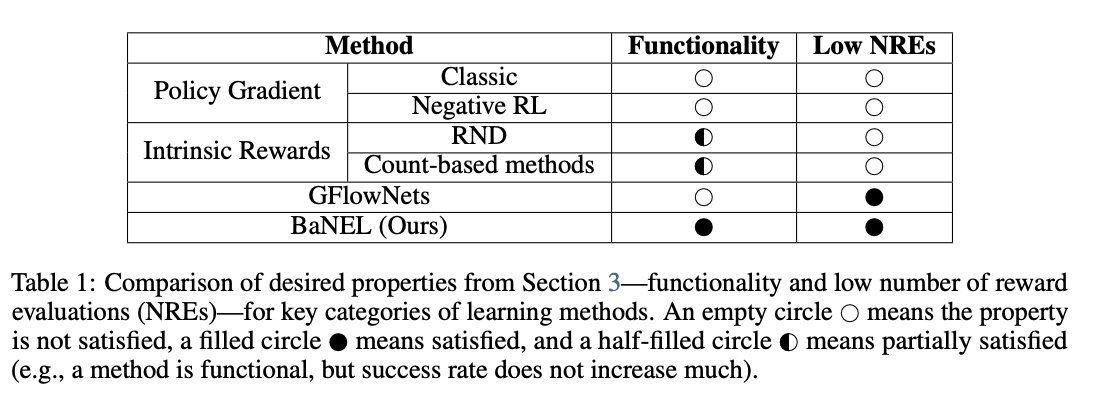
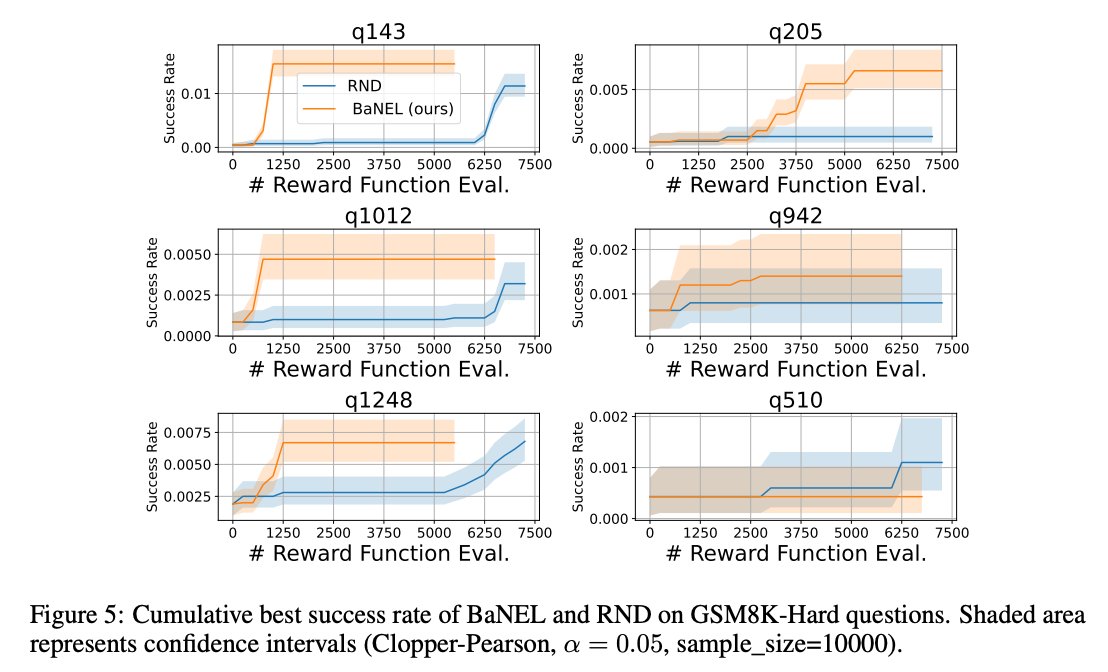
In a new paper with @sang_yun_lee and @giuliacfanti, we study how to make use of negative reward signal in sparse reward tasks, including GSM8K examples giving 0 reward. The idea is to push the policy's new samples away from the observed negative samples with a Bayesian posterior
Brandon Amos tweet mediaBrandon Amos tweet mediaBrandon Amos tweet mediaBrandon Amos tweet media
Sangyun Lee@sang_yun_lee

Can ML reliably solve big problems that humans cannot? We’ve seen post-training methods that learn from correct or successful samples. But we still don’t have good algorithms that learn solely from failures! Introducing BaNEL: a method for post-training from zero-reward samples.

English
1
15
92
11.3K
Riccardo De Santi retweetledi
Michael Bronstein
Michael Bronstein@mmbronstein·
Apply for the AITHYRA-CeMM International PhD Program! 15-20 fully funded PhD fellowships available in Vienna in AI/ML and Life Sciences Deadline for applications: 10 September 2025 apply.cemm.at
Michael Bronstein tweet media
English
1
33
82
10.4K
Riccardo De Santi
Riccardo De Santi@desariky·
Over the last years we understood how to control generative models via RL/control to maximize expected rewards under KL regularization. But for many applications, that’s not enough. Hence the question: can we control them further? Excited to present our ✨Oral✨ paper “Flow Density Control: Generative Optimization Beyond Entropy-Regularized Fine-Tuning” this Friday at the Generative AI and Biology Workshop at ICML 2025! We propose a theoretically grounded method to fine-tune a pre-trained diffusion or flow model for arbitrary objective functions — even beyond expected reward. For instance, this is crucial in scientific discovery, where the goal is often to maximize the quality of the single best sample rather than the average sample quality. We achieve this by bridging probability-space optimization and flow modeling enabling general optimization processes over generative models via sequential fine-tuning - with guarantees. Feel free to reach out if you’re interested — and check out riccardodesanti.com for updates! 📄 Paper: shorturl.at/I1wNr ⏳Friday at 2:35pm (Vancouver time), BioGen Workshop at ICML 2025 Work done with amazing collaborators @vlastelicap, @yapinghsieh, @ZebangShen, Niao He, and @arkrause
Riccardo De Santi tweet media
English
0
9
43
2.6K
tau18analytics
tau18analytics@tau18analytics·
@desariky ... real discovery requires understanding the generator ...
English
1
0
0
368
Riccardo De Santi
Riccardo De Santi@desariky·
Generative models are great at mimicking data — but real (scientific) discovery requires going beyond it. Excited to present our paper “Provable Maximum Entropy Manifold Exploration via Diffusion Models” this Wednesday at ICML 2025! We propose a scalable, theoretically grounded method to fine-tune a pre-trained diffusion model to become maximally explorative over its learned manifold. This makes it possible to go beyond high-density regions and uncover hidden modes via a novel mechanism for self-guided surprise maximization. Feel free to reach out if interested — and check out riccardodesanti.com for updates! 📄 Paper: arxiv.org/abs/2506.15385 ⏳Wednesday at 4:30pm (Vancouver time), Hall A-B/E-2011! Work done with amazing collaborators @vlastelicap, @yapinghsieh, @ZebangShen, Niao He, and @arkrause
Riccardo De Santi tweet media
English
5
109
648
34.6K
Riccardo De Santi
Riccardo De Santi@desariky·
@harrisonmohr1 Good question! We used the creative keyword to hint at a computational design problem. Then the method serves as a way to enhance diversity (or perform mode discovery) of the creative designs in that context.
English
1
0
5
349
harrison mohr
harrison mohr@harrisonmohr1·
@desariky Hey cool paper! Why do you use 'creative' in your image prompts? Does the most creative furniture correspond to a surprising point on the 'creative furniture' manifold or a highly probable point? Why didn't you just opt for the 'furniture' manifold ib your experiment?
English
1
0
3
447
Riccardo De Santi retweetledi
Viacheslav Borovitskiy (Hiring PhD Students)
Fully-funded #PhD in #ML at @EdinburghUni (@InfAtEd, @ancAtEd), in 𝐠𝐞𝐨𝐦𝐞𝐭𝐫𝐢𝐜 𝐥𝐞𝐚𝐫𝐧𝐢𝐧𝐠 and 𝐮𝐧𝐜𝐞𝐫𝐭𝐚𝐢𝐧𝐭𝐲 𝐪𝐮𝐚𝐧𝐭𝐢𝐟𝐢𝐜𝐚𝐭𝐢𝐨𝐧. Application deadline: 15 Dec '24. Starting Sep '25. Details in the reply. Please RT and share with anyone interested!
Viacheslav Borovitskiy (Hiring PhD Students) tweet media
English
4
60
258
25.2K
Riccardo De Santi retweetledi
Jürgen Schmidhuber
Jürgen Schmidhuber@SchmidhuberAI·
I am hiring 3 postdocs at #KAUST to develop an Artificial Scientist for discovering novel chemical materials for carbon capture. Join this project with @FaccioAI at the intersection of RL and Material Science. Learn more and apply: faccio.ai/postdoctoral-p…
Jürgen Schmidhuber tweet media
English
13
65
372
83.1K
Riccardo De Santi retweetledi
Tim van Erven
Tim van Erven@tverven·
The final draft of @BachFrancis's excellent new learning theory book is available: di.ens.fr/~fbach/ He doesn't cover VC dimension, but builds up from regression to general smooth losses, which is heresy of course, but actually fills a much-needed niche. Highly recommended!
English
1
34
160
22.3K
Claire Vernade @claireve.bsky.app
I have the great pleasure to announce that I received a Starting Grant from @ERC_Research to work on Continual and Sequential Learning problems in Machine Learning. I want to thank my students and collaborators and @ml4science for their support. cvernade.com
Claire Vernade @claireve.bsky.app tweet media
European Research Council (ERC)@ERC_Research

📣 The latest ERC Starting Grant competition results are out! 📣 494 bright minds awarded €780 million to fund research ideas at the frontiers of science. Find out who, where & why 👉 europa.eu/!hrxyBp 🇪🇺 #EUfunded #FrontierResearch #ERCStG @HorizonEU @EUScienceInnov

English
33
15
207
17.6K
Riccardo De Santi retweetledi
Tim Roughgarden
Tim Roughgarden@Tim_Roughgarden·
Periodic reminder that at my website you can find over 1000 pages of lecture notes on algorithms, data science, game theory, market and mechanism design, blockchain protocols, and more (see replies for link)
English
8
88
689
67.2K