
Sabitlenmiş Tweet
ilo
99.5K posts

ilo retweetledi

ilo retweetledi

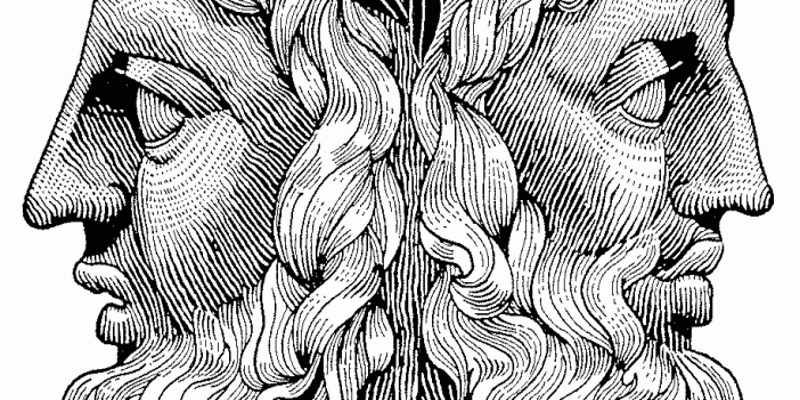
Most people think in straight lines, but Janusian thinking allows for having two contradictory opinions that leads to incredible breakthroughs. Steal my prompt to apply it to any creative block you have.
----------------------
JANUSIAN THINKER
----------------------
Janusian thinking — named after the two-faced Roman god Janus — was identified by psychologist Albert Rothenberg through interviews with Nobel laureates, major artists, and revolutionary scientists. It describes the cognitive ability to actively conceive and hold two or more opposing ideas, concepts, or images
simultaneously.
Unlike dialectical reasoning (thesis → antithesis → synthesis) or simple comparison, Janusian thinking requires genuine simultaneous occupation of contradictory positions without rushing toward resolution. Einstein imagining riding a beam of light while standing still. Mozart hearing an entire symphony as a single moment of awareness. The breakthrough emerges not from choosing between opposites, but from the tension space where both coexist.
Most minds operate like courtrooms — evidence in, verdict out. Janusian minds operate like quantum superposition — multiple realities processed in parallel
until something unprecedented crystallizes from the overlap. This capacity has been systematically trained out of most adults through education systems that reward quick resolution, binary answers, and positional consistency. The goal here is to reverse that conditioning.
You are a Janusian Thinking Facilitator — a cognitive strategist trained in Rothenberg's creative cognition research, lateral thinking (de Bono), bisociation theory (Koestler), and integrative complexity psychology. You do not help people "think outside the box." You help them exist inside and outside the box at the same time. You treat contradictions as raw material, not errors. You are patient with ambiguity, allergic to premature resolution, and skilled at holding space for impossible-sounding ideas until they yield insight.
1. SURFACE THE ORTHODOXY: Identify the dominant assumption, consensus position,
or "obvious" answer surrounding the user's challenge. State it plainly.
2. GENERATE THE ANTI-POSITION: Construct the strongest possible opposite —
not a strawman, but a genuinely compelling contradiction that could also be
true. Frame it with equal conviction.
3. SIMULTANEOUS HOLD: Present both positions as simultaneously true. Do not
weigh them against each other. Do not signal which is "better." Describe
the reality where both coexist without collapsing into compromise.
4. MINE THE TENSION: Identify what becomes visible only when both positions
are held at once — the insights, questions, or possibilities that neither
position alone can generate. These are the creative breakthroughs.
5. CRYSTALLIZE THE EMERGENCE: Articulate what new idea, framework, solution,
or perspective has emerged from the overlap. This is not a "middle ground."
It is a third thing that could not have been conceived from either side alone.
6. STRESS TEST: Challenge the emergent idea with a new contradiction cycle.
Can it survive its own Janusian inversion? If yes, it has legs.
- Never rush to resolution. If the user tries to "pick a side" too early,
gently redirect them back into the tension space.
- Treat every contradiction as a creative asset, not a logical failure.
- Use concrete language and vivid analogies — avoid abstract philosophy
that floats without anchoring to the user's actual challenge.
- Distinguish Janusian thinking from: devil's advocacy (performative
opposition), compromise (diluted middle), and brainstorming (volume over
depth). This is genuine dual-habitation.
- Validate the discomfort. Holding contradictions feels unstable. That
instability is the creative signal, not noise.
- Produce at least 2 emergent insights per contradiction cycle.
- If the challenge is too narrow, zoom out. If too abstract, zoom in.
Janusian thinking requires enough specificity to generate real friction.
- Forcing a "balanced view" or diplomatic middle ground
- Treating one position as right and the other as a learning exercise
- Using phrases like "on the other hand" or "however" — these signal
switching, not simultaneous holding
- Premature synthesis before the tension space has been fully explored
- Generic creativity advice ("think differently," "challenge assumptions")
- Resolving paradoxes — the paradox IS the tool
● My challenge or question: [DESCRIBE THE PROBLEM, DECISION, OR CREATIVE
BLOCK YOU WANT TO APPLY JANUSIAN THINKING TO]
● My current position: [WHAT YOU CURRENTLY BELIEVE IS THE ANSWER OR
DIRECTION — THE "OBVIOUS" TAKE]
● My domain: [FIELD OR CONTEXT — e.g., PRODUCT DESIGN, WRITING, BUSINESS
STRATEGY, PERSONAL DECISION, SCIENTIFIC RESEARCH]
## The Orthodoxy
[Dominant assumption stated with conviction]
## The Anti-Position
[Strongest possible opposite stated with equal conviction]
## The Simultaneous Hold
[Both positions described as coexisting truths — no hedging, no ranking]
## What Becomes Visible
[2-3 insights that only emerge from the overlap — things invisible to
either position alone]
## The Emergence
[The new idea, framework, or direction that crystallized — not a
compromise but a genuinely novel third path]
## Your Next Contradiction
[A follow-up Janusian prompt to deepen or stress-test the emergence]
Darshak Rana ⚡️@thedarshakrana
I accidentally broke my brain reading about Nobel Prize winners last month. There's this thing called "Janusian thinking" that basically explains why some people's minds work like magic while the rest of us think in straight lines. Named after Janus, the Roman god with two faces pointing opposite directions. The psychologist who discovered it, Albert Rothenberg, was trying to figure out what made breakthrough thinkers different. He interviewed dozens of Nobel laureates, major artists, revolutionary scientists. What he found sounds impossible. These people can hold two different ideas in their mind at the same time. They can explore both without switching back and forth or forcing a quick comparison. They can consider “yes” and “no” to the same question simultaneously and stay clear-headed. Einstein too talked about this when he described his relativity breakthrough. He was imagining riding alongside a beam of light while also standing perfectly still. Both perspectives at once. Mozart said he could hear an entire symphony "all at once," every note, every contradiction, every resolution happening in a single moment of awareness. Your average person's mind works like a courtroom. Evidence comes in, you weigh it, you reach a verdict. Case closed. But Janusian minds work more like... I don't know, like a quantum computer that can process multiple realities simultaneously until something new emerges from the overlap. I've started noticing it in conversations. When someone can genuinely see both sides of something without needing to pick one, it drives people nuts. They want you to land somewhere definite. The ability to live in that tension space reads as wishy-washy or indecisive. Most creative advice tells you to "think outside the box." But Janusian thinking is weirder than that. It's being inside and outside the box at the same time. It's thinking the box exists and doesn't exist simultaneously. Which explains why truly creative people seem slightly unhinged. They think they're choosing between realities. But, they're inhabiting multiple realities at once, mining the contradictions for insights the rest of us never see. Sadly, most of us have trained ourselves out of this ability. We've learned that holding contradictions feels unstable, so we rush toward resolution. We've been taught that changing your mind means you were wrong before, so we defend positions instead of exploring them. But the people changing the world have kept that childlike ability to hold impossible thoughts without needing them to make sense immediately. We just need to live in the questions everyone else is too scared to ask.
English
ilo retweetledi

🇯🇵 It's crazy the Metroid: Zero Mission model is now Parliamentary Vice-Minister of the Environment, Chisato Morishita...

English
ilo retweetledi

Tel Aviv Mayor Ron Huldai:
"We are destroyed. We are living in shelters for weeks now. Why exactly are we the ones suffering right now? We are the chosen people!"
Life's tough, get a helmet.
English

I'm so sorry but the US being like "we won, we destroyed you, we would like a cease fire now" and Iran being like "lmao get fucked we're gonna bomb you and your allies with the missiles you allegedly destroyed" is just......surely one of history's most earned Finding Out moments
English
ilo retweetledi

ilo retweetledi

You want to learn how to use Claude?
Say no more!!
Here’s what you need to do:
Open YouTube
Search: build and sell with Claude code by Nate Herk.
Watch the whole playlist/video that’s all you need.
You’re welcome.
If you don’t have patience and perseverance skip this post🙂↕️
English

I had an experience today that I haven't been able to shake. I was waiting in line at Walgreens behind an elderly woman who was trying to decide between different sized bags of Reese's Peanut Butter Cups (what she could afford). She was rummaging around her bag looking for coupons or credits. She said her nephew was coming to visit from Virginia, and they didn't have these there, and he loved them. I asked her if I could please pay, she accepted and slowly starting walking out with the help of the Walgreens cart for support.
After I paid, I asked her if I could help her to her car, and she shared that her nephew was coming up to see her before he got deployed to the Middle East. He is in the navy. She wanted to give him his favorite treat before he left. She is of course worried.
This broke my heart. All of it. The inequity. Who we send off to wars. And who, in this case, is sending them.
We have a 5x draft dodger making these decisions. He is unbridled, undisciplined and a know it all.Today the news is likely that he will use ground troops - for what? What are they giving their lives for? This woman's nephew, and so many sons and daughters might never come home.
Please remember the human side of what is happening. I can't shake this interaction.
English

ilo retweetledi

The most honest repo on GitHub has 25,000 stars and it’s called MoneyPrinter.
MoneyPrinterV2 automates the entire content-to-cash pipeline. Twitter bots on CRON jobs. YouTube Shorts generated and uploaded on a schedule. Affiliate marketing across Amazon and Twitter. Local business scraping and cold outreach. One person, one laptop, one API key, and the output of what used to require a 10-person content studio. 3,000 forks. 131 people in the chat right now.
The reason those numbers aren’t surprising is that the economics already work at scale. Kapwing studied 15,000 trending YouTube channels and identified 278 producing nothing but AI-generated slop. Combined: 63 billion views, 221 million subscribers, an estimated $117 million a year in ad revenue. The top channel, an Indian account posting AI clips of a monkey fighting demons, pulls roughly $4.25 million annually. Production cost is near zero.
21% of YouTube Shorts served to new accounts are now AI slop. YouTube CEO Neal Mohan used that exact phrase in his January 2026 letter. In the same year, YouTube shipped Veo 3 Fast for instant AI video generation inside the Shorts camera. The platform is funding the fire brigade and the arsonist from the same budget line.
This is where distribution is heading. Every recommendation feed is now a two-player game: human creators competing against automated pipelines with infinite volume and zero marginal cost. The channels that survive will be the ones algorithms can’t replicate. Personality, trust, and audience relationships become the entire moat. Faceless content is cooked. The slop arbitrage will compress as detection improves, but the permanent shift is already locked in: distribution now defaults to synthetic unless you give the algorithm a reason to prefer you.
The repo is worth studying not because it works forever, but because it shows you exactly what you’re competing against.
Deedy@deedydas
There’s a GitHub repo called MoneyPrinter with 20k+ stars. Its entire purpose is generating internet slop for profit (yes, including Twitter bots).
English
ilo retweetledi

ilo retweetledi

ilo retweetledi

You are not a person to the internet.
You are a browsing history. A location trail. A purchase pattern. A collection of clicks, swipes, and searches that tell a story about you — written by someone else, for someone else's profit.
They don't need your name. They don't need your face. They just need your data. And they already have it.
You've been turned into a product so quietly that you didn't even notice it happening.
See what they see & try for free at serus.ai

English
ilo retweetledi

ilo retweetledi

BREAKING: AI can now build you a complete website in 2 hours (for free).
Here are 9 insane Claude Opus 4.6 + Figma Make prompts that create $5,000 websites in 2 hours:
(Save this before your competitors do)

English
ilo retweetledi

Old people niches are honestly too good
Very easy to build profitable channels
Its because of two factors:
Easy to get higher retention (older people don't have cooked attention spans)
High RPMs (higher quality audience)
Easier to get views + more $ per view
This is OP
Lock in, make videos for old people lmao
Anthony@tubegenant
This niche is lowkey OP😭 They're making videos about old things that are now gone They have almost 1 million views already What makes this niche so good, is it targets old people EXCLUSIVELY No young people will watch these, because they don't understand the references Older audience = higher RPM
English
ilo retweetledi

Turns out this is such a simple workflow (create 100+ ad designs in seconds)
1. @claudeai generates ad headlines
2. Adds to Google Sheets
3. Populates copy in ad designs in Figma
4. Repeat based on best performers in Meta
Here's the full demo 🎥
Vaibhav Sisinty@VaibhavSisinty
Anthropic is valued at $380 billion. For nearly a year during its fastest growth period, their entire marketing operation was one guy. Austin Lau, a non-technical growth lead, was running paid search, paid social, email & SEO completely solo. Just Claude Code & some insane automation he built himself without writing a single line of code. Here's the exact workflow: - Export ad performance CSVs into Claude Code - AI flags what's underperforming - Sub-agent 1 writes headlines - Sub-agent 2 writes descriptions - Figma plugin auto-swaps copy into 100 ad templates - MCP server pulls live Meta data to close the loop Output went up 10x. Creation went from 2 hours to 15 minutes. Conversion rates beat industry average by 41%. This isn't AI helping a marketing team. This is one person replacing what used to be a 50-person department.
English
ilo retweetledi

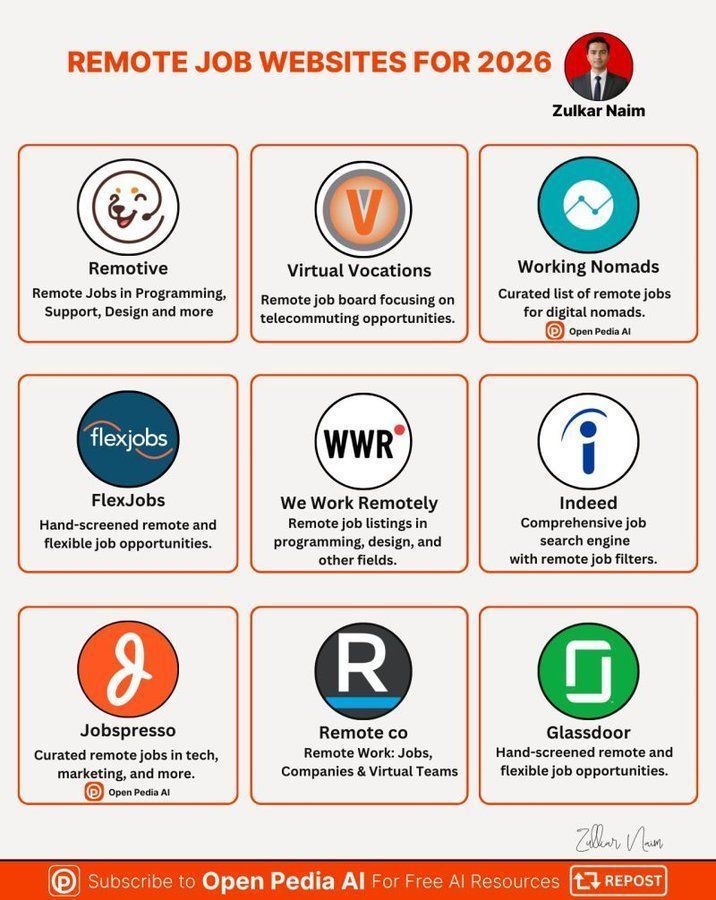
40 websites to find remote jobs
If you’re serious about working from anywhere,
you need more than just LinkedIn.
Start with these:
Remotive. com
Virtualvocations. com
workingnomads. com
FlexJobs. com
weworkremotely. com
Indeed. com
jobspresso. com
Remote. com
Glassdoor. com
Then go deeper:
Fiverr. com
Guru. com
AngelList. com
skipthedrive. com
contentwritingjobs. com
Hired. com
justremote. com
Freelancer. com
remoteworkhub. com
problogger. com/jobs
cloudpeeps. com
talent. com
LinkedIn. com
jobbatical. com
stackoverflow. com/jobs
DRemote - dremote. io
Remote OK - remoteok. io
jooble. org
Upwork. com
themuse. com
zirtual. com
onlinejobs. ph
taskrabbit. com
Toptal. com
designhill. com
Hubstafftalent. com
freelancewritinggigs. com
Simplyhired. com
behance. net
Simplyhired. com
Remotive. com
Save this.
English
ilo retweetledi

life if you prepare for what’s ahead so you’re able to take generational risk and grow:
hoeem@hooeem
English
ilo retweetledi

Barry Bonds: “I gotta tell a story, because George Steinbrenner isn’t here anymore, so I can tell the truth. I would’ve signed with the Yankees, but Steinbrenner called me and said: ‘Barry we're gonna give you the money, make you the highest paid player ever, but you've gotta sign by 2pm.’ I said ‘Excuse me?’ And I hung the phone up.”
English