DidierResearchGroup

221 posts

DidierResearchGroup banner
DidierResearchGroup

DidierResearchGroup

@didier_group

Research group in Darmstadt. Organic and organometallic chemistry. Synthesis of strained ring systems. Electro-coupling.

Darmstadt, Germany Katılım Temmuz 2019
678 Takip Edilen3.3K Takipçiler
DidierResearchGroup retweetledi
Baran Lab
Baran Lab@BaranLabReads·
Finally, RADICAL CROSS COUPLING without the exogenous REDOX. We disclose in @ChemRxiv (chemrxiv.org/engage/chemrxi…) a broadly general platform for achieving transformations that normally required excess metallic or chemical reducing agents or photochemical setups (and their requisite catalysts) or potentiostats for electrochemistry. Now, such transformations can be accomplished with the same ease that one conducts a Suzuki coupling. You can scale up (its homogeneous) or scale down (use cheap parallel screening plates). Moisture is tolerated and base metal catalysis is used. As the best engineers like to say, "The best part is no part". Now, chemists have the option to remove the redox part from radical couplings. Quick Summary: Sulfonyl hydrazides are disclosed as versatile radical precursors as exemplified with seven new C–C bond forming, redox-neutral cross-couplings with: (1) activated olefins, (2) alkyl halides, (3) redox active esters, (4) aryl halides, (5) alkenyl halides, (6) alkynyl halides, and (7) a trifluoromethylating reagent to forge C(sp3)-C(sp3), C(sp3)-C(sp2), and C(sp3)-C(sp) bonds. Sulfonyl hydrazides are stable and usually crystalline substances that can be accessed in a variety of ways including transiently from hydrazones to achieve a net reductive arylation of carbonyl compounds. Exogenous redox (chemical, photo/electrochemical) additives are not necessary as these functional groups serve the dual role of radical precursor and electron donor. The operational simplicity (homogeneous, water tolerant, dump-and-stir) and practicality of the method are demonstrated as well as applications to streamlining synthesis and mild late-stage functionalization.
Baran Lab tweet media
English
9
136
551
170.4K
DidierResearchGroup
DidierResearchGroup@didier_group·
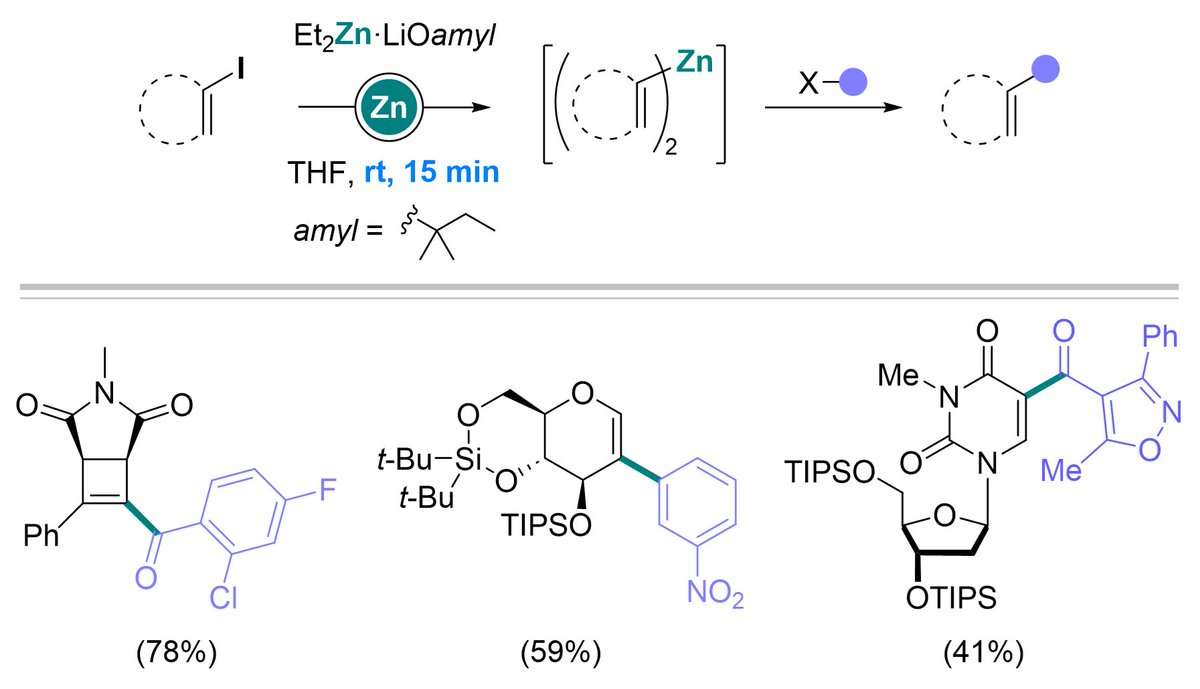
I/Zn exchanges have never been so easy. With our new reagent: 15min, rt. Alkene vs. Aryl selectivity, broad scope, great functional group tolerance. Functionalization of nucleotides, glycals, cyclobutenes, and much more. Preprint online now: chemrxiv.org/engage/chemrxi…
DidierResearchGroup tweet media
English
0
9
52
3.8K
Baran Lab
Baran Lab@BaranLabReads·
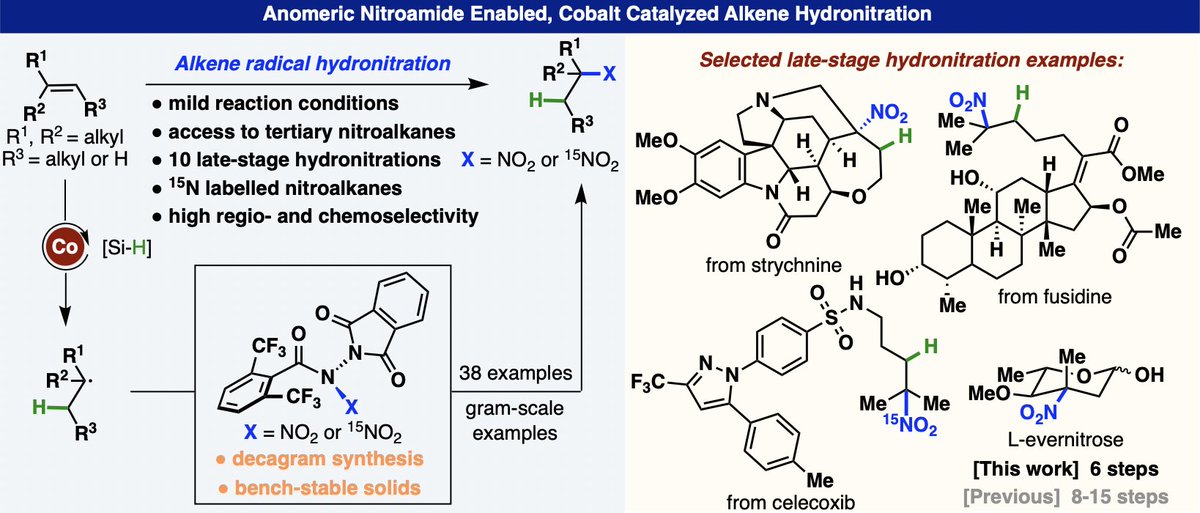
Anomeric Nitroamide Enabled, Cobalt Catalyzed Alkene Hydronitration: Appearing today in @ChemRxiv : chemrxiv.org/engage/chemrxi… Tertiary nitroalkanes, as well as its reduced products, α-tertiary amines, play an essential role in drug discovery either as key synthetic precursors or final incorporation in targeted molecules. Existing methods to prepare tertiary nitro compounds generally rely on polar-bond disconnections, in which strong bases or highly active electrophiles are needed. Here, we report the development of an anomeric nitroamide-based reagent that enables exquisitely selective MHAT-based Co-catalyzed alkene hydronitration for the preparation of valuable tertiary nitro compounds. This mild, scalable reaction shows broad functional group tolerance, is applied to a variety of structures. Late-stage nitration of complex contexts (9 examples) derived from drugs and natural products is also pursued. Its high prowess is further highlighted in simplifying the synthesis of a rare naturally occurring nitro sugar. Simple access to isotopically labeled 15N-containing nitro compounds is also disclosed. The anomeric nitroamide reagent was deemed safe by energetic measurements and its unique reactivity rationalized based on X-ray crystallographic analysis.
Baran Lab tweet media
English
2
29
195
29.7K
DidierResearchGroup
DidierResearchGroup@didier_group·
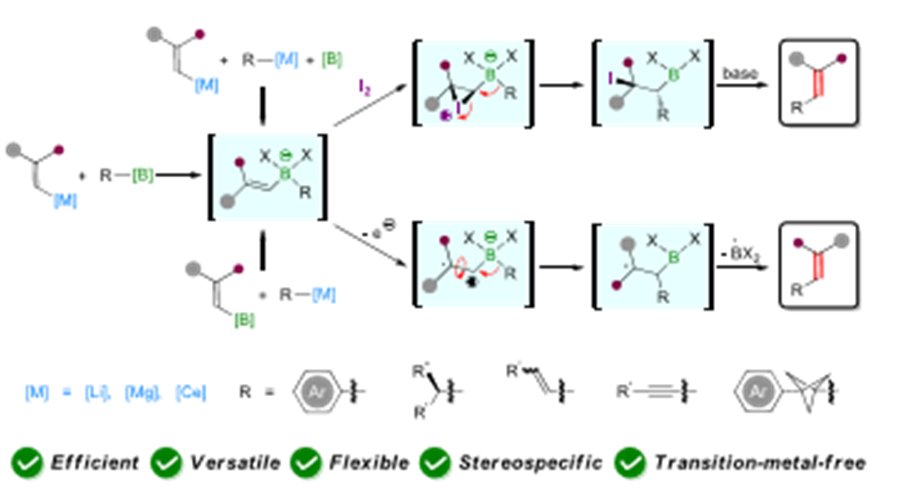
Excited to share a story that started before the pandemic and was on standby during our moving: Zweifel olefination for C-glycosylation - an alternative route towards C-glucosides, -rhamnosides, -xylosides and -arabinosides. Congrats to Flo and Bilel (also his first paper!)
English
1
1
7
1.5K
DidierResearchGroup retweetledi
Barham Lab
Barham Lab@BarhamLab·
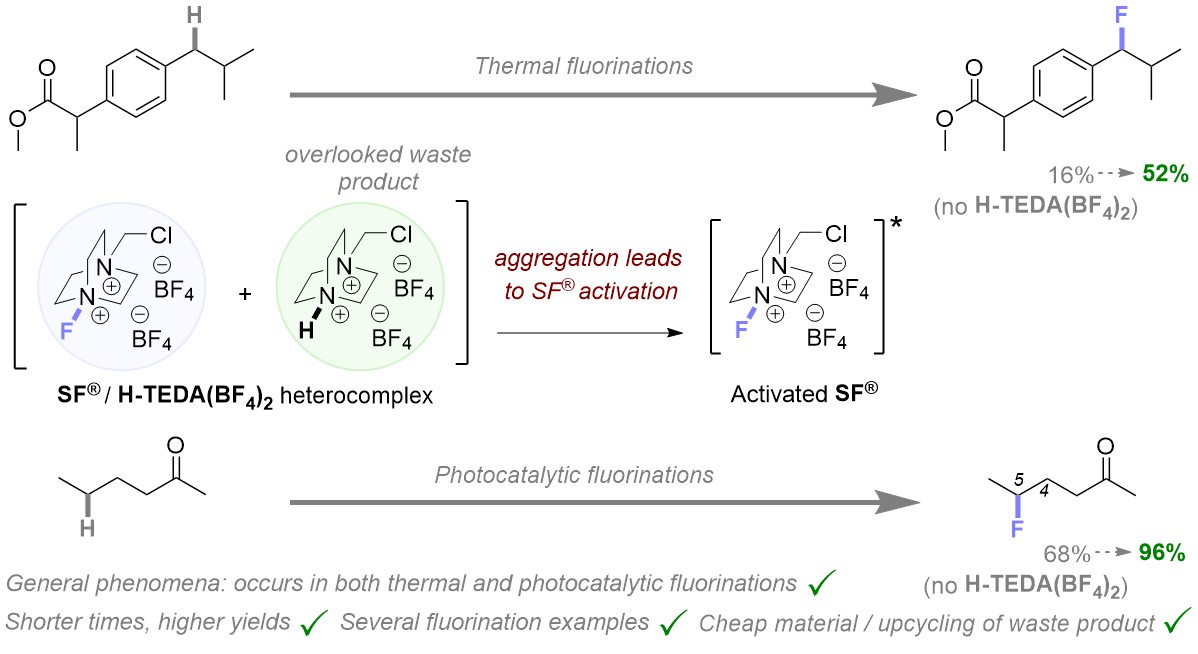
One man's trash🗑️=another man's treasure🪙Selectfluor: world's🌍favourite fluorinator(?), yet we throw away 95% its MW. Adding the same waste at the start promotes radical fluorinations to higher rates & yields (~3x) by a reactive heteroaggregate w/SF⛓️💡 tinyurl.com/yvv62fex
Barham Lab tweet media
English
2
6
77
7.8K
DidierResearchGroup
DidierResearchGroup@didier_group·
Excited to share our latest contribution to small-ring functionalization, this time using stereoselective radical-polar crossover processes. First contribution since we moved from Munich to Darmstadt. Congrats Flo and @RahmaGhazali2 for the team effort. nature.com/articles/s4200…
English
1
1
37
2.1K
DidierResearchGroup
DidierResearchGroup@didier_group·
Main Group Metal Chemistry Symposium in Nancy, thanks for the invite!
DidierResearchGroup tweet media
English
0
3
67
4.6K
DidierResearchGroup retweetledi
TU Darmstadt
TU Darmstadt@TUDarmstadt·
"Ich gratuliere den Kollegen Alexander Friedrich und Andreas Dreizler sehr herzlich zur Auszeichnung mit zwei ERC Synergy Grants! Die beiden Projekte stehen beispielhaft für wesentliche Charakteristiken und Stärken der Forschung an unserer Universität: 1/3
TU Darmstadt tweet media
Deutsch
1
3
27
2.6K
DidierResearchGroup retweetledi
Das group
Das group@shoubhikdas4·
We have an open postdoctoral position in our group in Bayreuth (shoubhikdas.uni-bayreuth.de). Experience in catalysis (Photo-, electro- or thermo-) is an advantage. Please send your application with a cover letter and a cv by 15 th of October.
English
10
86
234
43.6K