Dmitri retweetledi
Dmitri
165 posts

Dmitri retweetledi

jax-js now supports `einsum()`, general notation for multidimensional tensor operations — this was one heck of an API to fully implement 😅
thanks Joy and Greg for hacking with me on an einsum optimizer after NYSRG on Sunday
github.com/ekzhang/jax-js…

English
Dmitri retweetledi
Dmitri retweetledi

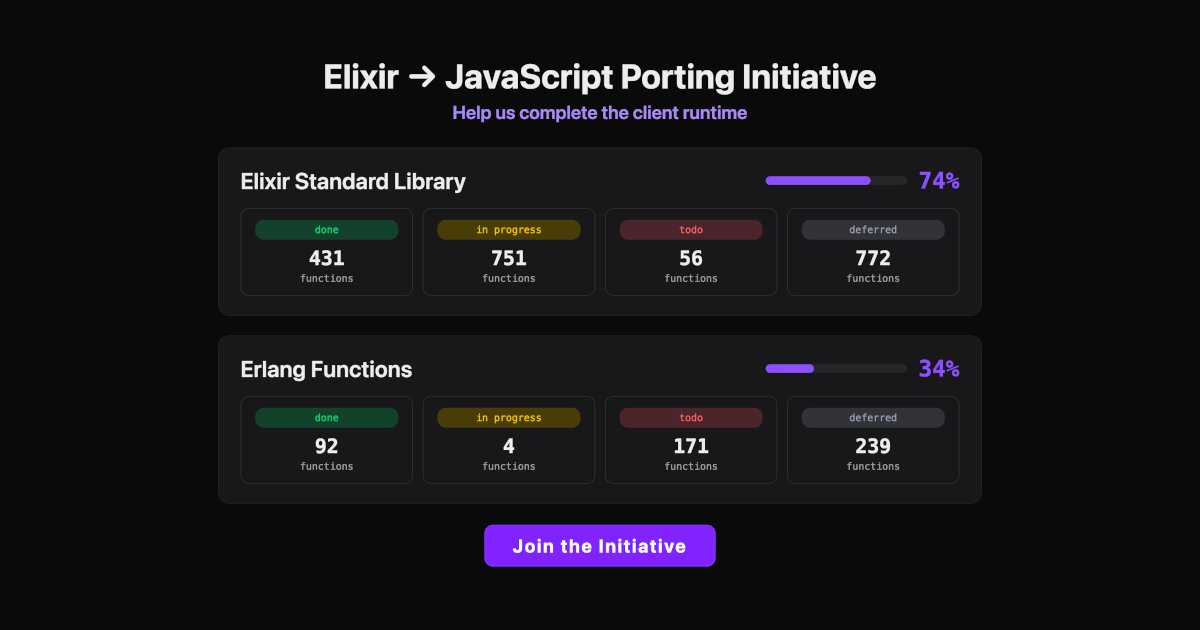
Hey Elixir friends! :)
We need help completing Elixir's browser runtime by porting some Erlang functions to JavaScript.
No Erlang knowledge required. Each function unlocks multiple Elixir stdlib functions!
More here: hologram.page/blog/elixir-to…
#Hologram #Elixir #ElixirLang #BEAM #WebDev

English
Dmitri retweetledi

splat troubleshooting guide:
If you ever export a splat from NerfStudio that's transparent, let it train for another 1000 steps
what's happening is the alphas get reset every 3k steps, so here when i exported at 12k steps, it was right when the alphas reset, hence the transparency.
you can adjust the reset frequency with reset_every: int = 3000
this might've been obvious to some, but I was confused by it last night and found no discussions/explanation about it online. so posting it here to help others
English
Dmitri retweetledi
Dmitri retweetledi

I really like Zod, so I'm happy to see Zoi (hexdocs.pm/zoi/readme.html) gaining traction in the Elixir ecosystem.

English
Dmitri retweetledi

Last week, we released the Elixir Language Tour to help new learners get started faster.
Thanks to Popcorn, you can run examples and do coding exercises straight in your browser! No installs - use it even on your smartphone. Behind the scenes, Popcorn compiles and runs your code locally via WebAssembly 🍿
Check it out – link below 🧵
English
Dmitri retweetledi

Elixir v1.19.0-rc.2 is out! It is our last stop before v1.19, so please give it a try: elixirforum.com/t/elixir-v1-19…
The results are great: the @remote folks confirmed their codebase compiles 55% on v1.19 and type checking is still ~1ms/module on average, even with all new features!
We worked really hard on this one! @duboc_guillaume and I had to go beyond the current state of the art to optimize some key operations used during set-theoretic typing checking! We will publish some articles on this later on. Enjoy!
English
Dmitri retweetledi
Dmitri retweetledi

I started my career in robotics, participating in Robocup (twice, once with the Swedish team, 2002, and then creating the first Italian Humanoid Team, in 2003).
As many teams have asked me for a free license of #Groot2, I decided to make it available for free to anyone for 45 days, until the end of Robocup 2025.
License:
EF1D1F-2885CE-40B88A-3145E6-B8E1BD-99A406

English
Dmitri retweetledi

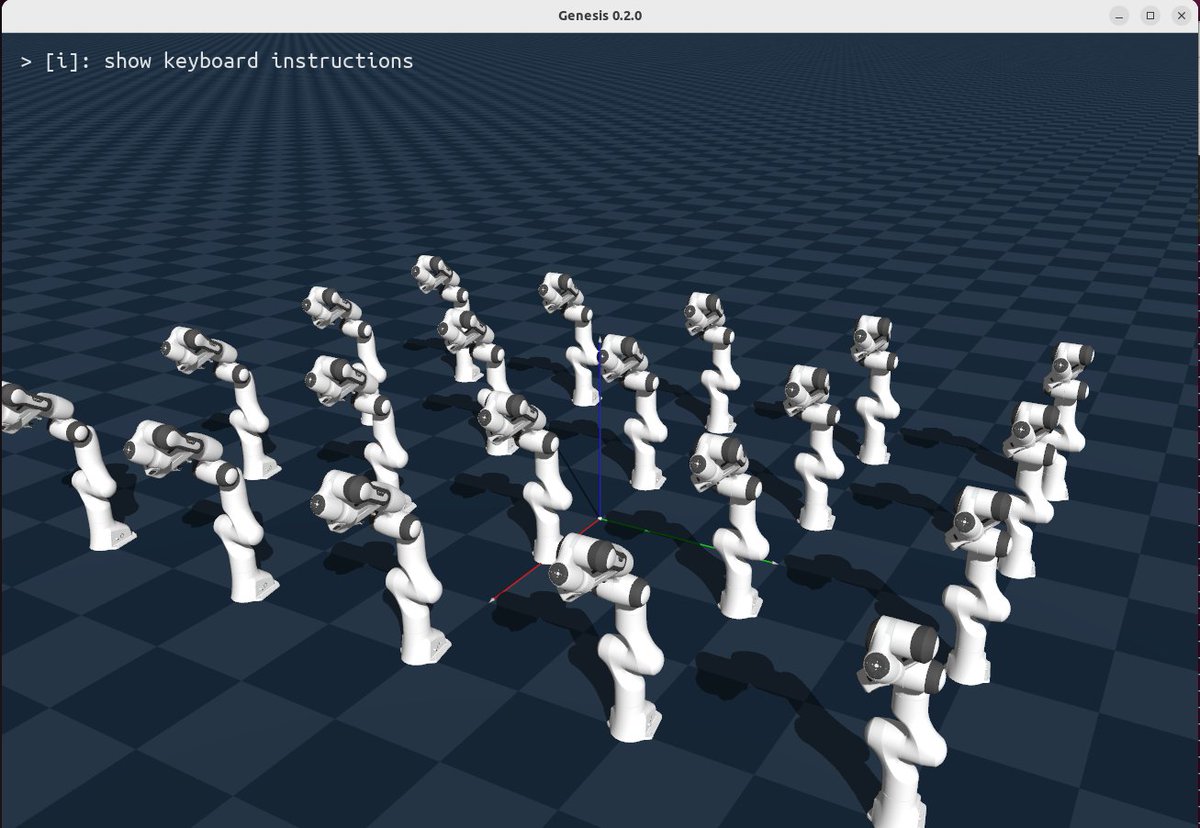
Incredibly fun when you can just download a project off GitHub, follow the tutorials, and wow - it actually works: genesis-world.readthedocs.io/en/latest/user…

English
Dmitri retweetledi

$400 open-source 3d-printed arm with full finger articulation demod at @huggingface's booth at @HumanoidsSummit today
English
Dmitri retweetledi

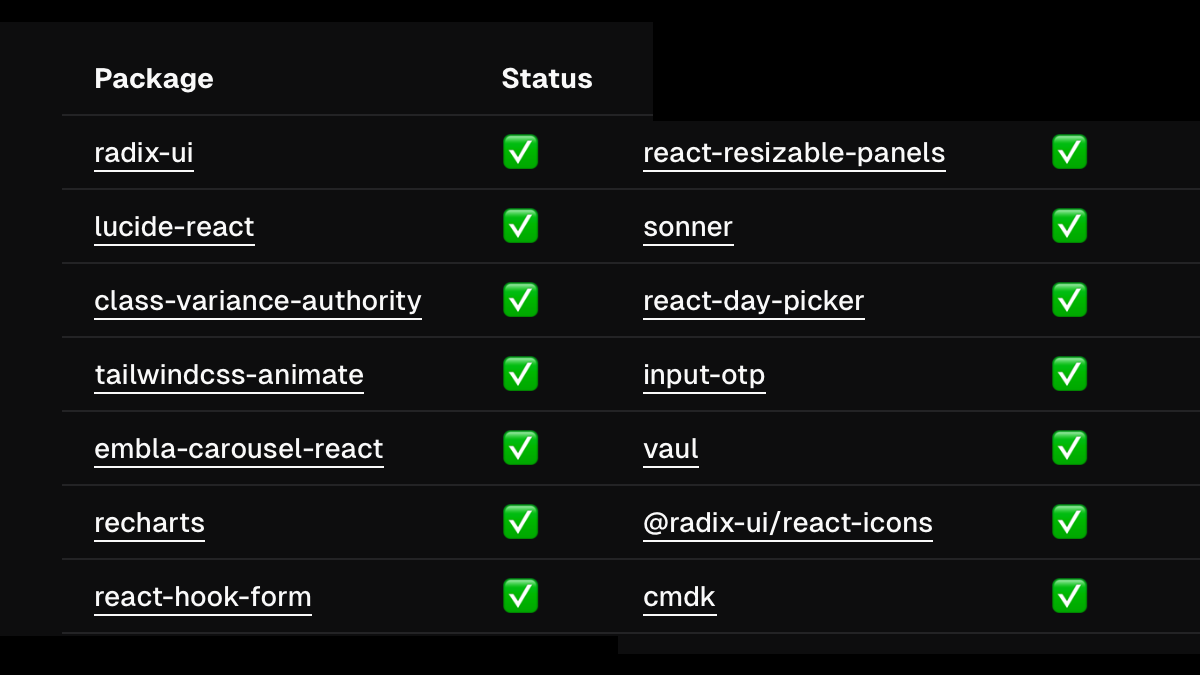
🎉 shadcn/ui is now fully compatible with React 19 (and Next.js 15).

shadcn@shadcn
An update on Next.js 15 and React 19 1/5 - I published a guide on how to use shadcn/ui with React 19: ui.shadcn.com/docs/react-19 - it covers the peer deps issue & how to resolve. - how to use recharts with React 19 - upgrade status of dependencies - and more ⬇️

English
Dmitri retweetledi

We've been shipping y-sweet.dev as an open-source project for over a year. Now you can deploy it on @JamsocketHQ as a natively-supported service, without touching a Dockerfile!
Jamsocket@JamsocketHQ
Today we're launching Y-Sweet on Jamsocket! Y-Sweet is a Yjs sync server + document store that makes building realtime applications like Google Docs easy. jamsocket.com/y-sweet

English
Dmitri retweetledi

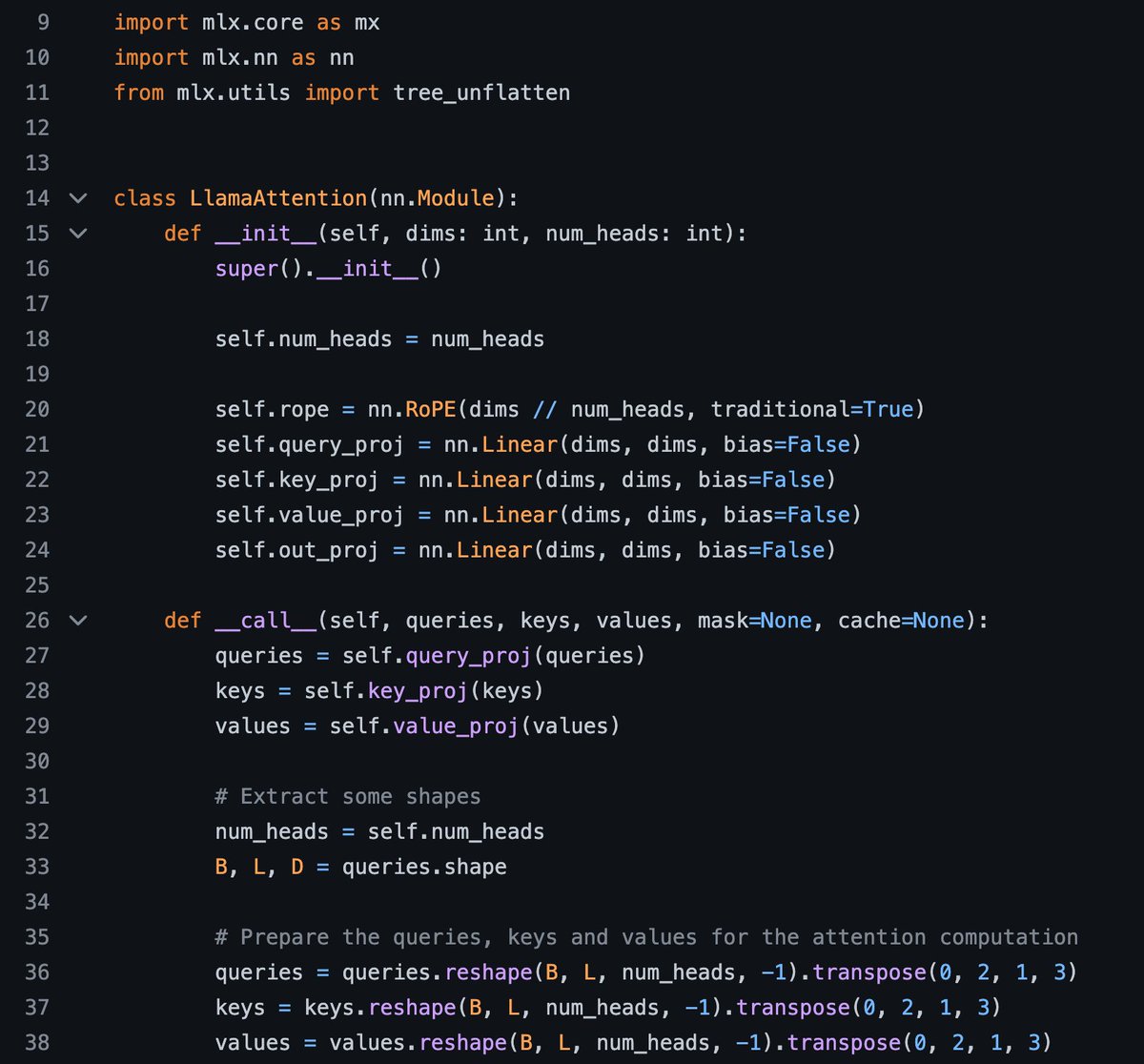
This may be Apple's biggest move on open-source AI so far: MLX, a PyTorch-style NN framework optimized for Apple Silicon, e.g. laptops with M-series chips.
The release did an excellent job on designing an API familiar to the deep learning audience, and showing minimalistic examples on OSS models that most people care about: Llama, LoRA, Stable Diffusion, and Whisper.
I expect no less from my former colleague @awnihannun, spearheading this effort at Apple. Thanks for the early Christmas gift! 🎄🎁
MLX source: github.com/ml-explore/mlx
Well-documented, self-contained examples: github.com/ml-explore/mlx…

English
Dmitri retweetledi

This is amazing → emojis.alexandru.so
An AI emoji generator, built by @pondorasti using @nextjs, @replicate, and @vercel ▲
100% free & open-source too 🤩
English
Dmitri retweetledi

You'll soon see lots of "Llama just dethroned ChatGPT" or "OpenAI is so done" posts on Twitter. Before your timeline gets flooded, I'll share my notes:
▸ Llama-2 likely costs $20M+ to train. Meta has done an incredible service to the community by releasing the model with a commercially-friendly license. AI researchers from big companies were wary of Llama-1 due to licensing issues, but now I think many of them will jump on the ship and contribute their firepower.
▸ Meta's team did a human study on 4K prompts to evaluate Llama-2's helpfulness. They use "win rate" as a metric to compare models, in similar spirit as the Vicuna benchmark. 70B model roughly ties with GPT-3.5-0301, and performs noticeably stronger than Falcon, MPT, and Vicuna.
I trust these real human ratings more than academic benchmarks, because they typically capture the "in-the-wild vibe" better.
▸ Llama-2 is NOT yet at GPT-3.5 level, mainly because of its weak coding abilities. On "HumanEval" (standard coding benchmark), it isn't nearly as good as StarCoder or many other models specifically designed for coding. That being said, I have little doubt that Llama-2 will improve significantly thanks to its open weights.
▸ Meta's team goes above and beyond on AI safety issues. In fact, almost half of the paper is talking about safety guardrails, red-teaming, and evaluations. A round of applause for such responsible efforts!
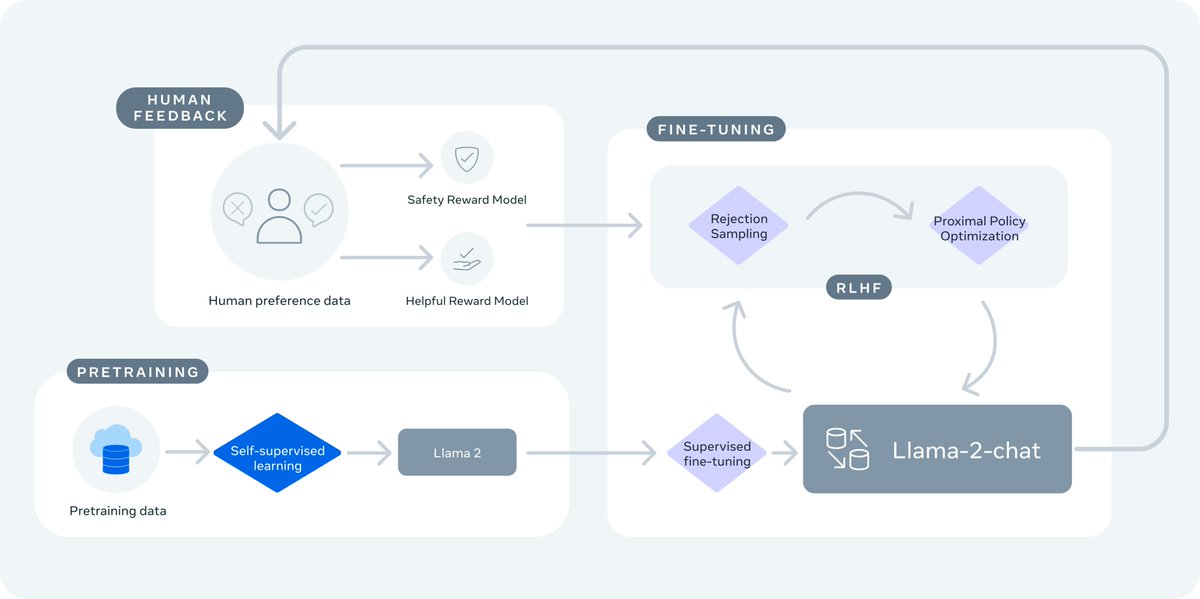
In prior works, there's a thorny tradeoff between helpfulness and safety. Meta mitigates this by training 2 separate reward models. They aren't open-source yet, but would be extremely valuable to the community.
▸ I think Llama-2 will dramatically boost multimodal AI and robotics research. These fields need more than just blackbox access to an API.
So far, we have to convert the complex sensory signals (video, audio, 3D perception) to text description and then feed to an LLM, which is awkward and leads to huge information loss. It'd be much more effective to graft sensory modules directly on a strong LLM backbone.
▸ The whitepaper itself is a masterpiece. Unlike GPT-4's paper that shared very little info, Llama-2 spelled out the entire recipe, including model details, training stages, hardware, data pipeline, and annotation process. For example, there's a systematic analysis on the effect of RLHF with nice visualizations.
Quote sec 5.1: "We posit that the superior writing abilities of LLMs, as manifested in surpassing human annotators in certain tasks, are fundamentally driven by RLHF."
Congrats to the team again 🥂! Today is another delightful day in OSS AI.

English
Dmitri retweetledi
Dmitri retweetledi