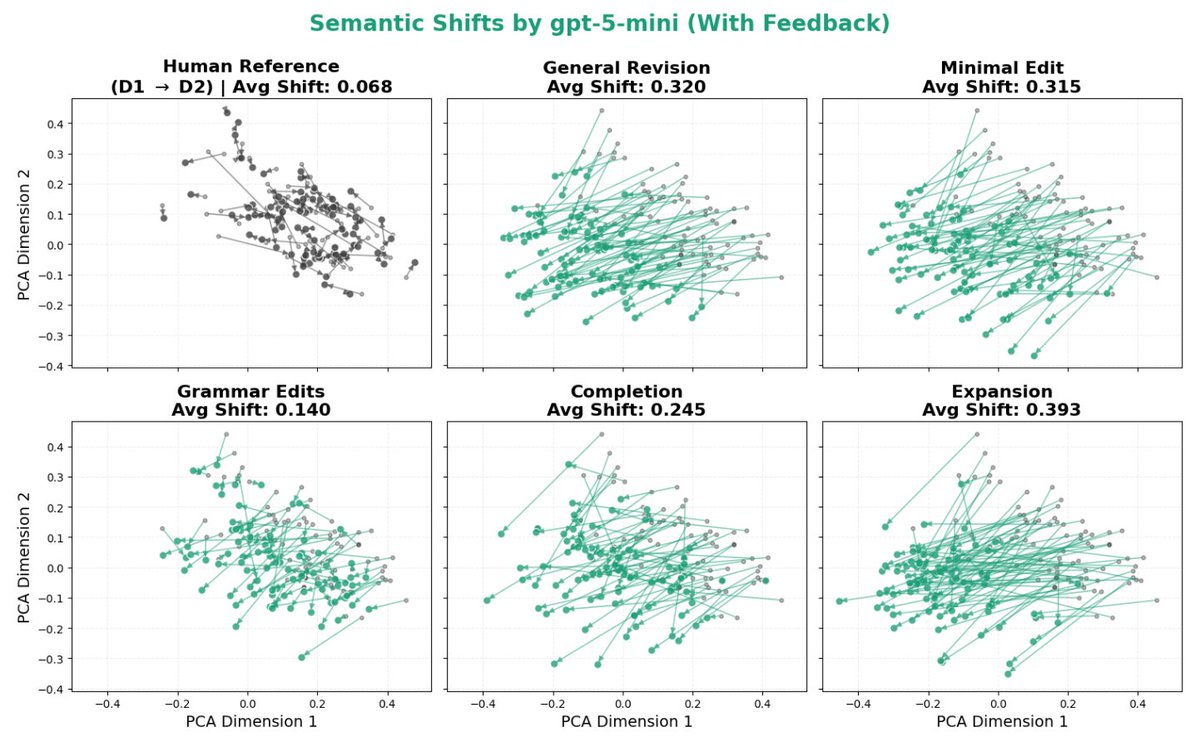
The paper I’ve been most obsessed with lately is finally out: nbcnews.com/tech/tech-news…! Check out this beautiful plot: it shows how much LLMs distort human writing when making edits, compared to how humans would revise the same content.
We take a dataset of human-written essays from 2021, before the release of ChatGPT. We compare how people revise draft v1 -> v2 given expert feedback, with how an LLM revises the same v1 given the same feedback. This enables a counterfactual comparison: how much does the LLM alter the essay compared to what the human was originally intending to write? We find LLMs consistently induce massive distortions, even changing the actual meaning and conclusions argued for.
Solid mathematical ideas almost always outperform contrived engineering tricks.
For years deep learning has been dominated by increasingly complex architectural hacks: CNN blocks, attention layers, channel mixers, residual pathways, normalization stacks.
Every few years a new architecture is announced as if it were a revolution.
One of the most famous examples was Kaiming He and Residual Networks (ResNet). At the time he was paraded around the AI world like a celebrity because residual connections supposedly “solved” deep learning.
But these were largely engineering patches.
Now something much more interesting appeared.
A new architecture called CliffordNet returns to mathematics — specifically Clifford Algebra, developed in the 19th century by William Kingdon Clifford.
Instead of stacking arbitrary modules, the model is built around the geometric product
uv = u·v + u∧v
A single algebraic operation that simultaneously captures inner product structure and geometric interactions.
In other words: the math already contains the interaction mechanism.
No attention blocks.
No mixer layers.
No architectural spaghetti.
The result:
• 77.82% accuracy on CIFAR-100 with only 1.4M parameters
• roughly 8× fewer parameters than ResNet-18
And with strict O(N) complexity.
The paper even suggests that once geometric interactions are modeled correctly, feed-forward networks become largely redundant.
A good reminder for the AI community.
Engineering tricks can dominate for years.
But eventually mathematics shows up and deletes half the architecture.
Paper:
[arxiv.org/pdf/2601.06793…)
19th century geometry just walked into computer vision.
Godfather of neuroscience and author of The free energy principle (active inference), Karl Friston @KarlFristonNews , discussed with me his take on AGI, consciousness, why we will never fully understand the brain, and why humans tend to repeat their mistakes. Key moments:
- You'll know AGI has arrived when the system starts asking you questions out of genuine curiosity, not because it was prompted to
- You cannot hand an intelligent system a value function from the outside, it must learn its own, just as children do (in that sense, RL with assigned reward is the wrong direction)
- The only sustainable universal objective function is adaptive fitness: how well the agent fits and survives within its ecosystem
- Consciousness requires multiple layers: genuine agency, a self-reflective loop, and the ability to recognize your own states of mind
- True sentience may be impossible on standard computer architecture, because memory and processing are separate and cannot self-organize
- Understanding your own brain is philosophically impossible in the same way a ruler cannot measure itself
- Neuroscience is always "peeking behind" the Markov blanket indirectly: through imaging, electrophysiology, psychology — never seeing inside directly
- The only way to truly access the brain is to breach that boundary (e.g. neurosurgery), but a breached brain is no longer a normally functioning one
Watch the full interview and let me know what you think. Link below👇
Hay un término japonés me encanta es "yutori".
Yutori significa ralentizar deliberadamente el ritmo de vida para poder absorber la vida que le rodea, negándose a apresurarse.
Simplemente elija estar presente, solo observe y evite la presión excesiva del acelerado ritmo de la vida "moderna".
A 2-layer neural network goes from total chaos to perfectly separating left vs right classes in real time.
Watch the decision boundary form live as gradient descent works its magic!
Pure maths beauty in motion..
Arsameia, the summer capital of Commagene (1st century BC), hosts the sanctuary of Mithridates I. The relief of the reception with Hercules symbolizes the divine origin of the dynasty, while the huge Greek inscription on the rock is a top historical relic of the region.
1/2
"Dialectics"
Dialectics represents both a mode of thought and a methodological approach that conceptualizes reality as inherently dynamic, unfolding through ongoing processes of change driven by internal contradictions.
researchgate.net/publication/40…
8/8
Grateful to Abeba Birhane, Thomas A. Pollak, and Leonhard Schilbach for this wonderful collaboration.
Thoughts very welcome.
osf.io/preprints/psya…
7/8
This work grows out of our broader research on how social interaction shapes cognition, selfhood, and mental health, and extends those questions into the domain of human–AI interaction.
1/8
I’m excited to share our new paper, now available as a preprint!
𝐈𝐧 𝐃𝐞𝐟𝐞𝐧𝐬𝐞 𝐨𝐟 𝐌𝐢𝐬𝐚𝐭𝐭𝐮𝐧𝐞𝐦𝐞𝐧𝐭: 𝐇𝐲𝐩𝐞𝐫𝐚𝐥𝐢𝐠𝐧𝐦𝐞𝐧𝐭 𝐢𝐧 𝐇𝐮𝐦𝐚𝐧–𝐀𝐈 𝐈𝐧𝐭𝐞𝐫𝐚𝐜𝐭𝐢𝐨𝐧𝐬
with @Abebab, Tom Pollak, and @leoschilbach
link: osf.io/preprints/psya…