Dmitriy Zhuk

834 posts

Dmitriy Zhuk banner
Dmitriy Zhuk

Dmitriy Zhuk

@dimzhuk

Author of Agent-Friendly Code and co-founder of https://t.co/9TCZIgoiai. I make RAG & CAG Pipelines for custom AI Agents... uhm... I make AI helpers that know your business.

AI Agents with RAG Katılım Temmuz 2010
58 Takip Edilen150 Takipçiler
Dmitriy Zhuk
Dmitriy Zhuk@dimzhuk·
@rohit4verse been building Agentfy on this model for 2 years most teams obsess over the model. real work is the harness — permissions, failure propagation, what each agent can touch context is where it compounds. agent that knows 7 years of store history is untouchable
English
0
0
0
5
Rohit
Rohit@rohit4verse·
Every AI company on the planet has access to the same model weights. Same Sonnet. Same GPT. Same Gemini. Same API key. So why do some agents feel magical and others feel broken? Because the model was never the moat, the harness and the context are. Harrison Chase just laid out the three layers where an AI agent actually learns: >Model - the weights. Everyone has them. You're not special for calling an API. Expensive to update, slow to iterate, and catastrophic forgetting is still unsolved. >Harness - the code, tools, and system prompts powering your agent. This is why Claude Code and Codex feel nothing alike despite sharing similar models. This is where your architecture decisions compound into real product differentiation. >Context - memory, skills, and configuration that sit outside the harness entirely. User-level, org-level, agent-level. The fastest layer to update and the cheapest to maintain. This is where your agent goes from generic tool to something that actually knows the user. The builders winning right now aren't fine-tuning their way to a better product. They're stacking all three layers with traces as the connective tissue between them. You can train the best model in the world, but without a strong harness and deep context you're shipping a glorified autocomplete with an API bill. Harness is everything. Context is the unlock. Model weights are table stakes. Read this article for the complete deep dive.
Harrison Chase@hwchase17

x.com/i/article/2040…

English
17
10
59
9.2K
Dmitriy Zhuk
Dmitriy Zhuk@dimzhuk·
I tried to build a general-purpose agent. It could do everything. Pulled in every direction. Finished nothing. Narrowed it to one workflow. One domain. One outcome. Shipped in a week. Scope isn't a limitation. It's the feature.
English
0
0
0
6
Dmitriy Zhuk
Dmitriy Zhuk@dimzhuk·
@heynavtoor This is the right direction. Context files > prompting. Building Agentfy I noticed agents make better decisions when you give them structured context about domain conventions — design, code style, business rules. The .md-as-context pattern scales further than most realize.
English
0
0
2
3K
Nav Toor
Nav Toor@heynavtoor·
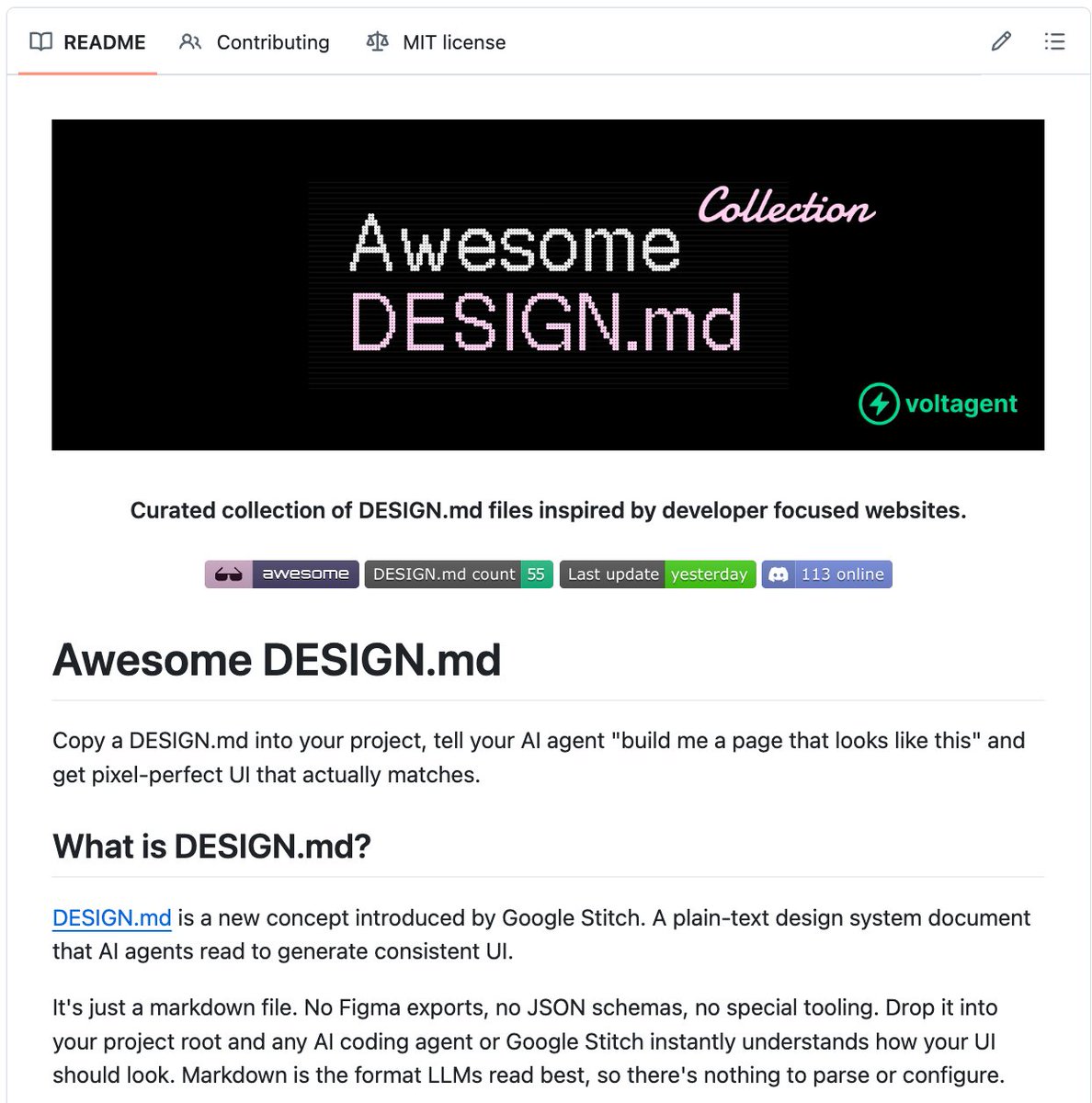
🚨 Someone reverse-engineered the design systems of Apple, Spotify, Airbnb, and 30+ billion-dollar companies. Packed each one into a single file. Free. It's called Awesome Design MD. Drop one file into your project. Your AI agent builds UI that looks like Spotify. Or Apple. Or Airbnb. Instantly. Not screenshots. Not Figma links. A single DESIGN .md file that captures every color, font, spacing value, button style, and layout pattern from a real website. In a format AI agents read and reproduce. Here's the difference: Tell Claude Code "build me a landing page" and it gives you generic UI. Tell Claude Code "build me a landing page" with Spotify's DESIGN .md in your project and it gives you Spotify. Here's what's inside: → Apple. Premium white space, SF Pro typography, cinematic imagery. → Spotify. Vibrant green on dark, bold type, album-art-driven layout. → Airbnb. Warm coral accent, photography-driven, rounded UI. → Linear. Ultra-minimal, precise spacing, purple accent. → SpaceX. Stark black and white, full-bleed imagery, futuristic. → BMW. Dark premium surfaces, precise German engineering aesthetic. → NVIDIA. Green-black energy, technical power aesthetic. → Uber. Bold black and white, tight type, urban energy. → Sentry, PostHog, Raycast, Cursor, ElevenLabs, and 20+ more. Here's how to use it: → Pick a design system from the collection → Copy the DESIGN .md file into your project root → Tell your AI agent to use it → Get UI that matches the design language of a billion-dollar company That's it. One file. Your AI agent now has the design taste of a $200/hour design consultant. Designers charge $5,000+ for a custom design system. Companies spend $50,000+ building one from scratch. This is free. 31 design systems. Copy. Paste. Ship beautiful UI. Works with Claude Code, Cursor, Codex, and any AI coding agent that reads project files. 100% Open Source. MIT License.
Nav Toor tweet media
English
108
634
6.8K
1.1M
Dmitriy Zhuk
Dmitriy Zhuk@dimzhuk·
openscreen just gained 2,692 stars today. Open-source Screen Studio alternative. No subscriptions. No watermarks. Free for commercial use. Every founder demos their product eventually. The best demo tool just stopped costing money.
English
0
0
0
19
Dmitriy Zhuk
Dmitriy Zhuk@dimzhuk·
@heynavtoor the .md-as-context pattern is the real unlock been using it in Agentfy and Instalegram — not just design, but product context, error patterns, voice files agents perform at the quality of what you give them design systems are just one file away from becoming obvious
English
0
0
0
2.8K
Dmitriy Zhuk
Dmitriy Zhuk@dimzhuk·
@RoundtableSpace Context is everything. Building Agentfy, we found agents fall apart not because they're dumb — but because they have no shared understanding of what 'good' looks like. A file that packs that in is exactly the right primitive.
English
0
0
0
631
0xMarioNawfal
0xMarioNawfal@RoundtableSpace·
SOMEONE PACKED THE DESIGN SYSTEMS OF APPLE, SPOTIFY, AIRBNB, AND 30+ BILLION DOLLAR COMPANIES INTO SINGLE FILES FOR AI AGENTS. x.com/heynavtoor/sta…
Nav Toor@heynavtoor

🚨 Someone reverse-engineered the design systems of Apple, Spotify, Airbnb, and 30+ billion-dollar companies. Packed each one into a single file. Free. It's called Awesome Design MD. Drop one file into your project. Your AI agent builds UI that looks like Spotify. Or Apple. Or Airbnb. Instantly. Not screenshots. Not Figma links. A single DESIGN .md file that captures every color, font, spacing value, button style, and layout pattern from a real website. In a format AI agents read and reproduce. Here's the difference: Tell Claude Code "build me a landing page" and it gives you generic UI. Tell Claude Code "build me a landing page" with Spotify's DESIGN .md in your project and it gives you Spotify. Here's what's inside: → Apple. Premium white space, SF Pro typography, cinematic imagery. → Spotify. Vibrant green on dark, bold type, album-art-driven layout. → Airbnb. Warm coral accent, photography-driven, rounded UI. → Linear. Ultra-minimal, precise spacing, purple accent. → SpaceX. Stark black and white, full-bleed imagery, futuristic. → BMW. Dark premium surfaces, precise German engineering aesthetic. → NVIDIA. Green-black energy, technical power aesthetic. → Uber. Bold black and white, tight type, urban energy. → Sentry, PostHog, Raycast, Cursor, ElevenLabs, and 20+ more. Here's how to use it: → Pick a design system from the collection → Copy the DESIGN .md file into your project root → Tell your AI agent to use it → Get UI that matches the design language of a billion-dollar company That's it. One file. Your AI agent now has the design taste of a $200/hour design consultant. Designers charge $5,000+ for a custom design system. Companies spend $50,000+ building one from scratch. This is free. 31 design systems. Copy. Paste. Ship beautiful UI. Works with Claude Code, Cursor, Codex, and any AI coding agent that reads project files. 100% Open Source. MIT License.

English
37
139
2.6K
582.4K
Dmitriy Zhuk
Dmitriy Zhuk@dimzhuk·
@svpino that question is harder. and way more interesting
English
0
0
0
2
Santiago
Santiago@svpino·
I'm having more fun building software today than I've ever had. (Except, of course, when I run through my whole Claude MAX plan in 2 hours. That sucks big time.) I'm writing less code, but that doesn't bother me. The fun part for me has always been building new things. Writing the code is a means to an end. Fun, but not the most important piece. I'm still proud of the code I write, by the way. And I try to make it as nice as possible, but I'm also learning to let go and trust coding agents more. These are new times.
English
80
8
150
15K
Dmitriy Zhuk
Dmitriy Zhuk@dimzhuk·
@sukh_saroy Been building Instalegram with Claude for months. It's not prompt engineering that matters — it's architecture. How you structure tool calls, context, memory boundaries. Skills/agents are modular programs, not magic strings. Anthropic finally said the quiet part loud.
English
0
0
1
122
Sukh Sroay
Sukh Sroay@sukh_saroy·
Prompt engineering is dead. Anthropic recently released the real playbook for building AI agents that actually work. It’s a 30+ page deep dive called The Complete Guide to Building Skills for Claude and it quietly shifts the conversation from “prompt engineering” to real execution design. Here’s the big idea: A Skill isn’t just a prompt. It’s a structured system. You package instructions inside a SKILL .md file, optionally add scripts, references, and assets, and teach Claude a repeatable workflow once instead of re-explaining it every chat. But the real unlock is something they call progressive disclosure. Instead of dumping everything into context: • A lightweight YAML frontmatter tells Claude when to use the skill • Full instructions load only when relevant • Extra files are accessed only if needed Less context bloat. More precision. They also introduce a powerful analogy: MCP gives Claude the kitchen. Skills give it the recipe. Without skills: users connect tools and don’t know what to do next. With skills: workflows trigger automatically, best practices are embedded, API calls become consistent. They outline 3 major patterns: 1) Document & asset creation 2) Workflow automation 3) MCP enhancement And they emphasize something most builders ignore: testing. Trigger accuracy. Tool call efficiency. Failure rate. Token usage. This isn’t about clever wording. It’s about designing an execution layer on top of LLMs. Skills work across Claude, Claude Code, and the API. Build once, deploy everywhere. The era of “just write a better prompt” is ending. Anthropic just handed everyone a blueprint for turning chat into infrastructure. Download the guide here: resources.anthropic.com/hubfs/The-Comp…
Sukh Sroay tweet media
English
8
24
157
17.8K
Dmitriy Zhuk
Dmitriy Zhuk@dimzhuk·
Mercor — $10B AI training startup — just got breached. Not user data. Meta's training secrets. Labeling protocols. Data selection. All exposed. Entry point: LiteLLM supply chain attack. The labs outsourced their most sensitive IP. One package. Everything cracked open.
English
0
0
0
67
Dmitriy Zhuk
Dmitriy Zhuk@dimzhuk·
@ingliguori Roadmap is solid but missing the hardest step: keeping agents coherent across tool calls. Memory + RAG = recall. Planning = intent. But agents fail in the seams — between retries, between context windows. That's the frontier we're navigating with CleanSlice.
English
0
0
0
55
Giuliano Liguori
Giuliano Liguori@ingliguori·
Roadmap to learn Agentic AI 🚀 AI fundamentals Python + frameworks LLMs Agents architecture Memory + RAG Planning & decision-making RL & self-improvement Deployment Real-world automation Agentic AI = full-stack intelligence. Credit: Tiksly #AgenticAI #LLM #RAG #A
Giuliano Liguori tweet media
English
9
77
277
7.1K
Dmitriy Zhuk
Dmitriy Zhuk@dimzhuk·
@sukh_saroy We figured this the hard way with Agentfy. Treating each agent capability as a deployable file — SKILL.md + scripts — made everything predictable and testable. "MCP = kitchen, skills = recipe" is the cleanest mental model I've seen for this. Saves everyone 6 months.
English
0
0
0
100
Dmitriy Zhuk
Dmitriy Zhuk@dimzhuk·
@pascal_bornet Judgment isn't magic — it's context. Building CleanSlice I learned: agents fail not because they can't execute, but because they're missing the business layer that tells them what "good" looks like. The gap isn't execution vs judgment. It's who owns the context that frames both.
English
0
0
0
12
Pascal Bornet
Pascal Bornet@pascal_bornet·
When you ask an agentic AI to implement your design… it executes perfectly. The gap: judgment and context. Execution is solved. Judgment and context aren’t. Agentic systems can act autonomously. But they don’t always understand what matters… or why. This is where things start to matter. So here’s the real question: Are we building agents that act… or systems that can truly decide? #ArtificialIntelligence #AI #AgenticAI #FutureOfWork #Innovation Credits: Ralph
Pascal Bornet tweet media
English
9
1
9
897
Dmitriy Zhuk
Dmitriy Zhuk@dimzhuk·
@StartupArchive_ Jensen is right, but that's exactly why you do it before you know better. I've been running Dreamvention and now building Agentfy — if I'd known the real cost upfront, I wouldn't have started either. The ignorance is the fuel. Use it.
English
0
0
0
70
Startup Archive
Startup Archive@StartupArchive_·
Why NVIDIA founder Jensen Huang wouldn’t start a company if he had to do it all over again In this clip from the Acquired podcast, Jensen is asked what company he would start if he was 30 years old again today. His response: “I wouldn’t do it.” “Building a company and building NVIDIA turned out to have been a million times harder than any of us expected it to be. And at the time, if we realized the pain and suffering and just how vulnerable you’re going to feel and the challenges that you’re going to endure, the embarrassment and the shame, and the list of all the things that go wrong—I don’t think anybody would start a company.” Jensen believes that the superpower of entrepreneur is that they don’t know how hard it is. They only ask themselves: How hard can it be? “You have to get yourself to believe that it’s not that hard because it’s way harder than you think. And if—taking all of my knowledge now—I go back, and I said I’m going to endure that whole journey again, I think it’s too much. It is just too much.” And he believes entrepreneurs need to surround themselves with supportive family, friends and colleagues. “You need the unwavering support of the people around you… I’m pretty sure that almost every successful company and entrepreneur that has gone through some difficult challenges had that support system around them.” Video source: @AcquiredFM (2023)
English
18
25
174
26.1K
Dmitriy Zhuk
Dmitriy Zhuk@dimzhuk·
Building used to take weeks. Now it takes hours. So I have more decisions to make. Faster. With less time to think. The constraint isn't skill anymore. It's judgment at speed. AI made the work faster. It made the decisions harder.
English
0
0
0
8
Dmitriy Zhuk
Dmitriy Zhuk@dimzhuk·
@RoundtableSpace MCP is cool but the bigger unlock is when the agent stops asking what does the design look like and starts asking what does this user expect UI tools are still the easy part. Context about behavior is where we're stuck building Agentfy.
English
0
0
0
210
0xMarioNawfal
0xMarioNawfal@RoundtableSpace·
MCP SOLVES CLAUDE CODE'S UI DESIGN PROBLEM - Built-in AI design tool for Claude Code that creates UIs and drops them directly into your codebase - Eliminates back-and-forth between design platforms and code editor
English
31
20
287
61.6K
Dmitriy Zhuk
Dmitriy Zhuk@dimzhuk·
@bigdatasumit the definition is clean, but building agents in production hits different. the hard part isn't the tool call — it's detecting when the agent takes a wrong turn 3 steps in, without user input. that's the layer we spend most time on in CleanSlice
English
0
0
0
200
Sumit Mittal
Sumit Mittal@bigdatasumit·
Let me explain Gen AI in a very simple way. LLM - can you answer my query based on knowledge you have RAG - Hey LLM can you answer my query, based on this book I am giving you Agents - Hey LLM, you can do a google search and answer my query Similarity Search - How do you make sure which pages in the book are relevant for my answer Vector embeddings - how to know the semantic meaning of a piece of text. Prompt Engineering - can you communicate to the LLM in a better way. Embedding model - to convert documents to vector embeddings Generation Model - is the LLM (acts like a brain) Vector Database - A database to hold the vector embeddings for doing similarity search later. Pre Training - Create a foundation model where you give a sequence of tokens and it generates the next token. Fine Tuning - further tuning a pre trained model using high quality data. This is done for alignment purpose. you can add more to this list in comments. I hope you find this helpful. My new Gen AI program is starting on coming Saturday. DM to know more!
Sumit Mittal tweet media
English
3
28
140
7.9K
Dmitriy Zhuk
Dmitriy Zhuk@dimzhuk·
@karpathy the explicit vs implicit memory distinction is the one that actually matters building Instalegram — each user bot needs to know its owner. started implicit. switched to explicit wiki-style profiles the quality difference is not subtle
English
0
0
0
827
Andrej Karpathy
Andrej Karpathy@karpathy·
Farzapedia, personal wikipedia of Farza, good example following my Wiki LLM tweet. I really like this approach to personalization in a number of ways, compared to "status quo" of an AI that allegedly gets better the more you use it or something: 1. Explicit. The memory artifact is explicit and navigable (the wiki), you can see exactly what the AI does and does not know and you can inspect and manage this artifact, even if you don't do the direct text writing (the LLM does). The knowledge of you is not implicit and unknown, it's explicit and viewable. 2. Yours. Your data is yours, on your local computer, it's not in some particular AI provider's system without the ability to extract it. You're in control of your information. 3. File over app. The memory here is a simple collection of files in universal formats (images, markdown). This means the data is interoperable: you can use a very large collection of tools/CLIs or whatever you want over this information because it's just files. The agents can apply the entire Unix toolkit over them. They can natively read and understand them. Any kind of data can be imported into files as input, and any kind of interface can be used to view them as the output. E.g. you can use Obsidian to view them or vibe code something of your own. Search "File over app" for an article on this philosophy. 4. BYOAI. You can use whatever AI you want to "plug into" this information - Claude, Codex, OpenCode, whatever. You can even think about taking an open source AI and finetuning it on your wiki - in principle, this AI could "know" you in its weights, not just attend over your data. So this approach to personalization puts *you* in full control. The data is yours. In Universal formats. Explicit and inspectable. Use whatever AI you want over it, keep the AI companies on their toes! :) Certainly this is not the simplest way to get an AI to know you - it does require you to manage file directories and so on, but agents also make it quite simple and they can help you a lot. I imagine a number of products might come out to make this all easier, but imo "agent proficiency" is a CORE SKILL of the 21st century. These are extremely powerful tools - they speak English and they do all the computer stuff for you. Try this opportunity to play with one.
Farza 🇵🇰🇺🇸@FarzaTV

This is Farzapedia. I had an LLM take 2,500 entries from my diary, Apple Notes, and some iMessage convos to create a personal Wikipedia for me. It made 400 detailed articles for my friends, my startups, research areas, and even my favorite animes and their impact on me complete with backlinks. But, this Wiki was not built for me! I built it for my agent! The structure of the wiki files and how it's all backlinked is very easily crawlable by any agent + makes it a truly useful knowledge base. I can spin up Claude Code on the wiki and starting at index.md (a catalog of all my articles) the agent does a really good job at drilling into the specific pages on my wiki it needs context on when I have a query. For example, when trying to cook up a new landing page I may ask: "I'm trying to design this landing page for a new idea I have. Please look into the images and films that inspired me recently and give me ideas for new copy and aesthetics". In my diary I kept track of everything from: learnings, people, inspo, interesting links, images. So the agent reads my wiki and pulls up my "Philosophy" articles from notes on a Studio Ghibli documentary, "Competitor" articles with YC companies whose landing pages I screenshotted, and pics of 1970s Beatles merch I saved years ago. And it delivers a great answer. I built a similar system to this a year ago with RAG but it was ass. A knowledge base that lets an agent find what it needs via a file system it actually understands just works better. The most magical thing now is as I add new things to my wiki (articles, images of inspo, meeting notes) the system will likely update 2-3 different articles where it feels that context belongs, or, just creates a new article. It's like this super genius librarian for your brain that's always filing stuff for your perfectly and also let's you easily query the knowledge for tasks useful to you (ex. design, product, writing, etc) and it never gets tired. I might spend next week productizing this, if that's of interest to you DM me + tell me your usecase!

English
294
644
7.1K
806.8K
Dmitriy Zhuk
Dmitriy Zhuk@dimzhuk·
@karpathy building per-user memory for Instalegram bots — explicit wins every time agents with a visible memory file > black-box "it remembers stuff" users trust what they can see. context quality also jumps when memory is structured, not implicit noise
English
0
0
0
818
Dmitriy Zhuk
Dmitriy Zhuk@dimzhuk·
@om_patel5 the design consistency gap is real. we hit it building Instalegram — Claude generates functionally correct UI but with zero visual memory. giving it your design system as context via MCP is the right fix. context is the bottleneck, not the model
English
0
0
0
953
Om Patel
Om Patel@om_patel5·
Claude Code is terrible at UI design and everyone knows it so this guy fixed it by building an MCP that gives Claude its own AI design tool instead of going back and forth between a design platform and your code editor, Claude now creates the designs itself and drops them straight into your codebase the MCP has full context of your existing design system and project so everything it generates actually matches what you already have. one command to set up and it installs the MCP and skill files so Claude instantly knows how to use it if you're tired of the same Inter font, purple gradient, card grid layout on every project, this is definitely worth trying
English
143
254
3.3K
363.8K
Dmitriy Zhuk
Dmitriy Zhuk@dimzhuk·
@aakashgupta felt this shift months ago building Agentfy. stopped writing features, started directing agents. the mental model change is bigger than the tooling — you're not a coder anymore, you're a team lead for something that never sleeps
English
0
0
0
4
Aakash Gupta
Aakash Gupta@aakashgupta·
Cursor just mass-migrated its entire product surface from "AI helps you code" to "you manage a fleet of agents that code for you." This is a $29.3B company betting that the IDE itself becomes irrelevant. They forked VS Code two years ago because they needed control over the surface. Now they're building a second interface on top of it because even their own fork is too code-centric for where this is heading. The numbers tell the story. 35% of Cursor's internal PRs are already generated by agents running on their own VMs. They shipped Composer 2, cloud agents, automations, JetBrains ACP, and 30+ plugins in the last month alone. This isn't a feature release. This is a company trying to outrun the model providers eating their lunch from below. Because here's the constraint nobody's pricing in. Cursor pays retail for the models that Anthropic gets wholesale. Claude Code hit a $2.5B run rate with 300K+ business customers by offering the same agentic coding at lower prices with no IDE overhead. Every time Anthropic ships a better model, Claude Code gets better for free. Cursor has to reintegrate, retune, and reprice. So Cursor's move is to go vertical on the orchestration layer. Multi-agent management, parallel VMs, automation triggers from Slack and GitHub, plugin marketplace, enterprise security. They're saying: the model is a commodity, the workflow is the moat. The question is whether developers want a dedicated cockpit for managing agent fleets, or whether the terminal where the model lives is enough. That's the $29.3B bet.
Cursor@cursor_ai

We’re introducing Cursor 3. It is simpler, more powerful, and built for a world where all code is written by agents, while keeping the depth of a development environment.

English
27
13
240
48.1K