dionigi

1.1K posts

dionigi

dionigi

@dionigiii

🌴 Katılım Mayıs 2025
185 Takip Edilen48 Takipçiler
jestergoon ☦️
jestergoon ☦️@fool2theworld·
Hey bud, I know it’s one of your very first Lents, but the spirit leading you to call Orthodox Christians you disagree with “pond scum” is not the Holy Spirit.
Alex Sorin, JD@Alex_Ortodoxie

@forsman_josh @Nicholai_Korea @HosannaHosannaa @C2Antiquity Joshua they’re pond scum. They’re lying and they know they’re lying (or ought to know they’re lying, which would arguably be worse). I didn’t even have Shamoun in mind honestly, it was just kind of flowed from my heart through my thumbs into the tweet.

English
2
2
35
1.6K
dionigi retweetledi
Energetic Procession
Energetic Procession@Acolyte83349490·
Well a few things here. First since PSA is a Protestant creation, it comes on the scene late. Second the philosophical categories that made PSA possible are also late comers so this would make it difficult to critique it as a hypothetical position. Third, PSA grows out of Satisfaction models via Anselm, and Anselm himself notes that the Ransom model, a form of CV was the pervasive view of his time (11th century) in the West. So Protestants for along time just keep calling their view satisfaction and use lots of the classical scholastic terms and categories but with new twists. This is why even the term PSA to my knowledge doesn't start getting used by Protestants to describe their own views against the Catholic teaching until the late 18th, and 19th centuries. This makes it difficult for figures in Russia and elsewhere to differentiate PSA from the Lutherans and Reformed, who were at times active in Russia and other Orthodox lands, from Anselmian Satisfaction model. In fact they often reinterpret Lutheran sources during this period to be expressing Satisfaction, when they weren't. As to your point about what various saints express in terms of substitution and punishment, it is important to remember that that language is part of non-PSA views. For it to be expressing PSA, it has to be a certain kind of substitution and the death of Christ has to be a just death. That is, Jesus has to be classed as a sinner by God so God can pour out all his wrath on him and Jesus can absorb it. Jesus ex hypothesi doesn't assuage the wrath or turn it away as he does for say Anselm. For Anselm he takes a punishment that was ot due him in terms of dying a death and not as a matter of a legal requirement. His suffering and love are then offered to God INSTEAD of a fulfillment of a legal requirement. And because of who he is, qua deity, God accepts it as more valuable than the deficiency of human sin. Therefore, voluntarily acting on behalf of others and for their benefit and undergoing suffering and the punishment of death is doesn't pick out PSA alone. You don't get some Odox figures expressing what would count as PSA or plausibly so until later and they are deriving such views from Lutheran sources. And last I checked Luther and Melancthon weren't Orthodox Saints.
English
1
6
28
423
Alex Sorin, JD
Alex Sorin, JD@Alex_Ortodoxie·
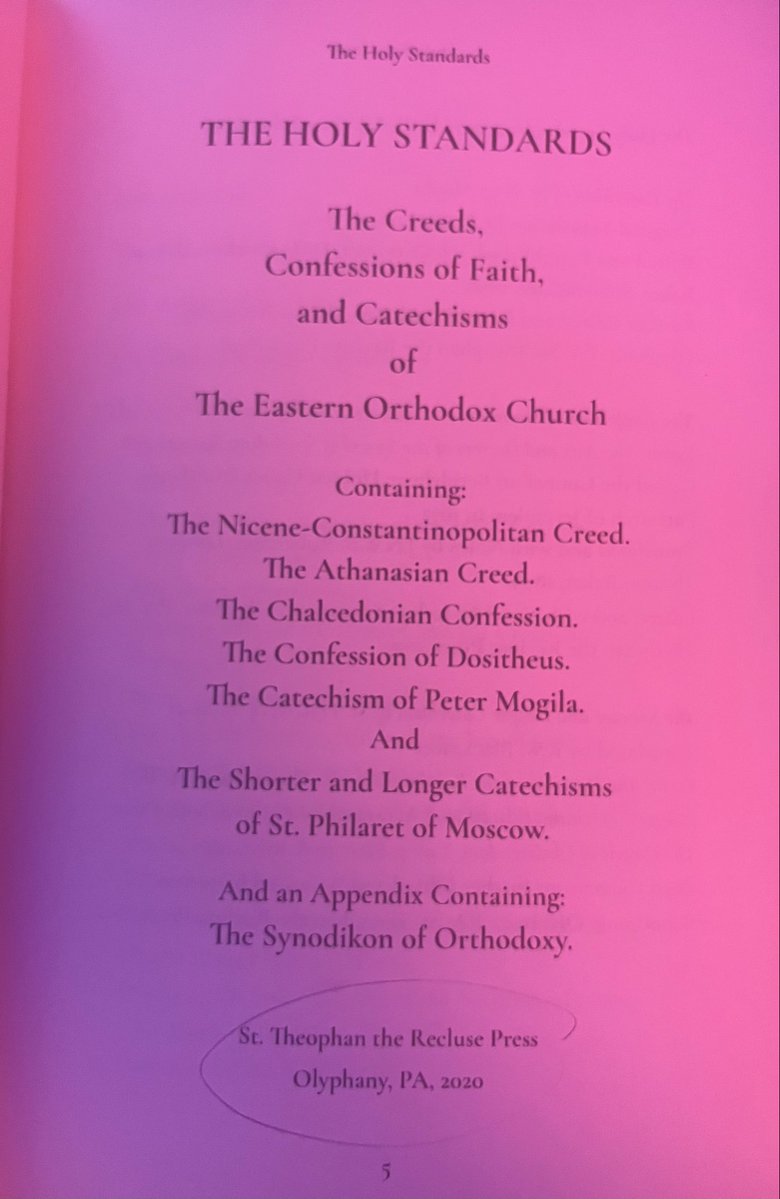
@HosannaHosannaa @C2Antiquity Take your tainted Latin text and shove it up your butt, demon. How dare you slander the great St Peter Moghila in this way? He was thoroughly ORTHODOX.
Alex Sorin, JD tweet mediaAlex Sorin, JD tweet mediaAlex Sorin, JD tweet media
English
9
4
82
7.4K
CleavetoAntiquity
CleavetoAntiquity@C2Antiquity·
I can’t believe the latinizers are getting their theology from this guy.
English
37
11
257
7.1K
dionigi
dionigi@dionigiii·
@HosannaHosannaa @DohMkay I don't think there's doublespeak; I think he's being very clear and specific. The *teaching* of theology, the *style* of theology-this is undeniable, and it's what some find particularly laudable. It does make for some symbolic books that can be confusing to certain audiences.
English
0
0
0
9
.
.@HosannaHosannaa·
@dionigiii @DohMkay I mean before that he does say the theology deviated. It’s kinda like a double think tactic.
English
1
0
2
41
Babushka Adele
Babushka Adele@DohMkay·
Not only was there latinising in Russia, but there was also protestant influence during Peter I, who removed Patriarchy in Russia and replaced with Most Holy Synod, and the de facto leader Theophan Prokopovich was directly influenced by protestantism especially Calvinism. Young Russian men were forced to go to this latinising protestant school, where they learned the theology in latin. The question and answers were protestant minded. Peter I disliked monasticism as he was influenced by protestant culture, he viewed monastics as parasites, doing nothing and living off of other people. He forbid monks to write and forced them to go study in those latinising protestant schools. It was a time of enlightenment and protestanism was in line with this ideology.
English
7
3
41
3.4K
dionigi
dionigi@dionigiii·
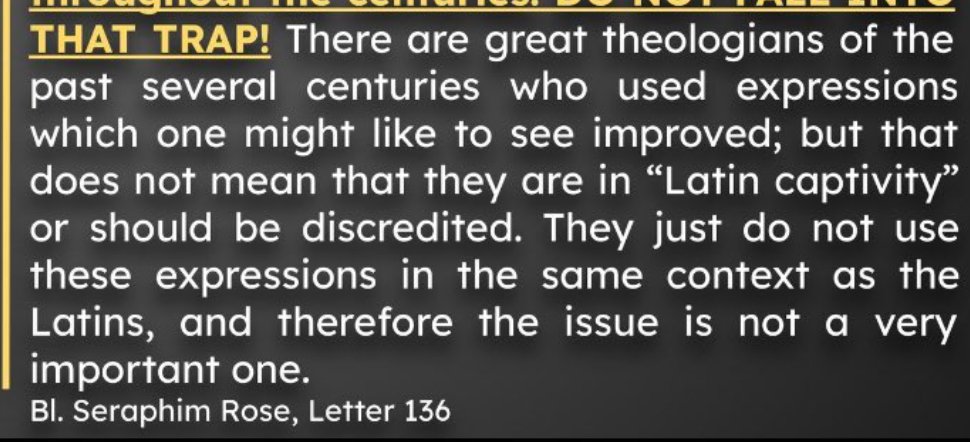
@HosannaHosannaa @DohMkay I like that the end of the quote from Fr Seraphim isn't that far off from the basis of Fr Georges Florovsky's Pseudomorphosis. (Obviously they went in different ways with it, though, but it's interesting to see that Florovsky wasn't dismissing or condemning with that language.)
dionigi tweet mediadionigi tweet media
English
1
0
1
53
.
.@HosannaHosannaa·
@DohMkay “Latin captivity” is a false exaggerated narrative pushed by liberal academics to discredit our saints. These centuries were a time of great triumph over heresy for the church. People exaggerate the reality for their own narratives
. tweet media. tweet media. tweet media
English
6
3
40
2.1K
dionigi
dionigi@dionigiii·
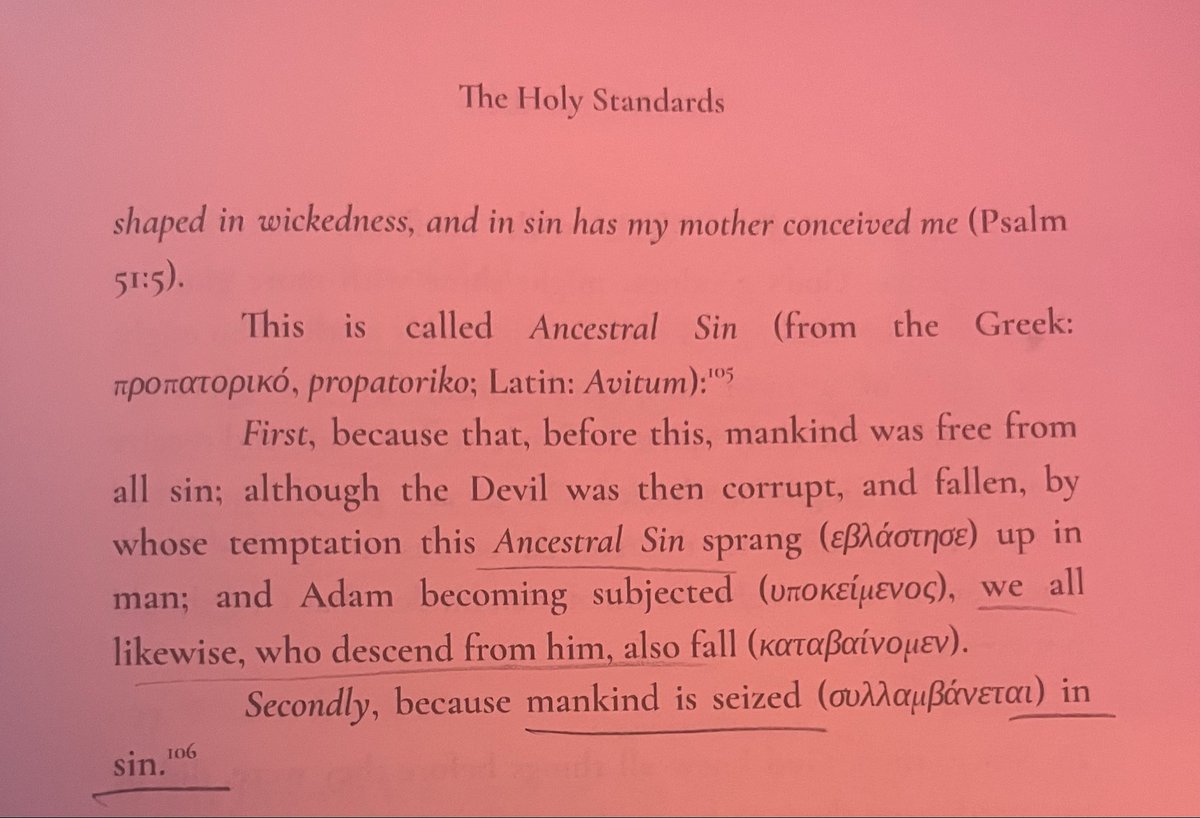
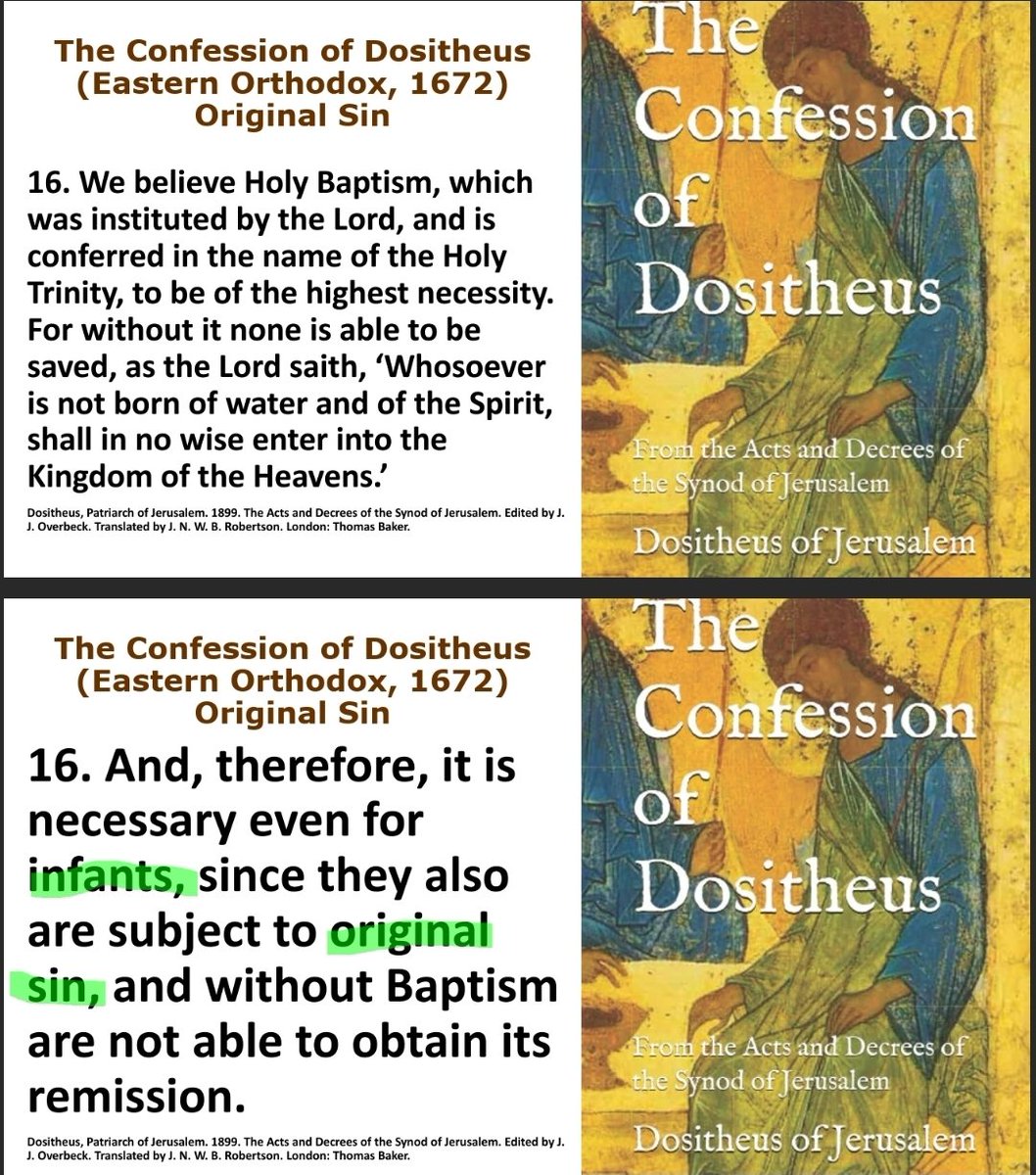
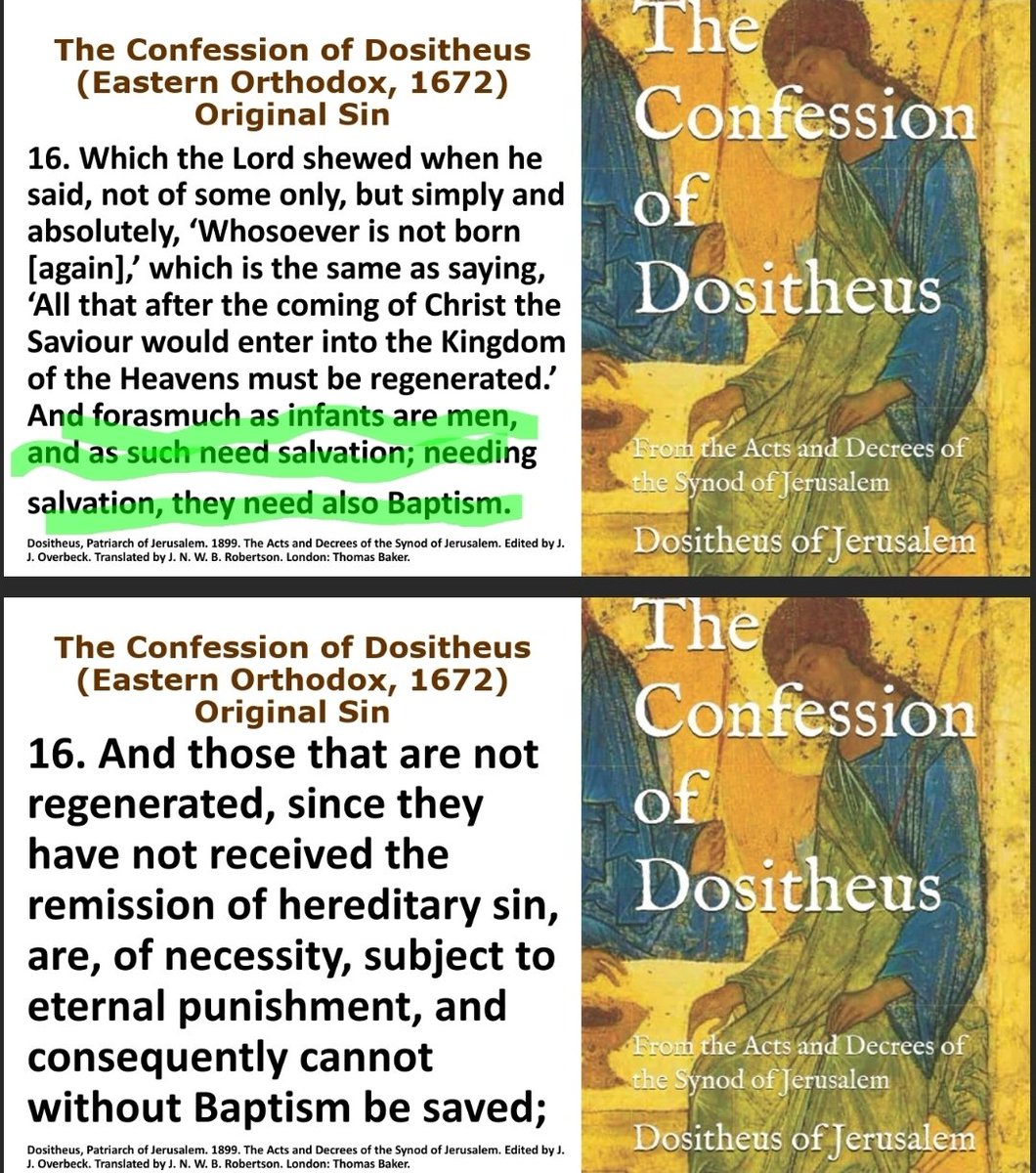
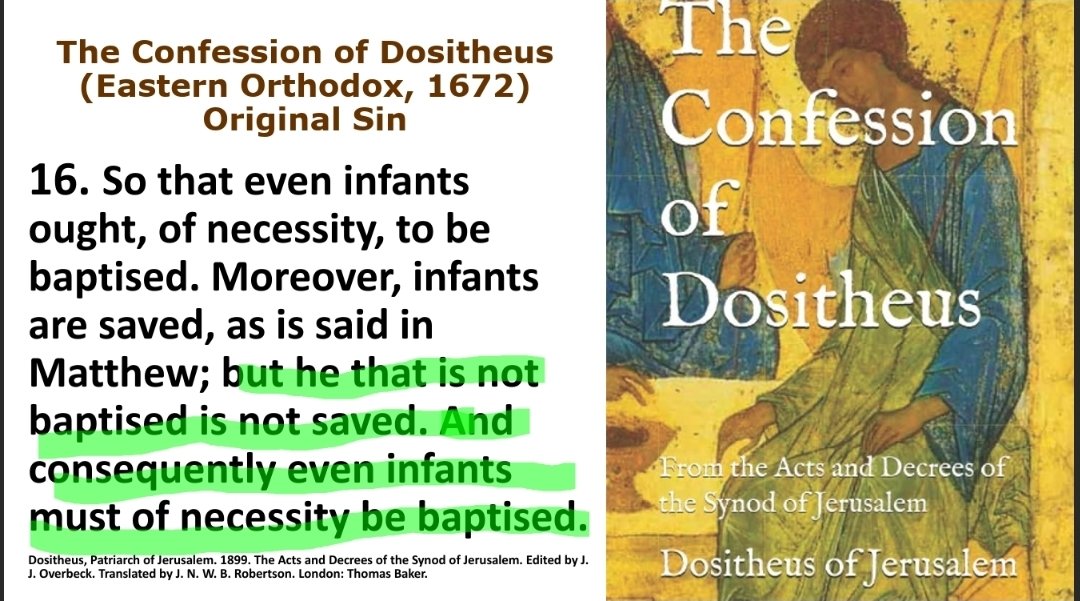
@AL_J82 It's an inaccurate and sloppy polemic that leads to people saying we don't believe in Original Sin, but it's mostly nuance. "Salvation" is not simply "going to the good place" vs the "bad place".
English
0
0
0
71
Alton T. Johnson
Alton T. Johnson@AL_J82·
Why are these online Eastern Orthodox Folks saying they reject original sin when their churches CLEARLY held that view?? Someone's not being honest....
Alton T. Johnson tweet mediaAlton T. Johnson tweet mediaAlton T. Johnson tweet media
English
22
4
35
16.7K
dionigi retweetledi
Energetic Procession
Energetic Procession@Acolyte83349490·
No I haven't and no I won't. And the reason is that I have spent hours and hours in the past with Erick to get him to understand a point or issue and then to have him go right back to asserting the contrary after he had assented to the point I made. It is a hamster wheel. Erick seems like a nice guy, but I think he is out of his depth and lacks requisite education. That doesn't mean people can't learn without the formal education but I see the same kinds of mistakes over and over again so it isn't worth my time. On the atonement, Erick seems to think that having a penal feature in a model amounts to PSA or that if he can't come up with any other way of understanding certain terms or phrases, then it must be fundamentally the Protestant schema, which is a fallacy of ignorance. This is not how a proper analysis of a text proceeds. Nor will it do to keep using the Protestant term and then redefine it and speak of "properly defined." Yeah concepts and word meanings don't work that way. Here Saul Kripke could help him out. I leave it to Catholic theologians to deal with Erick's material since they are decidedly opposed to PSA and have been for 500 years and counting. And I feel bad for Catholics that they now have to clean up this mess Erick has created. On the bright side, Erick has just produced something that undermines his credibility as a representative of Catholic theology and as an apologist. I never needed to refute him. I just needed to wait long enough for him to do it to himself.
English
1
10
85
4.8K
Dmitry
Dmitry@blessedmikko·
The recurrent claim seen in pop apologetics, originating in easily-contested Anglican scholarship, that a “penal substitutionary” atonement by virtue of imputation “requires medieval nominalism” seems to mistake a very ordinary juridical distinction for metaphysical fiction—which is unexpected from a jurist of all people. In any serious court, there is a plain difference between the person who originally incurred an obligation & the person who later assumes liability for it. Consider the example of a son who seeks to receive his deceased father’s estate by inheritance, but is made to receive not only the assets, but also the encumbrances attached to them. In such a case, no judge, by imposing responsibility for the debt upon the heir of the inheritance, consequently reckons the son as the one who first borrowed the money & incurred it. Thus, the legal order is not falsification of history; it is rather assignment of responsibility according to a recognised relation. And the analogy becomes stronger still when supplemented by suretyship: an innocent man may lawfully bind himself for another’s debt, satisfy the creditor, and release the debtor, without ever being reckoned the original author of the debt itself. That alone is sufficient to dispose of this nominalist charge. Imputation does not require this ridiculous thesis that one subject is merely verbally relabelled as another; it merely requires the affirmation that liability may be assumed without moral authorship being transferred. This is, of course, exactly the line taken by the 19ᵗʰ cent. Russian dogmaticians. Met. Macarius speaks of Christ as the “Surety” (Споручник) of the New Covenant, who by His death “paid our debt” before God, arguing that substitution is intelligible before Divine Justice precisely because the substitute is not Himself indebted, acts voluntarily, and renders full satisfaction. (ODT, Vol. 2, §149-55) Our sins remain ours in their origin, while their burden is taken up by Christ through His voluntary self-offering. He is debtor by gracious suretyship. He bears our guilt as the sinless Mediator and sacrificial Substitute.
Dmitry tweet media
English
7
19
51
3.9K
dionigi
dionigi@dionigiii·
@blessedmikko @sivartus Based on this, would you say that the punishment required is the eternal death, with suffering as a inevitable byproduct, or is the torment that comes with said eternal death also something God's Justice specifically requires?
English
1
0
1
33
Dmitry
Dmitry@blessedmikko·
@dionigiii @sivartus St. Philaret of Moscow explains it quite well here, this is from Patristic Nectar Films’ collection: x.com/i/status/19911…
Dmitry@blessedmikko

‘To satisfy God's Justice, strictly speaking, would mean to send sinners to eternal death, not allowing them any possibility of eternal life. After all, how can the sinful life of a person approach the life of the all-holy God? Such a huge disparity threatens the inevitability of the destruction of unworthy creation, like straw in a furnace. It gives no hope of salvation. And so, what does the God of miracles do? He takes His own hypostatic life, the life of His only begotten Son, and places It into a small lot of human nature, long prepared by mystical activity for this fate, protected by His own grace from the admixture of sin, and He united divinity and humanity into a single hypostatic union of God and Man. He then led this divine-human union, which includes all of human nature save for sin, even into suffering, weakness, and death itself. And what happened? The Justice of God is completely satisfied, because in the person of the God-Man, Mankind as a whole received a just death, and received it fully, for all times, because the moment of the death of the God-Man, by virtue of the presence of eternal divinity, is equated to eternity. It is on the satisfaction of God's Justice that the Redeemer has the power to forgive a repentant sinner without the dangerous hope of non-punishment for those who do not repent. At the same time, the life of God, having descended deep into human death, but not being contained by that death in His essence, from the depth of death shines forth for all mankind that has been brought to death through sin, and so He leads into eternal life all souls that open themselves up to that light through faith and do not repel it with unbelief and hard-heartedness. This is how God loved the world.’ –Saint Philaret of Moscow, Sermons on the Mother of God, Sermon IX, The Mystery of Ungodliness

English
1
0
0
76
dionigi
dionigi@dionigiii·
@blessedmikko @sivartus Is the idea that that Divine Justice just requires someone to suffer, whether or not it's the guilty party?
English
1
0
0
43
Dmitry
Dmitry@blessedmikko·
In ordinary human law, not anymore, although that in fact has been the case historically (albiet rare). Criminal punishment is understood today as personal & proportioned to the offender’s own intention and blameworthiness. Whereas suretyship properly belongs to obligation & debt, not to the transfer of criminal culpability or sentences. However, if such a fact were to be weaponised as some objection, it would sort of miss the point of OP, as I don’t claim God accepts an unrelated innocent man as the criminal himself; rather I claim that the Incarnate Son, as the voluntary Surety & sinless Mediator, bears sin’s penal consequences in a sacrificial & representative manner. The absence of a 1:1 analogue in municipal criminal law is unnecessary, since the atonement is a unique divine act in which our sins remain ours in origin, while their burden is taken up by Christ through His voluntary self-offering. Ultimately the analogy I provided was used specifically in order to refute the nominalist objection to imputation, not to suggest that the Atonement must be mapped without remainder onto the positive forms of municipal criminal law.
English
1
0
3
142
dionigi
dionigi@dionigiii·
@ConvincedO @AL_J82 "supports Catholic things and criticizes Orthodox things" *does* sound a lot like a certain group of people identifying as Orthodox on Twitter...
English
0
0
0
5
ConvincedOptimist ☦️
@AL_J82 If you look at his feed, he supports Catholic things and criticizes Orthodox things. The way he behaves is unchristian, but I see no reason to slander us on his account.
English
1
0
11
94
dionigi
dionigi@dionigiii·
@Hleowstede Sorry that was the wrong video and super boring. This one is the same guy and also kind of boring but less so. He's a former tradcath-oblate convert to Orthodoxy occasionally grappling with not having a cohesive Breviary or Missal youtube.com/watch?v=J24PqN…
YouTube video
YouTube
English
0
0
1
18
Dæg
Dæg@Hleowstede·
@dionigiii I'll check it out, thank you
English
1
0
0
16
Dæg
Dæg@Hleowstede·
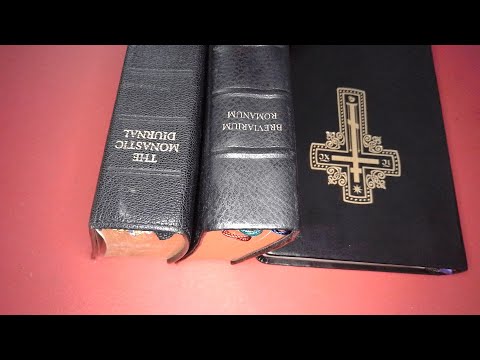
So do you actually need all those books to pray the eastern rite hours or are there more compact sources?
English
3
0
1
185
dionigi
dionigi@dionigiii·
@Hleowstede If you want to cover every single proper through the year you'd need a lot, but for parish/lay use (as with most things) it's expected that you'd just scale down from the monastic practice. BUT, there's always this: liturgy.io/orthodox
English
1
0
1
35
FloridaMan 🇺🇸🇵🇷🇮🇹☦
There needs to be an Orthodox council in the US to standardize a western rite. The western rite is a beautiful concept it just needs standardization.
English
28
6
124
6.9K
dionigi
dionigi@dionigiii·
@TheodoreR_Daug @firsttosettle @FloridaMan7745 If the Church accepts it as Orthodox, it is. Doesn't matter if I like it, but I also don't have to believe that it's the OG Mass of St Gregory or that it's been preserved by living tradition. But I'm also a layman bullshitting on Twitter to kill time, same as everyone else here
English
1
0
0
19
dionigi
dionigi@dionigiii·
@TheodoreR_Daug @firsttosettle @FloridaMan7745 How is that not clear..? Anyway, you're getting stuck on a detail I don't find particularly important or interesting, and I'm happy to let it go. I'd love to know how referring to Trent isn't *deeply* suspicious if there was Orthodox tradition to utilize instead, though.
English
1
0
0
26