Djino

182 posts

Djino banner
Djino

Djino

@djigamer_

ETH BNB AND LAYERS2

Katılım Ocak 2018
368 Takip Edilen168 Takipçiler
Djino retweetledi
MH Ventures
MH Ventures@mhventures·
🚨 Important Security Alert for MH Ventures Portfolio Companies & others We've seen a surge in sophisticated phishing emails impersonating, Berkower LLC. They attach or link to a fake “MH Ventures - Audit Confirmation Request Form” and ask you to sign/return it. Key red flags: Fake domain: berkowerllc.org (real Berkower is berkower.io) Sender “Seyma Altinsoy Korkmaz” is not part of the real Berkower team Do not click any links Do not open attachments Do not sign or reply to these emails Notify MH Ventures immediately if you receive one of these emails. You can also verify directly with Berkower via their official site: berkower.io
English
6
21
31
1.1K
Djino retweetledi
0G Labs (Home of Infinite AI)
Building apps used to require code, cloud accounts, and centralized providers watching your every prompt. That era just ended. Meet 0G App, the ultimate hub for decentralized AI. Prompt to app. Verified inference. 🐼 Try the Desktop App now → app.0g.ai
English
78
54
249
176.9K
Djino retweetledi
Varun
Varun@varun_mathur·
Introducing the Agent Virtual Machine (AVM) Think V8 for agents. AI agents are currently running on your computer with no unified security, no resource limits, and no visibility into what data they're sending out. Every agent framework builds its own security model, its own sandboxing, its own permission system. You configure each one separately. You audit each one separately. You hope you didn't miss anything in any of them. The AVM changes this. It's a single runtime daemon (avmd) that sits between every agent framework and your operating system. Install it once, configure one policy file, and every agent on your machine runs inside it - regardless of which framework built it. The AVM enforces security (91-pattern injection scanner, tool/file/network ACLs, approval prompts), protects your privacy (classifies every outbound byte for PII, credentials, and financial data - blocks or alerts in real-time), and governs resources (you say "50% CPU, 4GB RAM" and the AVM fair-shares it across all agents, halting any that exceed their budget). One config. One audit command. One kill switch. The architectural model is V8 for agents. Chrome, Node.js, and Deno are different products but they share V8 as their execution engine. Agent frameworks bring the UX. The AVM brings the trust. Where needed, AVM can also generate zero-knowledge proofs of agent execution via 25 purpose-built opcodes and 6 proof systems, providing the foundational pillar for the agent-to-agent economy. AVM v0.1.0 - Changelog - Security gate: 5-layer injection scanner with 91 compiled regex patterns. Every input and output scanned. Fail-closed - nothing passes without clearing the gate. - Privacy layer: Classifies all outbound data for PII, credentials, and financial info (27 detection patterns + Luhn validation). Block, ask, warn, or allow per category. Tamper-evident hash-chained log of every egress event. - Resource governor: User sets system-wide caps (CPU/memory/disk/network). AVM fair-shares across all agents. Gas budget per agent - when gas runs out, execution halts. No agent starves your machine. - Sandbox execution: Real code execution in isolated process sandboxes (rlimits, env sanitization) or Docker containers (--cap-drop ALL, --network none, --read-only). AVM auto-selects the tier - agents never choose their own sandbox. - Approval flow: Dangerous operations (file writes, shell commands, network requests) trigger interactive approval prompts. 5-minute timeout auto-denies. Every decision logged. - CLI dashboard: hyperspace-avm top shows all running agents, resource usage, gas budgets, security events, and privacy stats in one live-updating screen. - Node.js SDK: Zero-dependency hyperspace/avm package. AVM.tryConnect() for graceful fallback - if avmd isn't running, the agent framework uses its own execution path. OpenClaw adapter example included. - One config for all agents: ~/.hyperspace/avm-policy.json governs every agent framework on your machine. One file. One audit. One kill switch.
English
139
181
1.3K
139.6K
Djino retweetledi
Varun
Varun@varun_mathur·
Introducing Matrix I crawled 100,000+ agents, skills and tools to train a new model which can answer what capabilities are the best match for a task. Think Google, but for agents. A living model that learns from the gossiping network, and gets smarter with every interaction.
Varun@varun_mathur

Hyperspace: Gossiping Agents Protocol Every agent protocol today is point-to-point. MCP connects one model to one tool server. A2A delegates one task to one agent. Stripe's MPP routes one payment through one intermediary. None of them create a network. None of them learn. Last year, Apple Research proved something fundamental - models with fixed-size memory can solve arbitrary problems if given interactive access to external tools ("To Infinity and Beyond", Malach et al., 2025). Tool use isn't a convenience. It's what makes bounded agents unbounded. That finding shaped how we think about agent memory and tool access. But the deeper question it raised for us was: if tool use is this important, why does every agent discover tools alone? Why does every agent learn alone? Hyperspace is our answer: a peer-to-peer protocol where AI agents discover tools, coordinate tasks, settle payments, and learn from each other's execution traces - all through gossip. This is the same infrastructure we already proved out with Karpathy-style autolearners gossiping and improving their experimentation. Now we extend it into a universal protocol. Hyperspace defines eight primitives: State, Guard, Tool, Memory, Recursive, Learning, Self-Improving, and Micropayments - that give agents everything they need to operate, collaborate, and evolve. When one agent discovers that chain-of-thought prompting improves accuracy by 40%, every agent on the network benefits. Trajectories gossip through GossipSub. Playbooks update in real-time. No servers. No intermediaries. No configuration. Agents connect to the mesh and start learning immediately. The protocol is open source under Apache-2.0. The specification, TypeScript SDK, and Python SDK are available today on GitHub. The CLI implements the spec - download from the links below.

English
54
136
1.2K
897.7K
Djino retweetledi
0G Labs (Home of Infinite AI)
ICYMI - 0G Introduces Sealed Inference: "AI agents read your entire codebase now. Your source code, your keys, your business logic. Privacy at that level can't be a policy promise. It has to be enforced by the architecture. That's what Sealed Inference does: the hardware itself prevents anyone from seeing your data during processing. Not us, not the node operators, not anyone." -  @aytunc - Chief Growth Officer
0G Labs (Home of Infinite AI) tweet media
English
16
17
99
68.3K
Djino
Djino@djigamer_·
@offgridcash Really need this card, let me test please
English
0
0
0
33
OFFGRID
OFFGRID@offgridcash·
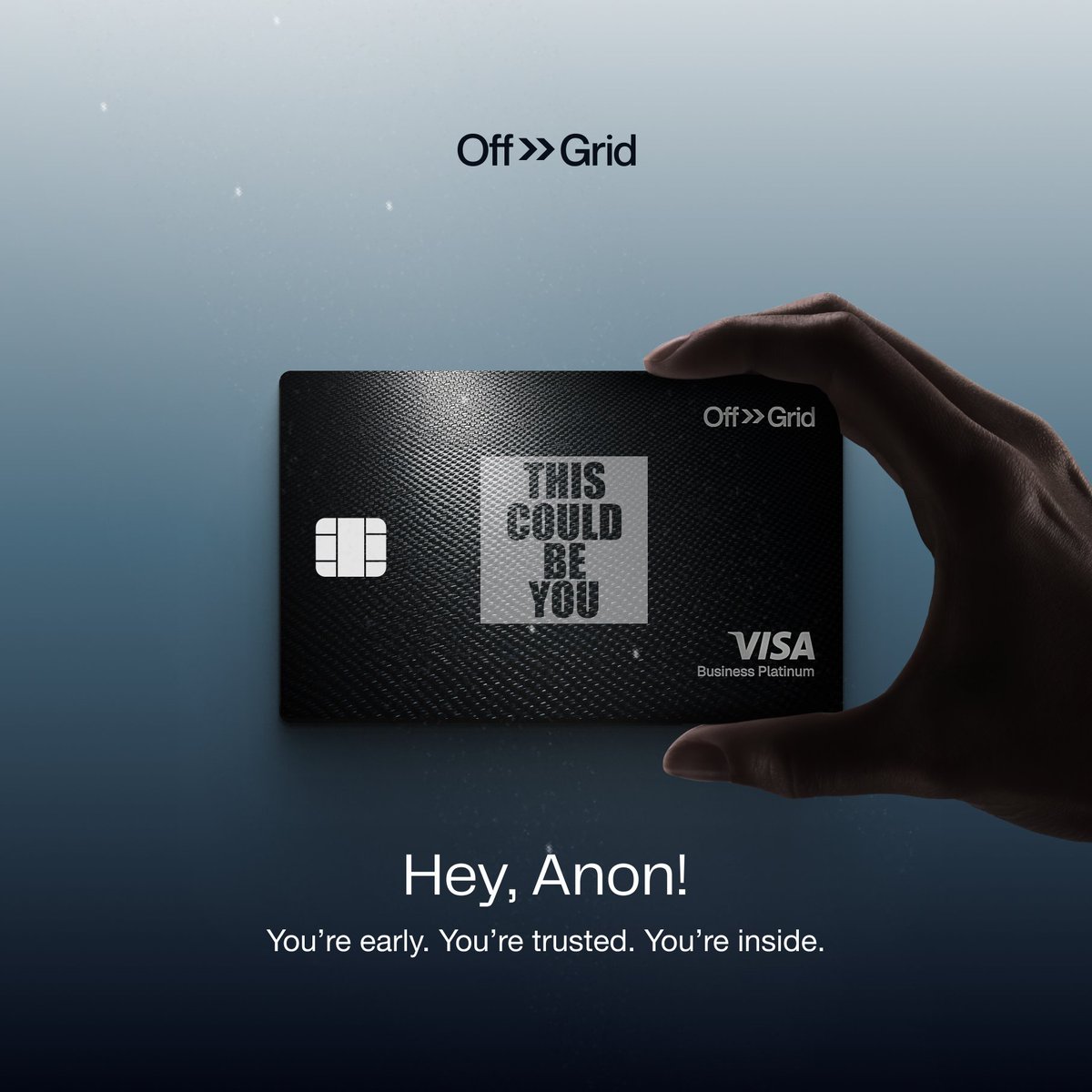
We've been quiet. Now we're back. Instead of announcing beta, we shipped it. Gave access to a small group, let them test everything first. App is live, transactions going through, feedback has been solid. (More big updates coming soon. A lot more.) For now we're slowly dropping more invites. Reply why you should be next.
OFFGRID tweet media
English
144
13
308
26.5K
Djino retweetledi
DeFi Dad ⟠ defidad.eth
DeFi Dad ⟠ defidad.eth@DeFi_Dad·
I just uncovered a great story of DeFi builders executing. When the bear market hits, you always learn who's serious about building long-lasting DeFi and who's not. I would implore you to take a second look at @gaib_ai. The protocol currently has: + Over $20M in stablecoin deposits + $19.9M in sAID (staked AID) earning yield + Current gross yield = 14.46% (all real yield) + 20% fee on all interest paid goes to GAIB treasury + Leaving 11.6% APY real yield for sAID holders + 99% of this liquidity issued on Ethereum + Of the $20M in liquidity, $19.4M has been issued across 2 loans, which is why the real yield is possible (see screenshot from attestation report as of Feb 2nd). GAIB is working--private credit for neocloud providers (ie AI data centers). Meeting insane demand for loans to expand and grow data centers. Also, for anyone rightfully concerned about the risk of default, there are 3 ways GAIB protects its lenders: + Legally enforceable contracts + Credit default insurance + GPU-backed loans (which was always the pitch) And they're issuing more loans soon, I don't know how much and what date, but they've got a huge pipeline of borrowers they're working through with LPs excited to meet borrower demand. This is what bear markets are for--discovering and reinforcing the builders who build real value onchain. And the GAIB token currently trading at $30M FDV, isn't some worthless governance token, it's already accruing value through a 20% platform fee, with ample room to grow profits.
DeFi Dad ⟠ defidad.eth tweet media
GAIB@gaib_ai

Portfolio Tracking You can now see estimated earnings directly in your portfolio page. Your projected sAID returns are calculated based on historical and current holdings, giving you clearer visibility over time.

English
12
2
28
5.3K
Djino retweetledi
Varun
Varun@varun_mathur·
we have built a product exponentially more powerful than the one I demo-ed in SF last august. this is our product roadmap progression: > agentic-os release (March 2026): where it all comes together. more lines of code than Openclaw, using it's own brain (not Claude Code). likely one of the most craziest and ambitious software systems ever synthesized (productizing it phase) > hyperdev-1 agent (Aug - Sept 2025): pre-dated Openclaw with a highly opinionated and optimized Claude Code setup running on a powerful machine with local models, full system access - optimal combination of powerful software and hardware to do useful things rapidly (fun/experiment phase for me) > agentic-os vision (July - Aug 2025) going beyond just the agentic browser; demos showed orchestrating multiple CLIs, spatial UI, in-built browser automated navigation, local graph memory, all integrated into one (hey everybody build this and everything here) > agentic network: collaborative peer-to-peer network (May 2025); built the largest adhoc network of connected agents in the world each bringing their verified compute with over 2 million unique machines registered (it is possible to build the next bittorrent, but for ai agents) > agentic browser vision (Dec 2024) going beyond individual AI apps: what does the right UI look like, how extensive the software should be, use cases (think of what comes after the browser) > collaborative DAG-based multi-agent co-ordination (Sept 2024); key insight: orchestrating multiple models and agents yielded comparable results to gpt-4 at the time + show user how the AI system thinks to built trust UX (it seems rabid, but we must dream and push for what the alternative world could be) > collaborative RAG (Sept 2023); key insight: this was better for UX than just one big model, better results than ChatGPT and Perplexity at the time for certain curated domains ("it is hopeless to compete against us")
Varun@varun_mathur

Hyperspace: The Agentic OS Apple Should Have Built On December 19th, 2024, we announced the world’s first Agentic Browser. What followed was a movement — a new category was born which led to many early products in this space and recently the hundreds of people lining up outside the The Agentic Browser Summit in San Francisco underscored that. Silicon Valley instinctively gets it, from students to tech executives, people can feel a revolutionary new change in computing is in the air. Past year taught us why such a product was inevitable, a hard engineering effort, and also the last mover in the entire software world this decade if and when done right. All paths are headed in the same direction: one tool which orchestrates them all. At Hyperspace we showed that path with essays and products we launched in earlier months: from a spatial UI of orchestrating agents, to showcasing transparent activity in how the AI system operates which leads to user trust, to presenting the software end-game, which massively improves human productivity. We also built the world’s largest AI network, drawing participation from people in almost 6000 cities around the world contributing their machines as nodes in the network. Think Uber, but for AI. That is, planetary-scale. And now we are stretching this industry ambition further with our end-to-end vision of the Agentic Supercomputer, the first breakthrough new AI OS, and an effort which spans from AI research to distributed systems to inventing a new UI to inventing a new business model to complement it. All of this together helps us in serving our mission, of delivering “Everyone’s Personal Supercomputer”. While others have built AI-native browsers, no one though has built something agentic from the ground up — with AI as the foundation, not a feature. How do you fundamentally improve the lives’ of billions around the world ? We believe that requires building a native environment for agents to be viewed, created, deployed, executed, discovered and priced in. That is a world where we move on from static apps, to dynamic agents. But, as my 2 year old niece likes to ask: “but why ?” The issue is that the world of software today is fragmented, and everyone is sprinkling on AI as a feature and charging a subscription fees for it. From browser makers, to IDEs, to design and other productivity tools. This leads to a fragmented UX, where people have to learn to use AI in each app, their memory and other context is not shared between all these apps, and they also have to pay separately for compute for each such AI-enhanced app. Each app maker has to figure out basics such as compute, and leads to the issues we saw with Cursor pricing recently. This is not the future. What if AI was the foundation instead of a feature ? What if Apple had built a fundamentally new AI OS from the ground up and what would it have looked like ? At Hyperspace, that is what we did. On July 15th we introduced three breakthrough key pillars of our AI OS: 1. Agentic Browser 2. Agentic Memory 3. Agentic Payments And we didn’t stop there. We also introduced a breakthrough new user interface called the Spatial AI which is inspired both from the spreadsheet and the HyperCard - each card is an agent, with it’s own inputs and outputs, endlessly extensible and pluggable with others, just like cells of a spreadsheet. Update one cell and all the dependents update, like a spreadsheet formula. It goes beyond a static linear workflow to being able to operate in all directions. This revolutionary new interface helps manage all of the below: 1. Multiple websites being browsed in parallel 2. Multiple desktop apps being browsed in parallel 3. Multiple server tools being used in parallel 4. Multiple smartphone apps streamed to your device or opened via an emulator All the software which you need comes together in this one seamless, agent-native interface. This interface provides you access to the largest network of models, vectors, agents and compute on the planet. The Browser. The IDE. The Notepad… they are not separate products: they are all in one, the Agentic Browser. As Steve Jobs famously said at the iPhone announcement, “are you getting it ?” And beneath this UI lies a new intelligence routing layer — leveraging both swarms of specialized models to the Hyperspace Matrix model that recalls thousands of tools in real-time, not by context window hacks, but through retrieval, ranking, and reuse. To many, this will feel like AGI. Not one big system by one big company, but an intelligent network. Now lets talk about privacy… Are you comfortable with one company owning all your memory forever ? I am not. So we have invented Agentic Memory as a new open protocol which provides full power over memory to you, the user. Your memory is yours, encrypted, on your device, and portable if and how you want. Anyone can build on it without our permission, but not without your permission. This protocol, and the decentralized vector database spread out across the world, would enable apps and agents to share context and memory. Think copy-paste, but for the AI world. It doesn’t just remember — it knows what matters. VectorRank helps your AI weigh your life’s most relevant moments over time, just like the way our minds elevate memories. Now each time you use an agent, your experience with other agents will also continuously improve: you don’t have to keep repeating the same things about yourself, while fully preserving your privacy. Agentic Memory is accessible within the Agentic Browser to manage. And there is one more thing… AI as the foundation requires compute to be available at the base layer, but this base layer spans models running on your own device, to cloud APIs, to also running across the peer-to-peer distributed network. Agentic Payments provides a singular interface to all of that compute, running a spot auction clearing marketplace every second to determine the fair price of compute. This results in price transparency, and you as the user paying the lowest possible cost. If you want predictability, you can reserve compute in advance. This end-to-end system provides the most streamlined world for agents to operate in. In order to enable this world and the world of agents being able to pay each other in sub-cent increments millions of times a second, we had to also invent a fundamentally new agentic micropayments blockchain. All of this together would enable a world where you as a user, or the agent itself, can efficiently call and utilize other agents built by others and also pay for content which is unique and useful. This enables a move away from the current AI exploitative economy for bloggers and other content creators, to a web with a fundamental new business model. Earlier we didn’t have the right infrastructure to enable such a world. Now, all the dots connect. The Hyperspace AI OS would give the power of a supercomputer in everyone’s hands. This isn’t a browser, or an IDE or limited to any device or cloud. It’s an entire AI operating system — with a breakthrough new spatial UI, local and distributed compute, agentic memory, agentic payments, and orchestration built into the foundation. As a user, we move the choice back in your hands with an experience you will love and find delightful. You get to choose the level of privacy, cost, and utility you want. And while Apple should have done it, we could not wait, and we feel this just required a new level of passion and DNA which we bring here. We are just getting started. Thank you, Varun Mathur Cofounder and CEO, Hyperspace cc @naval @pmarca @vkhosla @karpathy @sama

English
11
3
44
6.3K
Djino retweetledi
Nesa
Nesa@nesaorg·
Miner Mondays: Built To Scale ⬟ As the Nesa ecosystem expands, so does the need for reliable nodes. Run a node to contribute compute and support overall network reliability, all while being exclusively rewarded with Miner Points. Now with Nesa Bootstrap, it’s easier than ever to get setup! Get started below ↓ 📚 Docs: #quickstart" target="_blank" rel="nofollow noopener">github.com/nesaorg/bootst… ❓ FAQ: github.com/nesaorg/bootst… 🧰 Custom scripting: @nesaorg/ai-sdk" target="_blank" rel="nofollow noopener">npmjs.com/package/@nesao… 💬 Need help? Join Discord: discord.gg/nesa
English
323
176
354
14.9K
Djino retweetledi
zkPass
zkPass@zkPass·
Introducing zkPass: Building the Verifiable Internet through zkTLS TL;DR zkPass is a zkTLS-based oracle protocol that enables applications to verify facts derived from private web data through cryptographic proofs. It allows statements about HTTPS-sourced data to be verified without exposing underlying information or requiring changes to existing systems. zkPass extends standard TLS with zero-knowledge cryptography to enable verifiable claims over authenticated HTTPS data. The protocol has been applied across hundreds of verification schemas and integrated by dozens of applications, allowing Web2-sourced facts to be used in decentralized systems in a privacy-preserving manner. This architecture bridges authenticated web data and onchain verification without introducing trusted intermediaries, enabling applications to rely on real-world information while preserving user privacy. For readers seeking deeper technical detail on the cryptographic constructions, protocol flows, and performance considerations, a dedicated technical paper is available: paper.zkpass.org/tech.pdf Additional documentation and references are available at docs.zkpass.org.
zkPass tweet media
English
80
44
391
39.4K
Cascade
Cascade@cascade_xyz·
The first 24/7 neo-brokerage. Trade perpetual markets for crypto, equities, and private assets. Move USD in and out, all from one unified account. 48 hours to secure an early invite. cascade.xyz/join
English
36K
36.4K
40K
874.2K
Djino retweetledi
zkPass
zkPass@zkPass·
Introducing PoMA (Proof of Medium Authorship) powered by @zkPass. 🔗 poma.zkpass.org Outside of X, content creators are often ignored in incentive designs because platforms like Medium offer no public APIs or OAuth to verify who actually wrote what. So we built a simple tool that taps into zkPass’s core capability: proving anything from any website privately, without ever revealing the underlying data. This group of verified creators will be included as an additional eligibility type for the $ZKP Genesis Airdrop. A few notes: 1/ Use TransGate on web to generate a ZK proof for any of your articles. It runs locally and no gas is required. 2/ Only articles published before this announcement are eligible. No last-minute farming. 3/ Topics are not limited to zkPass - any ZK-related writing, even about other ZK projects, is welcome. 4/ This is a small additional reward and does not dilute existing credit holders. Nothing here is financial advice or a promise. gZKP.
zkPass tweet media
English
83
49
394
208.1K
Djino retweetledi
zkPass
zkPass@zkPass·
Quick Tutorial: How to Prove You’re the Author of a Medium Article 1/ Open poma.zkpass.org (best experience on Chrome desktop) and install the TransGate extension when prompted. 2/ Generate Your Proof › Click “Verify on Medium.” You’ll be redirected to Medium - scroll and open the article you want to prove. › When you're on the correct article, click Start at the bottom-right corner. › TransGate will generate a ZK proof locally in your browser, and you’ll immediately see whether your authorship is verified.
zkPass@zkPass

Introducing PoMA (Proof of Medium Authorship) powered by @zkPass. 🔗 poma.zkpass.org Outside of X, content creators are often ignored in incentive designs because platforms like Medium offer no public APIs or OAuth to verify who actually wrote what. So we built a simple tool that taps into zkPass’s core capability: proving anything from any website privately, without ever revealing the underlying data. This group of verified creators will be included as an additional eligibility type for the $ZKP Genesis Airdrop. A few notes: 1/ Use TransGate on web to generate a ZK proof for any of your articles. It runs locally and no gas is required. 2/ Only articles published before this announcement are eligible. No last-minute farming. 3/ Topics are not limited to zkPass - any ZK-related writing, even about other ZK projects, is welcome. 4/ This is a small additional reward and does not dilute existing credit holders. Nothing here is financial advice or a promise. gZKP.

English
42
46
298
36.8K
Djino retweetledi
zkPass
zkPass@zkPass·
🎥 Recap of The Verifiable Nights - the biggest zkPass Community Meetup in Seoul🇰🇷! When privacy showed up wearing a hoodie and somehow became the most trusted person on the rooftop. ZKP vibe 🔥
English
66
35
235
36.3K
Djino retweetledi
Nesa
Nesa@nesaorg·
The counter to centralized AI. Built by a team of award-winning researchers, now powering the largest companies on earth. This is Nesa.
English
788
3K
8.3K
434.7K
Djino
Djino@djigamer_·
@gaib_ai nice 🔥🔥🔥🔥
English
0
0
0
1K
Djino retweetledi
zkPass
zkPass@zkPass·
Key words of zkPass: • ZKP • zkTLS • VOLEitH • Schema • TransGate • Attestation • Verifiable Internet • Privacy-Preserving
Deutsch
71
27
295
28.1K
Djino retweetledi
Wise3 Ventures
Wise3 Ventures@Wise3Ventures·
The $ZKP launch is getting closer every day, and we at Wise3 couldn’t be more excited about this project. One of the key factors for success is the people you surround yourself with, and zkPass has chosen the best partners to make it happen. Let’s take a look at them. 🧵
English
16
23
35
1.2K