David Tse

1.2K posts

David Tse

David Tse

@dntse

Professor at Stanford University (https://t.co/LJLXu7aKyi, https://t.co/lwU5yWvC6W) Co-founder of Babylon protocol, Information theorist.

Katılım Kasım 2013
172 Takip Edilen8.8K Takipçiler
Sabitlenmiş Tweet
David Tse
David Tse@dntse·
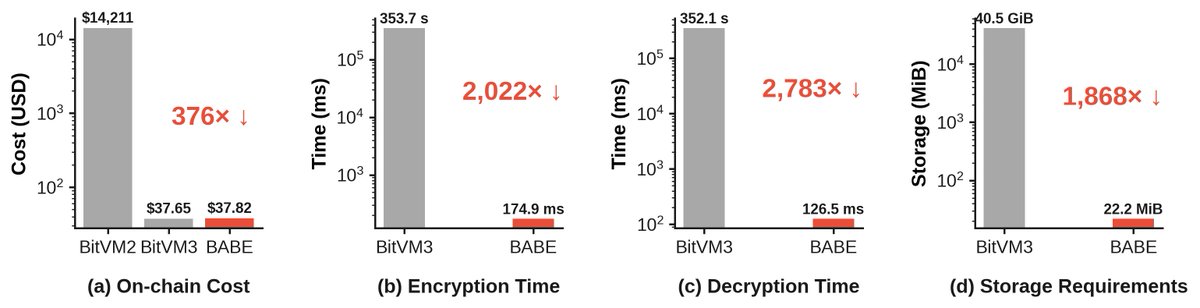
Today we release BABE, a new Groth16 proof verification protocol for Bitcoin. It improves the state-of-the-art by three orders of magnitude in setup and storage costs. eprint.iacr.org/2026/065.pdf BABE (BAbylon-BErkeley) is a synthesis of two key ideas: Witness encryption on linear pairing, and Argo MAC, a recently introduced garbling primitive. Witness encryption on linear pairing reduces the complex pairing operations in Groth16 verification to a single scalar multiplication on the BN254 elliptic curve. The single scalar multiplication can further be transformed into a vector homomorphic MAC, which can be efficiently computed by Argo MAC. BABE will be launched as part of Babylon's alpha-testnet for the Trustless Bitcoin Vault in February. We thank: - our Berkeley collaborators @SanjamGarg and Dimitris Kolonelos for teaching us so much about witness encryption - @liameagen and @therealyingtong for sharing their amazing work on Argo MAC - the Babylon engineering team, for turning our theoretical ideas into a real system with demonstrable performance gains Check out the paper and give us feedback!
David Tse tweet media
David Tse@dntse

BitVM2 suffers from a huge on-chain fee of > $15,000. BitVM3 dramatically reduces this to be less than $100, but the off-chain costs are very significant: terabytes to store the garbled circuits and hours of compute and communication to set things up. Bulky. Three months ago we embarked on a totally different approach based on witness encryption. Happy to report today that we got a 3 orders of magnitude reduction in storage and in the setup time while keeping the transaction fees as BitVM3. More details later.

English
15
41
212
28.9K
David Tse retweetledi
Babylon
Babylon@babylonlabs_io·
Today we published a temp check on the @aave governance forum: Babylon Trustless BTC Vault Integration on Aave v4. The temp check proposes two new Aave v4 Spokes to onboard native BTC as collateral via Trustless Bitcoin Vaults and seeks community input. governance.aave.com/t/temp-check-b…
English
14
13
69
31.8K
David Tse
David Tse@dntse·
@MillieMarconnni Sometimes you work on a research problem not because you already know it is the most important problem but because you are curious to understand something. Only later does it become really important. Claude Shannon’s information theory is a good example .
English
1
0
6
587
Millie Marconi
Millie Marconi@MillieMarconnni·
A mathematician at Bell Labs noticed that the scientists who won Nobel Prizes and the ones who never amounted to anything were equally smart, equally hardworking, and equally credentialed, and the only thing that separated them was a single question almost nobody is brave enough to ask themselves before they die. His name was Richard Hamming. He spent 30 years at Bell Labs, in the same building as John Tukey, Walter Brattain, and a long list of physicists who took home Nobel prizes for work they did down the hall from his office, including the legendary Claude Shannon. His invention of error-correcting codes made modern computing possible. He has won the Turing Award. And all the while he was creating his own legacy he was secretly doing a study on the people around him. The study was straightforward. 2 Teams. The legends and the lost. Same I.Q.s. Degrees same. Same desk hours. Same access to the world’s best resources. And yet, at the end of 40 years in their careers, one group had changed entire fields, and the other group could not be remembered by their own colleagues five years after retirement. He wanted to discover what the actual difference was. In March 1986, he stood before 200 researchers in a Bellcore auditorium and told them what he had seen. He said it all came down to one question. And hardly anyone he ever met was willing to ask it directly. He called it the Friday-afternoon ritual. He spent years blocking out his Friday afternoons and not doing anything productive with them every week. No experiments. No meetings. No deliverables. He called it Great Thoughts Time. He sat down with a notebook and asked himself a couple of questions in order. What are the most relevant problems in my discipline? And why I am not working on either of them.” Most weeks, the answer was the same, he said. For a week now he had marched confidently in a direction he did not think was the most important direction. He was a goer. He worked a bit. He was getting clean results that would publish in respected journals. ( And for five days straight he'd been lying to himself about whether any of it mattered. The reason almost nobody does this ritual is because the honest answer is unbearable. The thing is that if you sit down on a Friday afternoon and say out loud that you are not working on the most important problem in your field, now you have to do something about it. You have an immediate change in direction, or you have to keep lying to yourself every week from that point on. Most people choose the lie. In the short term it’s cheaper, but over a career it’s more expensive. Hamming took the ritual a step further in the Bell Labs cafeteria. He began approaching scientists he barely knew, asking them what they thought the most important problems in their field were. A week later he would ask them why they had not worked on these problems. Eventually people wouldn't have lunch with him. “I had to keep finding new tables,” he said. Nobody had a good answer for that, and being around someone who kept asking it made every meal feel like a performance review. The line that broke me is the line that most people skim over in the transcript. His words: If you do not work on an important problem you are unlikely to do important work. That’s not motivational line. It is a rational one. You cannot make a great result from a problem that does not matter. Input restricts the output. The choice of the problem is the ceiling of the career. The transcript has been freely available on the internet for almost 40 years. Stripe Press published the complete lectures as a book. Naval Ravikant quotes it all the time. It’s still given out to new hires at every serious engineering lab in Silicon Valley. Most people will not run the ritual this Friday. They will be busy. They always are.
Millie Marconi tweet media
English
46
346
1.4K
119.6K
David Tse
David Tse@dntse·
Babylon is looking for a researcher! Let me know if you or your colleagues are interested. Here is a short blurb: Babylon (babylonlabs.io) is a blockchain infrastructure startup founded by David Tse of Stanford and Fisher Yu, and backed by a16z, Paradigm, Polychain, and other leading investors. Babylon’s vision is to enable the trillion-dollar Bitcoin asset to be used trustlessly in the DeFi economy. Babylon invented Bitcoin staking, now a live protocol with over $4 billion in BTC staked (staking.babylonlabs.io). The team is currently focused on launching trustless Bitcoin vaults (docs.babylonlabs.io/papers/trustle…), enabling native Bitcoin to be used as collateral in DeFi protocols such as Aave, without wrapping or bridging. This work is powered by BABE (CCS 2026), a proof-verification protocol for Bitcoin based on witness encryption and garbled circuits, achieving a 1000× cost reduction over the state of the art (eprint.iacr.org/2026/065). The ideal candidate has a Ph.D. in distributed consensus, cryptographic protocols, or a related area, and a strong interest in doing impactful research in the blockchain space. In this role, the Senior Researcher will work closely with Babylon’s engineering team as well as external research collaborators at a16z, Common Prefix and leading universities.
English
7
28
95
9.5K
David Tse retweetledi
Babylon
Babylon@babylonlabs_io·
Today we published SCRIPT - Bitcoin Collateral Risk Assessment Framework. Bitcoin holders and applications can use SCRIPT to assess the counterparty risks of any Bitcoin collateral solution, including Babylon’s. The framework consists of six risk categories. Read more 🧵👇 babylonlabs.io/blog/script-bi…
Babylon tweet media
English
13
37
95
15.9K
David Tse
David Tse@dntse·
United we are all stronger.
Babylon Foundation@bbn_foundation

Babylon brings native Bitcoin into DeFi and bringing more Bitcoin into DeFi means supporting in hard moments. Babylon Foundation will deposit $3M USDT into Aave, with $2M allocated to V3 and $1M to V4, as a show of support and confidence in @aave and DeFi. Any interest earned from this deposit would be directed back into the Aave ecosystem through Aave x Babylon integration incentives, so the same capital can support recovery now and future adoption later. We believe DeFi is a core part of the modern financial system. That means competing, building, and rallying with the ecosystem when it needs it. We’re putting capital behind conviction and our commitment to the @aave ecosystem. defiunited.world

English
9
16
43
3.5K
David Tse
David Tse@dntse·
Forget about bridges.
English
5
7
40
6.2K
David Tse
David Tse@dntse·
Good engineering teams keep building.
English
1
1
17
977
David Tse
David Tse@dntse·
I've loved collaborating with the team at Berkeley (including @SanjamGarg and Dimitris Kolonelos), but we have set a high bar by solving a breakthrough problem in our very first work together.
English
0
2
21
2.3K
David Tse
David Tse@dntse·
When we entered the BitVM space 12mos ago, we were learners studying existing approaches. Fast forward and we've developed the 4G equivalent The way I see it. BitVM2 is like 2G, BitVM3 is 3G, and BABE is 4G By entering later, we got to skip generations.
English
1
1
10
1.2K
David Tse
David Tse@dntse·
Dan Boneh gets phone calls every few days asking whether quantum computing threatens Bitcoin. I'm not an expert in quantum cryptography, but Robin Linus thinks the fear is overblown. Right now, I'm focused on the more immediate challenge: launching the Bitcoin vault without losing anyone's bitcoin.
English
6
1
30
4.4K
David Tse
David Tse@dntse·
Ethereum's long-term goal: Everything should be proven, nothing trusted. Every transaction, every operation, formally verified as correct. They're starting with ZK proof systems. The ambition is remarkable even if fully achieving it remains distant.
English
11
19
82
6.9K
David Tse
David Tse@dntse·
Every time you move to a new research area, you lose everything except your thinking. No reputation. No relationships. No credibility. Just the problem in front of you.
English
2
2
36
2.2K
David Tse
David Tse@dntse·
Four years to find product-market fit. Four years to continuously improve it. That's the honest timeline for most successful protocols. Anyone claiming a shorter path is measuring something else.
English
1
2
24
1.1K
David Tse retweetledi
The Defiant
The Defiant@DefiantNews·
Ep 3 of Beyond Digital Gold is out! Will the real Bitcoin DeFi Please Stand Up?? Everyone disagrees with what Bitcoin DeFi is. Some say it already exists through wrapped Bitcoin on Ethereum. Others argue it will happen on Bitcoin Layer 2s, while disagreeing on what Bitcoin Layer 2s are. And some believe the only real Bitcoin DeFi must happen directly on Bitcoin itself. In our latest episode in our Beyond Digital Gold documentary series with @StarkWareLtd , we map the entire ecosystem and break down the six competing models trying to unlock Bitcoin’s trillion-dollar liquidity. Watch here 👇🏻 Full episode: youtu.be/cBHh1Fq9GjU?si…
YouTube video
YouTube
English
4
8
22
25.9K
David Tse
David Tse@dntse·
I'm learning cryptography through two methods: 1. Shamelessly asking our collaborator cryptographers "stupid" questions 2. ChatGPT as a 24/7 tutor After Dan Boneh's course, I can't ask him questions daily. But collaborators are captive audiences, and ChatGPT never sleeps.
English
3
0
32
2.3K
David Tse
David Tse@dntse·
Hackers perform cost-benefit analysis: How much benefit versus how much effort to find the exploit? Smart contract vulnerabilities offer better ROI than Bitcoin protocol attacks. This economic reality provides an additional security layer beyond cryptographic guarantees.
English
1
1
6
703
David Tse
David Tse@dntse·
AI learns from human-written papers. That means it also inherits our bad habits. The most common one in academic writing: when you're not sure about something, you cover it with language. "This is obvious" or "it follows that." No proof. No explanation. AI is doing the same thing. Confident hand-waving at the exact step where rigor matters most. If AI is trained on human shortcuts, how does it learn to do better than us?
English
3
0
16
1.1K
David Tse
David Tse@dntse·
Our 10.000x reduction in BitVM proof verification transforms three critical dimensions: 1/ Speed: Engineering cycles accelerate from months to weeks 2/ Cost: Operating expenses drop from $14,000 to $37 per transaction 3/ Sovereignty: What was technically possible but economically impractical becomes viable for everyday use
English
2
3
26
2.4K