Don ‘🇩🇴Bring Tesla 2 DR 🇩🇴’ Coon
5.1K posts

Don ‘🇩🇴Bring Tesla 2 DR 🇩🇴’ Coon
@donmcoon
Spirit-filled retired public High school science teacher w/ Tesla geek tendencies.


🇺🇸 SpaceX is exploring extending Starlink's laser communication network to the Moon, using the same optical tech already running in orbit today. Current Starlink satellites carry space lasers hitting 100 Gbps per link, with over 10,000 already operating and transmitting at least 42 petabytes of data daily. Reaching the Moon is a different challenge entirely. At 384,000 km away vs. a few hundred for LEO satellites, keeping a coherent laser locked on target is a serious engineering problem. There’s no timeline yet, but if it works, it would give NASA's Artemis missions a data pipeline far beyond anything currently possible with deep space communications. Elon is basically building the internet in space. Source: @starlink, @spaceX, Basenor

NEWS: California trucking firms have applied to buy 1,200+ Tesla Semis, a deal worth ~$348M. That is more applications than all other electric trucks combined since the state's incentive program launched in 2019. The Semi starts at ~$290,000 for the 500-mile range version. Competitors from Daimler and Volvo start at $400,000+ for less range. Tesla is also bringing a 350-mile version at a lower price. Both options out-range every other electric truck on the market. Jennie Abarca, owner of King Fio Trucking in Long Beach, ordered 20 Semis. "This is something new coming to the market that kind of answers all those problems." The Semi is doing to trucking what Model Y did to SUVs. Better range, lower price, massive demand. The incumbents never saw it coming.

Michigan police use grappling hooks, and this happens…


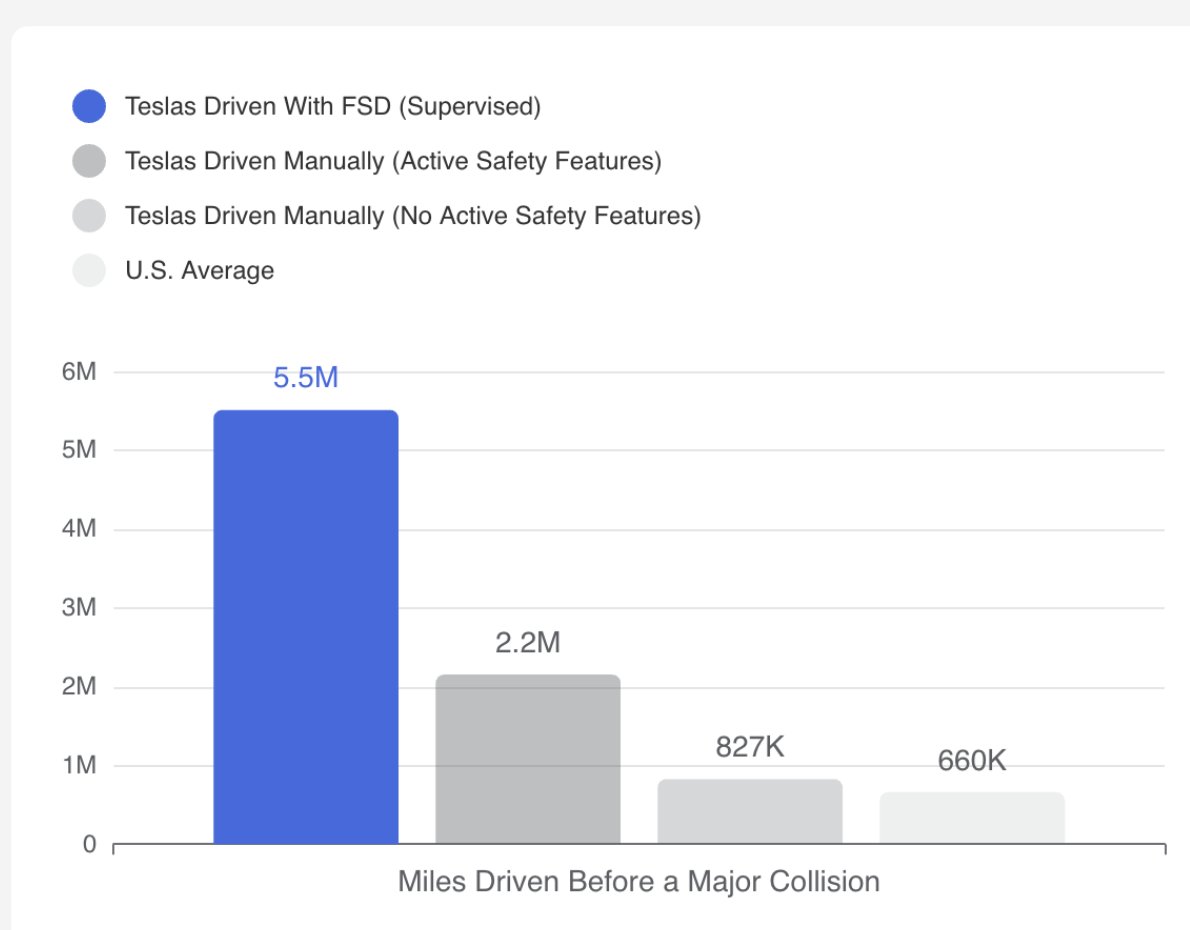
Just like a secondhand iPhone was a better option than a Nokia, BlackBerry or another flip phone around 2010-2020, for most people, a secondhand Tesla is a better option than any other new EV. If you’ve driven and experienced both for a sufficiently long time and if you’re objective, sooner or later you’ll realise there are several things that Tesla has that the “competition” doesn’t including: - Full Self-Driving (Supervised): While some brands now offer various driver-assistance systems, apart from Waymo (unavailable to private owners) and some systems in China, none provide comparable city streets capability in urban environments. (Note: Hardware 3 Teslas, especially outside the US, are still running effectively 6-year old software that’s night-and-day compared to FSD (Supervised) on HW4/AI4 vehicles.) - Supercharger network: Tesla has opened up its SC network to other EVs, however, the busier chargers are generally still reserved for Teslas and it’s a much more streamlined experience to charge a Tesla, For eg. no apps or adapters required - Safety - Service & maintenance: Tesla is still the only manufacturer without a mandated service schedule - Economics incl. Value for money, resale value, and lower total cost of ownership (TCoO) - Performance, Efficiency & Range Management - Software & Free over-the-air updates Some cars now have OTA but Tesla is the only manufacturer that can change the car’s performance characteristics with an OTA update. Also, the Tesla updates are much more frequent, delivering many more features and much more value than anyone else. - Best app - In-car entertainment - Storage & Practicality - Owner Satisfaction - Real World Data - Range of 3rd party accessories - The Tesla Community Teslas are the best value cars on the market but if the upfront cost or sticker price is too high you’re better off with a second hand Model Y or Model 3 than a new substandard EV which will lose its value much faster and you’ll be looking to upgrade it in a few years especially when Teslas are driving their owners around. You’ll feel like you did in 2010 when you had a flip phone while everyone else got an iPhone. A second hand iPhone would have been a better option than a new Nokia or BlackBerry. The same principle applies now with electric vehicles. If you haven’t driven a Tesla, especially a HW4/AI4 Model Y with FSD (Supervised), rent one for at least a week and you’ll understand what I’m talking about. Video created with @Grok


At this U.S. visit to China dinner banquet, the most eye-catching figure in the prime center seat between Musk and Cook was Lansi Technology founder Zhou Qunfei—from a rural factory girl to China's richest woman, with absolutely no background to rely on, building everything from scratch through her own grit. She was born in a small village in Hunan Province. At age 5, her mother passed away, and her father became disabled and blind from a work injury, leaving the family in dire poverty with nothing to their name. At 16, unable to afford school fees, she was forced to drop out and head to Guangdong to work in a factory, grinding glass on the assembly line—working days away during the day and furiously self-studying at night, earning certifications in accounting, computer operations, and other skills. That's how she spent a few years, until she scraped together 20,000 yuan from her wages, rallied eight relatives including her brother, sister, sister-in-law, and brother-in-law, and started a small workshop in Shenzhen doing watch glass processing. She handled machine repairs and sales runs single-handedly, grinding away like that for another four years. By the 2000s, the mobile phone industry began booming on a massive scale. By a stroke of luck, her watch glass factory landed an order for TCL phone screens. She spotted the huge potential in the phone glass market and quickly founded Lansi Technology, specializing in the production, R&D, and sales of phone glass. At first, they only handled domestic phones and knockoffs, but everything changed when she went after a Motorola order—foreign companies had insanely strict quality standards. She bet nearly all her resources to meet Motorola's demands and snagged the V3 order, which sold over 100 million units worldwide, catapulting Lansi Technology straight to industry leadership. From there, she smoothly secured deals with Nokia, Samsung, and other foreign giants. The pivotal turning point hit again in 2007, when Jobs unveiled the first iPhone, revolutionizing phones toward full-glass touchscreens. Jobs' obsessive craftsmanship demands left the whole world scrambling for a supplier that could meet them. Zhou Qunfei keenly sensed this was another massive opportunity, so she led her team in a three-month joint push with Apple engineers, breaking through key processes to mass-produce the first-generation iPhone glass panels. That locked in a long-term Apple contract, and soon after, nearly all Apple gear—from iPads to MacBooks—went to Lansi Technology for production. It also propelled Lansi to become the world's top player in touch glass panels. That's why she got to sit next to Cook. But why was Musk right there beside her too? After dominating global glass panels, Lansi Technology branched into more diverse smart devices, including car cockpits and robots. In autos, they've already locked in deals with 30 carmakers like Tesla, BMW, Mercedes, and Li Auto for windows, center consoles, and more. In robotics, they handle joints, sensors, and other components—areas with deep overlap in Musk's businesses. A girl who dropped out at 15 with just a junior high diploma, emerging from rural Hunan to build an empire from nothing and become China's richest woman—forty years later, stepping into U.S.-China talks, seated between Musk and Cook. That's Zhou Qunfei's story. - @hihongjie