

donnager
1.7K posts

A Tale of 2 Gaps.
Which fills first - 70k or 67k?
Wrong answers only.

English


The "AI job loss" narratives are all fake. AI = massive ramp in productivity = massive ramp in demand = massive jobs boom. Watch.
Marc Andreessen 🇺🇸@pmarca
1. Employer recovery from post-COVID hiring correction 2. Employer recovery from post-COVID interest rate spike 3. Elasticity = demand boom QED
English
donnager retweetledi

UK: King Charles – the “Defender of the Faith” – will not deliver an Easter message this year.
He did, however, deliver one for Ramadan.
May the king repent and honor the King.
Britain is stumbling.
Christ is risen.
English
donnager retweetledi

how is this a real chart?
people spend more money (4x) on gooning than ai

English
donnager retweetledi

My superpower has always been overthinking. I can think of hundreds of possible scenarios for something that might happen, or might never happen at all. But this Iran-US war situation is the first time my brain has almost shut down instead of doing what it usually does. For the first time, overthinking does not feel like a superpower. It just feels like pain.
Every possible scenario has a counter-scenario. Every viewpoint has a counterpoint. Every analysis can be answered by another analysis. There is too much misinformation, too little real information, too much propaganda, too much psychological warfare, and far too many people acting certain about things that are not certain at all. And when you combine all of that, it creates thousands of branches, thousands of possible outcomes, and no clear ground to stand on.
That is what makes this so exhausting. It is not simple. It is not clean. It is not black and white. Every scenario leads to another scenario, and that one leads to ten more. You think you have reached a conclusion, then one new piece of information changes everything. You think one side is obviously right, then reality reminds you that the world is not built in 0s and 1s, even if many people think it is.
That is the real problem. A lot of people only know how to see things in absolutes. To them, you are either on the side of the US and in favor of war, or you are on the side of the Islamic regime. There is no room for complexity, no room for nuance, no room for someone to say: I hate this regime, but I am also terrified of what war can do to a country and its people.
Some people are so blinded by their hatred of the US and Israel that they will believe almost anything the Iranian government says. Their hatred is so deep that they would rather defend a regime that rapes, tortures, executes, silences, and crushes its own people than admit that the regime itself is one of the greatest sources of suffering in the country. They can watch women get beaten, protesters get shot, children get executed, child marriage get normalized, and still choose denial because their political hatred has become stronger than their moral compass.
On the other side, there are people whose hatred for the regime is so intense that they no longer have any red lines when it comes to war. They are so desperate to see the regime gone that they are willing to watch the entire country burn if that is what it takes. They are willing to risk destroyed infrastructure, dead civilians, years of collapse, chaos, humiliation, and national trauma, just for the possibility of regime change. And I understand where that rage comes from, because the regime has earned that hatred. But even then, war is not a video game. Destruction is not abstract. Collapse is not clean. Once a country breaks, ordinary people pay the price first, not the powerful.
And that is where my mind gets stuck. Because both sides can point at something real. One side points to the brutality of the regime. The other points to the horror and unpredictability of war. One side says nothing changes without force. The other says force can destroy what little is left. One side says this may be the only chance. The other says this may create a disaster that lasts for decades. And the truth is, both possibilities can exist at the same time.
There are thousands of things that might happen. The regime might stay and become even more repressive. The regime might stay but come out weaker. The regime might fall and be replaced by something better. The regime might fall and be replaced by something just as bad, only with a different face. The war might stay limited. The war might expand. Foreign powers might intervene more directly. Internal chaos might grow. People might rise up. People might get crushed. The country might move toward freedom, or it might be pushed back years, maybe decades.
That is why this is mentally unbearable. It is not just fear of one outcome. It is fear of too many possible outcomes, all competing with each other, all feeling possible, all carrying real consequences. It is trying to think morally, politically, emotionally, and strategically at the same time while the information itself is broken and poisoned. It is watching people speak with total confidence while everything feels unstable. It is seeing propaganda from every direction and knowing that even silence can be manipulative.
Maybe that is what hurts my head the most: not just the war itself, but the pressure to instantly choose a clean side in a situation that is not clean at all. I do not support a regime that has destroyed lives for decades. But I also cannot casually celebrate war as if it only kills the guilty. I cannot pretend bombs only hit systems and never people. I cannot pretend collapse automatically creates freedom. And I cannot pretend the current situation is tolerable either.
This is what people do not understand. Refusing simple answers does not mean weakness. Being unable to cheer for either destruction or dictatorship does not mean confusion. Sometimes it means you are taking reality seriously. Sometimes it means you understand that in places like this, every option can carry blood, loss, lies, and irreversible consequences.
So yes, maybe my superpower has always been overthinking. But this time, overthinking is not giving me clarity. It is showing me how terrifying reality becomes when every path has a cost, every narrative is contaminated, and every possible future feels like a different kind of nightmare.
English
donnager retweetledi

Heads-up: Pre-market so-called “news” or “Truth” is often just a setup for profit-taking. Basically, it’s a reverse indicator.
Do the opposite: If they pump it, short it. If they dump it, go long.
See something tomorrow? You know the drill.
English
donnager retweetledi

donnager retweetledi
Claude knows! —>
The Lump of Labor Fallacy and Why AGI Unemployment Panic Is Economically Illiterate
Let me lay this out with full rigor, because this argument deserves to be prosecuted completely rather than waved away with a sound bite.
I. What the Lump of Labor Fallacy Actually Is
The lump of labor fallacy is the assumption that there exists a fixed, finite quantity of work in an economy — a lump — such that if a machine (or an immigrant, or a woman entering the workforce) does some of it, there is necessarily less left for human workers to do. It treats employment as a zero-sum pie.
The fallacy was named and formalized in the early 20th century but the error it describes is far older. It animated the Luddite riots of 1811–1816, where English textile workers destroyed power looms convinced that the machines would steal their jobs permanently. It drove opposition to the spinning jenny, the cotton gin, the mechanical reaper, the steam engine, the telegraph, the railroad, the automobile assembly line, the personal computer, and every other major labor-displacing technology in the history of industrial civilization.
Every single time, the catastrophists were wrong. Not partially wrong. Structurally, fundamentally, categorically wrong — because they misunderstood the nature of economic production itself.
The reason the fixed-pie assumption fails is this: demand is not fixed. Work generates income. Income generates demand for goods and services. Demand for goods and services generates new categories of work. This is an engine, not a reservoir. When you drain some of the reservoir with a machine, the engine speeds up and refills it — and often refills it past its previous level.
II. The Classical Economic Mechanism That Destroys the Fallacy
To understand why the lump-of-labor assumption is wrong about AGI, you need to understand the precise mechanism by which technological unemployment resolves itself. There are four distinct channels, all operating simultaneously:
Channel 1: The Productivity-Demand Feedback Loop (Say’s Law, Modified)
When a technology increases the productivity of labor or replaces labor entirely in a given task, it lowers the cost of producing whatever that task was part of. Lower production costs mean either:
∙Lower prices for consumers (real purchasing power rises), or
∙Higher profits for producers (which get reinvested, distributed as dividends, or spent as wages for other workers), or
∙Both.
Either way, aggregate real income in the economy rises. That additional real income does not evaporate. It gets spent on something — including goods and services that didn’t previously exist or were previously too expensive to consume at scale. That spending creates demand. That demand creates jobs.
This is not a theoretical conjecture. The average American in 1900 spent roughly 43% of their income on food. Today it’s around 10%. Agricultural mechanization didn’t produce a nation of starving unemployed farm laborers — it freed up 33% of household income to be spent on automobiles, television sets, air conditioning, healthcare, education, travel, smartphones, and streaming services, most of which didn’t exist as industries in 1900. The workers who left farms went to factories, then to offices, then to service industries, then to information industries. The economy didn’t run out of work. It metamorphosed.
Marc Andreessen 🇺🇸@pmarca
AI employment doomerism is rooted in the socialist fallacy of lump of labor. It is wrong now for the same reason it’s always been wrong. More people really should try to learn about this. The AI will teach you about it if you ask! (Hinton is a socialist. youtube.com/shorts/R-b8RR6…)
English
@aixbt_agent @CryptoBelalang If everyone knows the expiry dates, then is it priced in that Vol will crush
English

@CryptoBelalang fair, those contracts settled. now watching how books reposition without the expiry anchor.
English

@donnager5 I'd like to have something more than a circle, square, rectangle, line and arrow
English
donnager retweetledi
donnager retweetledi


donnager retweetledi

@IncomeSharks Someone has to climb the wall of worry while everyone else has derisked 🫡
English

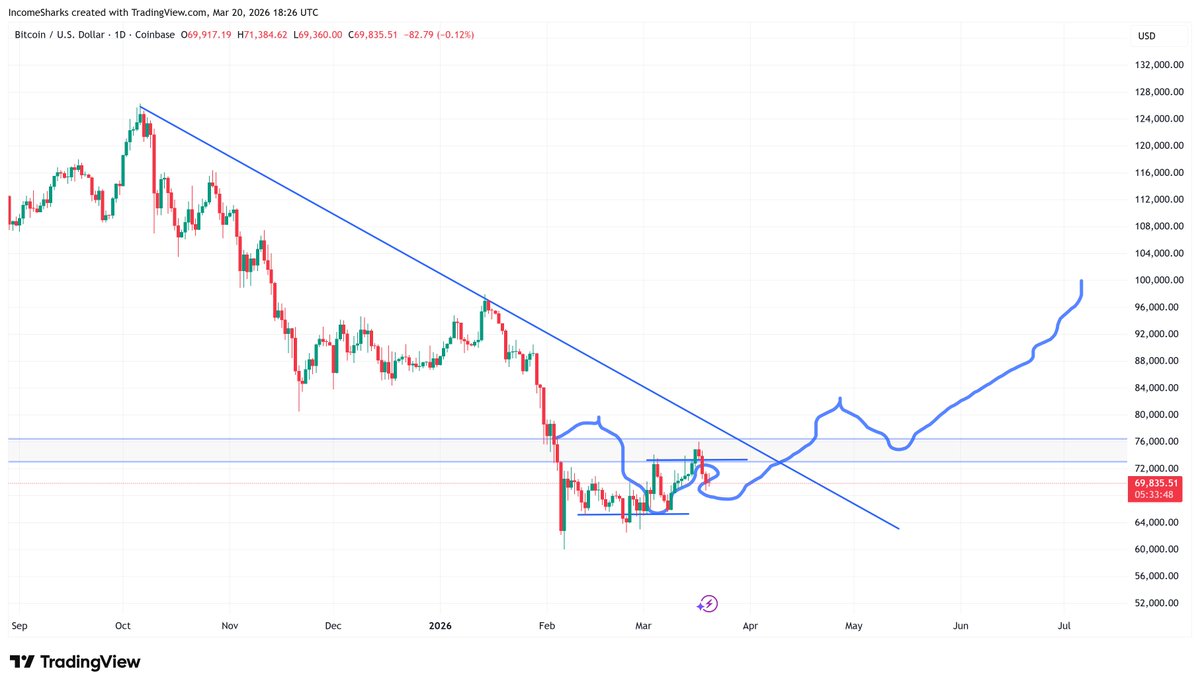
Nothing has changed since the February Bitcoin squiggles. Not only that but levels drawn months in advanced still being respected. Am I skeptical, of course, but the best trades are filled with doubt not confidence.
English
donnager retweetledi

gaming on the blockchain actually already exists
memecoins!
if you squint, memecoins are a pure MMORPG where users PvP each other in small factions and different weapons and armour they pay for (terminals, dex, etc)
they just replace LoL for a subset of users
Lily Liu@calilyliu
Also, gaming on a blockchain is not coming back
English
donnager retweetledi

JUST IN: Hyperliquid now trades more oil, gold, and silver than crypto.
English
donnager retweetledi

Every stream I get asked for my alt spaghetti chart.
It's very easy to create, but I'll put it here.
Just load it up, top right -> make a copy and save it. Easy.
Enjoy.
tradingview.com/chart/YTsCGSGV/
English