dpolishuk

267 posts

dpolishuk

dpolishuk

@dpolishuk

Java hipster ;)

Katılım Mayıs 2009
162 Takip Edilen82 Takipçiler
dpolishuk
dpolishuk@dpolishuk·
I recently bought the VITURE Beast XR, primarily for coding and managing multiple AI agents—not for gaming or watching movies. The problem I wanted to solve was simple: I often need much more screen space than my MacBook Pro can provide, but I don’t always have room for external monitors. I considered getting an iPad as a secondary display for terminals, but XR glasses seemed like a more flexible experiment. With VITURE’s SpaceWalker app, I can create two or three virtual displays. The advertised 174-inch workspace can be split into multiple screens, while the physical MacBook display remains available as another workspace. I initially tried three virtual screens, but that was a bit overwhelming. Two Full HD displays turned out to be more than enough. My current setup looks like this: Termius, Codex, several agent windows, and Jump Desktop connected to my Mac mini all live inside the virtual workspace. The MacBook screen remains my primary display. It feels like a portable command center where I can monitor multiple agents, terminals, remote machines, and projects at the same time. For this specific workflow, it genuinely works. The biggest advantage is portability. I can take the glasses out, connect them to a MacBook, iPad, or even an iPhone, add a keyboard, and get a large private workspace almost anywhere—at an airport, on a plane, in a taxi, at a café, or even in a park. People around me also can’t see what’s on the screens, which is useful when working with code, terminals, or private information. The biggest downside is comfort. I don’t normally wear glasses, and working with a lot of text in XR creates a type of eye and head fatigue I hadn’t experienced before. After a long session, my eyes get tired, and I can sometimes feel slightly dizzy. Watching a movie or playing a game might be easier, but reading code and monitoring constantly changing information is demanding. So far, my limit is around two hours of continuous work. I wouldn’t replace large physical monitors with the VITURE Beast XR for an entire workday. Real monitors are still more comfortable when you have the space for them. But as a portable virtual office—and especially as a way to manage multiple coding agents while traveling or working away from a desk—it’s a genuinely useful tool. youtu.be/HgKEeOdMIew?si…

YouTube video
YouTube
English
0
0
2
115
dpolishuk
dpolishuk@dpolishuk·
I’d make it more personal and grounded: Kimi K3 is finally here. I’ve been waiting for this release because K2.7 Code has become my daily coding model. I use Kimi extensively since I have an almost unlimited Kimi Code subscription, and I also develop plugins for the Kimi Code ecosystem. The numbers are impressive: • 2.8T parameter MoE • 1M token context • Native vision + video understanding • Always-on reasoning Official benchmarks put it firmly in frontier territory: → 80.2% SWE-bench Verified → 89.6% LiveCodeBench v6 → 96.4% AIME 2026 → 90.5% GPQA Diamond What I find more interesting is the product positioning. K3 doesn’t feel like a replacement for K2.7 Code. Instead, it feels like K2.7 Code HighSpeed evolved into a new frontier model. My workflow will probably look like this: K2.7 Code → daily implementation and iteration. K3 → architecture, large refactors, million-token repositories, and long autonomous agent runs. The catch? Pricing. K3 costs roughly 3× more on input and 4× more on output than K2.7 Code via the API. If you’re using Kimi Code subscriptions, expect it to consume your quota at roughly the same pace as K2.7 Code HighSpeed. Moonshot doesn’t publish the exact multiplier, but the pricing strongly points in that direction. Moonshot is no longer competing on “Claude-level quality at Chinese prices.” They’re competing as a frontier lab now—with frontier models, frontier benchmarks, and frontier pricing.
English
0
0
0
59
dpolishuk
dpolishuk@dpolishuk·
@OpenAI just reset usage limits third time for last 7 days! So gpt 5.6 sol ultra is unlim. It's awesome! Thank you
English
0
0
0
55
Command Code
Command Code@CommandCodeAI·
Who wants access to Kimi K3 model?
English
272
18
1.3K
70.8K
dpolishuk
dpolishuk@dpolishuk·
@thsottiaux I'd like to say without $100, that it feels like you hired phd guy who is very self-sufficient, independent and who does the job well. Yes, it takes long, but it's really worth it
English
0
0
1
2.7K
dpolishuk
dpolishuk@dpolishuk·
One of the most valuable lessons I learned about AI came from building the dispatch system at Yandex Taxi. Our goal was deceptively simple: ➡️ Maximize completed trips. The first version of the dispatcher didn't use machine learning at all. Instead, it relied on: • Deterministic business rules • Hard constraints • Carefully tuned heuristics • Hand-crafted scoring Things like child seats, luggage requirements, driver eligibility, pickup distance, and hundreds of other rules were handled without AI. And it worked remarkably well. Only after we had squeezed almost everything out of the deterministic system did we introduce ML. Not to replace the dispatcher. To predict the things you simply can't hardcode: • Will this driver accept the ride? • Will they actually reach the passenger? • How long will pickup really take? • What's the probability the trip gets canceled? Those predictive models improved our core metric by another 5–7%. For Yandex Taxi, that translated into massive business value. But those extra percentage points came with an entirely new engineering discipline: → Feature pipelines → Model training → Monitoring → Retraining → Experimentation → Drift detection → Continuous tuning That's when I learned an important lesson: AI shouldn't replace engineering. It should extend it. Build the strongest deterministic system you can first. Use rules where rules work. Use optimization where optimization works. And bring in ML only where the problem is fundamentally uncertain. The best AI systems I've seen don't replace great software engineering. They stand on top of it.
English
0
0
0
82
Tech Dev Notes
Tech Dev Notes@techdevnotes·
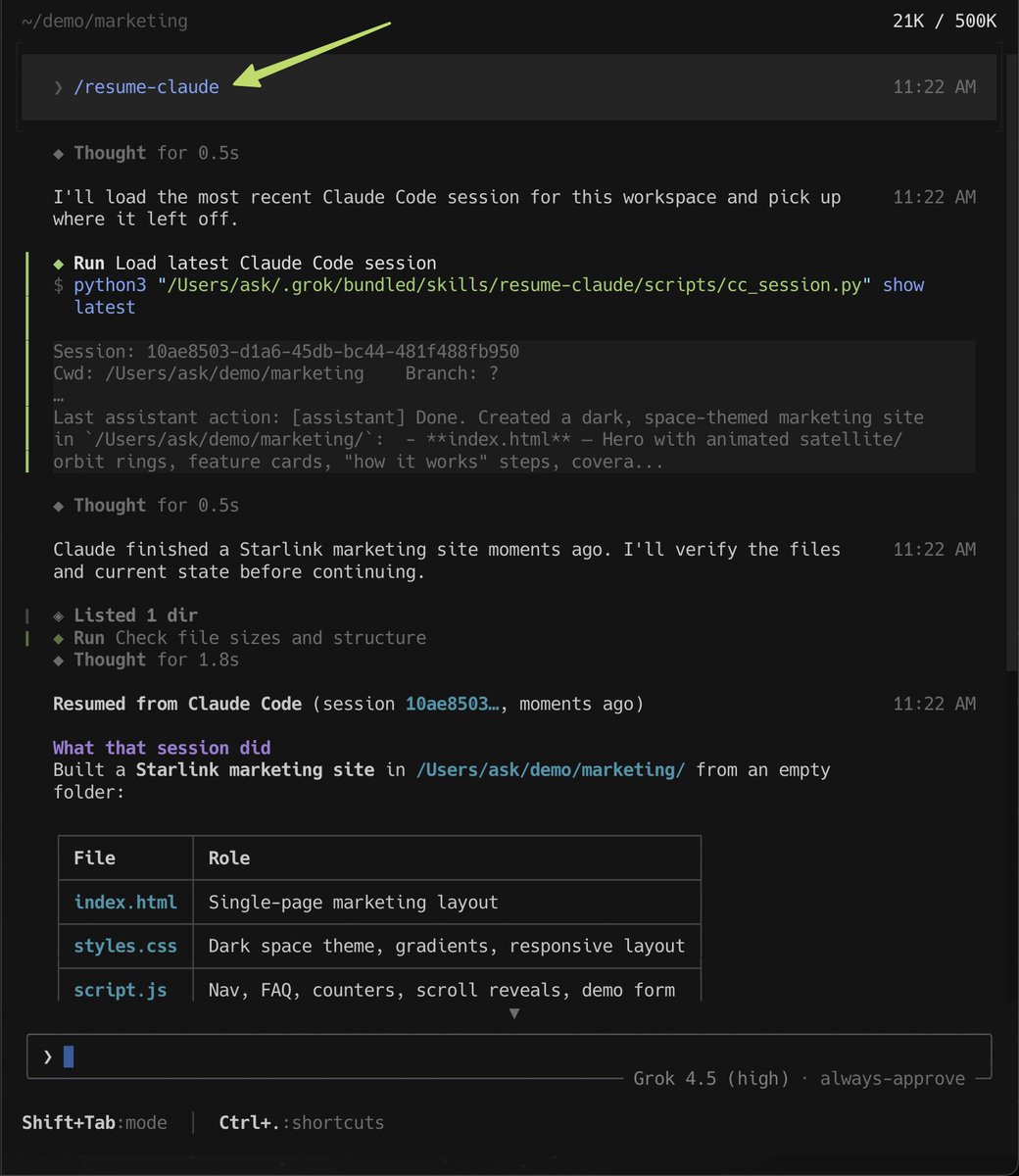
Grok Build now has Bundled skill /resume-claude for resuming Claude Code sessions
Tech Dev Notes tweet media
English
5
8
132
7.5K
dpolishuk
dpolishuk@dpolishuk·
@tolledo23 One hundred percent. The speediest one ☝🏻
English
0
0
0
23
Constantine Gerasimovich
Constantine Gerasimovich@tolledo23·
Very good model 🔥
dpolishuk@dpolishuk

After spending the last few days with Grok 4.5 + Grok Build, I think xAI has built one of the most compelling terminal coding agents available today. Not because of benchmark scores. Not because of marketing claims. Because I put it through the same kind of long-running engineering work I use every day. I ran exactly the same task through my Xpowers agent framework using three different models: Grok 4.5 Kimi K2.7 GLM 5.2 Everything else was identical. Same planning. Same harness. Same MCP servers. Same tools. Same workflow. The only variable was the model. Only Grok 4.5 completed the task end-to-end without requiring manual intervention. That's not a scientific benchmark, and I'm not claiming it's universally better than every other model. It's simply one real engineering task from my daily workflow. But I've stopped caring about benchmark leaderboards. The question I optimize for is much simpler: Can an agent take a large engineering task and actually finish it? For this task, Grok 4.5 did. The bigger surprise, though, wasn't the model. It was Grok Build. This is the first terminal agent I've tried that immediately understood my existing development environment. On first launch it automatically discovered my MCP servers, imported my existing skills, picked up my tooling, and started using everything without me rebuilding my setup. No copying prompts. No migrating configs. No spending an hour making the new agent usable. I installed it. I typed a command. I started working. That onboarding experience is honestly the smoothest I've seen. The closest experience for me is Z Code 3, but Grok Build currently has the best first-run experience I've personally used. Another thing I appreciated was the overall product polish. The new TUI is excellent. The animations and visual effects are subtle, responsive, and actually useful. They make long-running agent sessions feel alive without becoming distracting. It's one of those details that sounds minor until you spend your entire day inside a terminal. Combined with the onboarding experience, it feels like xAI spent a lot of time thinking about developer experience—not just model quality. I also smiled at one small product decision. The executable isn't just grok. You can simply run: agent That tells you exactly how xAI sees the future. Not another chatbot. Not another CLI. An agent. It's a small detail, but it's surprisingly confident product positioning. Is Grok Build more mature than Claude Code? I don't think so. Claude Code still feels like the more mature overall product today. But Grok Build has made an incredibly strong entrance. Fast execution. 500K context. Excellent tool use. Fantastic onboarding. A polished terminal experience. And, most importantly for me, it successfully completed a large engineering task inside my Xpowers workflow where the other models I tested did not. That's enough to earn a permanent place in my toolbox. Great work, @xai and @elonmusk

English
1
0
4
734
dpolishuk
dpolishuk@dpolishuk·
After spending the last few days with Grok 4.5 + Grok Build, I think xAI has built one of the most compelling terminal coding agents available today. Not because of benchmark scores. Not because of marketing claims. Because I put it through the same kind of long-running engineering work I use every day. I ran exactly the same task through my Xpowers agent framework using three different models: Grok 4.5 Kimi K2.7 GLM 5.2 Everything else was identical. Same planning. Same harness. Same MCP servers. Same tools. Same workflow. The only variable was the model. Only Grok 4.5 completed the task end-to-end without requiring manual intervention. That's not a scientific benchmark, and I'm not claiming it's universally better than every other model. It's simply one real engineering task from my daily workflow. But I've stopped caring about benchmark leaderboards. The question I optimize for is much simpler: Can an agent take a large engineering task and actually finish it? For this task, Grok 4.5 did. The bigger surprise, though, wasn't the model. It was Grok Build. This is the first terminal agent I've tried that immediately understood my existing development environment. On first launch it automatically discovered my MCP servers, imported my existing skills, picked up my tooling, and started using everything without me rebuilding my setup. No copying prompts. No migrating configs. No spending an hour making the new agent usable. I installed it. I typed a command. I started working. That onboarding experience is honestly the smoothest I've seen. The closest experience for me is Z Code 3, but Grok Build currently has the best first-run experience I've personally used. Another thing I appreciated was the overall product polish. The new TUI is excellent. The animations and visual effects are subtle, responsive, and actually useful. They make long-running agent sessions feel alive without becoming distracting. It's one of those details that sounds minor until you spend your entire day inside a terminal. Combined with the onboarding experience, it feels like xAI spent a lot of time thinking about developer experience—not just model quality. I also smiled at one small product decision. The executable isn't just grok. You can simply run: agent That tells you exactly how xAI sees the future. Not another chatbot. Not another CLI. An agent. It's a small detail, but it's surprisingly confident product positioning. Is Grok Build more mature than Claude Code? I don't think so. Claude Code still feels like the more mature overall product today. But Grok Build has made an incredibly strong entrance. Fast execution. 500K context. Excellent tool use. Fantastic onboarding. A polished terminal experience. And, most importantly for me, it successfully completed a large engineering task inside my Xpowers workflow where the other models I tested did not. That's enough to earn a permanent place in my toolbox. Great work, @xai and @elonmusk
English
0
0
4
918
dpolishuk
dpolishuk@dpolishuk·
@elonmusk I really like grok 4.5 and grok build. Speed and cost are incredible! And thank for 7 days trial period. Amazing job!
English
0
0
0
21
dpolishuk
dpolishuk@dpolishuk·
@NekDenis Crazy shit meh! I even don't understand what's better, what you do or what glm does. Cool!
English
0
0
1
41
Denis Nekliudov
Denis Nekliudov@NekDenis·
Vibecoded in 1 hr of glm 5.2 and ClaudeCode from a single prompt. Calisthenics coach right in your browser with local CV. 😮 Want a link to try? I’ll deploy quickly
English
6
1
21
3.5K
chilipote
chilipote@chilipote·
🎉🎉Just launched the first cross-platform MCP (Model Context Protocol) for Zoom, Meet & Teams via @tldview, live in Claude’s desktop app! Query meeting history: - “Summarize feature requests” - “List top bugs” - “Write product update” Comment MCP to get access 👇
English
27
4
26
2.5K
dpolishuk
dpolishuk@dpolishuk·
Зашел в гости к @nekdenis в ADVM c докладом - Как улучшить геолокацию в приложении? (GPS, GLONASS, spoofing) youtu.be/cU_XbGhuBfo
YouTube video
YouTube
Русский
0
0
0
0
dpolishuk
dpolishuk@dpolishuk·
Друзья! Мы готовим контест по программированию и я один из составителей задач для этого соревнования! Мне будет очень приятно если вы присоединитесь к этому мероприятию. Чтобы зарегистрироваться, кликать сюда -> yandex.ru/championship/ ЗЫ Ну и максимальный лайк, шэр, репост
dpolishuk tweet media
Русский
0
1
1
0
Dart Language
Dart Language@dart_lang·
Syntax is important! We're redesigning the Dart type system to support non-nullable types, and it'll require some syntax changes. This new article talks about one of those changes, with tips on how you can participate in the language design. medium.com/dartlang/dart-…
Dart Language tweet media
English
22
149
439
0
dpolishuk retweetledi
Ali Spittel
Ali Spittel@ASpittel·
Hi, hello. I am recruiting for a senior C++ position. You must also know Rust, Kubernetes, JavaScript, PHP, and Brainfuck. We will give you $8 and 0 days off. But we have a ping pong table and also beer. Plz work 4 us after our 18 round interviews. Ur impressive.
English
176
716
4.6K
0
dpolishuk retweetledi
Aleksandr Efremenkov
Aleksandr Efremenkov@iamironz·
Тут ребята из RMR написали статейку, как интегрировать в binaryprefs огненный tink от Google: habr.com/ru/company/red…
Русский
0
2
6
0