
Thank you Sarah, my pleasure to come on the pod! And happy to do some more Q&A in the replies.
John Fletcher (𝔦, 𝔦)
1.1K posts

@Dr_JohnFletcher
Chief Scientist @ The Innovation Game (TIG) @tigfoundation | Cambridge PhD in Maths + Theoretical Physics | SciFi | DeAI | ❤️ { Maths, Science, Computers }


Thank you Sarah, my pleasure to come on the pod! And happy to do some more Q&A in the replies.


One of the most famous AI researchers on the planet just described his "big idea" on a major podcast. He had no idea someone already built it. Here's everything from last Friday's TIG community call


Google DeepMind veteran David Silver just launched a London AI lab Ineffable Intelligence, and raised $1B at a $4B valuation, bets on radically new type of Reinforcement Learning to build superintelligence. Silver’s core argument is that large language models — the architecture behind ChatGPT, Claude, Gemini and every major AI system in commercial use today — are fundamentally limited. They learn from human-generated data. They can synthesise, summarise and extend what humans have already written or thought. But they cannot, in Silver’s view, discover genuinely new knowledge. Ineffable Intelligence aims to build what Silver has described as “an endlessly learning superintelligence that self-discovers the foundations of all knowledge.” The approach is rooted in reinforcement learning — the branch of AI Silver has spent his entire career advancing. --- the-decoder. com/deepmind-veteran-david-silver-raises-1b-seed-round-to-build-superintelligence-without-llms/

Andrej, I’m John Fletcher. I have a PhD in mathematics and theoretical physics from Cambridge, and since 2016 I have been working full-time on the problem of how to coordinate untrusted distributed compute for algorithmic innovation. I listened to your No Priors conversation and recognised the architecture you were describing: commits that build on each other, computational asymmetry (hard to find, cheap to verify), an untrusted pool of workers collaborating through a blockchain-like structure. The result is The Innovation Game (TIG), which has been in continuous operation since mid-2024. The correspondence is so close that I thought it worth writing. The short version: roughly 7,000 Benchmarkers test algorithms submitted by Innovators by solving instances of asymmetric computational challenges (SAT, Vehicle Routing, Quadratic Knapsack, Vector Search, among others). This testing is "proof of work" in the technical sense of Dwork and Naor (1992). Innovators earn rewards proportional to adoption by the Benchmarkers. The repository of algorithms is open source (github.com/tig-foundation…). The system is already producing state-of-the-art results. For the Quadratic Knapsack Problem, 476 iterative submissions by independent contributors brought solution quality to a level that now exceeds methods published by Hochbaum et al. in the European Journal of Operational Research (2025). We are working with Thibaut Vidal (Polytechnique Montréal), who has submitted a state-of-the-art vehicle routing algorithm directly to TIG, and with Yuji Nakatsukasa (Oxford) and Dario Paccagnan (Imperial College London), among many others. One of TIG’s active challenges is directly relevant to your autoresearch work: an optimiser for neural network training (play.tig.foundation/challenges?cha…), where Innovators compete to develop an improved optimiser (see screenshot). One way in which TIG extends the vision is on the economic side. In our view, a monetary incentive is required, otherwise the open strand simply cannot compete at scale. TIG’s open source dual licensing model (designed by my co-founder Philip David, who was General Counsel at Arm Holdings for over a decade, and was the artchitect of ARMs licensing strategy) is intended to solve that problem. I expect we have each thought about parts of this that the other hasn’t. Happy to talk whenever suits. John Fletcher tig.foundation
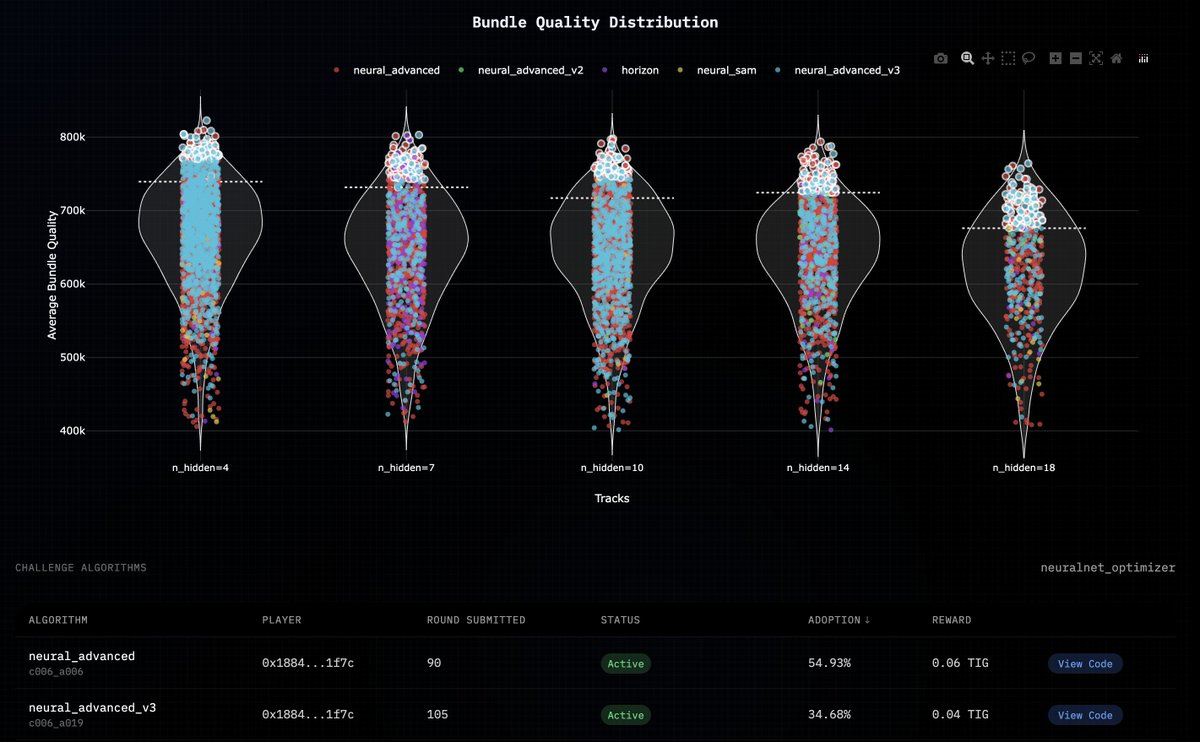

Andrej, I’m John Fletcher. I have a PhD in mathematics and theoretical physics from Cambridge, and since 2016 I have been working full-time on the problem of how to coordinate untrusted distributed compute for algorithmic innovation. I listened to your No Priors conversation and recognised the architecture you were describing: commits that build on each other, computational asymmetry (hard to find, cheap to verify), an untrusted pool of workers collaborating through a blockchain-like structure. The result is The Innovation Game (TIG), which has been in continuous operation since mid-2024. The correspondence is so close that I thought it worth writing. The short version: roughly 7,000 Benchmarkers test algorithms submitted by Innovators by solving instances of asymmetric computational challenges (SAT, Vehicle Routing, Quadratic Knapsack, Vector Search, among others). This testing is "proof of work" in the technical sense of Dwork and Naor (1992). Innovators earn rewards proportional to adoption by the Benchmarkers. The repository of algorithms is open source (github.com/tig-foundation…). The system is already producing state-of-the-art results. For the Quadratic Knapsack Problem, 476 iterative submissions by independent contributors brought solution quality to a level that now exceeds methods published by Hochbaum et al. in the European Journal of Operational Research (2025). We are working with Thibaut Vidal (Polytechnique Montréal), who has submitted a state-of-the-art vehicle routing algorithm directly to TIG, and with Yuji Nakatsukasa (Oxford) and Dario Paccagnan (Imperial College London), among many others. One of TIG’s active challenges is directly relevant to your autoresearch work: an optimiser for neural network training (play.tig.foundation/challenges?cha…), where Innovators compete to develop an improved optimiser (see screenshot). One way in which TIG extends the vision is on the economic side. In our view, a monetary incentive is required, otherwise the open strand simply cannot compete at scale. TIG’s open source dual licensing model (designed by my co-founder Philip David, who was General Counsel at Arm Holdings for over a decade, and was the artchitect of ARMs licensing strategy) is intended to solve that problem. I expect we have each thought about parts of this that the other hasn’t. Happy to talk whenever suits. John Fletcher tig.foundation


Hi Sebastian, Thanks for your engagement. In my view, the issue with traditional dual licensing is not well described by the word "complexity." For example, the conceptual complexity of understanding two licences (lets say its GPLv2 and something like MIT) one of which you can use if you are willing to pay, is low. I fell it’s more accurate to say that dual licensing creates a tension between the commercial interests and the collaborative norms of open source development, and that this tension can result in the suppression of community contributions. Of these tensions, the most insoluble has always been the tendency for perceived injustice when monetary compensation for contributors available/necessary, and this was necessarily centrally-determined (by the vendor). The solution, in the context of open source, was in fact identified by Eric Raymond 25 years ago: a market mechanism for pricing contributions econ.ucsb.edu/~tedb/Courses/… This works because a market is an impersonal allocation mechanism (Hayek), and avoids creating tensions that otherwise result from centrally-determined (intentional) allocation. In TIG the “utility” of the proof of work is the market signal generated by the miners (the “Benchmarkers”) choice of algorithm. This signal allows us to address a market failure in the pricing of algorithms and achieve a market distribution of rewards to the contributors of the algorithms (the “Innovators”).


Thank you Sarah, my pleasure to come on the pod! And happy to do some more Q&A in the replies.