Dana Johnson, PhD

156 posts

Dana Johnson, PhD banner
Dana Johnson, PhD

Dana Johnson, PhD

@drdanajohnson

✨Changing how the world understands autism and apraxia 💪🏻Creator of Intentional Motor Health™️ 🧭Tips + roadmaps to empower parents

Katılım Temmuz 2024
139 Takip Edilen112 Takipçiler
Dana Johnson, PhD retweetledi
Children’s Health Defense
Children’s Health Defense@ChildrensHD·
Families of nonspeaking autistic people are pushing back at The New York Times after they published an op-ed claiming that "spelling" — a method through which nonspeakers communicate using a letter board — is “debunked” and unsupported by scientific evidence. childrenshealthdefense.org/defender/new-y…
English
8
27
64
2.8K
Heidi Brown
Heidi Brown@heidieatsalot·
@drdanajohnson @BrianHookerPhD @ChildrensHD @CHDTVLive @maryhollandnyc Personally I’m less concerned w/ spelling being fake & more concerned w/ several ppl in the pod being linked to Epstein, being vocally supportive of a country committing war crimes, & being anti-LGBTQ & anti-choice. Not the unconditional love message they claim to promote.
English
2
0
0
33
Brian Hooker, PhD
Brian Hooker, PhD@BrianHookerPhD·
Here is my letter to the editor of the NYT... @ChildrensHD @CHDTVLive @drdanajohnson @maryhollandnyc Dear Editor, I read Dr. Amy Lutz’s recent opinion piece on communication methods for non-speaking autistic individuals with concern. Her characterization of letterboarding and related spelling modalities as anti-science or offering “false hope” overlooks both compelling personal outcomes and emerging research. My own son has been letterboarding—and more recently keyboarding—for five years. Through this method, he openly communicates his thoughts, feelings, and ideas directly to my wife and me, as well as to many others. He is now attending high school and aspires to earn a PhD in physics. His work is his own and neither my wife nor I can comprehend the physics problems he is able to complete correctly. His progress has been nothing short of transformative. While facilitated communication in its earlier forms raised valid concerns about authorship, newer studies challenge blanket dismissals. A 2020 eye-tracking study by Vikram Jaswal and colleagues, published in Scientific Reports, examined nine non-speaking autistic letterboard users and found that participants consistently fixated on the correct letters beforepointing to them. Their speed, accuracy, and gaze patterns were consistent with independent authorship rather than real-time facilitator cueing. Many non-speaking autistics also experience severe motor-planning difficulties (dyspraxia), not cognitive impairment. This is a subtype of autistics that Lutz wants to lock away as prisoners of their own dyspraxic bodies. The SPELLERS Method instead directly addresses these challenges by supporting purposeful movement, allowing individuals to bypass unreliable speech or fine-motor barriers. Recently, living relatives of Helen Keller have publicly advocated for preserving access to spelling-based communication methods. They warn that overly restrictive policies risk silencing a new generation of potential “Helen Kellers.” I strongly urge Lutz—and anyone skeptical of these approaches—to spend time with a proficient speller before concluding that hundreds of thousands of non-speaking autistics should be denied this pathway. These individuals have distinct voices that deserve to be heard. We should support individualized evaluation, further rigorous research, and every promising tool that gives them the chance to communicate. Sincerely, Brian Hooker, PhD
katie wright@katiewr31413491

Don’t bother reading #AmyLutz@nytimes (naturally!) latest. It’s all about Lutz believing spelling method fake. For a smart person this is a REALLY dumb move. Amy, if u don’t like spelling fine, but u cross a line when u present yourselves as “knowing better” than these parents. More condescension & judgement NOT what our community needs. You do U!! @amylutz4

English
10
31
81
3.5K
Dana Johnson, PhD
Dana Johnson, PhD@drdanajohnson·
I know the producers and director personally. That wasn’t their intent but I can see how you got to that conclusion. I personally think it got people who otherwise thought that nonspeakers are intellectually delayed, thinking. Thinking it’s possible they can learn and know much more but can’t demonstrate it due to whole body apraxia. This changes things dramatically. Yes, it brought criticism but only because the debunkers feel threatened and they are loud and have big microphones.
English
1
0
0
32
Dana Johnson, PhD
Dana Johnson, PhD@drdanajohnson·
Wanted to chime in here. I’m the co-creator of spellers method & have worked with hundreds of spellers at this point. We have to remember a couple of things. Spellers are very aware of the criticism surrounding spelling. If we share any videos they have to concent. When they know it’s to prove something, it changes their regulation. Similar to when you are asked to prove something in front of someone who is criticizing something you’re doing. Stress increases, anxiety increases & you start to stumble over your words. The exact thing can happen with spellers. They get anxious, stress increases & their once regulated body isn’t & they start to misspoke, or stall. Not all spellers can spell in front of people because of this. Just like not all people feel comfortable talking in front of people. The people who want to prove this by video or “message passing” will keep moving the goal post. If it’s a hill they want to die on, let them die on it. Spellers will continue to impact and change the world leaving them behind. I can go deeper into the neurology behind it all & am always happy to have logical discussions with people about this.
English
2
0
0
69
Dana Johnson, PhD
Dana Johnson, PhD@drdanajohnson·
This is why @FogelSylvia is the perfect individual for this position. There are no attacks or disparaging comments. A professional and extremely well-written response. Let's all work together even when there are differences of opinion. Please take the time to read.
Sylvia Fogel MD@FogelSylvia

Dear Ms. Singer, Your April 28 press release identifies several areas of agreement with the proposals adopted by the IACC on April 28 — among them, the urgency of wandering and elopement, inadequate medical care attributable to diagnostic overshadowing, and the persistent under-representation of individuals with profound autism in both research and federal policy. That common ground is real and valued and it is precisely because we share these priorities that the significant inaccuracies in your statement warrant a careful and direct response, in the interest of an accurate public record and the integrity of the work before us. On wandering and elopement specifically — associated with at least 7–8 preventable deaths per month, estimated from media reports in the absence of active surveillance — the April 28 proposals built directly on years of prior IACC presentations and public comment. Families and advocates have raised this issue before the Committee repeatedly, and for years the urgency of those voices was not translated into concrete action. The April 28 proposals represent exactly that translation — finally moving from acknowledgment to recommendation. That progress deserves to be recognized for what it is. Because we share common ground on these issues, I want to address several significant inaccuracies in your statement, in the interest of ensuring that the public record is accurate and that our shared goals are not undermined by mischaracterization. The Statutory Authority of the IACC Your statement asserts that the IACC's proper role is solely to "develop a strategic plan for the conduct of and support for autism research," and that the April 28 proposals fell outside that mandate. This is incorrect. I understand that this view may reflect the operational practice of the Committee during prior service periods, in which the strategic plan functioned as the primary — and at times, effectively the sole — vehicle for Committee output. That history is acknowledged. It does not, however, define the statute. The Autism CARES Act, reauthorized in 2024 (Pub. L. 118-267), establishes a broad, lifespan mandate for the IACC that extends well beyond the strategic plan requirement. While the Committee is required to develop and update a strategic plan for autism research, that requirement exists alongside, not instead of, the Committee's authority to advise the Secretary of HHS directly, coordinate federal autism activities, and make recommendations addressing prevention, identification, intervention, treatment, services, supports, and real-world outcomes across the lifespan. These are co-equal statutory functions, not subordinate ones. Contrary to the assertion in your statement, translating lived experience and urgent community needs into actionable policy recommendations is therefore not outside the Committee's role — it is central to it. The authority to make direct recommendations to the Secretary — outside of and in addition to the strategic plan — has existed since the Committee's authorizing legislation was first enacted. Whether that authority was exercised in prior cycles is a matter of historical record that this Committee does not presume to characterize on behalf of those who served before us. What is clear is that a thorough reading of the statute informed the April 28 recommendations from their inception. The Committee acted within its authority because it understood its authority. The families who have waited years — in some cases, decades — for action on these issues did not require the Committee to discover new powers. They required the Committee to exercise the powers it has always possessed. April 28 was that exercise. Profound Autism Designation and the Hughes et al. Study With regard to your critique of the Committee's recommended criteria for the "profound autism" designation, we agree that continuous (24/7) support is the central defining criterion — emphasized by both the Lancet Commission (Lord et al.) and the INSAR Delphi process (Siegel et al.) in which you participated. It is therefore particularly notable that Hughes et al. — a study on which you are an author — did not operationalize this criterion at all. I want to address both that methodological problem and your claim that excluding IQ would eliminate nearly half the profound autism population. Your press release states that 42.7% of individuals in Hughes et al. qualified for profound autism solely on the basis of IQ. What that figure does not reflect is that the study's alternative criterion — being "nonverbal or minimally verbal" — was defined so narrowly as to exclude many individuals who would be considered minimally verbal in standard clinical practice.* In other words, the 42.7% figure is an artifact of an unusually restrictive speech threshold, not evidence that IQ is the only reliable way to capture this population. Had the study used a clinically representative definition of minimally verbal, the proportion qualifying on speech criteria alone would have been substantially higher — and the case for IQ as an indispensable criterion correspondingly weaker. There is a further methodological problem with Hughes et al. that bears directly on this debate: the study did not operationalize the requirement for continuous, 24/7 support — which is widely understood to be the defining feature of profound autism. IQ appears to have served as a substitute for that criterion, not because it is the conceptually correct measure, but because continuous support needs were not assessed. Where a study does not measure what matters most, the proxies it uses in its place should not be held as the standard. Additionally, approximately 20% of participants in Hughes et al. had no IQ data available. In those cases, IQ was imputed using functional and behavioral measures — including the Vineland and the presence or absence of self-injury and aggression. This is precisely the kind of functional proxy the IACC's criteria are designed to use directly. It is difficult to argue that IQ is essential when the study itself relied on functional measures to estimate it for one in five participants. This is not unique to Hughes et al. The 2018 CDC ADDM surveillance report (Maenner et al.) — one of the most comprehensive autism datasets available, covering over 5,000 eight-year-olds across 11 states — found that nearly 40% of children with ASD had no cognitive ability data at all. If IQ is unavailable for four in ten children in a rigorously conducted federal surveillance study, it cannot reasonably serve as a required criterion for identifying profound autism in research or policy contexts. While the INSAR Delphi process included support from approximately two-thirds of participants for incorporating IQ, a substantial minority of qualified experts did not consider it necessary. IQ testing is resource-intensive, variably available, and may not be feasible or reliable for individuals with significant communication and motor challenges. In more than two decades of clinical experience, I have not encountered a single individual with a measured IQ below 50 who did not require continuous or near-continuous supervision for safety. That relationship exists — but it exists because low IQ tracks with high support needs, not because IQ is the construct we actually care about. The IACC's criteria are designed to measure that construct directly. I recognize there may be genuine disagreement here among qualified researchers and clinicians. What I hope we can agree on is the underlying purpose: ensuring that individuals with the highest support needs are no longer excluded from research and policy. A definition grounded in functional support needs — directly measured rather than proxied — is more likely to achieve that goal, not less. FACA Compliance Your allegation that the Committee did not operate within Federal Advisory Committee Act (FACA) requirements is serious, and it is inaccurate. I would ask that you review these claims with counsel experienced in FACA before making such assertions in a public press release. I address each claim in turn. Your assertion that materials were "marked final" is factually incorrect as framed. Materials carried "final" in their working file names solely to distinguish them from earlier drafts and to ensure the correct version was transmitted to ONAC on April 20. The decision by ONAC staff to post documents to the public website using the original working file names — without relabeling them appropriately, as would be standard practice — was entirely ONAC's, not the Committee's. This was not a trivial oversight; it created a misleading public record for which the Committee bears no responsibility. Moreover, the claim that documents were treated as final and not subject to amendment is directly contradicted by the record. Committee member Elizabeth Bonker added language to Attachment C on profound autism during the meeting itself — precisely the kind of deliberative amendment that characterizes an open, functioning advisory committee. Members were specifically instructed to read each attachment and offer their views. That is not the behavior of a committee rubber-stamping pre-determined outcomes. It is the behavior of a committee doing its job. The procedural record is equally clear. The meeting agenda was developed in collaboration with the Designated Federal Officer (DFO). The Office of National Autism Coordination (ONAC) received proposals for full Committee deliberation on the evening of Monday, April 20. IACC members received the agenda and proposals on Thursday, April 23—five days in advance of the meeting, which is typical for a FACA committee. The agenda and proposals were made publicly available on the IACC website as part of standard transparency practices. As is customary, the distribution and posting of materials were handled by ONAC, not Committee members, and ONAC had intended for materials to be distributed on Thursday, April 23. The proposals then underwent more than two hours of open Committee deliberation, including the amendment of one proposal, before being adopted by a clear majority that included many federal members. This is precisely how a deliberative body is supposed to function. Families and advocates had brought the issue of wandering and elopement before the IACC for years, and for years it was heard and not acted upon. This meeting acted. Given your extensive twelve-year experience with the IACC, I am sure you are aware that FACA requires transparency and public access to advisory committee materials but does not establish a minimum advance distribution period. There is no specified number of days by which materials must be provided prior to a meeting. Likewise, FACA requires that advisory committee meetings be open to the public, ensuring that proposals are discussed in a transparent forum, but it does not prescribe any minimum duration for deliberation. It does not require that votes be deferred to subsequent meetings. These are the actual requirements of the statute. The April 28 meeting met all of them. I encourage you to issue corrections on both points — the "marked final" assertion and the allegation that FACA requirements were not followed. More importantly, the urgent real-world needs of the autism community — and the thoughtful, evidence-based recommendations that emerged from the April 28 IACC meeting — deserve to be celebrated and built upon. The individuals and families we both care about are best served when we direct our energy there, rather than toward assertions that do not withstand scrutiny. Looking Forward We are aligned on the issues that matter most — wandering and elopement, diagnostic overshadowing, and ensuring that individuals with the highest support needs are seen and served by research and policy. I hope we can build on that common ground. The families who have waited years — decades — for action on these issues deserve nothing less than our full collaboration and our most rigorous work. There is far more that unites us than divides us, and I remain committed to keeping the focus where it belongs: on the individuals and families who are counting on us to get this right. Regards, Sylvia Fogel M.D. Chair, Interagency Autism Coordinating Committee These statements are made in my personal capacity and do not necessarily reflect the views of the IACC or any federal government entity. *Footnote — Technical Note on the Hughes et al. "Minimally Verbal" Criterion The criteria used to define "minimally verbal" in Hughes et al. were considerably more conservative than the way the term is typically used in clinical practice. In the study, children were categorized as "nonverbal" if they had no words or word approximations — that criterion is straightforward. "Minimally verbal" was defined very narrowly: either speech consisting primarily of echolalia or jargon, or a history of administration of ADOS Module 1, which is specifically designed for individuals who do not consistently use phrase speech. The ADOS defines phrase speech as flexible, non-echoed three-word utterances that include a verb. In practice, an individual who uses a limited number of simple phrases — such as "wanna go potty" or "wanna go out" — may be administered Module 2, yet still lack the generative, flexible language expected even in early childhood. In clinical settings, such individuals would commonly still be considered minimally verbal. Importantly, the study did not use Module 2 administration as the threshold — it used Module 1 — reflecting a particularly narrow definition that does not fully align with how the term is used in clinical practice. The real-world significance of this distinction is considerable. An individual may have some simple, context-specific speech and still lack the functional communication needed for safety — for example, the ability to call 911 and effectively seek help in an emergency. The IACC's broader definition of minimally verbal is designed to capture this population accurately, rather than exclude them on the basis of a speech threshold that does not reflect functional communicative ability in the ways that matter most for research and policy.

English
0
0
1
59
Dana Johnson, PhD
Dana Johnson, PhD@drdanajohnson·
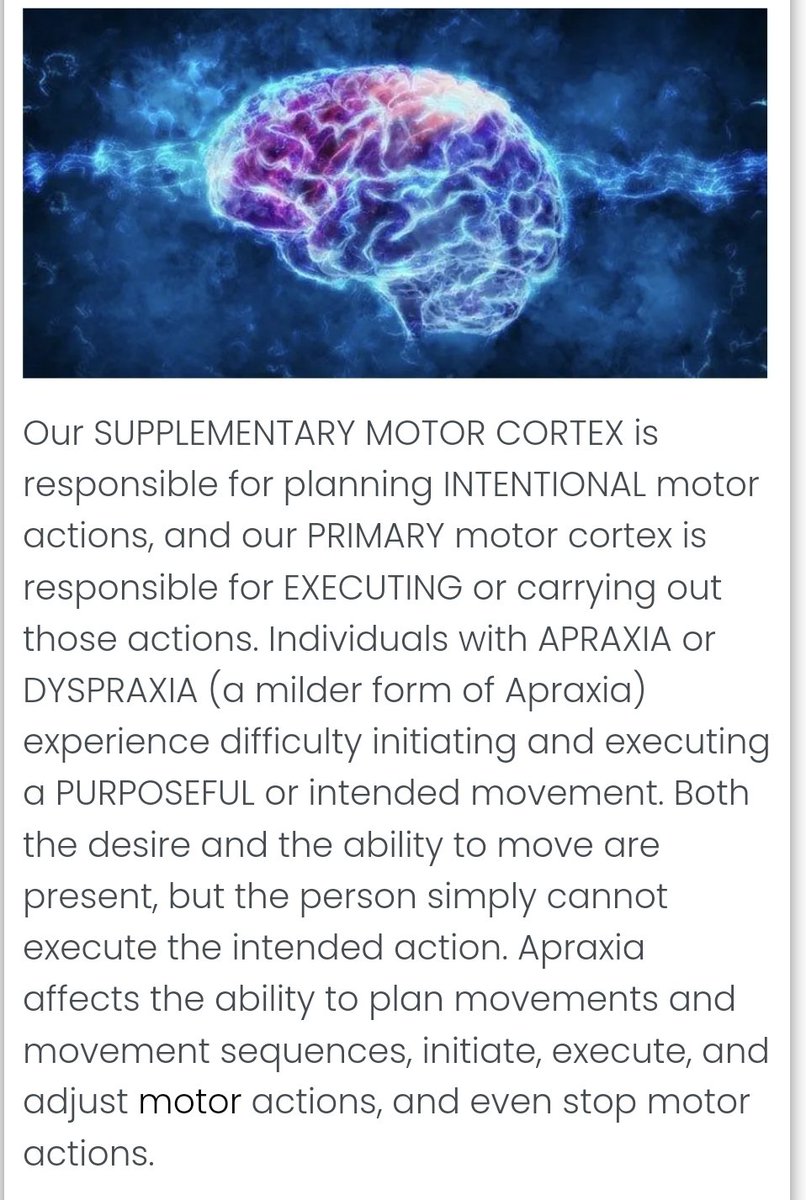
@angie4_liberty @NCSAutismOrg @nytimes @AmySFLutz YES! She is focusing solely on cognitive function when ALL forms of intentional & reliable communication require motor planning. Catatonia makes it impossible to intentionally move on demand. The individual isn't able to demonstrate knowledge reliably.
English
0
0
1
31
Angela🌼
Angela🌼@angie4_liberty·
@NCSAutismOrg @nytimes @AmySFLutz This is so disappointing. @AmySFLutz has publicly spoken about her son's catatonia. Catatonia is a psychomotor syndrome affecting 10-20% of the ASD population. It directly impairs motor initiation. Why then, is the concept of motor impairment and apraxia off the table?
English
1
0
2
233
Dana Johnson, PhD
Dana Johnson, PhD@drdanajohnson·
@PaulWhiteleyPhD Yes! Agreed. The author doesn’t even touch on the motor science. This article, while very difficult to read, does light the fire for continued research.
English
0
0
0
51
Paul Whiteley
Paul Whiteley@PaulWhiteleyPhD·
Profound Autism Is Difficult Enough Without This Debunked Method nytimes.com/2026/05/01/opi… Won't be everyone's cup of tea but is important. Friction around such issues reiterates the need for solid biological science on the hows & whys of communication issues. Start with motor...
English
1
2
6
521
Andrea
Andrea@and_kell·
APRAXIA I'm seeing a lot of criticism about Woody Brown authoring the book Upward Bound. Do any of these critics know anything about apraxia? Or do they not believe that it's a real condition? Or, do they know that Woody painstakingly wrote a paragraph a day. That's it. Why? Because that's all he could manage. It took him two and a half years to write the book. If he wasn't the one writing it why did it take that long? Critics? So easy to criticize something you don't understand. Easy to look at something & say oh, that's fake. Spelling is absolutely the most positive intervention we ever stumbled on to. My son was 25 when we heard about it from JB & Jamison Handley's book UNDERESTIMATED AN AUTISM MIRACLE. My son's life could have been so different if this came on our radar decades ago. Instead, we wasted years & years on meaningless ABA drills. It was pure torture for my son. ABA and apraxic bodies are not conducive. For the first time my son has a group of friends. He is telling us his likes & dislikes. He's making decisions like how he wants his hair & the clothes he wants to wear. He has more purposed filled activities filling his days. He's consuming more age appropriate media instead of watching the same Disney movies ad nauseam. Everything that has come from Spelling is positive. For all the critics -You have no idea what you are criticizing. Spelling is a life-changing shift that impacts everything. Not just "pecking" letters on a keyboard or letterboard. Countless hours are spent helping spellers get better control of their bodies. And the mantra PRESUME COMPETENCE is the key and absolutely necessary.
Andrea@and_kell

Here is my 30 year old son learning how to roll over. He rolled over as a baby, but somehow lost the skill. He has a brain body disconnect called apraxia. He can't feel his body in space. He understands everything he is being asked to do here, but can't get his body to do it. So we practice many motor movements meant to help fill in the gaps of his development. I wonder if injecting aluminum, mercury & live viruses under the guise of preventative medical care into infants could have caused these problems? Has apraxia ever been studied in relationship to oh safe & effective childhood vaccines? The first crime was injuring children with oh so safe and effective vaccines. The second crime & by far the worse crime is treating them as if they're cognitively impaired. Absolute torture. "Apraxia is a neurological disorder characterized by the inability to perform skilled movements or execute specific actions, despite having the physical ability and comprehension to do so. It is typically caused by damage or dysfunction in brain regions involved in motor planning and coordination."

English
5
4
16
881
Andrea
Andrea@and_kell·
Most nonspeakers or unreliable speakers suffer from full body #apraxia. With #S2C (spelling to communicate), we've found out how significant this is. It's infuriating to realize our children are cognitively intact but suffer from an inability to motor plan. And why this still isn't mainstream information I can't comprehend. 😬 The skeptics certainly don't understand the significance of apraxia and motor planning. They also don't understand the bedrock of spelling...presuming competence. When we started presuming competence & talking to my son like the adult he is his "behaviors" got tremendously better. His aggression & self-injury significantly diminished. Do we still deal with these things? On occasion, & it always has to do with a medical issue either gut related or seizures. Since S2C came into our lives my son was able to lose 60 lbs as we would talk about the role diet plays in health. He now has a community of speller friends. Priceless. ❤️ We've read several books - many written by other spellers & learned of their lives & journeys. He's changing his TV viewing habits from exclusively watching Disney movies to documentaries, films of multiple genres geared for adults & he listens to podcasts. He is expanding his world by stepping out of the comfort of sameness that we assumed he preferred. He told us he didn't like his clothes & his haircut. He found what he liked & went for it. (Btw, I never knew my son has curly hair because he always had a butch because we thought he looked good in one. 🤦‍♀️) He's been working hard through Vision therapy to gain better control of his body through various exercises- focusing on large & small muscle movements & especially getting his eyes to where they need to be at any given moment. The first crime against nonspeaking "autistic" individuals is the harm they suffered from vaccinations. The worst crime is being treated like they are intellectually disabled. I've made many posts about how life-changing spelling is. It's hard work for him, but he's keeps at it. And I couldn't be prouder. He once told us : "I'm lousy at skills that require me to do new things not because im autistic but im apraxic." #AutismAwarenessMonth What is S2C (spelling to communicate)? 👇 i-asc.org/what-is-s2c/
Andrea tweet mediaAndrea tweet mediaAndrea tweet media
English
7
14
37
1.9K
Dana Johnson, PhD
Dana Johnson, PhD@drdanajohnson·
What if ONE issue is driving your autistic child’s sleep problems, meltdowns, gut issues, and anxiety? Up to 80% of autistic individuals may have mitochondrial dysfunction. This is the mission piece. This isn’t behavior; it's an issue with their physiology. If the brain + body don’t have enough energy, everything is harder. I break it down in my latest video 👇 youtu.be/mpIroKlLinM
YouTube video
YouTube
English
0
0
0
90
Dana Johnson, PhD
Dana Johnson, PhD@drdanajohnson·
@Metabolic_Mind @ChrisPalmerMD Thank you! I will definitely check those courses out. I would love to connect to talk more about autism & ketogenic diets. I have many clients who have had positive outcomes with keto.
English
0
0
1
29
Metabolic Mind
Metabolic Mind@Metabolic_Mind·
So encouraging to hear! Thank you for being part of the conversation and this growing movement! The momentum between clinical experience and research is building quickly, and we appreciate your insight. Since you mentioned wanting to study more, you may find the CME educational courses for clinicians helpful: metabolicmind.org/for-clinicians…
English
1
0
0
34
Chris Palmer, MD
Chris Palmer, MD@ChrisPalmerMD·
In this small pilot trial, 10 Indian children with autism were found to have differences in metabolic biomarkers compared to neurotypical children that partially normalized with a ketogenic diet. Some of their symptoms of autism also improved with the ketogenic diet.
J P Fanton@HealthyFellow

Plasma metabolomic signatures in children with autism spectrum disorder and their modulation following a gluten-free modified ketogenic diet Attn: ⁦@ChrisPalmerMD⁩ ⁦@Metabolic_Mindlink.springer.com/article/10.118…

English
5
27
174
25.2K
CHEN'
CHEN'@camiberry_x·
@drdanajohnson I agree with the fine motor part, it could be one of the important reasons impact their speech
English
1
0
0
16
Dana Johnson, PhD
Dana Johnson, PhD@drdanajohnson·
I’ve worked with complex autistic children for 20+ years. I’ve watched families spend YEARS chasing speech… only to realize they were targeting the wrong thing. Not because they failed, but because no one told them the truth. This could change everything for your family. Watch my new video here: youtu.be/sea77zYHv1Y
YouTube video
YouTube
English
2
1
6
726
Dana Johnson, PhD
Dana Johnson, PhD@drdanajohnson·
@VigilantFox Yes, exercise, but let's not forget about diet, specifically the benefits of a ketogenic diet on mental health. If only this were the norm.
English
0
0
2
319
The Vigilant Fox 🦊
The Vigilant Fox 🦊@VigilantFox·
Theo Von reveals he was put on antidepressants after “a tough day at school” and has NEVER been able to get off them since. THEO: “That shit makes you feel dead, man.” ROGAN: “So why did you take them in the first place?” THEO: “Cause I was in a bad relationship 20 years ago, and I was having a tough day at school, and they f*cking gave them to me, and then I never got off.” Theo’s experience is not uncommon. A 2019 meta-analysis revealed that 56% of people experience withdrawal symptoms when trying to quit antidepressants. Of those who experienced withdrawal symptoms, nearly half (46%) described them as “severe.” Before you get placed on the antidepressant hamster wheel like Theo Von did, consider trying exercise instead. Large-scale meta-analyses show that physical exercise is about 1.5 times more effective than antidepressants for depression.
The Vigilant Fox 🦊@VigilantFox

Surprise, surprise. It turns out antidepressants may have been propped up by deeply flawed science. “Most clinical drug trials have found the effectiveness of antidepressants is ON PAR with placebo,” wrote Dr. Joseph Mercola. On the other hand: “Large-scale meta-analyses show that physical exercise is the most effective remedy — about 1.5 times more effective than antidepressants — for depression.” You probably never heard that on TV because in 1996, Bill Clinton signed the Telecommunications Act, which allowed Big Pharma to buy off the news. Here’s what else they’re not telling you about antidepressants. If you or someone you love is taking them, you might want to read to this. 🧵

English
187
445
4.2K
1.7M