Dr Idan 🦡

9.3K posts

Dr Idan 🦡 banner
Dr Idan 🦡

Dr Idan 🦡

@dridan

Bitcoin Futurist, Social Networks, GPT Neural Networks

Satoshi City Katılım Eylül 2007
1.6K Takip Edilen1.2K Takipçiler
Dr Idan 🦡 retweetledi
Ricardo
Ricardo@Ric_RTP·
Jeff Bezos just announced the largest industrial takeover plan in history. He's raising $100 BILLION to acquire manufacturing companies across aerospace, defense, and chipmaking and REPLACE their workforces with AI. He's calling it a "manufacturing transformation vehicle." But here's the full picture and what actually makes this so genius: 6 months ago, Bezos quietly launched Project Prometheus with $6.2 billion in funding. His co-CEO is Vik Bajaj, a physicist who helped build the self-driving car project at Google X that became Waymo. They've been hiring from OpenAI, DeepMind, and Meta's AI division. Blue Origin CEO David Limp just joined the board. And the technology they're building isn't chatbots or content generators... It's digital twins. AI systems that simulate entire factories, stress-test materials, model supply chains, and design products without a single human touching the process. The kind of AI that could design a rocket engine, test it virtually across a million simulations, and manufacture the perfect version on the first attempt. That was phase one. Build the AI. And phase two just started: Now Bezos is flying to the Middle East pitching sovereign wealth funds. He went to Singapore meeting the world's biggest asset managers. He's in talks with JPMorgan Chase. The pitch: Give me $100 billion. I'll buy the factories. I'll install my AI. I'll automate the workforce. Then I'll SELL the playbook to every manufacturer on Earth. He's not licensing software to companies and hoping they adopt it. He's BUYING the companies and doing it himself. Think about what that means: Every other AI company sells tools and waits. OpenAI sells API access. Anthropic sells Claude subscriptions. Microsoft sells Copilot licenses. Bezos said forget that. I'll buy the entire production chain, replace the humans at the source, prove the model works with my own money, and then scale it globally. He did the exact same thing with retail. Amazon didn't sell software to bookstores. Amazon BECAME the bookstore. Then the department store. Then the grocery store. Then the pharmacy. Then the cloud. Now he's doing it with factories. And the fund is targeting the industries that matter most. Chipmaking. Defense. Aerospace. The sectors governments cannot afford to let fail. Which means once Bezos owns and automates these companies, governments become dependent on his AI infrastructure the same way they became dependent on AWS. The last time Bezos launched something at this scale, Amazon Web Services now powers a third of the internet. The US intelligence community runs on it. The Pentagon runs on it. Now imagine that same lock-in but for manufacturing. The man who automated how America shops is about to automate how America builds. And he's doing it with $100 billion of other people's money while risking about 2% of his own net worth through Prometheus. If it fails? Sovereign wealth funds take the loss. If it works? Bezos controls the AI operating system for global manufacturing. At a conference in Italy last year, Bezos said: "AI can have a huge impact on every company in the world, including manufacturers." That wasn't just a prediction. That was literally his business plan.
English
108
210
717
171K
Dr Idan 🦡
Dr Idan 🦡@dridan·
@balajis 4/4 The manifesto will present the new Network-State “Agentya” with the new money Bitcoin, which is stronger than the dollar, the euro, and the Chinese yuan
English
0
0
0
8
Dr Idan 🦡
Dr Idan 🦡@dridan·
@balajis 3/4 Agentism is already recognized as a superpower by all the forces of the first humanity (Humanity 1.0). The time has come for the forces of Humanity 2.0
English
1
0
0
7
Dr Idan 🦡 retweetledi
Balaji
Balaji@balajis·
This is American Anarchy vs Chinese Control. American Anarchy is the superposition of left- and right-libertarianism, taken to their extremes. We are all equal and you ain't the boss of me. So no one is in charge, and everything is in chaos. America is all about consent, and also no one consents. Chinese Control is the opposite. It's the total integration of nation, state, and network into one collectivist whole. Roughly 96% of people of Han Chinese descent are now governed by the communist one party-state and organized by apps within the Chinese network. China is all about cooperation, and also everyone better cooperate. A useful goal is to carve out an Internet Intermediate, which is about consensual cooperation. Combine the voluntarism of the West with the cooperation of the East. If we had many different jurisdictions, you could sign a social smart contract prior to entering a jurisdiction that limited the power of both digital and physical government. You then abide by it so long as you're within that jurisdiction, or exit it by leaving. This balances consent with cooperation. You opt in to constraints.
Samuel Hammond 🦉@hamandcheese

There is something to this. The US-China pole is not lawyers vs engineers, but adversarial anti-sociality vs draconian hyper-sociality. josephheath.substack.com/p/the-outliers

English
78
49
395
90.6K
Dr Idan 🦡
Dr Idan 🦡@dridan·
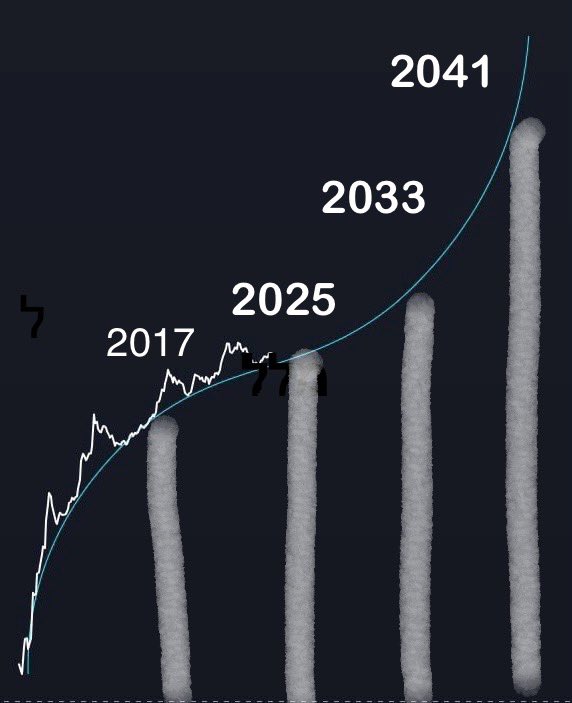
RT @LnAmbassador: Bitcoin’s price path in a log-log chart behaves very much like a heavily drunken sailor who’s trying to walk straight dow…
English
0
1
0
9
Dr Idan 🦡 retweetledi
Philosophy Of Physics
Philosophy Of Physics@PhilosophyOfPhy·
A pendulum with a variable length is a example of classical physics which demonstrates non-constant angular frequency and complex oscillatory motion. x.com/codek_tv/statu…
English
5
36
196
10.5K
Dr Idan 🦡 retweetledi
Giovanni's BTC_POWER_LAW
Giovanni's BTC_POWER_LAW@Giovann35084111·
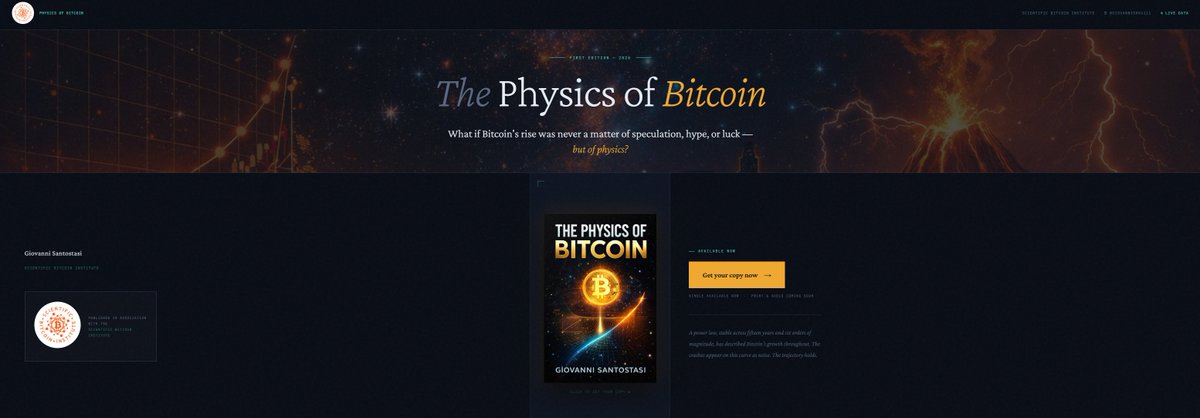
The Physics of Bitcoin website is ready. It is going to be a companion to the book with additional learning material (code, visualizations, live charts, videos and so on). It is a work in progress but bookmark it because it is going to be an important resource for understanding Bitcoin as a system. Link to the website in the comments.
Giovanni's BTC_POWER_LAW tweet media
English
4
11
81
7.1K
Dr Idan 🦡 retweetledi
Giovanni's BTC_POWER_LAW
Giovanni's BTC_POWER_LAW@Giovann35084111·
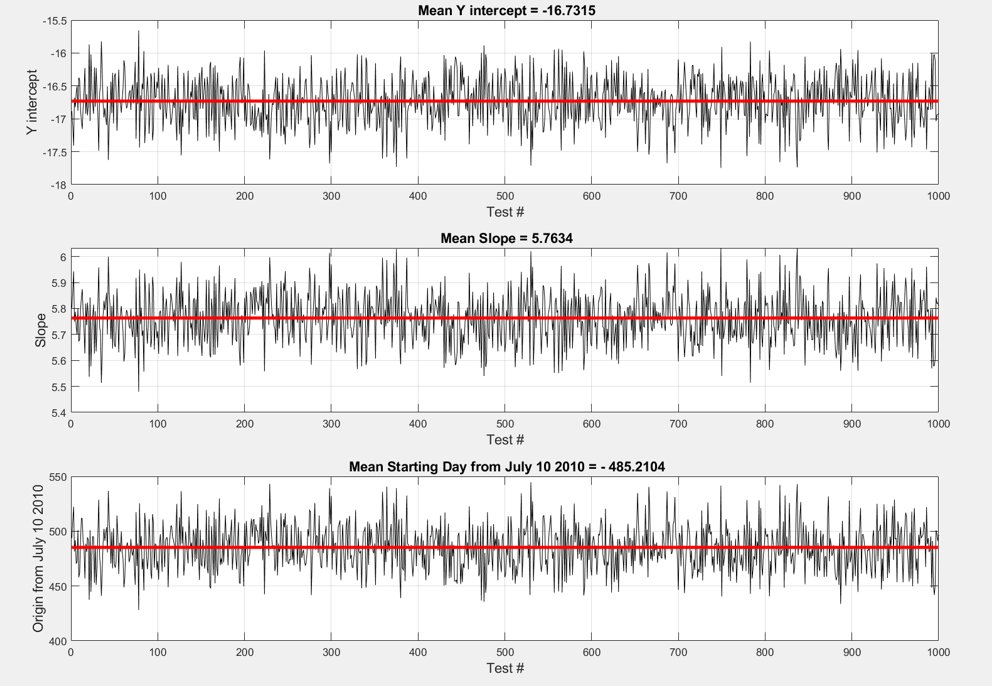
One of the beautiful aspects of a power law is that it describes a process with a well-defined origin in time. For Bitcoin, the natural candidate for this origin is the Genesis Block. However, the starting point does not need to be assumed a priori—it can actually be inferred directly from the data. The article below addresses this question in an interesting way, but I believe a clearer approach is to solve the power-law equation explicitly: P₁ = A (t₀ + t₁)ⁿ where t₁ is a known time corresponding to a real data point, and P₁ is the observed Bitcoin price at that time. Because real price data contain noise, a single solution is not sufficient. Instead, one should use many data points and repeatedly solve the equation, generating multiple estimates and then averaging the results to obtain a stable solution. In the experiment below, I fix one reference date t₂ = July 10, 2010 and pair it with several randomly chosen dates in the dataset. This produces many independent numerical solutions to the equation. From these trials we obtain consistent estimates for A, n, and t₀. The parameter t₀ represents the effective origin of the power law. On average, the results place t₀ about 450 days before July 10, 2010, which corresponds closely to the time of the Genesis Block. Given the noise present in the early price data, this level of agreement is remarkably precise.
Giovanni's BTC_POWER_LAW tweet media
mNAV.com@BitcoinPowerLaw

x.com/i/article/2029…

English
7
2
55
7.4K
Dr Idan 🦡 retweetledi
China live
China live@ChinaliveX·
This might be what socialized production in China will look like in the future:
English
931
2.3K
8.6K
3.5M
Dr Idan 🦡 retweetledi
Philosophy Of Physics
Philosophy Of Physics@PhilosophyOfPhy·
Geoffrey Hinton argues that "hallucinations" in AI should instead be called confabulations, reframing them as a characteristic of intelligence rather than a mere technical bug.
English
25
39
165
12.4K
Dr Idan 🦡 retweetledi
Conor Deegan
Conor Deegan@conordeegan·
Respectfully Saylor is wrong here on quantum. Specifically, he is wrong on four claims (I'm only focusing on the technical ones). Let me walk through each one. Claim 1: The consensus of the cyber security community is that quantum is not a threat for the next 10 years and thus no immediate action is needed. There is no such consensus. The opposite is true: every major national security and standards body in the world is actively mandating post-quantum migration right now, because the migrations themselves take a decade or more. NSA CNSA 2.0 requires all new National Security Systems to be quantum-safe before 2035 with most of that work being done in the next 5. NIST published finalized PQC standards (ML-KEM, ML-DSA, SLH-DSA) in August 2024 and released IR 8547 setting a target to deprecate all quantum-vulnerable public-key algorithms after 2030 and disallow completely by 2035. The UK NCSC set migration milestones for 2028, 2031, and 2035. These are not responses to a distant hypothetical. These are programs with compliance deadlines because the organizations that set them have concluded that starting now is barely early enough. Historically, it has taken a long time from the moment that a new algorithm is standardized until it is fully integrated into information systems. Past cryptographic migrations confirm this. The SHA-1 deprecation took about 7 years. The AES migration took around 5 years. The TLS 1.3 rollout took 3-5 years despite offering clear performance benefits. NIST has already concluded that PQC migration is fundamentally more complex than any of these precedents. The timeline argument ignores harvest-now-decrypt-later entirely. Adversaries are collecting encrypted data today for future decryption. The U.S. Federal Reserve published an analysis of this in September 2025, using Bitcoin as a case study. The threat is already active. Claim 2: When quantum hits, everything upgrades; banks, the internet, defense, Bitcoin. The internet is already upgrading. 52% of human web traffic on Cloudflare used post-quantum key exchange by December 2025, nearly doubling from 29% at the start of the year. Chrome ships ML-KEM for TLS. Apple enabled PQ TLS in iOS 26. OpenSSH has defaulted to post-quantum key agreement since version 9.0. Signal has post-quantum encryption. AWS and Google Cloud support PQC in their KMS products. Apple added ML-DSA and ML-KEM to CryptoKit as production APIs. Banks and payment networks are centralized. Visa pushes a firmware update or SWIFT changes a protocol spec. TLS upgrades are invisible to end users (if you use Chrome you use a TLS version that supports post-quantum and you didn't even know). These systems can and will migrate without their customers doing anything. Bitcoin cannot do this. Bitcoin requires a fork with global decentralized consensus. A PQC signature migration is categorically harder than previous forks: ML-DSA-44 signatures are 2,420 bytes versus 64 bytes for Schnorr, a 38x increase that breaks Bitcoin's existing SegWit weight economics, Script stack limits (520-byte maximum), and transaction propagation assumptions. A single ML-DSA-44 signature plus public key is several times larger than an entire typical single-input P2WPKH spend today. BIP-360 and QBIP exist as (great) proposals. Sadly, neither has an activation timeline. Enterprise PQC migration is much easier. These are organizations with executive authority to mandate changes, dedicated security teams, and established procurement processes. Bitcoin has none of these. Blockchain governance is structurally slower than centralized governance. The "everything upgrades together" framing also ignores the permanently exposed key problem. When banks upgrade TLS, old sessions don't matter, they were ephemeral. When Bitcoin upgrades, the ~6.9 million BTC with already-exposed public keys on the immutable ledger are still sitting there. You cannot un-publish a public key from a blockchain. Those coins need to be actively moved by their owners to new quantum-safe addresses. Approximately 1.72 million BTC in P2PK addresses, including Satoshi's estimated 1.1 million BTC, are likely permanently exposed because the private keys are lost. There is no banking equivalent to this. Banks do not maintain a public, permanent, immutable record of every customer's authentication key going back 17 years. Claim 3: Digital assets have the most advanced cryptographic security; more than banking, credit cards, stocks, etc This conflates trustlessness with cryptographic strength. They are not the same property. Bitcoin uses ECDSA over secp256k1. Your bank's TLS connection uses ECDHE over P-256 or X25519. These are the same class of cryptographic primitive, elliptic curve schemes whose security rests on the hardness of the discrete logarithm problem. Shors algorithm breaks both identically. Neither is "more advanced" than the other. What differs is what we call the defense-in-depth architecture around that primitive. A credit card tap-to-pay transaction involves: TLS with ephemeral key exchange, an EMV chip with hardware-bound keys in a certified secure element, tokenization so the merchant never sees the real card number, session-based key rotation, fraud detection, transaction reversal capability, and regulatory insurance. A Bitcoin transaction involves: one ECDSA signature. That is the entire authorization layer. No fraud department, no chargeback, no identity verification layer that can distinguish a legitimate owner from a quantum attacker holding the same derived private key. Once a forged signature is accepted by consensus, the transfer is irreversible. The systems Saylor describes as less secure are, in fact, already deploying post-quantum protections that Bitcoin has not yet started. They can do this because they are centralized. Bitcoin's decentralization, its core value proposition, is precisely what makes its quantum migration harder, slower, and later than every system he compared it to. Claim 4: The crypto community will be the first to spot the threat and move. This assumes a CRQC will be publicly announced. Nation-state adversaries have zero incentive to disclose a quantum capability. The entire intelligence value of a CRQC is that no one knows you have it. You harvest quietly, you decrypt quietly, you exploit quietly. What would "spotting it" look like on Bitcoin? A quantum attacker does not exploit a bug, bypass a firewall, or compromise a server. They produce valid signatures indistinguishable from the legitimate owner's, because mathematically, they hold the same key. If an attacker begins draining P2PK addresses, each theft is a correctly signed transaction. There is no intrusion detection system for the Bitcoin blockchain. Transactions are valid or they aren't. By the time someone notices a pattern across thousands of UTXOs, the damage is done and irreversible. And the empirical record directly contradicts the "first to move" claim. The current state of readiness: one BIP with no activation timeline, an ongoing debate about whether to freeze Satoshi's coins, and a quantum-vulnerable exposure surface that is only going up. The exposure is increasing, not decreasing, because address reuse continues to add more and more BTC to the vulnerable set. Meanwhile, the rest of the internet has already deployed PQC to billions of users without anyone noticing. Where things actually stand We maintain the Bitcoin Risq List, an open-source, continuously updated tracker of quantum-vulnerable Bitcoin at the address level. As of block height 936,882 (February 2026): approximately 6.9 million BTC across 13.9 million addresses have exposed public keys. Solana is 100% quantum-vulnerable as their address structure exposes the full public key. Deloitte's analysis found 65% of Ethereum is in quantum-vulnerable accounts. The internet started its post-quantum transition in 2022. National security systems have a 2027 compliance mandate. NIST targets deprecating and disallowing all quantum-vulnerable public-key algorithms well before 2035. The blockchain industry, which directly protects bearer value with the exact cryptographic primitives that a quantum computer breaks, has a BIP and a debate. The question is not whether quantum is a threat to digital assets. It is whether the industry will begin its migration before the window closes. The gap between the internet's pace of PQC adoption and the blockchain industry's pace is not a gap in awareness. It is a gap in urgency and importantly, the gap is not closed by asserting that the threat doesn't exist.
Natalie Brunell ⚡️@natbrunell

Michael @Saylor explains the quantum computing debate, the actual risks to Bitcoin, and what protocol upgrades could look like. Watch this clip from our full show👇🏼

English
105
88
569
139.2K
Dr Idan 🦡 retweetledi
Matt Corallo 🟠
Matt Corallo 🟠@TheBlueMatt·
Anyone who has uses agents for things beyond assistant- and coding-level tasks immediately runs into the same issue - payments sucks. With large AI labs starting to move towards capturing the agentic payments world, if open-source agents don't get serious this will be their end
Matt Corallo 🟠@TheBlueMatt

x.com/i/article/2026…

English
7
7
67
7.1K
Dr Idan 🦡
Dr Idan 🦡@dridan·
@meiramor 😥 יהי זיכרו ברוך מנביאי הדור. איש מעשה
עברית
0
0
0
11
Dr Idan 🦡 retweetledi
Meir Amor
Meir Amor@meiramor·
Meir Amor tweet media
ZXX
1
1
0
36