Mithun

240 posts

Mithun

Mithun

@drmithunraj

Gastroenterologist

India Katılım Haziran 2016
153 Takip Edilen260 Takipçiler
Mithun retweetledi
Sekhar
Sekhar@LearningEleven·
Timepass talk on Sunday 1. Navin Fluorine – Lowest number of retail shareholders since 2021 Darolutamide (brand Nubeqa) is a next-generation androgen-receptor inhibitor used to treat prostate cancer. It is considered best-in-class due to lower CNS penetration, meaning fewer side effects (fatigue, seizures) compared with peers like Xtandi/Erleada. The drug is jointly developed and marketed by Bayer AG and Orion Corporation. Orion discovered the molecule; Bayer handles global commercialization and large-scale clinical development. Launched in 2020, Nubeqa did ~€600–700m in 2021 and has already crossed ~€2.3bn annual sales by 2024. Consensus peak sales estimates are $3.5–5B. China rollout has begun, and combination therapies are still being explored, meaning the growth curve may not be finished yet. So where does Navin Fluorine fit in? Darolutamide is a heavily fluorinated complex molecule, requiring advanced fluorination chemistry. Industry tracking indicates Navin supplies specialty fluorinated advanced intermediates in the manufacturing chain. At peak drug sales, this single molecule alone could translate into roughly ₹200–300 crore annual revenue for Navin, and importantly, at very high margins. But the bigger story is not just one molecule. When a global innovator qualifies you for a complex patented oncology drug, it effectively validates your process chemistry, compliance, and reliability. That credibility often leads to additional contracts from other innovators needing advanced fluorinated intermediates, and Navin has already built capacity for such opportunities. In other words: Nubeqa is not just a product opportunity, it’s a credential. 2) Yatra Online – Operating leverage on the cards? For the past couple of weeks, the stock has been taking support near its 200-DMA. Results are due on Feb 11, and management commentary could set the near-term direction. After the IndiGo-related disruption in Q3, the market is expecting some pain, but if we treat that as a one-off, the broader business trajectory still looks constructive. Key things to watch: • Structural shift toward corporate travel: ~68% of bookings now come from corporate & MICE, higher margin, recurring, and far more stable than B2C leisure travel. • ROCE re-rating: Guided to improve from ~5% (FY25) to ~8–9% by FY26 exit and ~13–14% in FY27. Incremental business is already delivering 30%+ ROCE. • Operating leverage inflection: With much of the cost base fixed, revenue growth should increasingly translate into EBITDA expansion. Operating leverage tends to disproportionately benefit platform/tech businesses. Unlike manufacturing, they aren’t constrained by capacity utilization ceilings, once scale kicks in, margins can expand quickly. Let’s see whether Yatra can deliver the inflection in 2026! 3) The AI Noise Over the past few days, several reports suggested that nearly $1 trillion could be spent on AI infrastructure by 2026. That’s an enormous number. Whether this investment ultimately converts into durable earnings, and when, remains an open question. But in the near term, many ancillary players will enjoy a feast! This massive spending should create jobs and stimulate economic activity. Companies like MTAR Technologies, TD Power, Polycab India, and Quality Power are among the names that could benefit from this windfall capex. Then came the announcement from Anthropic, which wiped billions off tech companies’ market caps. The company’s CEO also made a striking prediction: "...Software engineering could become largely obsolete within 6–12 months..." There was a counter from George Noble of the Fidelity Overseas Fund on how many AI models are unable to do good enough job. There’s a lot of noise on both sides, let me not lose my sleeper over it! As Jensen Huang said - "You are not going to lose your job to AI. You are going to lose your job to someone who uses AI." 4) Shilpa Medicare - FY27 may be the real inflection year Back in Q4 FY24, the market expected FY25 to be the breakthrough year for Shilpa Medicare. The stock priced that in, it nearly doubled between Feb/Mar 2024 and Nov 2024. But fundamentals didn’t catch up immediately. H1 FY25 PAT was only ~₹32 Cr, far below expectations, and the stock corrected ~33% in just three months. So why revisit it now? Because it increasingly looks like the “breakthrough year” wasn’t wrong, just delayed. Instead of FY25, it appears to be shifting to FY26. FY25 PAT: ~₹78 Cr and 9M FY26 PAT: ~₹136 Cr already In the Q3 FY26 investor deck, the MD even stated: “...We are confident in a significantly better FY27...” What’s driving that confidence? API & CDMO • NCE pipeline: Three active U.S. NCE programs — one already commercialized, the second in Phase 3, and the third (with Unicycive Therapeutics) getting a dedicated commercial block by Q4 FY26. • Oncology APIs: Added 10 new blockbuster oncology products to the development grid; 3 validated this quarter. • Peptides: Developing semaglutide (oral and injectable). Large-scale peptide manufacturing capex underway; targeted completion in H2 FY27. Formulations (FDF): Fastest-growing segment • Nor-UDCA: Launched in Q3 with strong physician response and a firm order book for Q4. Europe and U.S. expansion planned. • Transdermal patch: EMA approval received for rotigotine; U.S. filing expected in Q4 FY26 with a potential FY27 launch. • Complex injectables: Long-acting ondansetron injection Phase 3 completed; India launch expected in H1 FY27. Biologics & Biosimilars • Aflibercept biosimilar (ophthalmology): Phase 3 on track for H1 FY27 submission. • Albumin: Global clinical trial protocol approved; Europe filing targeted in Q4 FY26. This is a multi-billion-dollar global market opportunity. 5) Listen to the market All of us carry biases. Sometimes in the name of “valuations,” sometimes in the name of “tailwinds,” we get attached to a few stocks, and social media storytelling only strengthens that attachment. Even if capital stays stuck there for a year with no returns, we manage to justify it. If 2 out of a 12-stock portfolio fall into that category, it’s manageable. But if 6 out of 12 are there, portfolio returns will almost certainly suffer. The reality is: the market is usually telling you something. If a stock keeps getting ignored or keeps correcting, there is often a reason, even if it isn’t immediately visible to us. Look at the price action in names like JM Financial, Ashapura Minechem, Timex Group, and Sanghvi Movers. Each had a convincing story at one point, and many of those stories were genuine. Yet price action changed much earlier than the narrative. We also carry the opposite bias - assuming expensive stocks are automatically dangerous. To a large extent that’s true, valuation discipline matters. But blindly ignoring high-valuation companies can be equally costly. Stocks like GE Vernova T&D India, Navin Fluorine, TD Power, MTAR Technologies, and Aether Industries don’t get premium multiples because they are “favorite children.” The market is pricing in a strong rate of change in earnings and opportunity over the next few years. And of course, when that rate of change slows, valuation corrects quickly, as seen in Kaynes Technology. The takeaway - Keep an open mind. Don’t marry a narrative. Don’t reject a stock only because it looks expensive. Very often, price action is the earliest information available to us, so sometimes the best thing to do is simply listen to the market. 6) Rishabh Instruments I presented Rishabh Instruments at ALD event when the stock price was in the ₹200s. My conviction was based largely on management’s stated target of ~₹100 Cr EBITDA for FY26. Now, looking at 9M FY26, EBITDA has already crossed ~₹93 Cr, a clear sign the management is walking the talk on restoring profitability. This improvement wasn’t accidental. It also involved consciously cutting low-margin/non-profitable revenues, especially from Lumel Alucast (automotive segment). While Electrical & Electronic Instrumentation remains the primary growth driver, the company has finally sounded positive on its solar business. After a long period of losses, the segment has turned operating-level profitable and the company has secured fresh orders for its single-phase inverter models. FY27 could become an important year for this vertical. However, profitability recovery is only step one. The bigger trigger will be growth. Currently the growth engine is still running a bit slow, the day revenue growth starts sustaining ~20–25%, the probability of a re-rating increases meaningfully. Management teams that go through tough conditions and fix their business models deserve attention. Execution during adversity often tells you more than execution during tailwinds. 7) Trade deals, economic growth & equities Since 2025, India has signed multiple trade agreements, with the UK, Oman, New Zealand, and Australia (zero-duty access from Jan 2026 already on the table), even before the mother of all deals with the EU entered the picture. Once details of the EU agreement emerged, including tariff reductions in some categories from ~110% to ~20% over a five-year window, it effectively triggered a FOMO moment for the US. That said, few expected how suddenly the US announcement would come. While the equity-market euphoria around the US deal lasted barely a day, the longer-term impact of these trade agreements should not be underestimated. These deals are likely to accelerate the build-out of a domestic manufacturing ecosystem, benefiting MSMEs and small companies the most. Over time, this should attract incremental foreign capital into Indian mid and small-cap equities. Even disciplined exposure via quality small-cap funds could do well over the next 2–3 years. Valuations today are broadly around long-term averages. That doesn’t rule out further downside, but with the US deal nearly in place and the EU agreement likely to be legally concluded over the next 2–3 quarters, the outlook for Indian manufacturing over the next 3–4 years looks encouraging. I don’t know how much more downside the market may see, or when the next bull phase will begin. But over a 3–4 year horizon, equities should still create meaningful wealth. That’s why this environment looks well-suited for SIP-based investing. However, just because major FTAs are broadly agreed (with the legal text still pending) doesn’t mean everything is hunky-dory. The EU deal is still 3–4 quarters away from becoming legally binding, and Trump could change his mind and rattle markets anytime on the US deal. Be optimistic, but cautiously so! That said, remember, trade agreements don’t move markets for a day, they reshape economies over years. 8) GNG Electronics - Unlikely tailwinds! GNG Electronics posted bumper numbers and gave extremely bullish commentary. Apparently, rapid AI adoption and supply constraints in new hardware are pushing up component costs and limiting new PC availability, driving a structural shift toward refurbished enterprise-grade devices and GNG obviously is in the middle of it! The company has now revised its revenue guidance from approximately ~25% to a range of 28% to 30% year-on-year. Likewise, the company now expects a 150 to 200 basis points improvement in margins for the full year! Management expects the high memory price environment to persist until at least the end of 2027, as building new production capacities takes time. This provides a long-term structural tailwind for the refurbished PC industry. Memory stocks have rallied strongly in recent months, and few would have expected GNG to be a beneficiary too. Of course, we should remember that supply-side constraints often create short-term opportunities; they may not last forever… but sometimes they last longer than we expect. 9) Eli Lilly - 2026 in Full Bloom Eli Lilly expects roughly ~25% revenue growth in 2026, driven by “industry-leading” volume expansion from its incretin franchise, Mounjaro and Zepbound. While volumes are surging, management also indicated a low-to-mid-teens drag from pricing, reflecting rebates and broader insurance coverage. 2026 could also be a defining year for Orforglipron, Lilly’s investigational oral weight-loss pill, with a targeted U.S. launch around Q2 2026 (subject to FDA approval). In contrast, Novo Nordisk projected a 5%–13% revenue decline due to pricing pressures and competition. Lilly has also reached an agreement with the U.S. government to expand access to obesity therapies, potentially enabling millions of Medicare and Medicaid beneficiaries to receive treatment starting July 1, 2026, with out-of-pocket costs capped near $50 per month. Most importantly, the company continues its aggressive manufacturing expansion, committing over $55 billion since 2020, to address earlier supply shortages. For investors tracking Indian CDMO and peptide-linked companies, that is the key point: demand is no longer the bottleneck; manufacturing capacity is. There’s a saying that India risks becoming obese before it becomes rich. Whether literal or not, one thing seems clear, the GLP-1/obesity therapy story is only beginning, and the next few years could be transformative for the global pharma supply chain. 10) Sakar Health - The up and coming CMO and Oncology hero Sakar Health post fantastic results in Q3FY26 and concall is coming up on Feb 11th. Founded in 2004, Sakar has evolved from a small contract manufacturer into an API-integrated pharmaceutical company with a growing global presence. The company now operates WHO-GMP and EU-GMP approved facilities in Gujarat, exports to 60+ countries, and has built a portfolio of ~292 product registrations across 75 international partners. They operate in three verticals: 1. CDMO / CMO Services, 2. Own Brand Exports, 3. Licensing / Product Development. For most of its history Sakar was primarily a generic formulations exporter, but in the last few years it has pivoted meaningfully toward oncology, and that is increasingly becoming the real story. The company has set up a vertically integrated oncology facility with EU-GMP approval. Its oncology portfolio includes 55 in-house developed products, of which 32 are ready for global launch. It has already secured 11 Marketing Authorisations (MAs) across geographies (six in Europe and the balance across APAC and Latin America). On the CDMO/CMO side, Sakar manufactures for established Indian pharma companies such as Zydus Life Sciences, Torrent Pharmaceuticals, Indus Pharma, Emcure, Cipla and Glenmark, with ~20 active clients. Going forward, while their generic formulations unit would continue to grow steadily (primarily in export markets), the two growth engines will be the CMO for these big Indian MNCs and Oncology portfolio. If execution sustains, Sakar appears to be transitioning from a plain export-generic company into a specialty manufacturing + oncology platform, which is a very different valuation narrative. That's all for today, see you next Sunday!
English

28
83
557
44K
Mithun retweetledi
THE SKIN DOCTOR
THE SKIN DOCTOR@theskindoctor13·
Azharuddin was loved by Indians and was made captain, but moment he got caught in match-fixing: “I’m targeted for my religion.” Hamid Ansari stayed at top posts, later became VP. Nobody objected. Moment his tenure completed: “Musalman dara hua hai.” Sanjay Dutt, a top actor, loved by the masses. The moment he got arrested in the 1992 Mumbai blast–related cases: “I’m targeted because my mother was a Muslim.” Aryan Khan, a superstar’s son. Living a private life, loved by superstar fans. The moment he got arrested in drug-related cases: “He is targeted for being a Muslim.” AR Rahman, one of the most loved composers in India. The moment his work dried up because his kind of music faded and he didn’t put in enough effort to catch up: “I think I get less work for communal reasons.” All the achievements are only theirs; failures aren’t. Failures are of the people who “target them for their religion". Bro, you were of the same religion when people were loving, celebrating, and supporting you. If religion were an issue, you wouldn’t have got the fame, money, and idolatry, but you never acknowledge that. When everything is going right, religion is invisible. It appears only when accountability begins.
English
431
7.2K
26.1K
554.2K
Mithun retweetledi
Sekhar
Sekhar@LearningEleven·
Timepass talk on a Sunday 1. Bempedoic Acid — remember the name? The market was obsessing over it in 2025, when optimism around bempedoic acid drove a sharp re-rating in Blue Jet Healthcare. That enthusiasm later faded amid chatter that Neuland Laboratories had become a serious competitor and was grabbing market share, triggering a sharp correction in Blue Jet. So why is bempedoic acid back in focus now? In August 2025, the European Society of Cardiology / European Atherosclerosis Society added bempedoic acid to their clinical practice guidelines, effectively placing it alongside other established non-statin LDL-C therapies. Following this, analysts increasingly expect the American College of Cardiology / American Heart Association to incorporate it in their next guideline update, expected around Jan–Feb 2026—a logical progression given historical guideline alignment. ACC/AHA inclusion would be a material commercial catalyst. It would legitimize bempedoic acid in mainstream US clinical practice, improve payer acceptance, reduce prescription friction, and meaningfully accelerate sales volumes for Esperion. There is a clear precedent. Once ACC/AHA guidelines endorsed PCSK9 inhibitors, Amgen’s Repatha saw sales ramp from sub-$1 billion to multi-billion dollars annually. Incidentally, prices of Neuland Laboratories and Blue Jet Healthcare have corrected meaningfully if anyone wants to track this bempedoic acid story! 2. Paytm's time is here? Paytm had gone thru a number of regulatory struggles such as ban on merchant acquisition, ban on Paytm Payments Bank etc., in last couple of years but finally the regulatory gods started smiling on them. In Nov' 25, Paytm received final approval to start onboarding online merchants, likewise, Paytm found alternate routes for some of the other challenges. Their recent tag lines are "AI Is a Revenue Line Item (Not Just Cost Saving)", "Merchant Ecosystem = Core Moat", "Net Payment Margin (NPM) is structurally improving", "Lending Engine Back on Track - Merchant loans are growing steadily and are resilient", "Classic setup for non-linear PAT growth - Indirect costs are range-bound, while revenues accelerate" Back in Aug' 2025, Emkay estimated Paytm to post Adjusted PAT of ~₹812 Cr, ~₹1606 Cr and ~₹2475 Cr respectively for FY26, FY27 and FY28. My good friend @deveshkedia_ did his own estimates, they are a bit more conservative than these but the question is, FY26 could finally be that inflection year that market has been waiting for? Let’s wait and watch or study and figure out yourself! MCX is expected to post a bumper Q3, aided by elevated activity in the metals complex, effectively making it a proxy for commodity volatility, particularly the metals cycle. In a similar vein, as the lending engine for merchant loans gains traction again, Paytm could emerge as a proxy beneficiary of the broader credit growth cycle. While Paytm does not lend on its own balance sheet, it plays a critical middle-layer role, sourcing and facilitating merchant loans for banks and NBFCs, benefiting directly from improved credit appetite and disbursement momentum. 3. Berlin’s Longest Blackout Since WWII 2026 didn't start well for Berlin. The city suffered its longest power outage since World War II, lasting several days and affecting ~45,000 households and thousands of businesses, during sub-zero winter temperatures. German authorities confirmed the blackout was caused by a deliberate arson attack on power infrastructure; a far-left group (“Vulkangruppe”) claimed responsibility, and federal prosecutors opened a terrorism investigation. Power was largely restored by January 7, 2026, but the episode reinforced just how critical electrification has become. When energy, heating, mobility, and payments all depend on electrons, resilience of the power grid is non-negotiable. The timing of rebound in energy, power, or renewables stocks is a separate debate, but the electrification theme itself is clearly here to stay. Speaking of the electrification theme, have you noticed the promoter buying at Yash Highvoltage? The promoters have been on a steady buying spree, often a quiet but telling signal. Yash Highvoltage is a specialised manufacturer of transformer bushings. Bushings are critical insulators that allow conductors to carry electricity safely through transformer tanks and other high-voltage equipment. Without reliable bushings, transformers can fail, leading to outages. If transformers are the hubs of the grid, bushings are the arteries, carrying high voltage safely in and out. No bushing, no transformer. No transformer, no grid. Alongside this, another interesting electrification play is Modern Insulators. If Yash Highvoltage is a proxy for transformers, then Modern Insulators is effectively a proxy for the transmission & distribution (T&D) network itself, benefiting directly from grid expansion, higher voltages, and renewable evacuation corridors. 4. Panacea Biotech The company may finally be entering the long-awaited growth phase. The stock saw a sharp move on January 8 following an exchange notification, though clear earnings visibility is still a few quarters away. That said, visibility is closer than it has ever been. Here are the key triggers: i) DengiAll (Dengue Vaccine) The Phase-III trials for DengiAll®, India’s first indigenous single-shot dengue vaccine, have completed enrollment with 10,335 participants! Now that the participants have received either the vaccine or a placebo, the company will enter a two-year monitoring phase. During this time, they will track: the efficacy and immunogenicity of the vaccine. Assuming the monitoring phase goes thru successfully with good efficacy and immune response, the vaccine might get launched in 2027! Besides Takeda's Qdenga starting rollout in 2026 (Biological E. is the local manufacturer), there is no other dengue vaccine in India and the fact that dengue is a serious pain in India, If Panacea is able to get all the approvals and launch it in sometime CY2027, they should have very good market. ii) NuCoVac-11 (Pneumococcal Vaccine) Phase 3 trials are expected to be completed by the end of FY2026. Panacea Biotec intends to participate in the next tender cycle. Pneumococcal Vaccines are already available in India. Serum Institute, Pfizer and Dr. Reddy's do have their own brands. However, the government demand is roughly 100 million doses annually. At a price of approximately ₹225 per dose, the total market is around ₹2,000 crore. So, Panacea should be able to grab some part of this market. iii) EasySix (Hexavalent Vaccine) The vaccine is already in the private market. The company is expanding capacity to meet UN demand, which is projected to reach over 100 million doses by 2030. They are currently taking trial batches and will soon seek WHO prequalification to participate in UN tenders. In many ways, it feels like Panacea Biotecis where Wockhardt was about two years ago. The timing is uncertain, whether the inflection comes in 2027 or 2028 is hard to predict, but when it does, the earnings trajectory could look distinctly J-curve. 5. Even crude couldn't escape Racism A recent ‘Secret Santa’ operation by the world’s most powerful man aimed at Caracas taught me something I hadn’t fully appreciated. Venezuela may hold the world’s largest oil reserves, but most of them are heavy, dark, thick crude that is expensive to extract and even more expensive to refine. It requires advanced technology, sustained capital, and stable long-term partnerships. When those conditions break down, the oil simply stays underground, and earns nothing. Saudi Arabia, by contrast, produces lighter crude at far lower costs from highly efficient fields, allowing it to remain profitable even during periods of low global oil prices. Some US refiners such as Valero, PBF Energy and Phillips 66, along with a few Chinese refiners and Croatia’s Rijeka refinery, have the technical capability to process Venezuela’s heavy crude. And of course, our very own Reliance Industries. Recently, Morgan Stanley laid out a detailed thesis on RIL, noting that since Covid the company has invested over US$80 bn, with most of this capex expected to start bearing fruit from 2026. 6. Cell gene therapy (CGT) - The "holy grail" Cell gene therapy (CGT) to drive next generation of precision medicine - $8.7bn (2024) to $46.2bn (2029). Cell and Gene Therapy (CGT) is a field of medicine that treats or cures diseases by either reprogramming a patient’s living cells or repairing their underlying genetic code. CGT is widely considered the "holy grail" of precision medicine because it shifts the focus from treating symptoms to fixing the underlying biological cause of a disease. Most traditional drugs (like those for diabetes or blood pressure) must be taken for life. CGT aims for "one-and-done" treatments that provide long-lasting or even permanent cures by repairing or replacing faulty genes. So far, about 100 CGT products have been approved globally, but there are currently over 3,000 therapies in clinical trials globally. Approximately 90 products are in the final stages of regulatory review or Phase III trials right now. India has couple of CGT products namely NexCAR19 (developed by ImmunoACT) and Qartemi (Immuneel). You might recall that Laurus Labs has ~34% investment in ImmunoACT. On the other hand, Immuneel is founded by Kiran Mazumdar-Shaw (Biocon) along with two other prominent figures. The CGT market was valued at USD 8.7 bn in 2024 and is projected to surge to USD 46.2 bn by 2029, with a CAGR of 39.5%. If you are investing in international markets, this is a good space to scout 7. China is moving from a “transition plan” (14th) to a “fortification plan” (15th) 2025 marked the end of China's 14th Five-Year Plan and 2026 marks the beginning of their 15th Five-Year Plan. Here is something that I have read about the potential focus areas of 15th five-year plan. i) Move on from GDP-growth mindset. Growth should be a by-product of strength ii) From “closing the gap” → to owning the frontier. Lead and set standards across AI, quantum, advanced manufacturing, space, robotics, iii) Energy as policy → energy as sovereignty, iv) From cultural revival → to cultural export, v) From adapting to the system → to reshaping it Long story short, China plans to take the domination to next level! 8. Strength or the Value? In a sideways and volatile market like this, unless you’re sitting on large cash piles and have infinite patience, it often pays to stay with strength. One simple way to do this is to run a scanner on Screener, or any tool you prefer, for stocks trading within 10% of their 52-week highs. This exercise doesn’t just throw up stock ideas; it also reveals sectoral leadership. Run the scan today and you’ll likely notice clusters in metals and metal proxies, financials, pharma, and auto ancillaries. Nothing is set in stone, of course, but as a rule of thumb, unless I have huge cash piles, it makes sense to listen to what the market is rewarding and allocate at least 90% of capital to strength, rather than fighting tape or trying to time deep turnarounds. If you’re tracking relative strength, one simple screen is stocks trading within ~10% of their recent 52-week highs - MTAR Tech, R R Kabel, JK Tyre, AB Capital, Laurus Labs, Craftsman Automation, Shriram Pistons, Ashapura Minechem, Lumax Industries etc. This does not imply immediate action or recommendation, rather, doing such a weekly relative-strength exercise helps in - Spotting themes that are resisting broader market volatility and narrowing the universe for deeper fundamental work later. If we had run a similar scan back in November, we would have thrown up many of the same names. When patterns and themes start repeating, they deserve attention. In a falling market, stocks hovering close to their 52-week highs are telling you something, and that signal is worth noticing. What refuses to fall often matters more than what rises...! 9. STARs looking good for MTAR - Why is MTAR Technologies stock standing like “The Rock”? You would have already heard the line - Airbus is effectively sold out for about a decade at today’s delivery pace. That's why commercial aerospace ancillaries are sitting on multi-year demand visibility. But aerospace isn’t the only space with this structural setup. A parallel story is unfolding in Gas Turbines. The AI + data-center boom has created a shock demand for 24×7 baseload power with 99.999% uptime. Hyperscalers are no longer comfortable relying only on grids and intermittent renewables. Naturally, this pushed them toward gas-based baseload capacity. The problem? Large gas turbine OEM capacity (such as GE Vernova, Siemens Energy etc.) is structurally capped. All OEMs are running into 3–5 year delivery timelines. Of course, such demand is precisely the core thesis behind TD Power. But, lets come back to MTAR for now. Because turbine deliveries aren’t matching hyperscalers’ urgency, customers are actively exploring non-turbine baseload alternatives. One of the most prominent is Bloom Energy’s Solid Oxide Fuel Cells (SOFCs). Unlike a gas turbine that burns fuel to spin a generator, an SOFC is a solid-state device that converts fuel into electricity via an electrochemical reaction. Think of it as a “battery that never runs out”, as long as fuel (like natural gas) is supplied. How exactly it works is a discussion for another day, but the key point is, SOFCs are gaining traction as a credible, fast-deployable baseload solution. SOFCs = ~3–12 months to deploy + zero NOx/SOx + ~35% lower CO₂ vs gas turbines Where MTAR Technologies fits in - MTAR specializes in the "Hot Box," which is the heart of the Bloom Energy Server where the electrochemical reaction takes place. If SOFC adoption accelerates due to turbine shortages, Bloom and hence MTAR would be in sweet spot and could grow their revenues multi-fold over the next few years! Of course, MTAR does have other optionalities in the areas such as Nuclear, Defence, Aerospace etc. 10. Results season is here and some of the NBFCs might post bumper results! Multiple analyst reports, corroborated by recent company business updates, indicate that Q3 could be meaningfully strong for several NBFC segments, driven by a confluence of macro tailwinds. Factors such as GST-led demand improvement, Surge in gold prices and Lower cost of borrowing would help several NBFCs to post strong numbers. Gold NBFCs are poised to deliver “once-in-a-cycle” kind of quarterly results, expect very strong Q3 numbers from auto-focused lenders and likewise, cut in the interest rates would have created favourable conditions for housing lenders. Muthoot Finance, Fedfina, L&T Finance, Shriram Finance etc. should have a strong Q3! That's for this episode! Happy Sunday!
English
34
52
384
33.2K
Mithun
Mithun@drmithunraj·
@unseenvalue Happy new year. So long, and thanks for all the fish
English
0
0
1
82
Antifragile Thinking
Antifragile Thinking@unseenvalue·
As 2025 comes to an end, I am taking a moment to pause, reflect, and reset. I’m grateful for everything this year brought, both the good and the hard parts. Things happened the way they did, and each experience taught me something. This year reminded me that happiness doesn’t come from controlling outcomes but from taking responsibility for my thoughts, intentions, and actions. The difficult moments mattered too. They pushed me to look inward, strengthen my character, and respond with care instead of reacting emotionally. I’m thankful for what I gained, what I learnt, and even for what didn’t work out, because none of it took away my ability to live well. Looking ahead to 2026, my focus is simple: to be a little better than I was yesterday. I want to act with honesty, kindness, and care and do my work thoughtfully and fairly. I’m not aiming for perfection, just clarity and alignment between what I think, what I choose, and how I act. My goal for the new year is to stay present and avoid unnecessary distractions. If I can keep my mind calm, disciplined, and grounded, that will be enough. A life lived with integrity is, in the end, a life well lived. Wishing you a happy, peaceful, and meaningful New Year.
English
38
9
256
13.4K
Sekhar
Sekhar@LearningEleven·
On this Vaikuntha Ekadashi, I have started my journey on Substack! My first post is about my highest conviction idea! Hope it adds value! Laurus Isn’t Expanding the Present. It’s Engineering the Future. The Real Laurus Story Is What Comes After FY26. open.substack.com/pub/kbsekhar/p…
English
86
49
705
109.4K
Mithun retweetledi
Mukul Dekhane
Mukul Dekhane@dekhane_mukul·
𝑯𝒐𝒘 𝒅𝒐 𝒚𝒐𝒖 𝒌𝒏𝒐𝒘 𝒚𝒐𝒖 𝒂𝒓𝒆 𝒓𝒊𝒄𝒉? 𝑨𝒎𝒂𝒛𝒊𝒏𝒈 𝒂𝒏𝒔𝒘𝒆𝒓 𝒃𝒚 𝒂𝒏 𝑰𝑰𝑻 𝒔𝒕𝒖𝒅𝒆𝒏𝒕. 𝑾𝒉𝒆𝒏 𝑰 𝒘𝒂𝒔 𝒅𝒐𝒊𝒏𝒈 𝒎𝒚 𝑩 𝑻𝒆𝒄𝒉, 𝒕𝒉𝒆𝒓𝒆 𝒘𝒂𝒔 𝒂 𝑷𝒓𝒐𝒇𝒆𝒔𝒔𝒐𝒓 𝒘𝒉𝒐 𝒖𝒔𝒆𝒅 𝒕𝒐 𝒕𝒆𝒂𝒄𝒉 𝒖𝒔 ‘𝑴𝒆𝒄𝒉𝒂𝒏𝒊𝒄𝒔’. 𝑯𝒊𝒔 𝒍𝒆𝒄𝒕𝒖𝒓𝒆𝒔 𝒖𝒔𝒆𝒅 𝒕𝒐 𝒃𝒆 𝒗𝒆𝒓𝒚 𝒊𝒏𝒕𝒆𝒓𝒆𝒔𝒕𝒊𝒏𝒈 𝒔𝒊𝒏𝒄𝒆 𝒉𝒆 𝒉𝒂𝒅 𝒂𝒏 𝒊𝒏𝒕𝒆𝒓𝒆𝒔𝒕𝒊𝒏𝒈 𝒘𝒂𝒚 𝒕𝒐 𝒕𝒆𝒂𝒄𝒉 𝒂𝒏𝒅 𝒆𝒙𝒑𝒍𝒂𝒊𝒏 𝒕𝒉𝒆 𝒄𝒐𝒏𝒄𝒆𝒑𝒕𝒔. 𝑶𝒏𝒆 𝒅𝒂𝒚, 𝒊𝒏 𝒕𝒉𝒆 𝒄𝒍𝒂𝒔𝒔, 𝒉𝒆 𝒂𝒔𝒌𝒆𝒅 𝒕𝒉𝒆 𝒇𝒐𝒍𝒍𝒐𝒘𝒊𝒏𝒈 𝒒𝒖𝒆𝒔𝒕𝒊𝒐𝒏𝒔: 𝟏. 𝑾𝒉𝒂𝒕 𝒊𝒔 𝒁𝑬𝑹𝑶? 𝟐. 𝑾𝒉𝒂𝒕 𝒊𝒔 𝑰𝑵𝑭𝑰𝑵𝑰𝑻𝒀? 𝟑. 𝑪𝒂𝒏 𝒁𝑬𝑹𝑶 𝒂𝒏𝒅 𝑰𝑵𝑭𝑰𝑵𝑰𝑻𝒀 𝒃𝒆 𝒔𝒂𝒎𝒆? 𝑾𝒆 𝒂𝒍𝒍 𝒕𝒉𝒐𝒖𝒈𝒉𝒕 𝒕𝒉𝒂𝒕 𝒘𝒆 𝒌𝒏𝒆𝒘 𝒕𝒉𝒆 𝒂𝒏𝒔𝒘𝒆𝒓𝒔 𝒂𝒏𝒅 𝒘𝒆 𝒓𝒆𝒑𝒍𝒊𝒆𝒅 𝒂𝒔 𝒇𝒐𝒍𝒍𝒐𝒘𝒊𝒏𝒈: 𝒁𝑬𝑹𝑶 𝒎𝒆𝒂𝒏𝒔 𝒏𝒐𝒕𝒉𝒊𝒏𝒈. 𝑰𝑵𝑭𝑰𝑵𝑰𝑻𝒀 𝒎𝒆𝒂𝒏𝒔 𝒂 𝒏𝒖𝒎𝒃𝒆𝒓 𝒈𝒓𝒆𝒂𝒕𝒆𝒓 𝒕𝒉𝒂𝒏 𝒂𝒏𝒚 𝒄𝒐𝒖𝒏𝒕𝒂𝒃𝒍𝒆 𝒏𝒖𝒎𝒃𝒆𝒓. 𝒁𝑬𝑹𝑶 𝒂𝒏𝒅 𝑰𝑵𝑭𝑰𝑵𝑰𝑻𝒀 𝒂𝒓𝒆 𝒐𝒑𝒑𝒐𝒔𝒊𝒕𝒆 𝒂𝒏𝒅 𝒕𝒉𝒆𝒚 𝒄𝒂𝒏 𝒏𝒆𝒗𝒆𝒓 𝒃𝒆 𝒔𝒂𝒎𝒆. 𝑯𝒆 𝒄𝒐𝒖𝒏𝒕𝒆𝒓𝒆𝒅 𝒖𝒔 𝒃𝒚 𝒇𝒊𝒓𝒔𝒕 𝒕𝒂𝒍𝒌𝒊𝒏𝒈 𝒂𝒃𝒐𝒖𝒕 𝒊𝒏𝒇𝒊𝒏𝒊𝒕𝒚 𝒂𝒏𝒅 𝒂𝒔𝒌𝒆𝒅, 𝑯𝒐𝒘 𝒄𝒂𝒏 𝒕𝒉𝒆𝒓𝒆 𝒃𝒆 𝒂𝒏𝒚 𝒏𝒖𝒎𝒃𝒆𝒓 𝒘𝒉𝒊𝒄𝒉 𝒊𝒔 𝒈𝒓𝒆𝒂𝒕𝒆𝒓 𝒕𝒉𝒂𝒏 𝒂𝒏𝒚 𝒄𝒐𝒖𝒏𝒕𝒂𝒃𝒍𝒆 𝒏𝒖𝒎𝒃𝒆𝒓? 𝑾𝒆 𝒉𝒂𝒅 𝒏𝒐 𝒂𝒏𝒔𝒘𝒆𝒓𝒔. 𝑯𝒆 𝒕𝒉𝒆𝒏 𝒆𝒙𝒑𝒍𝒂𝒊𝒏𝒆𝒅 𝒕𝒉𝒆 𝒄𝒐𝒏𝒄𝒆𝒑𝒕 𝒐𝒇 𝒊𝒏𝒇𝒊𝒏𝒊𝒕𝒚 𝒊𝒏 𝒂 𝒗𝒆𝒓𝒚 𝒊𝒏𝒕𝒆𝒓𝒆𝒔𝒕𝒊𝒏𝒈 𝒘𝒂𝒚. 𝑯𝒆 𝒔𝒂𝒊𝒅 𝒕𝒉𝒂𝒕 𝒊𝒎𝒂𝒈𝒊𝒏𝒆 𝒕𝒉𝒂𝒕 𝒕𝒉𝒆𝒓𝒆 𝒊𝒔 𝒂𝒏 𝒊𝒍𝒍𝒊𝒕𝒆𝒓𝒂𝒕𝒆 𝒔𝒉𝒆𝒑𝒉𝒆𝒓𝒅 𝒘𝒉𝒐 𝒄𝒂𝒏 𝒄𝒐𝒖𝒏𝒕 𝒐𝒏𝒍𝒚 𝒖𝒑𝒕𝒐 𝟐𝟎. 𝑵𝒐𝒘, 𝒊𝒇 𝒕𝒉𝒆 𝒏𝒖𝒎𝒃𝒆𝒓 𝒐𝒇 𝒔𝒉𝒆𝒆𝒑 𝒉𝒆 𝒉𝒂𝒔 𝒍𝒆𝒔𝒔 𝒕𝒉𝒂𝒏 𝟐𝟎 𝒂𝒏𝒅 𝒚𝒐𝒖 𝒂𝒔𝒌 𝒉𝒊𝒎 𝒉𝒐𝒘 𝒎𝒂𝒏𝒚 𝒔𝒉𝒆𝒆𝒑 𝒉𝒆 𝒉𝒂𝒔, 𝒉𝒆 𝒄𝒂𝒏 𝒕𝒆𝒍𝒍 𝒚𝒐𝒖 𝒕𝒉𝒆 𝒑𝒓𝒆𝒄𝒊𝒔𝒆 𝒏𝒖𝒎𝒃𝒆𝒓 (𝒍𝒊𝒌𝒆 𝟑, 𝟓, 𝟏𝟒 𝒆𝒕𝒄.). 𝑯𝒐𝒘𝒆𝒗𝒆𝒓, 𝒊𝒇 𝒕𝒉𝒆 𝒏𝒖𝒎𝒃𝒆𝒓 𝒊𝒔 𝒎𝒐𝒓𝒆 𝒕𝒉𝒂𝒏 𝟐𝟎, 𝒉𝒆 𝒊𝒔 𝒍𝒊𝒌𝒆𝒍𝒚 𝒕𝒐 𝒔𝒂𝒚 “𝑻𝑶𝑶 𝑴𝑨𝑵𝒀”. 𝑯𝒆 𝒕𝒉𝒆𝒏 𝒆𝒙𝒑𝒍𝒂𝒊𝒏𝒆𝒅 𝒕𝒉𝒂𝒕 𝒊𝒏 𝒔𝒄𝒊𝒆𝒏𝒄𝒆 𝒊𝒏𝒇𝒊𝒏𝒊𝒕𝒚 𝒎𝒆𝒂𝒏𝒔 ‘𝒕𝒐𝒐 𝒎𝒂𝒏𝒚’ (𝒂𝒏𝒅 𝒏𝒐𝒕 𝒖𝒏𝒄𝒐𝒖𝒏𝒕𝒂𝒃𝒍𝒆) 𝒂𝒏𝒅 𝒊𝒏 𝒕𝒉𝒆 𝒔𝒂𝒎𝒆 𝒘𝒂𝒚 𝒛𝒆𝒓𝒐 𝒎𝒆𝒂𝒏𝒔 ‘𝒕𝒐𝒐 𝒇𝒆𝒘’ (𝒂𝒏𝒅 𝒏𝒐𝒕 𝒏𝒐𝒕𝒉𝒊𝒏𝒈). 𝑨𝒔 𝒂𝒏 𝒆𝒙𝒂𝒎𝒑𝒍𝒆, 𝒉𝒆 𝒔𝒂𝒊𝒅 𝒕𝒉𝒂𝒕 𝒊𝒇 𝒘𝒆 𝒕𝒂𝒌𝒆 𝒕𝒉𝒆 𝒅𝒊𝒂𝒎𝒆𝒕𝒆𝒓 𝒐𝒇 𝒕𝒉𝒆 𝑬𝒂𝒓𝒕𝒉 𝒂𝒔 𝒄𝒐𝒎𝒑𝒂𝒓𝒆𝒅 𝒕𝒐 𝒅𝒊𝒔𝒕𝒂𝒏𝒄𝒆 𝒃𝒆𝒕𝒘𝒆𝒆𝒏 𝑬𝒂𝒓𝒕𝒉 𝒂𝒏𝒅 𝑺𝒖𝒏, 𝒕𝒉𝒆 𝒅𝒊𝒂𝒎𝒆𝒕𝒆𝒓 𝒐𝒇 𝒆𝒂𝒓𝒕𝒉 𝒄𝒂𝒏 𝒃𝒆 𝒔𝒂𝒊𝒅 𝒕𝒐 𝒃𝒆 𝒛𝒆𝒓𝒐 𝒔𝒊𝒏𝒄𝒆 𝒊𝒕 𝒊𝒔 𝒕𝒐𝒐 𝒔𝒎𝒂𝒍𝒍. 𝑯𝒐𝒘𝒆𝒗𝒆𝒓, 𝒘𝒉𝒆𝒏 𝒘𝒆 𝒄𝒐𝒎𝒑𝒂𝒓𝒆 𝒕𝒉𝒆 𝒔𝒂𝒎𝒆 𝒅𝒊𝒂𝒎𝒆𝒕𝒆𝒓 𝒐𝒇 𝒆𝒂𝒓𝒕𝒉 𝒘𝒊𝒕𝒉 𝒕𝒉𝒆 𝒔𝒊𝒛𝒆 𝒐𝒇 𝒂 𝒈𝒓𝒂𝒊𝒏, 𝒅𝒊𝒂𝒎𝒆𝒕𝒆𝒓 𝒐𝒇 𝒆𝒂𝒓𝒕𝒉 𝒄𝒂𝒏 𝒃𝒆 𝒔𝒂𝒊𝒅 𝒕𝒐 𝒃𝒆 𝒊𝒏𝒇𝒊𝒏𝒊𝒕𝒆. 𝑯𝒆𝒏𝒄𝒆, 𝒉𝒆 𝒄𝒐𝒏𝒄𝒍𝒖𝒅𝒆𝒅 𝒕𝒉𝒂𝒕 𝒕𝒉𝒆 𝒔𝒂𝒎𝒆 𝒕𝒉𝒊𝒏𝒈 𝒄𝒂𝒏 𝒃𝒆 𝒁𝑬𝑹𝑶 𝒂𝒏𝒅 𝑰𝑵𝑭𝑰𝑵𝑰𝑻𝑬 𝒂𝒕 𝒕𝒉𝒆 𝒔𝒂𝒎𝒆 𝒕𝒊𝒎𝒆, 𝒅𝒆𝒑𝒆𝒏𝒅𝒊𝒏𝒈 𝒐𝒏 𝒕𝒉𝒆 𝒄𝒐𝒏𝒕𝒆𝒙𝒕, 𝒐𝒓 𝒚𝒐𝒖𝒓 𝒎𝒂𝒕𝒓𝒊𝒙 𝒐𝒇 𝒄𝒐𝒎𝒑𝒂𝒓𝒊𝒔𝒐𝒏. 𝑻𝒉𝒆 𝒓𝒆𝒍𝒂𝒕𝒊𝒐𝒏𝒔𝒉𝒊𝒑 𝒃𝒆𝒕𝒘𝒆𝒆𝒏 𝒓𝒊𝒄𝒉𝒏𝒆𝒔𝒔 𝒂𝒏𝒅 𝒑𝒐𝒗𝒆𝒓𝒕𝒚 𝒊𝒔 𝒔𝒊𝒎𝒊𝒍𝒂𝒓 𝒕𝒐 𝒕𝒉𝒆 𝒓𝒆𝒍𝒂𝒕𝒊𝒐𝒏𝒔𝒉𝒊𝒑 𝒃𝒆𝒕𝒘𝒆𝒆𝒏 𝒊𝒏𝒇𝒊𝒏𝒊𝒕𝒚 𝒂𝒏𝒅 𝒛𝒆𝒓𝒐. 𝑰𝒕 𝒂𝒍𝒍 𝒅𝒆𝒑𝒆𝒏𝒅𝒔 𝒐𝒏 𝒕𝒉𝒆 𝒔𝒄𝒂𝒍𝒆 𝒐𝒇 𝒄𝒐𝒎𝒑𝒂𝒓𝒊𝒔𝒐𝒏 𝒘𝒊𝒕𝒉 𝒚𝒐𝒖𝒓 𝒘𝒂𝒏𝒕𝒔. 𝑰𝒇 𝒚𝒐𝒖𝒓 𝒊𝒏𝒄𝒐𝒎𝒆 𝒊𝒔 𝒎𝒐𝒓𝒆 𝒕𝒉𝒂𝒏 𝒚𝒐𝒖𝒓 𝒘𝒂𝒏𝒕𝒔, 𝒚𝒐𝒖 𝒂𝒓𝒆 𝒓𝒊𝒄𝒉.. 𝑰𝒇 𝒚𝒐𝒖𝒓 𝒘𝒂𝒏𝒕𝒔 𝒂𝒓𝒆 𝒎𝒐𝒓𝒆 𝒕𝒉𝒂𝒏 𝒚𝒐𝒖𝒓 𝒊𝒏𝒄𝒐𝒎𝒆, 𝒚𝒐𝒖 𝒂𝒓𝒆 𝒑𝒐𝒐𝒓. 𝑰 𝒄𝒐𝒏𝒔𝒊𝒅𝒆𝒓 𝒎𝒚𝒔𝒆𝒍𝒇 𝒓𝒊𝒄𝒉 𝒃𝒆𝒄𝒂𝒖𝒔𝒆 𝒎𝒚 𝒘𝒂𝒏𝒕𝒔 𝒂𝒓𝒆 𝒇𝒂𝒓 𝒍𝒆𝒔𝒔 𝒕𝒉𝒂𝒏 𝒎𝒚 𝒊𝒏𝒄𝒐𝒎𝒆. 𝑰 𝒉𝒂𝒗𝒆 𝒃𝒆𝒄𝒐𝒎𝒆 𝒓𝒊𝒄𝒉 𝒏𝒐𝒕 𝒔𝒐 𝒎𝒖𝒄𝒉 𝒃𝒚 𝒂𝒄𝒒𝒖𝒊𝒓𝒊𝒏𝒈 𝒍𝒐𝒕𝒔 𝒐𝒇 𝒎𝒐𝒏𝒆𝒚, 𝒃𝒖𝒕 𝒃𝒚 𝒑𝒓𝒐𝒈𝒓𝒆𝒔𝒔𝒊𝒗𝒆𝒍𝒚 𝒓𝒆𝒅𝒖𝒄𝒊𝒏𝒈 𝒎𝒚 𝒘𝒂𝒏𝒕𝒔. 𝑰𝒇 𝒚𝒐𝒖 𝒄𝒂𝒏 𝒓𝒆𝒅𝒖𝒄𝒆 𝒚𝒐𝒖𝒓 𝒘𝒂𝒏𝒕𝒔, 𝒚𝒐𝒖 𝒕𝒐𝒐 𝒄𝒂𝒏 𝒃𝒆𝒄𝒐𝒎𝒆 𝒓𝒊𝒄𝒉 𝒂𝒕 𝒕𝒉𝒊𝒔 𝒗𝒆𝒓𝒚 𝒎𝒐𝒎𝒆𝒏𝒕. #WisdomWords
English
78
687
3.5K
209.4K
Mithun retweetledi
Mukul Dekhane
Mukul Dekhane@dekhane_mukul·
Will Rogers, who died in a 1935 plane crash, was one of the greatest political sages America has ever known... Some of his sayings: *Never slap a man who's chewing tobacco.. *There are two theories to arguing with a woman. Neither works. *Never miss a good chance to shut up. *If you find yourself in a hole, stop digging... *The quickest way to double your money is to fold it and put it back into your pocket. There are three kinds of men : *The ones that learn by reading. *The few who learn by observation. *The rest of them have to pee on the electric fence and find out for themselves. *Good judgment comes from experience, and a lot of that comes from bad judgment. *If you're riding ahead of the herd, take a look back every now and then to make sure it's still there. *Letting the cat out of the bag is a whole lot easier than putting it back. *Don't let yesterday use up too much of today. Enjoy.....
English
9
30
182
6.7K
Mithun retweetledi
Rāma Śēṣan Chandraśēkaran
Rāma Śēṣan Chandraśēkaran@maa_bhaishiiH·
When malaria outbreak happens….. some people 1. Not all mosquitoes 2. Mosquitoes themselves are the biggest victims of malaria 3. Mosquitoes don’t kill, microbes do 4. Malaria has no carrier species 5. I am worried how this malaria outbreak will lead to hatred and bigotry against the non-malaria carrying mosquitoes 6. Don’t be entomophobic, there are good and bad ones in all species 7. If we stop behaving bigotedly towards mosquitoes by repelling them through bats and mats, they will stop causing malaria
English
45
870
3K
50.5K
Mithun
Mithun@drmithunraj·
@karthik2k2 Have to appreciate your clarity and eloquence . Literally putting my thoughts to words .
English
0
0
1
152
Karthik Balachandran
Karthik Balachandran@karthik2k2·
Excellent question. Answer : No, I dont want to be the patient Would you want to be a patient on a triple duty week friday afternoon who is turned away , because that day’s quota is over ? See how easy it is to flip the script. The fact is I don’t want to be the resident doing triple duty week either. No one does. No one did. Residency being brutal is a systemic issue- not an individual one. The solution. can’t be individual exemption. Emotional rhetoric doesn’t help anyone. It’s better to discuss practical solutions with their pros, cons and alternatives.
Dr. Ligma@PruritusAnii

@karthik2k2 Would you want to be that patient to meet you on such a triple emergency week friday afternoon?

English
11
2
40
16.5K
Mithun retweetledi
Karthik Balachandran
Karthik Balachandran@karthik2k2·
To be brutally honest, no one acts unless their ass is on fire. Take the public for example - which one will they vote for ? Increasing healthcare expenditure or giving INR 5000 for vote / pongal ? All the residents who fight for it now, will have 100 other things to worry about the day they pass out. The consensus among medical fraternity is this can’t be fixed. The system is eternal, the only options are shape up or ship out. So most people go in, tolerate the shit for 3 years, get out with a degree and never think about it again.
English
2
2
25
2.5K
Mithun retweetledi
Karthik Balachandran
Karthik Balachandran@karthik2k2·
One can understand if only one resident is forced to work while others are chilling.. But in most colleges,every resident is working 36 hours. During my time in Jipmer, we had only 4 units in medicine and every 6 weeks we have a triple duty week. I was in M1 and that meant Sunday, Monday and Friday duty. Each duty was 36 hours long. It was the fault of the faculty because there were only 8 residents in total per year..in DM it was only 2 residents per year in endo and 4 per year in cardio. Is it tough? Yes Will everyone be able to cope with it? No Is it toxic ? No If every resident asks his wife to tweet and give concession, all departments will collapse. All government medical colleges in India, run on the hardwork of residents. The only way to reduce the workload is to 3x the seats. That will come back to bite the same resident in the form of saturation when he becomes a junior consultant. In short, there's no workaround for hectic residency. If everyone does 36 hours, no matter how it sounds, it's hardwork not toxicity.
Dr Rishu Sinha@drrishu1993

GB pant Hospital, Delhi! Pls do not ruin our life. My Husband Dr. Amit is forced to work 36 hours and has resigned due to such toxicity. Pls provide him humanly duty hours as per 1992 rules for a month as cooling period and counselling before accepting resignation. #MedTwitter

English
114
27
258
140.7K
Mithun retweetledi
Rāma Śēṣan Chandraśēkaran
Rāma Śēṣan Chandraśēkaran@maa_bhaishiiH·
Allow me to address each of your points, offering a perspective that highlights the rationality, hope, and inclusivity of Hindu thought, while engaging respectfully with your Christian framework. 1. Karma vs. Grace: A Rational Explanation for Life’s Inequalities You ask why one would choose karma over grace, framing karma as a burdensome system compared to the liberating gift of grace. However, karma offers a rational, coherent and empowering explanation for one of life’s most perplexing questions: why do some people prosper while others suffer? why are some born with a silver spoon while another is born blind? Christianity struggles with this problem of theodicy—the challenge of reconciling a just, omnipotent, and omniscient God who created all humans as equal in his image, with the existence of arbitrariness in their plight. I assume even you can agree the simplistic explanation of "those who keep the covenant prosper and those who don't keep the covenant suffer" obviously does not hold and certainly can't explain inequalities right from birth. The Book of Job in the Bible, as you might agree, grapples with this issue head-on but concludes with an appeal to divine mystery: “God’s ways are beyond human understanding”. This can feel unsatisfying, as it suggests that human suffering is part of an unknowable divine plan, leaving us without agency or clarity. In contrast, the Hindu concept of karma provides a rational, cause-and-effect framework. Hinduism explains that past actions in this or previous lives shape our current circumstances. If someone is born into hardship, it reflects the consequences of their own past actions in their previous birth, and not because of some arbitrary/mysterious divine will. Far from “blaming the victim,” as critics sometimes claim, karma is profoundly optimistic. These critics only see one part - that your suffering now is responsible for what you did in the past. But when one looks the other way to the future, the doctrine of karma places our destiny into our own hands, affirming that through righteous actions, we can shape a better future for ourselves. As the Brhadaranyaka Upanishad states, “As is a man’s will, so is his action; as is his action, so is his destiny.” This empowers individuals to take responsibility for their spiritual growth, offering hope and agency rather than resigning it to divine inscrutability. Of course, for a person who is experiencing suffering, no doctrine can console him at that moment - the fact that it is due to the will of a mysterious divinity or that it is because it is due to his own past actions. But when viewed objectively, karma is moral determinism and hence provides opportunity for everyone to shape their own future destiny by acting appropriately now. Grace, while comforting, introduces its own challenges. The Christian doctrine of original sin holds that all humans are inherently sinful and hence deserving of eternal damnation. Grace, in Christian theology, is as an unmerited gift from God, and hence it implies that God can arbitrarily elect some for receiving His grace for salvation while condemning others to face eternal damnation, which has developed into doctrines like predestination in Augustinian theology as well as in some Protestant theologies. This is particularly stark in Calvinist theology, where the “elect” are chosen by God’s sovereign will, leaving others with no path to salvation. E.g. Paul says in Romans 9 : 14-18 What then shall we say? Is God unjust? Not at all! For he says to Moses, “I will have mercy on whom I have mercy, and I will have compassion on whom I have compassion.” It does not, therefore, depend on human desire or effort, but on God’s mercy. For Scripture says to Pharaoh: “I raised you up for this very purpose, that I might display my power in you and that my name might be proclaimed in all the earth.” Therefore God has mercy on whom he wants to have mercy, and he hardens whom he wants to harden. The anxiety this creates—evident in historical Puritan writings, where believers desperately went out to seek signs of their election—can be paralyzing. Karma, by contrast, avoids such arbitrariness, offering a universal system where every soul has the opportunity to progress through effort and righteousness. 2. Reincarnation vs. Eternal Salvation: A Journey of Infinite Possibilities You contrast reincarnation with the promise of eternal salvation, suggesting the latter is a singular, definitive goal. However, reincarnation offers a hopeful and dynamic view of existence. The Christian belief in a single life followed by eternal judgment places immense pressure on one fleeting existence to determine an eternal outcome. A single misstep could lead to eternal suffering, which can feel disproportionate and unforgiving. Hinduism’s doctrine of reincarnation views life as a series of opportunities for spiritual growth. The soul (atman) is eternal, moving through cycles of birth and rebirth until it attains moksha—liberation from the cycle of samsara. Far from being a burden, this offers reassurance: if you don’t achieve perfection in this life, you have further chances to learn, grow, and align with dharma. This perspective transforms life into a cosmic journey spanning eons, not a quick high-stakes test with eternal consequences. As the Upanishads beautifully state, “He who knows the Supreme Brahman becomes Brahman himself.” Reincarnation thus fosters resilience and hope, encouraging us to see each life as a step toward uniting oneself with the ultimate truth. 3. Hindu Gods vs. the Prince of Peace: A Misunderstanding of Divine Roles You describe Hindu gods as warlike and quarrelsome, contrasting them with the Christian God, whom you call the “Prince of Peace” (Isaiah 9:6). This comparison oversimplifies Hindu theology and ignores complexities in the biblical narrative. Hindu gods, such as Krishna, Shiva, or Durga, are multifaceted, embodying creation, preservation, and destruction as aspects of cosmic balance. Their “wars,” such as Krishna’s role in the Mahabharata, are not petty squabbles but profound for the struggle between dharma (righteousness) and adharma (chaos). Krishna, for instance, guides Arjuna in the Bhagavad Gita to fight not out of malice but to uphold justice for the sake of his duty as a warrior, emphasising duty over personal gain. Conversely, the Christian God, while described as peaceful, also commands acts of violence and explicit genocide in the Old Testament. The conquest of Canaan, where the Israelites are instructed to destroy entire populations (Deuteronomy 20, Joshua 6), reflects a divine mandate of genocide to eliminate idolatry. 4. A Broader Perspective: Unity in Diversity Hinduism’s strength lies in its inclusivity and adaptability. Unlike the exclusivity of salvation in Christianity (John 14:6), Hinduism acknowledges multiple paths to the divine—through knowledge (jnana), devotion (bhakti), or righteous action (karma yoga). The Rig Veda (1.164.46) famously declares, “Truth is one, though the wise call it by many names.” This pluralism allows Hindus to respect other faiths, including Christianity, while embracing a worldview that sees all souls as part of an interconnected cosmic journey. I respect the hope that grace and salvation offer you as a Christian. However, Hinduism’s karma and reincarnation too provide a rational, empowering, and hopeful framework that answers life’s inequalities without relying on divine mystery or arbitrary election. Our gods, far from being mere warriors, embody the complexity of existence, guiding us toward dharma in a universe of infinite possibilities.
Karma to Cross@ex_Brahmin

To all my Hindu brothers and sisters,

English
82
619
1.9K
160.9K
Mithun
Mithun@drmithunraj·
@phreakv6 Thank you for the writeup . More so for this table 👇
Mithun tweet media
English
0
1
4
452
Mithun retweetledi
Natalie hamilton
Natalie hamilton@Nataliehamil4·
Dear Shri Vishwajit Rane ji, Thank you for coming out with clarification. However it is riddled with holes. Let me point a few. 1. Commitment to basic medical care is good. GMC in fact provides high tech care. You have Govt centers which provide basic care. +
Vishwajit Rane@visrane

Over the last few hours, a lot has been said and written about an incident at Goa Medical College today involving and suspending a doctor on duty. I feel it is important to address this directly, not just as your Health Minister, but as someone deeply committed to ensuring that no citizen is ever denied basic medical care, especially the elderly who deserve our utmost respect and attention. I received a message from a concerned family member about how a senior citizen already in pain and medically advised to receive daily injections was refused the injection at GMC casualty on a public holiday. What made the matter worse was that the casualty had minimal patient load at the time, and yet, a simple act of compassion and care was withheld. I found this deeply upsetting. Yes, as the Health Minister, I did intervene and I accept that my tone and words could have been more measured. I’m not above reflection or criticism. I take full responsibility for how I communicated, and I assure you, such an approach will not be repeated. However, what I will not apologise for is standing up for a patient who was denied care. Doctors hold a noble position in society, and most of them at GMC serve with great dedication. But when arrogance seeps into duty, when compassion is replaced with indifference, it is my responsibility to take action. Because if we let such behaviour pass unaddressed, we send a message that it is acceptable to deny a senior citizen or any other person medical help. That cannot happen in a government hospital that is meant to serve the public. There is often outrage highlighted on the same media platforms and among public when things go wrong at GMC “Doctors don’t care, nurses don’t listen, no one takes responsibility. We were made to wait for basic treatment.” And rightly so. But when corrective action is taken, it is equally important that we support efforts to fix the system, not tear them down. I did what I did in defence of a helpless, elderly woman. And I will continue to speak up, act, and fight for the rights of every patient who walks into our hospital. Let us strive together for better services, more empathy, and a culture of healing that respects both the medical profession and the patients we are here to serve. @prudentgoa @InGoa24x7

English
50
290
2K
283.6K
Mithun retweetledi
Vishwajit Rane
Vishwajit Rane@visrane·
Over the last few hours, a lot has been said and written about an incident at Goa Medical College today involving and suspending a doctor on duty. I feel it is important to address this directly, not just as your Health Minister, but as someone deeply committed to ensuring that no citizen is ever denied basic medical care, especially the elderly who deserve our utmost respect and attention. I received a message from a concerned family member about how a senior citizen already in pain and medically advised to receive daily injections was refused the injection at GMC casualty on a public holiday. What made the matter worse was that the casualty had minimal patient load at the time, and yet, a simple act of compassion and care was withheld. I found this deeply upsetting. Yes, as the Health Minister, I did intervene and I accept that my tone and words could have been more measured. I’m not above reflection or criticism. I take full responsibility for how I communicated, and I assure you, such an approach will not be repeated. However, what I will not apologise for is standing up for a patient who was denied care. Doctors hold a noble position in society, and most of them at GMC serve with great dedication. But when arrogance seeps into duty, when compassion is replaced with indifference, it is my responsibility to take action. Because if we let such behaviour pass unaddressed, we send a message that it is acceptable to deny a senior citizen or any other person medical help. That cannot happen in a government hospital that is meant to serve the public. There is often outrage highlighted on the same media platforms and among public when things go wrong at GMC “Doctors don’t care, nurses don’t listen, no one takes responsibility. We were made to wait for basic treatment.” And rightly so. But when corrective action is taken, it is equally important that we support efforts to fix the system, not tear them down. I did what I did in defence of a helpless, elderly woman. And I will continue to speak up, act, and fight for the rights of every patient who walks into our hospital. Let us strive together for better services, more empathy, and a culture of healing that respects both the medical profession and the patients we are here to serve. @prudentgoa @InGoa24x7
Vishwajit Rane tweet media
English
2.9K
237
1.6K
1.4M
Mithun retweetledi
The Kaipullai
The Kaipullai@thekaipullai·
For everyone who is disappointed that we didn’t finish Pakistan. I have only one question. What exactly do you mean by “Finish Pakistan”? What do you expect to do? Do you want to do a WW2 style Operation Sickle Cut, launch armored pincer movements, encircle Pakistani armies and annex Pakistan? Why on earth would you want to do that? Do you want to add 300 million hostile people, some of whom already think blowing themselves up is their greatest purpose in life? How will you manage them? Is that how you will finish Pakistan? Or do you want to nuke them out of existence? Because let me give you a reality check here. We won’t do that. We can’t do that. Indian citizens cannot morally contemplate, let alone sanction, nuking 300 million people. So that option is out. Then Someone said, “Let’s split Pakistan into 5 countries”. Now, Pakistan isn’t some Ikea Furniture that you can assemble or disassemble at your will. As hopeless they may be, they still have a functioning military and a working bureaucracy. They will do anything they can to keep the country together. With all our might, with all our focus, we can exploit that Faultline, but it will take a lot of money and energy and 10-15 years. Are you ready to wait that long? Some people said we should do a large-scale attack on all their air bases, military bases, Ports, Military HQ everything. Obliterate them out of existence. Sounds nice if you are movie general. In reality if we do that, Pakistan will launch nukes on Mumbai and Delhi. Simple. Because it will be their last resort and they will exercise it. Obviously, we will retaliate and wipe them out of existence, but are ready to lose our 2 big cities and the lives of 20 million Indians as a price for taking out their military? I don’t think so. Finally, what is War? War is nothing but politics by other means. And War without objective is pointless. Any battle launched should be with a purpose. Our purpose in this strike was two-fold 1. Send a message to Pakistan that for every Indian your terrorist kills, we will kill 100 of your terrorists. We will take you out even if you are ensconced in the heart of your country. We will come after your terrorists like a wrath of God. 2. If Pakistan retaliates, not only can we handle them, but we will also hit and twist the knife if it comes to that. We have achieved it. In fact, we have more than achieved it. We have put the fear of God in the terrorists. Obviously, they will try again, but this time they know we will hit back. And we have clearly shown Pakistan that we can penetrate wherever we want into Pakistan, while the maximum they can do is look up and shake their fists. Some people also speak about India being diplomatically isolated. In this entire exercise, if anyone has been isolated, it is Pakistan. In the olden days, as soon as something bad from Pakistan happened, most countries used to descend on us, asking us to be restrained, calm, resilient etc. This time not only did nobody speak, but they also allowed us three days of complete freedom of action where we stuck fear in the hearts of the Pakistani military. So much so, they had to beg to us to stop. In international diplomacy, no country will come out and say “Please attack someone else. We are with you” . They will support you only when you are being attacked. The fact that nobody said anything when we attacked, is a diplomatic success in itself. Just that we don’t see it. To summarize, as far as Operation Sindoor is concerned 1. We sent 200 jihadis to where they belong. 2. Took out 9 terrorist locations deep inside Pakistan 3. Attacked all major Pakistani Air bases, made a complete mockery of their air defence system. 4. Made them beg for us to stop. I mean if it is a wrestling match, the person who taps out first is the one who loses. Pakistan tapped out. Ergo, they lost. 5. Ensured Indus Water Treaty is now firmly in the dustbin. 6. Have given ourselves the freedom to attack Pakistan as soon as a Terrorist incident takes place. If this is not a win for us, then I don’t know what is. P:S: India wants to be an advanced country and has to provide for 80 crore people who are below the age of 30. We have to focus on industrialization, technological self-sufficiency and agricultural modernization. We have higher priorities than fighting pointless wars against a country who has nothing and can give nothing.
English
1.1K
4K
14.9K
862.6K
Mithun retweetledi
THE SKIN DOCTOR
THE SKIN DOCTOR@theskindoctor13·
We must stop such welcomes. Our traditional dances carry sanctity and deserve to be performed in auditoriums with due dignity, decorum, and cultural reverence, not on makeshift airport stages under 40°C heat, where guests barely glance at them.
English
810
3.7K
24.5K
849.8K
Mithun retweetledi
Gabbar
Gabbar@GabbbarSingh·
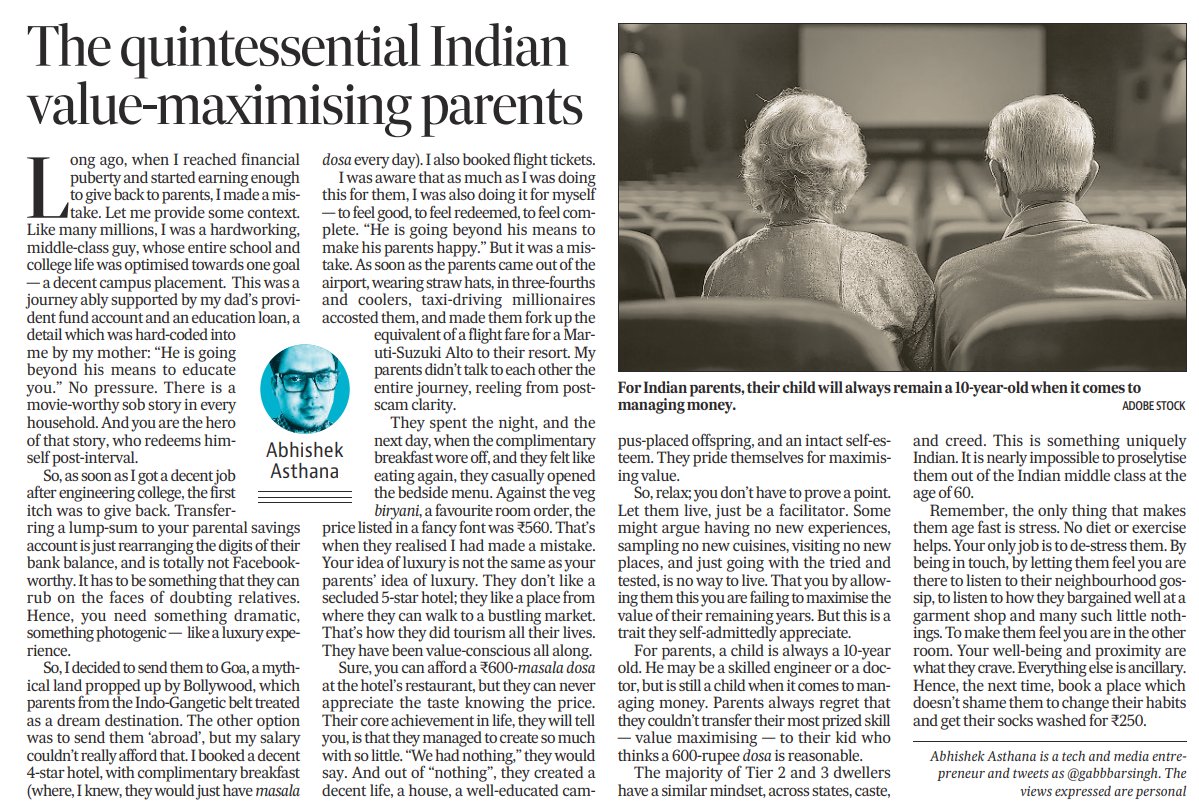
🚨 New Column! "A mistake that I made!" My latest in Hindustan Times, Sunday edition. Read, Share you views :)
Gabbar tweet media
English
123
93
1.1K
266.9K