Dr P S Vohra
4.4K posts

Dr P S Vohra
@drpsvohra
Financial Thinker | Columnist | Pioneering CEO with School Education | 20+ Years Leading Academic Transformation in Business Schools |
India Katılım Ağustos 2013
300 Takip Edilen590 Takipçiler
Dr P S Vohra retweetledi

ईरान जंग की आड़ में छिप रही मोदी सरकार!
@drpsvohra
#iranwar #iranuswar #dollar #rupees #pmmodi #crudeoil #stockmarket #tcnlive
हिन्दी

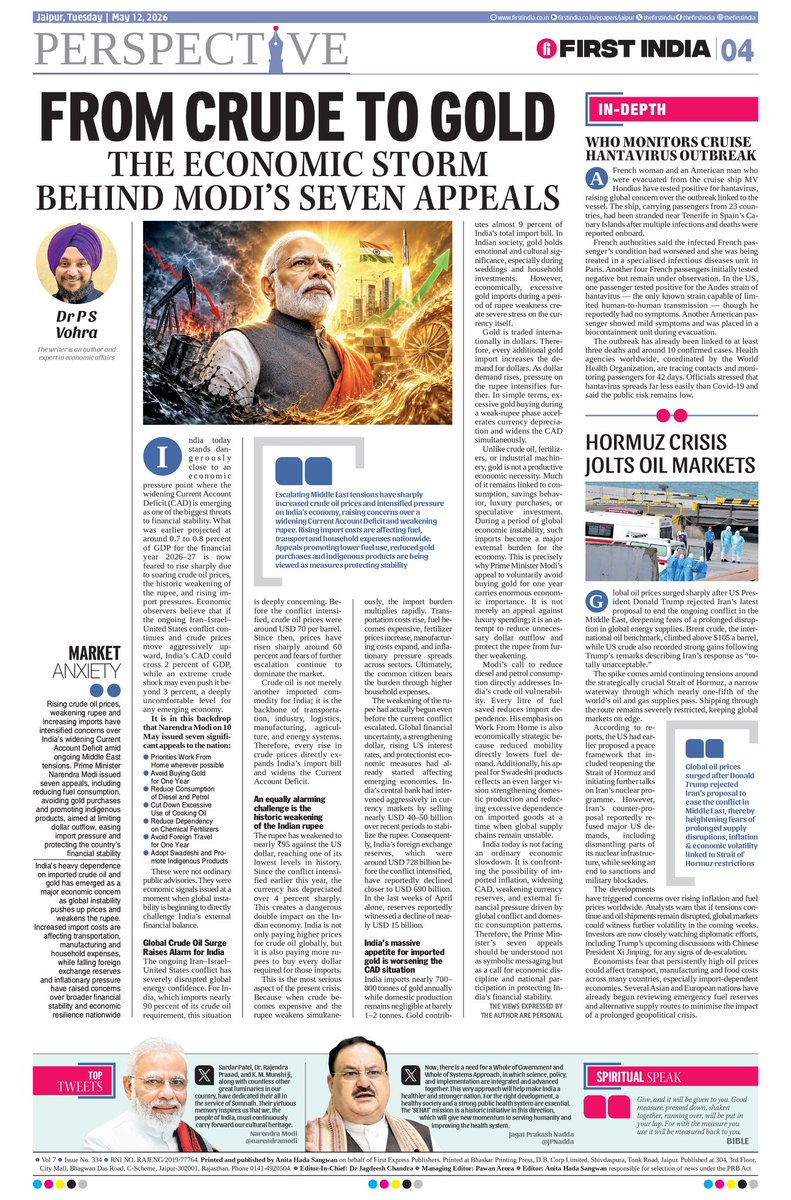
My today’s article explores the deeper economic concerns behind PM Modi’s recent seven appeals to the nation.
Gold buying is is becoming an economic challenge for India. It is nearly 9% of India’s total import bill and at a time when crude prices are rising, the rupee is weakening, and the threat of a widening Current Account Deficit (CAD) is becoming serious.
CAD was earlier projected at around 0.7 to 0.8 percent of GDP for the financial year 2026–27 is now feared to rise sharply due to soaring crude oil prices, the historic weakening of the rupee, and rising import pressures. It is also believe that if the ongoing Iran–Israel–United States conflict continues and crude prices move aggressively upward, India’s CAD could cross 2 percent of GDP, while an extreme crude shock 150 USD per barrel may even push it beyond 3 percent, a deeply uncomfortable level for any emerging economy.
Global Crude Surge Raises Alarm for India –
India imports nearly 90 percent of its crude oil requirement, this situation is deeply concerning. Before the conflict intensified, crude oil prices were around USD 70 per barrel. Since then, prices have risen sharply around 60 percent and fears of further escalation continue to dominate the market.
Alarming challenge the historic weakening of the Indian rupee –
The rupee has weakened to nearly ₹95 against the US dollar, reaching one of its lowest levels in history. Since the conflict intensified earlier this year, the currency has depreciated over 4 percent sharply. This creates a dangerous double impact on the Indian economy.
India’s central bank had intervened aggressively in currency markets by selling nearly USD 40–50 billion over recent periods to stabilize the rupee. Consequently, India’s foreign exchange reserves, which were around USD 728 billion before the conflict intensified, have reportedly declined closer to USD 690 billion. In the last weeks of April alone, reserves reportedly witnessed a decline of nearly USD 15 billion.
India’s massive appetite for imported gold is worsening the CAD situation -
India imports nearly 700–800 tonnes of gold annually while domestic production remains negligible at barely 1–2 tonnes. Gold contributes almost 9 percent of India’s total import bill. In Indian society, gold holds emotional and cultural significance, especially during weddings and household investments. However, economically, excessive gold imports during a period of rupee weakness create severe stress on the currency itself.
India today is not facing an ordinary economic slowdown. It is confronting the possibility of imported inflation, widening CAD, weakening currency reserves, and external financial pressure driven by global conflict and domestic consumption patterns. Therefore, the Prime Minister’s seven appeals should be understood not as symbolic messaging but as a call for economic discipline and national participation in protecting India’s financial stability.

English

My Piece today in Prabhat Khabar..!
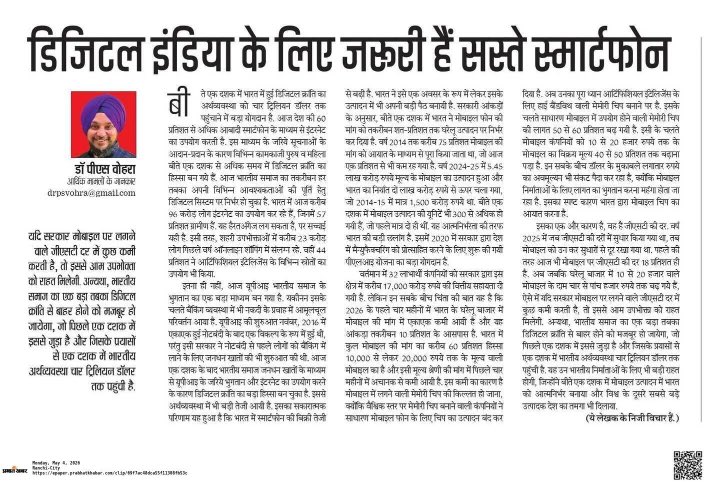
Despite GST cuts, something unusual has happened post Diwali.
The most in-demand mobile segment—priced around Rs 13,000 to Rs 15,000/18,000 and accounting for over 60% of market share has suddenly become costlier by Rs5,000 to ₹8,000.
Why?
A major reason is the reduced production of RAM, as global manufacturers shift their focus toward AI driven technologies.
The impact:
Sales have slowed down. More importantly, there is a real risk that a large section of the population who, over the past decade, entered the digital ecosystem through smartphones in this price range may now be pushed out of the digital space, including UPI, social media, and OTT platforms.
A larger concern:
The narrative around growth in mobile manufacturing under Make in India needs closer scrutiny. Much of this expansion is largely assembly based, not true manufacturing. When critical components like RAM are scarce, these units end up assembling imported, high-cost inputs ultimately passing the burden onto Indian consumers.
The core question remains:
Are we unintentionally widening the digital divide while celebrating growth?

English

My piece in First India (published a few days ago, sharing it here with a slight delay).
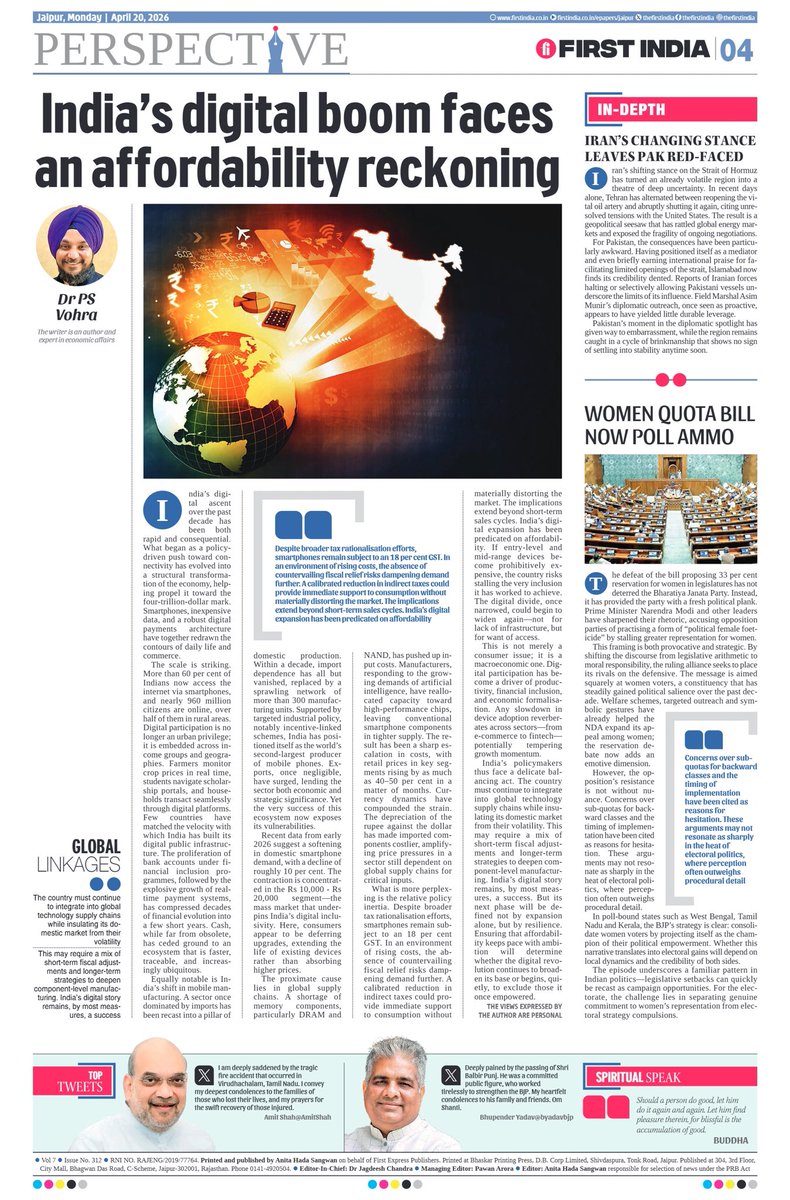
India’s digital growth story is now facing a serious affordability challenge because in the Rs 10,000 to Rs 15,000 smartphone segment (the backbone of mass digital access) prices are rising sharply.
Reason - Escalating RAM costs and a strategic shift by manufacturers toward AI-enabled, higher-end devices.
Post-Diwali, handset prices in this crucial segment have surged by nearly 30–40%, leading to a noticeable slowdown in demand.
This isn’t just a market correction, it’s a structural concern.
If this trend continues, it risks widening the digital divide in India. The very segment that enabled millions to come online may now struggle to sustain momentum. Reduced affordability could directly impact digital penetration, slowing down inclusion across semi-urban and rural India.
India’s digital revolution was built on accessibility. If affordability weakens, the foundation itself begins to crack.

English
Dr P S Vohra retweetledi

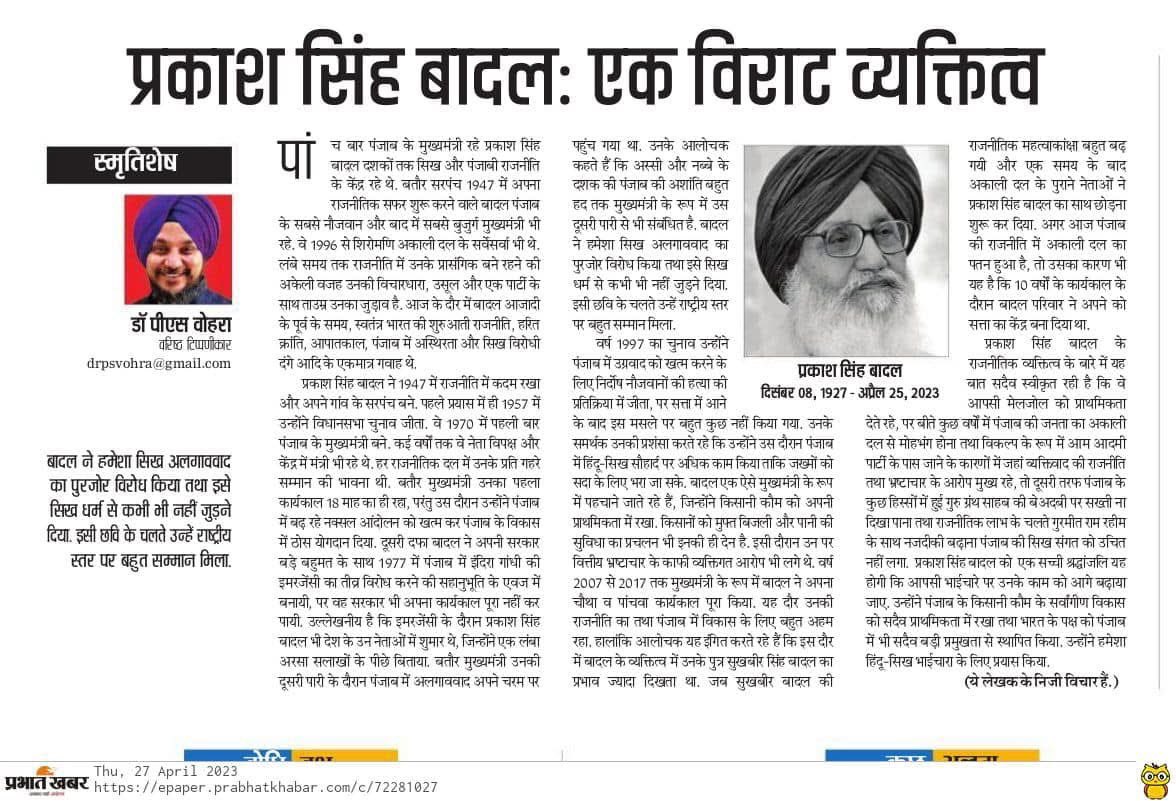
Three years ago, when Sardar Parkash Singh Badal Ji left us, I penned a tribute in his memory for Prabhat Khabar, based on desired of famous journalist Prakash K. Rey Ji. @pkray11
@Akali_Dal_

English

आज जनसत्ता (इंडियन एक्सप्रेस समूह) में प्रकाशित।
अर्थव्यवस्था की असली ताकत उसके आंकड़ों में नहीं, बल्कि उसके लोगों की बेहतर आर्थिक स्थिति में होती है।
नोएडा में 40,000 श्रमिकों का सड़कों पर उतरना सिर्फ़ एक हड़ताल नहीं, बल्कि एक स्पष्ट संदेश है, अब बदलाव ज़रूरी है।
आर्थिक विषमता अब सबसे बड़ी समस्या बन गयी है।
हम $4 ट्रिलियन अर्थव्यवस्था बन गये हैं, लेकिन उसी अर्थव्यवस्था की नींव रखने वाले श्रमिक आज भी न्यूनतम वेतन पर संघर्ष कर रहे हैं। ऐसा वेतन जो सम्मानजनक जीवन तक सुनिश्चित नहीं कर पाता।
सवाल यह नहीं है कि भारत कितना बड़ा बनेगा, बल्कि यह है कि भारत कितना न्यायपूर्ण बनेगा।

हिन्दी
Dr P S Vohra retweetledi

State wise Daily Average Wages (2024-25) (In Rs.):👨🏭🇮🇳
Kerala – 1,013
Tamil Nadu – 887
Andhra Pradesh – 829
Jammu & Kashmir – 813
Haryana – 782
Rajasthan – 756
Karnataka – 703
India – 654
Maharashtra – 651
Uttar Pradesh – 639
Punjab – 623
Bihar – 585
Odisha – 585
Gujarat – 565
Madhya Pradesh – 500
West Bengal – 477
(Labour Bureau, Rural - Non-agricultural Wages for Mason (Men) for August-2024, Ministry of Labour and Employment, GoI)
हिन्दी
Dr P S Vohra retweetledi

State-wise Per Capita Income in India (2025):-
1. Goa – ₹4.92 lakh
2. Sikkim – ₹4.75 lakh
3. Delhi – ₹4.59 lakh
4. Haryana – ₹3.77 lakh
5. Karnataka – ₹3.46 lakh
6. Telangana – ₹3.44 lakh
7. Tamil Nadu – ₹3.32 lakh
8. Maharashtra – ₹3.05 lakh
9. Gujarat – ₹2.95 lakh
10. Kerala – ₹2.91 lakh
11. Uttarakhand – ₹2.73 lakh
12. Punjab – ₹2.64 lakh
13. Andhra Pradesh – ₹2.42 lakh
14. West Bengal – ₹1.88 lakh
15. Rajasthan – ₹1.84 lakh
16. Madhya Pradesh – ₹1.73 lakh
17. Odisha – ₹1.66 lakh
18. Chhattisgarh – ₹1.58 lakh
19. Uttar Pradesh – ₹1.42 lakh
20. Bihar – ₹1.28 lakh
Source: Ministry of Statistics & Programme Implementation (MoSPI), India Economic Survey 2025.
हिन्दी
Dr P S Vohra retweetledi

@YossiGoldstein8 I live in India in a state called Tamil Nadu. The GDP of Tamil Nadu for 2025-26 is $420 Billion higher than Pakistan .
English
Dr P S Vohra retweetledi

🛕Number of Hindu Temples in India 🇮🇳
1. 🇮🇳 Tamil Nadu — 79,154
2. 🇮🇳 Maharashtra — 77,283
3. 🇮🇳 Karnataka — 61,232
4. 🇮🇳 West Bengal — 53,658
5. 🇮🇳 Gujarat — 49,995
6. 🇮🇳 Andhra Pradesh — 47,152
7. 🇮🇳 Rajasthan — 39,392
8. 🇮🇳 Uttar Pradesh — 37,518
9. 🇮🇳 Odisha — 30,877
10. 🇮🇳 Bihar — 29,748
11. 🇮🇳 Telangana — 28,312
12. 🇮🇳 Madhya Pradesh — 27,947
13. 🇮🇳 Kerala — 22,931
14. 🇮🇳 Jharkhand — 14,680
15. 🇮🇳 Haryana — 10,329
16. 🇮🇳 Chhattisgarh — 9,484
17. 🇮🇳 Assam — 5,394
18. 🇮🇳 Punjab — 4,827
19. 🇮🇳 Himachal Pradesh — 4,560
20. 🇮🇳 Uttarakhand — 3,695
Source: OneVisionMedia

हिन्दी
Dr P S Vohra retweetledi

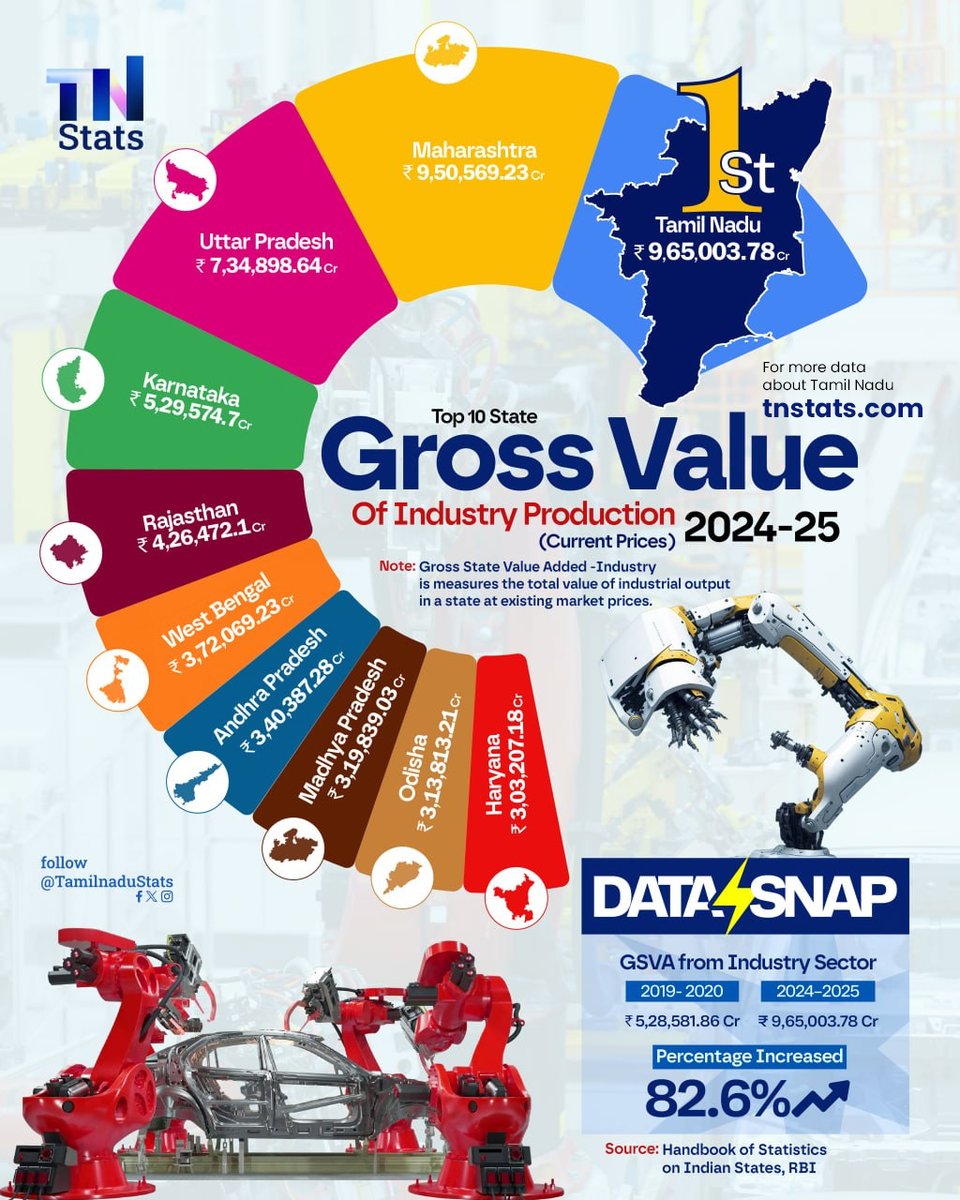
🏭 Tamil Nadu Tops India in Industrial Growth! 🚀
#TamilNadu secures the 🥇 1st position in Gross Value Added (GVA) from the industry sector for 2024–25, reaching a massive ₹9,65,003.78 Cr💰📈 surpassing Maharashtra and Uttar Pradesh.
From ₹5.28 lakh Cr (2019-20) to this peak, the state records an impressive 🔥 82.6% growth, showcasing its strong industrial base, policy push, and manufacturing excellence ⚙️🏗️.
States like Maharashtra, Uttar Pradesh, and Karnataka follow, but TN leads the way in consistent performance 👏
A true reflection of Tamil Nadu’s rise as India’s industrial powerhouse✨
@CimGOI
🔗 Explore more insights: tnstats.com

English
Dr P S Vohra retweetledi

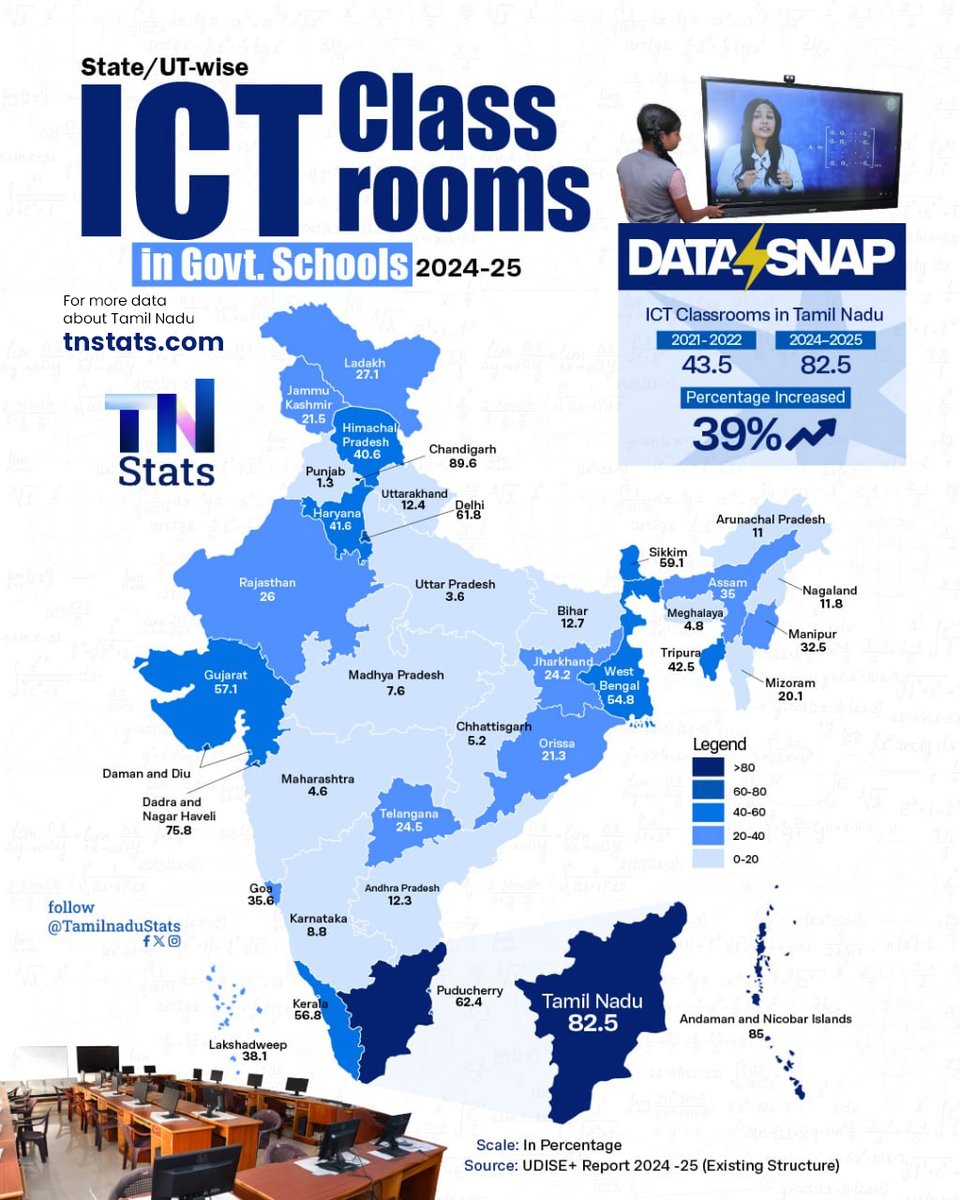
📊 #TamilNadu’s Digital Classroom Surge 💻🚀
Tamil Nadu is setting the pace in digital education across #India✨
With 82.5% of government schools having ICT classrooms in 2024–25, the state stands as a clear leader in tech-enabled learning.
📌 Key Data Highlights:
🔹 43.5% → 82.5% growth from 2021–22 to 2024–25
🔹 A strong +39 percentage point increase 📈
🔹 Among the highest ICT penetration in India
🔹 Far ahead of states like Uttar Pradesh (3.6%), Bihar (12.7%), and Madhya Pradesh (7.6%)
This rapid expansion reflects a focused push towards digital access, smarter classrooms, and better learning outcomes 🎓🌐
Tamil Nadu continues to set benchmarks in education and innovation 👏
🔗 Explore more insights: tnstats.com
@EduMinOfIndia

English
Dr P S Vohra retweetledi

Tamil Nadu is ranked as a 'Top Performer' (Category A) in the 5th edition of the States' Startup Ecosystem Ranking (2026).
Globally, Chennai holds the 88th position and is the 18th strongest in the Asia regional rankings.
Tharkuris please 🙏

Harshini Saravanakumar 🜲@harshini_sa
Seekiro CM aagitu vaanga na, startup ecosystem kaaga niraya contribute pannalam nu iruke 👋🥰
English
Dr P S Vohra retweetledi

🏭 #India Factory Map 2023-24 | #TamilNadu Leads the Way 🚀
Tamil Nadu emerges as India’s leading industrial state with 40,121 factories in 2023–24, the highest in the country 📊
🔹 Increased from 38,837 (2019–20) to 40,121
🔹 Growth of 3.31% over the period 📈
🔹 Ahead of Gujarat (33,311) and Maharashtra (26,539)
Other major contributors include:
➡️ Uttar Pradesh - 22,141
➡️ Andhra Pradesh - 16,011
➡️ Karnataka - 14,984
➡️ Telangana - 13,446
India’s industrial landscape shows strong regional diversity, but Tamil Nadu continues to drive manufacturing excellence 🏗️⚙️
📍 A true hub for jobs, exports, and economic growth.
@DoC_GoI

English


बहुत बड़ी बेवक़ूफ़ी
Rajesh Sahu@askrajeshsahu
कोई इस स्तर की मूर्खता कैसे कर सकता है! ये अपने ही बच्चे का दुश्मन बना हुआ है।
हिन्दी