
Zhizheng Wu

35 posts

Zhizheng Wu banner
Zhizheng Wu

Zhizheng Wu

@drwuz

Researcher, builder

Los Gatos, CA Katılım Ağustos 2010
89 Takip Edilen160 Takipçiler
Zhizheng Wu retweetledi

lester violeta
lester violeta@lesterphv·
Our paper discussing the SVCC 2025 summary has been accepted to ICASSP 2026! 🥳 Check it out here: arxiv.org/abs/2509.15629 We're still working on an extension journal paper that covers more details about SVCC, so stay tuned 😄
English
1
7
12
1.4K
Zhizheng Wu retweetledi
lester violeta
lester violeta@lesterphv·
The first SVCC 2025 baseline system is now out! 🥳 We introduce Serenade: A Singing Style Conversion Framework Based On Audio Infilling. This preliminary investigation covers the main difficulties of singing style conversion (SSC) and details our findings.
lester violeta tweet media
English
1
6
13
3.4K
Zhizheng Wu retweetledi
Rajesh Agarwal
Rajesh Agarwal@Rajesh992510253·
80+ AI tools to finish months of work in minutes. 1. Research - ChatGPT - Copilot - Gemini - Abacus - Perplexity 2. Image - Fotor - Dalle 3 - Stability AI - Midjourney - Microsoft Designer 3. CopyWriting - Rytr - Copy AI - Writesonic - Adcreative AI 4. Writing - Jasper - HIX AI - Jenny AI - Textblaze - Quillbot 5. Website - 10Web - Durable - Framer - Style AI 6. Video - Klap - Opus - Eightify - InVideo - HeyGen - Runway - ImgCreator AI - Morphstudio .xyz 7. Meeting - Tldv - Otter - Noty AI - Fireflies 8. SEO - VidIQ - Seona AI - BlogSEO - Keywrds ai 9. Chatbot - Droxy - Chatbase - Mutual info - Chatsimple 10. Presentation - Decktopus - Slides AI - Gamma AI - Designs AI - Beautiful AI 11. Automation - Make - Zapier - Xembly - Bardeen 12. Prompts - FlowGPT - Alicent AI - PromptBox - Promptbase - Snack Prompt 13. UI/UX - Figma - Uizard - UiMagic - Photoshop 14. Design - Canva - Flair AI - Designify - Clipdrop - Autodraw - Magician design 15. Logo Generator - Looka - Designs AI - Brandmark - Stockimg AI - Namecheap 16. Audio - Lovo ai - Eleven labs - Songburst AI - Adobe Podcast 17. Productivity - Merlin - Tinywow - Notion AI - Adobe Sensei - Personal AI 18. Social media management - Tapilo - Typefully - Hypefury - TweetHunter Follow me for more.
Rajesh Agarwal tweet media
English
194
1.6K
5.4K
508K
Zhizheng Wu retweetledi
SLT 2024
SLT 2024@ieee_slt·
👥 Keynote highlights from industry and academia! 🤝 Supported by top tech leaders and innovators! 📅 Secure your spot now: 2024.ieeeslt.org/program/ #SLT2024
SLT 2024 tweet mediaSLT 2024 tweet mediaSLT 2024 tweet media
English
0
2
3
750
Zhizheng Wu retweetledi
Cameron R. Wolfe, Ph.D.
Cameron R. Wolfe, Ph.D.@cwolferesearch·
LLM-as-a-Judge is one of the most widely-used techniques for evaluating LLM outputs, but how exactly should we implement LLM-as-a-Judge? To answer this question, let’s look at a few widely-cited papers / blogs / tutorials, study their exact implementation of LLM-as-a-Judge, and try to find some useful patterns. (1) Vicuna was one of the first models to use LLMs as an evaluator. Their approach is different depending on the problem being solved. Separate prompts are written for i) general, ii) coding, and iii) math questions. Each domain-specific prompt introduces some extra, relevant details compared to the vanilla prompt. For example: - The coding prompt provides a list of desirable characteristics for a good solution. - The math prompt asks the judge to first solve the question before generating a score. Interestingly, the judge is given two model outputs within its prompt, but it is asked to score each output on a scale of 1-10 instead of just choosing the better output. (2) AlpacaEval is one of the most widely-used LLM leaderboards, and it is entirely based on LLM-as-a-Judge! The current approach used by AlpacaEval is based upon GPT-4-Turbo and uses a very simple prompt that: - Provides an instruction to the judge. - Gives the judge two example responses to the instruction. - Asks the judge to identify the better response based on human preferences. Despite the simplicity, this strategy correlates very highly with human preference scores (i.e., 0.9+ Spearman correlation with chatbot arena). (3) G-Eval was one of the first LLM-powered evaluation metrics that was shown to correlate well with human judgements. The key to success for this metric was to leverage a two-stage prompting approach. First, the LLM is given the task / instruction as input and asked to generate a sequence of steps that should be used to evaluate a solution to this task. This approach is called AutoCoT. Then, the LLM uses this reasoning strategy as input when generating an actual score, which is found to improve scoring accuracy! (4) The LLM-as-a-Judge paper itself uses a pretty simple prompting strategy to score model outputs. However, the model is also asked to provide an explanation for its scores. Generating such an explanation resembles a chain-of-thought prompting strategy and is found to improve scoring accuracy. Going further, several different prompting strategies–including both pointwise and pairwise prompts–are explored and found to be effective within this paper. Key takeaways. From these examples, we can arrive at a few common takeaways / learnings: - LLM judges are very good at identifying responses that are preferable to humans (due to training with RLHF). - Creating specialized evaluation prompts for each domain / application is useful. - Providing a scoring rubric or list of desirable properties for a good solution can be helpful to the LLM. - Simple prompts can be extremely effective (don’t make it overly complicated!). - Providing (or generating) a reference solution for complex problems (e.g., math) is useful. - CoT prompting (in various forms) is helpful. - Both pairwise and pointwise prompts are commonly used. - Pairwise prompts can either i) ask for each output to be scored or ii) ask for the better output to be identified.
Cameron R. Wolfe, Ph.D. tweet media
English
10
78
456
45.4K
Steve Korshakov
Steve Korshakov@Ex3NDR·
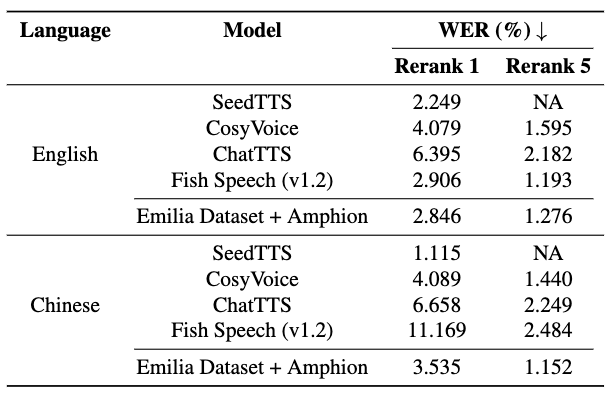
@realamphion Very impressive! I wasn’t able to train voice box to match your quality using only ligrilight
English
1
0
2
402
Zhizheng Wu retweetledi
SLT 2024
SLT 2024@ieee_slt·
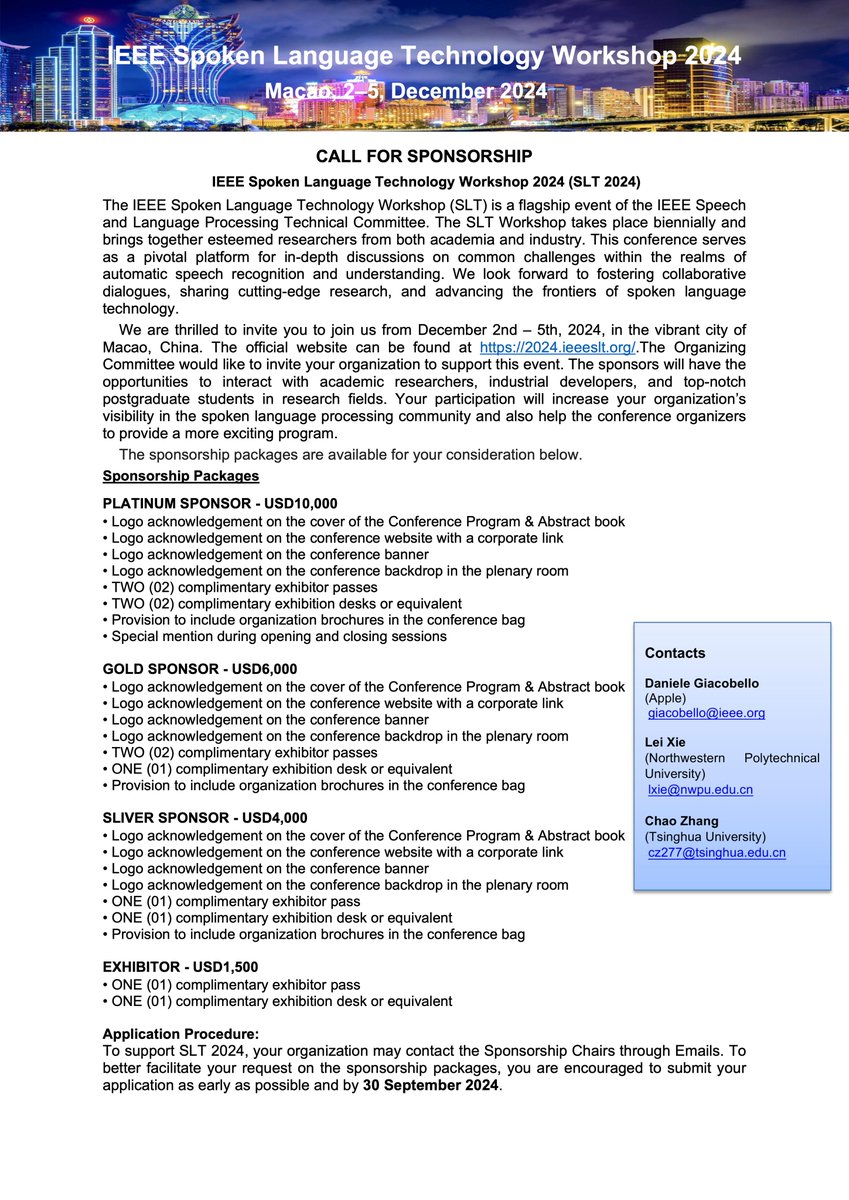
We're excited to announce the Call for Sponsorship for IEEE SLT 2024! Join us in Macao from Dec 2-5, 2024, to explore the latest in speech and language technology. Check out our sponsorship packages and enhance your organization's visibility!
SLT 2024 tweet media
English
0
1
7
1.3K
Zhizheng Wu retweetledi
SLT 2024
SLT 2024@ieee_slt·
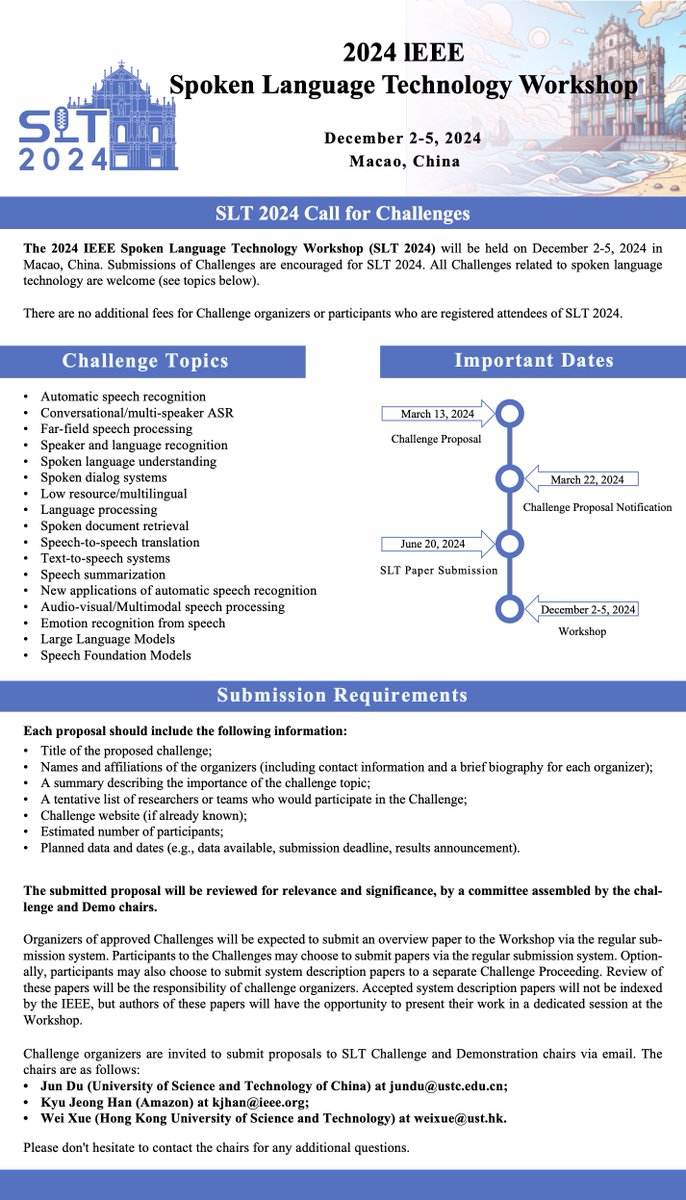
IEEE Spoken Language Technology Workshop (SLT 2024) will be held in Macao later this year, China in Dec 2-5. We are calling for challenges! Make a proposal by March 13
SLT 2024 tweet media
English
0
13
17
2.2K
Zhizheng Wu
Zhizheng Wu@drwuz·
IEEE Spoken Language Technology Workshop (SLT 2024) will be held in Macao later this year, China in Dec 2-5. We are calling for challenges! Make a proposal by March 13
Zhizheng Wu tweet media
English
0
7
12
1.7K
Zhizheng Wu
Zhizheng Wu@drwuz·
IEEE Spoken Language Technology Workshop (SLT 2024) will be held in Macao later this year, China in Dec 2-5. Get your paper ready :) we are looking forward to seeing you in Macao!
Zhizheng Wu tweet media
English
0
8
20
3.2K