Eli Chase

275 posts

Eli Chase

Eli Chase

@echase003

Katılım Ocak 2018
452 Takip Edilen25 Takipçiler
Eli Chase
Eli Chase@echase003·
@ChartGuys This is why we are here, the OG Chart Man! - sometimes when you lose your confidence, you can lose your talent. Keep it - it's hard not to be confident when you are the best.
English
0
0
0
27
Eli Chase
Eli Chase@echase003·
@junglefunk_ I've said it all along - nature, charts, and a little jungle funk is the way, either that or you're doing it wrong.
English
1
0
1
23
Jay Alto
Jay Alto@theJayAlto·
you pity the moth confusing a lamp for the moon, yet here you are confusing a screen for the world
English
806
36.4K
190.8K
11.6M
Castillo Trading
Castillo Trading@CastilloTrading·
Still stand with everything I do for this community to be completely free! Paid VIP Telegram? Mine is free Paid indicator signals? Mine is free Paid courses? I teach for free This world is crazy enough and I will never line my pocket with your money. Work hard, be rewarded!
English
276
180
1.7K
791.2K
Castillo Trading
Castillo Trading@CastilloTrading·
Traded in the sports car for a dad car 👴🏼
Castillo Trading tweet media
English
22
1
137
15.9K
THE SHORT BEAR
THE SHORT BEAR@TheShortBear·
Past weeks go to show narrative builds around price, not price around narrative. Especially when an asset is already running as the narrative forms. Each time is different, each time has reasons. The point in historical data is to show you despite the best reasons in the world, what the outer edges of normal 2 sigma+ and even abnormal events are such as Silver 3 Sigma+. Do not get lost in the conventional rational, that's where 90% of players reside.
English
14
25
363
30.3K
Mr. Anderson
Mr. Anderson@Truecrypto·
Gold bugs watched their asset hit an all-time high in 2011… and then waited 10 years just to revisit that level. Then waited another four to finally break out. Fourteen years. Fourteen years of silence, boredom, conviction, and absurd patience. Meanwhile… Bitcoiners set an all-time high 14 weeks ago, and half of Crypto Twitter is acting like we’re in breadlines again, coming off nearly an 8x run from November 2022, ~40x from December 2018, and ~125x since January 2017. Most people don’t fail because their asset is bad, they fail because their psychology is weak. Gold investors endured a decade-long winter. Bitcoiners can’t endure three months of pullback or consolidation without spiraling into existential crisis. And markets punish that difference brutally. The patient trader earns the asymmetric move. The impatient trader donates their position to the patient one. If gold bugs earned their breakout after fourteen years, and you’re panicking after fourteen weeks? You’re not early. You’re not unlucky. You’re just not ready. Patience is the entry. Discipline is the position. Time is the leverage. Master those, or the market will teach you the same lesson over and over again until you finally do.
English
49
65
619
43.6K
Eli Chase
Eli Chase@echase003·
@junglefunk_ @ChartGuys Cool pic awesome spot - Joey sure figured out Thailand fast, he's one with the Jungle, perhaps some Junglefunk!
English
1
0
3
66
junglefunk
junglefunk@junglefunk_·
Took @ChartGuys to my favorite waterfall today- Mok Fa
junglefunk tweet media
English
3
0
40
3.6K
Castillo Trading
Castillo Trading@CastilloTrading·
I try to make things easy & simple for traders to understand Clip is from livestream on Friday, 4 days ago. Walking members through my exact thoughts/setups. Not just a chart, but a real breakdown We do 3 streams /week, updating all of our trade ideas & game plans, all for free
English
5
3
134
12.5K
Mikey Charalambous
Mikey Charalambous@m_charalambous·
@scottmelker's best ever post 🌊🔥🌴👏
The Wolf Of All Streets@scottmelker

I want to die completely broke. When I tell people this, I usually get one of two reactions. Either they assume I’m joking, or they assume I’ve lost my mind. Sometimes both. So let me clarify before anyone forwards this to a financial planner in panic. I don’t mean reckless. I don’t mean irresponsible. And I definitely don’t mean unprepared. What I mean is that I don’t want to die having optimized my entire life around a number that only matters when my ability to actually use it is gone. We talk constantly about the time value of money. A dollar today is worth more than a dollar tomorrow because it can be invested, compounded, and put to work. Time increases its potential. Life, however, works in the opposite direction. Time doesn’t increase the value of experiences – it usually decreases it. Certain experiences are simply more accessible, more enjoyable, and more meaningful at specific stages of life, and no amount of money later can fully replicate them. When you’re younger, you’re sitting on an asset that quietly depreciates every year: health, energy, physical capability, curiosity, and a tolerance for discomfort. A dollar at 35 buys a fundamentally different life than a dollar at 75. Pretending otherwise is comforting, but it’s not honest. Life has a time value too, and it doesn’t compound. When people hear “die broke,” they often picture irresponsibility or excess. That’s not what I’m describing. I’m talking about intentional depletion – using money as a tool to maximize life while you’re able to live it, rather than stockpiling it indefinitely for a future version of yourself that may not exist in the way you imagine. Saving matters. Security matters. Optionality matters. But past a certain point, additional saving delivers diminishing returns while the cost of waiting keeps rising. Saving for retirement makes sense. Over-saving at the expense of living doesn’t. We’re taught to treat retirement as the main event – sacrifice now so you can enjoy later. Delay life so you can eventually live it. But that framework assumes a lot: that your health cooperates, that your energy remains, that your relationships are intact, and that your interests don’t change. Most of all, it assumes experiences are interchangeable across time. They aren’t. The trip you take at 35 is not the same trip at 70, even if it’s first class. Skiing with your kids, traveling with friends, pushing your body, starting something new – these things are perishable. They don’t age gracefully, and postponing them doesn’t preserve value. It destroys it. There’s also a strange moral judgment baked into personal finance culture that equates delayed gratification with virtue and present enjoyment with failure. I don’t buy that. There’s a meaningful difference between consumption that disappears and spending that compounds in memory, perspective, relationships, and confidence. Experiences don’t show up on a balance sheet, but they pay dividends in ways that money never can. Your memories are what matter in the end, not your net worth. This way of thinking has also changed how I view legacy and what I want to give my kids. I don’t care about leaving behind generational wealth the way I once did, especially not as a lump sum that shows up only after I’m gone. If I’m going to give them anything meaningful, I’d rather do it while I’m alive – when it can actually shape who they become. I want to use my resources earlier to give them experiences, exposure, and tools that help them build confidence, curiosity, and resilience. Travel that broadens perspective. Opportunities that stretch them. Lessons about money, risk, work, and independence learned through experience, not inheritance. I want them to understand how to create value, how to adapt, and how to rebuild if things fall apart. I still want to leave them with enough. But “enough” isn’t a massive number waiting at the end of my life. Enough is a foundation, plus the skills to stand on their own. Unlimited money can become a crutch. Capability is freedom. I’d rather they inherit confidence than comfort – and I’d rather be around to help them learn it than hope they figure it out after I’m gone. Everyone talks about the risk of running out of money. Almost no one talks about the risk of running out of time. And even less people talk about the tragedy of wasting valuable hours of your youth working for money that will never get spent. What a waste of your valuable time. We’re very good at smoothing consumption – using money, planning, and credit to keep life stable while quietly deferring the things that actually make it meaningful. From the outside, everything looks fine. Under the hood, life is being postponed. The biggest gamble isn’t that you won’t have enough someday. It’s that someday arrives and you’re no longer capable of the life you spent decades planning for. I want to die broke not because I don’t value money, but because I value life more. I want to use my resources to create memories while they’re available, not just affordable. To save enough to be secure, but not so much that I defer living indefinitely. To leave my kids with a foundation, not a cage. I don’t pretend this is the right answer for everyone. I don’t even pretend it’s my final answer. But if the time value of money matters, then the time value of life matters more.

English
6
2
14
9.8K
The Wolf Of All Streets
The Wolf Of All Streets@scottmelker·
I want to die completely broke. When I tell people this, I usually get one of two reactions. Either they assume I’m joking, or they assume I’ve lost my mind. Sometimes both. So let me clarify before anyone forwards this to a financial planner in panic. I don’t mean reckless. I don’t mean irresponsible. And I definitely don’t mean unprepared. What I mean is that I don’t want to die having optimized my entire life around a number that only matters when my ability to actually use it is gone. We talk constantly about the time value of money. A dollar today is worth more than a dollar tomorrow because it can be invested, compounded, and put to work. Time increases its potential. Life, however, works in the opposite direction. Time doesn’t increase the value of experiences – it usually decreases it. Certain experiences are simply more accessible, more enjoyable, and more meaningful at specific stages of life, and no amount of money later can fully replicate them. When you’re younger, you’re sitting on an asset that quietly depreciates every year: health, energy, physical capability, curiosity, and a tolerance for discomfort. A dollar at 35 buys a fundamentally different life than a dollar at 75. Pretending otherwise is comforting, but it’s not honest. Life has a time value too, and it doesn’t compound. When people hear “die broke,” they often picture irresponsibility or excess. That’s not what I’m describing. I’m talking about intentional depletion – using money as a tool to maximize life while you’re able to live it, rather than stockpiling it indefinitely for a future version of yourself that may not exist in the way you imagine. Saving matters. Security matters. Optionality matters. But past a certain point, additional saving delivers diminishing returns while the cost of waiting keeps rising. Saving for retirement makes sense. Over-saving at the expense of living doesn’t. We’re taught to treat retirement as the main event – sacrifice now so you can enjoy later. Delay life so you can eventually live it. But that framework assumes a lot: that your health cooperates, that your energy remains, that your relationships are intact, and that your interests don’t change. Most of all, it assumes experiences are interchangeable across time. They aren’t. The trip you take at 35 is not the same trip at 70, even if it’s first class. Skiing with your kids, traveling with friends, pushing your body, starting something new – these things are perishable. They don’t age gracefully, and postponing them doesn’t preserve value. It destroys it. There’s also a strange moral judgment baked into personal finance culture that equates delayed gratification with virtue and present enjoyment with failure. I don’t buy that. There’s a meaningful difference between consumption that disappears and spending that compounds in memory, perspective, relationships, and confidence. Experiences don’t show up on a balance sheet, but they pay dividends in ways that money never can. Your memories are what matter in the end, not your net worth. This way of thinking has also changed how I view legacy and what I want to give my kids. I don’t care about leaving behind generational wealth the way I once did, especially not as a lump sum that shows up only after I’m gone. If I’m going to give them anything meaningful, I’d rather do it while I’m alive – when it can actually shape who they become. I want to use my resources earlier to give them experiences, exposure, and tools that help them build confidence, curiosity, and resilience. Travel that broadens perspective. Opportunities that stretch them. Lessons about money, risk, work, and independence learned through experience, not inheritance. I want them to understand how to create value, how to adapt, and how to rebuild if things fall apart. I still want to leave them with enough. But “enough” isn’t a massive number waiting at the end of my life. Enough is a foundation, plus the skills to stand on their own. Unlimited money can become a crutch. Capability is freedom. I’d rather they inherit confidence than comfort – and I’d rather be around to help them learn it than hope they figure it out after I’m gone. Everyone talks about the risk of running out of money. Almost no one talks about the risk of running out of time. And even less people talk about the tragedy of wasting valuable hours of your youth working for money that will never get spent. What a waste of your valuable time. We’re very good at smoothing consumption – using money, planning, and credit to keep life stable while quietly deferring the things that actually make it meaningful. From the outside, everything looks fine. Under the hood, life is being postponed. The biggest gamble isn’t that you won’t have enough someday. It’s that someday arrives and you’re no longer capable of the life you spent decades planning for. I want to die broke not because I don’t value money, but because I value life more. I want to use my resources to create memories while they’re available, not just affordable. To save enough to be secure, but not so much that I defer living indefinitely. To leave my kids with a foundation, not a cage. I don’t pretend this is the right answer for everyone. I don’t even pretend it’s my final answer. But if the time value of money matters, then the time value of life matters more.
English
218
117
1.1K
269.2K
Eli Chase
Eli Chase@echase003·
@junglefunk_ Impressive man - you are even good at taking pictures!
English
1
0
1
62
junglefunk
junglefunk@junglefunk_·
Saturday waterfallin
junglefunk tweet mediajunglefunk tweet media
English
4
1
29
480
junglefunk
junglefunk@junglefunk_·
Loaded with fruit right now 🥑🍌 Half will go to the freezer for smoothies, a quarter to the neighbors and a quarter to eat fresh.
junglefunk tweet media
English
3
1
24
645
Eli Chase
Eli Chase@echase003·
@junglefunk_ Didn't realize you have amazing taste and know how to live right! Enjoy it!
English
0
0
1
44
junglefunk
junglefunk@junglefunk_·
Adventure day
junglefunk tweet mediajunglefunk tweet mediajunglefunk tweet mediajunglefunk tweet media
English
6
0
27
719
junglefunk
junglefunk@junglefunk_·
With that, check out the new office setup. Ready to continue the grind.
junglefunk tweet mediajunglefunk tweet media
English
8
0
20
496
Eli Chase
Eli Chase@echase003·
@TheFlowHorse So well said dude. I was feeling that exact way and couldn't even put it in words.
English
0
0
0
25
Horse
Horse@TheFlowHorse·
Something switches in you when you become a parent. Suddenly you feel the gravity of everything 10000x times more. Shit like this leaves you sad for an entire day, and you find yourself praying for a stranger because you know those girls need their dad.
Horse tweet media
English
134
108
2.1K
100.2K
Eli Chase
Eli Chase@echase003·
@ChartGuys @junglefunk_ Cool how you guys come to the same conclusion independently - Dan mentioned this in yesterday's video. Kings!
English
0
0
1
30
TheChartGuys
TheChartGuys@ChartGuys·
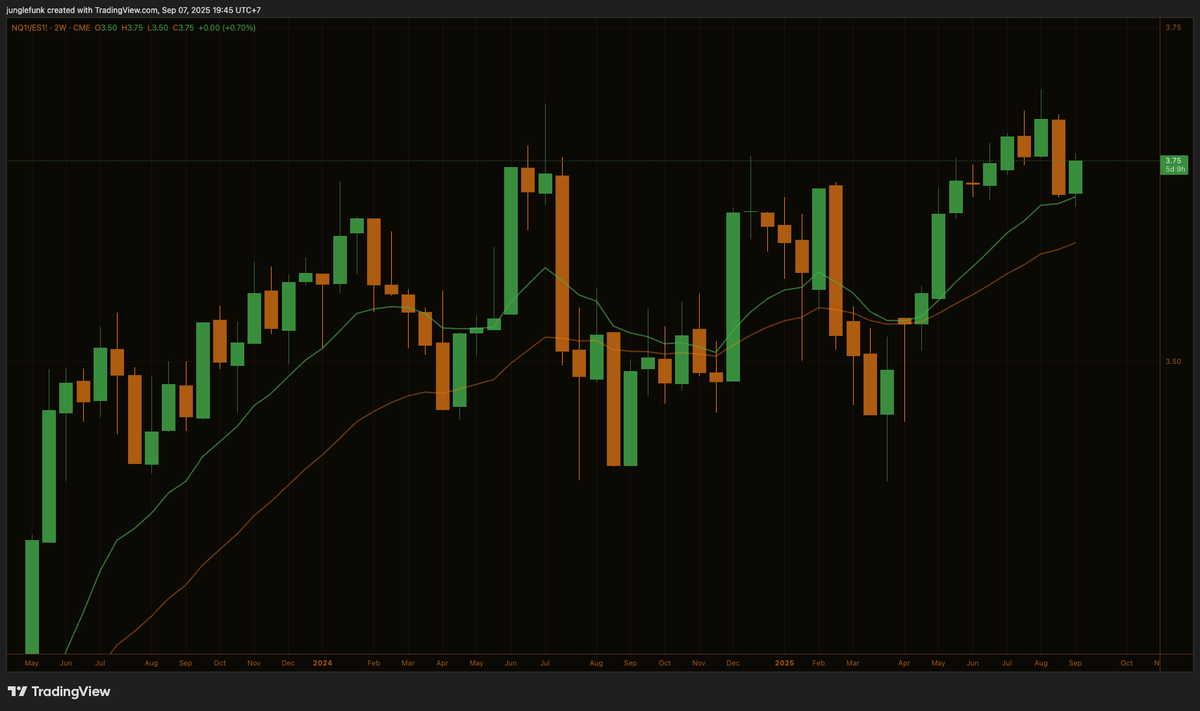
@junglefunk_ Starting to feel like it is better to go MAGS/ES and SMH/ES as opposed to QQQ. Biggest shift between the two in a while.
English
2
0
12
229
junglefunk
junglefunk@junglefunk_·
looking to see if tech can regain sustained relative strength with bounce follow through off the 2w 12ema on the NQ/ES ratio $NQ $QQQ
junglefunk tweet media
English
1
0
18
2.3K
Mr. Anderson
Mr. Anderson@Truecrypto·
“Of course that’s your contention. You’re a first-year technical trader." You just discovered support and resistance, plotted your first trendline, and now every wick is a “liquidity grab.” Right now, it’s bull flags, RSI signals, golden crosses; you think patterns are the edge. You just started talking about “confluence,” but you're stacking five indicators that all say the same thing. You’re trading without risk defined, but your chart has zones drawn in four colors. Next month, you’ll find Smart Money Concepts, start saying “order flow” and “displacement,” and pretend you know what a fair value gap is all while never realizing that ALL this information has been taken and renamed from the OG's of the 1990's who all stole them from Wyckoff and renamed them as well. You’ll post charts with five entries marked… but no exits. By fall, you’ll be convinced your superpower is direction. And while you’ll do great if you truly master direction, every failed trader has correctly guessed direction at some point. The winners? They know how to act on it, with discipline and risk control. You'll call the top on Monday, short it Tuesday, long it by Thursday, then tweet that “price is fractal.” You haven’t even started suffering yet. You haven’t watched a clean setup run 3R without you, because you hesitated. You haven’t taken a great trade, nailed the bias, but still lost because your entry was trash. You haven’t risked 1R, stuck to plan, lost, and still called it a win. You think this is about patterns. It’s not. It’s about precision. It’s about knowing your edge: finding high-probability direction, then narrowing focus to execute clean entries in alignment. It’s about risk management that keeps you in the game, not maximizing wins, but minimizing damage when you're wrong. And you will be wrong. That’s the part nobody teaches: how fast can you admit it? Because the best traders aren’t the ones who are always right, they’re the ones who can cut dead ideas before they bleed out. You haven’t studied yourself yet. Your flaws. Your triggers. Your ego. You’re not a trader until your biggest edge is self-awareness. Come back when you’ve watched a perfect setup fail, not because of the chart, but because you didn’t follow your system. Come back when you’ve journaled 100 trades and found out most of your losses weren’t edge failures, they were YOU failures. Come back when your superpower isn’t analysis, it's discipline... Then we’ll talk technicals.
Mr. Anderson tweet media
English
36
30
287
23.9K
Eli Chase
Eli Chase@echase003·
@ChartGuys I feel for that person - Dan out here showing us the light on a Saturday morning, and that's what I like to see! I really wouldn't want to be smoking what that dude is smoking or see what that dude is seeing.
English
0
0
1
32
TheChartGuys
TheChartGuys@ChartGuys·
This is more baffled than I have been in a while. I really want to know what is going on psychologically to lead to that perception.
English
7
0
16
1.9K
TheChartGuys
TheChartGuys@ChartGuys·
I had fun making this video because markets get me jazzed and there is lots to talk about! No HYPE or FEAR clickbait just good old fashioned useful information from a full time trader on navigating these markets. chartguys.com/watch?v=9jHMkB…
English
9
2
62
11K