econsmalaysia

37.2K posts

econsmalaysia

econsmalaysia

@econsmalaysia

An applied and practicing economist in the Malaysian financial sector.

Earth Katılım Eylül 2013
1.2K Takip Edilen10.2K Takipçiler
econsmalaysia retweetledi
Wilson is Running 🇲🇾
Wilson is Running 🇲🇾@wilsonyimby·
I need to convince myself that wealth tax works because I’m skeptical. So I went digging. Most people imagine a wealth tax like this. Tax the billionaires. The rich pay more. The country becomes more equal. Simple. What does the day say? Only 4 countries in the world still have a broad wealth tax today. Norway, Spain, Switzerland, and Colombia. Out of these, only Switzerland has clearly succeeded. Why? Switzerland does the opposite of what most people would guess. Switzerland taxes wealth at very low rates. Between 0.05% and 1%. The starting point is also very low, around CHF 80,000 (about RM390,000). So the tax does not just hit billionaires. It hits the upper middle class too. This sounds unfair at first. But it is exactly why it works. Because the tax is small and applies to many people, the wealthy cannot escape it easily. Moving to another country to avoid 0.5% tax is not worth the trouble. Plus there are millions of taxpayers contributing, so the total revenue is huge. Switzerland collects about 4.3% of all tax revenue from this single tax. That is a lot. Now compare with France. France used to have a wealth tax from 1982 until 2018. The rates were high. The tax only applied to the very rich. Sounds fairer right? Result. About 10,000 wealthy French citizens left France over 15 years, taking 35 billion euros with them. The tax raised very little money. France gave up and replaced it with a property-only tax in 2018. Sweden tried the same. High rates. Narrow target. The IKEA founder Ingvar Kamprad moved to Switzerland and stayed there for decades. Sweden gave up in 2007. The wealth tax was only collecting 0.16% of GDP. Repealing it had basically no effect on government finances. Norway is in between. They have a wealth tax since 1892. Their income inequality is very low (Gini 0.26, one of the lowest in the world). But their wealth inequality is still high (Gini 0.63, above OECD average). When Norway raised wealth tax rates in 2022, more rich people left in one year than in the past 13 years combined. Spain has the same structure but with a twist. The Madrid region offers 100% exemption. So Spanish billionaires just move from other regions to Madrid. The national wealth tax effectively does not work because of this loophole. So what actually reduces inequality? Studies show that personal income taxes and property taxes do far more for reducing inequality than wealth taxes ever do. The countries with the lowest Gini coefficients in the world (Belgium, Slovenia, Finland, Czech Republic) do not have wealth taxes. They have progressive income taxes and strong welfare systems. What this means for Malaysia. We need more tax revenue. But if we want to reduce inequality, a 2% tax on the richest billionaire is not the strongest tool. A few things that would work better. Reform our property tax. Improve capital gains tax. Strengthen inheritance tax. Make our income tax brackets more progressive. Better enforcement on existing tax laws. A separate question worth thinking about. Are we sure the existing wealth transfer mechanisms in our tax system (rebates, allowances, zakat treatment) are reaching the poor as efficiently as we assume? Worth a separate conversation. If we really want to introduce a wealth tax, we should copy Switzerland. Low rates, applied broadly, hard to escape. Not high rates on a small group of billionaires who can simply move to Singapore or Hong Kong. 2% on 1b is 20million, that’s a penthouse in Singapore, per year. Most people imagine a wealth tax catches the super rich. The data says only the Swiss model actually does that. Most expensive lesson Europe learned in 30 years.
Charles Santiago@mpklang

While workers were being told to tighten their belts, Malaysia’s 50 richest billionaires grew their wealth by RM103B in a single year. One year! Their combined fortune now sits at RM458 billion & is projected to grow by another 39% by 2031. This is not a crisis of scarcity. 4/

English
14
53
138
22.6K
econsmalaysia retweetledi
Syahir
Syahir@syahir·
Masalah besar kebanyakan loji penapisan di Asia termasuk Malaysia sekarang kekurangan bekalan minyak mentah medium-sour yang kebiasaannya diimport dari Asia Barat seperti Saudi, UAE, Iraq, Kuwait kerana sekatan Selat Hormuz. Kenapa masalah besar? 1. Minyak mentah medium-sour menghasilkan lebih banyak Diesel dan minyak jet apabila ditapis - menyebabkan kekurangan bekalan diesel dan minyak jet di sebahagian Asia dan Oceania. 2. Sebahagian besar loji penapisan di Asia termasuk Malaysia dikonfigurasi untuk menapis minyak mentah medium-sour. Pembeli-pembeli minyak mentah medium-sour juga terpaksa membayar pada harga premium yang lebih tinggi daripada harga pasaran untuk mendapatkan bekalan.
Syahir tweet mediaSyahir tweet media
Bloomberg@business

Some Asian refiners offered to buy Upper Zakum crude from the UAE at around $20 a barrel above official prices, as processors scramble for medium-sour grades after the Iran war disrupted supply bloomberg.com/news/articles/…

Indonesia
1
69
129
13.8K
econsmalaysia retweetledi
Ihtesham Ali
Ihtesham Ali@ihtesham2005·
A Persian scholar finished a single math book in 9th century Baghdad that quietly became the foundation for every line of code running on Earth today. I started reading about him at midnight and could not believe how many things in my daily life trace back to one man. His name was Muhammad ibn Musa al-Khwarizmi. The book is called The Compendious Book on Calculation by Completion and Balancing. Every time you say the word algebra, you are saying his book title. Every time someone says the word algorithm, they are saying his name. Both English words come from him. Both are Latin transliterations of Arabic and of his own identity. The man did not just contribute to mathematics. He named it. Here is the part almost nobody tells you. Al-Khwarizmi was born around 780 CE in Khwarazm, in what is now Uzbekistan. He moved to Baghdad and worked at a research institution called the House of Wisdom, which during the Islamic Golden Age was the single most important center of learning on the planet. The caliph al-Mamun hired the best mathematicians, astronomers, and philosophers from across three continents and put them in one building with one job. Translate, study, and produce new knowledge. Al-Khwarizmi finished his book on algebra around 820 CE. The Arabic title contained the word al-jabr, which referred to one of the two operations he used to solve equations. When the book was translated into Latin in the 12th century, the Latin world did not have a word for what he had built. So they kept his Arabic word. Al-jabr became algebra. The discipline was named after a single Arabic word in the title of a single book by a single man. The deeper insight is what he actually changed about how humans think. Before al-Khwarizmi, mathematical problems were solved geometrically. You drew shapes. You measured them. You compared areas. The Greeks had built an entire mathematical tradition on visual proofs and physical constructions. It was beautiful and limited. You could not solve a problem you could not draw. Al-Khwarizmi did something nobody had done before him at this scale. He said you could solve any problem using abstract symbols and rules. You did not need a shape. You needed a procedure. You moved terms across the equation. You cancelled like terms on both sides. You isolated the unknown. He invented the idea that mathematics is a manipulation of symbols according to rules, not a study of physical figures. That single shift made everything that came afterward possible. Calculus. Differential equations. Linear algebra. Quantum mechanics. None of it works if math is locked inside geometry. He pulled it out. The second thing he did is the one that changed how the world counted forever. He took the Hindu numeral system from Indian mathematics, refined it, and wrote a book introducing it to the Arab world. That system included the concept of zero as a placeholder, and a positional notation where the value of a digit depends on its location. Roman numerals could not do complex calculation. Hindu-Arabic numerals could. When his book on numerals was translated into Latin as Algoritmi de numero Indorum, the word Algoritmi was just the Latin spelling of his own name. Europeans started calling the new method "doing algorism," then "running an algorithm." The word for the most important concept in computer science is literally his name in Latin. The third thing he did is the part that should haunt anyone who works in tech. His method of solving problems was systematic. Step one, do this. Step two, check that. Step three, if condition A, then do X, otherwise do Y. He wrote down procedures that could be followed by anyone, anywhere, who knew how to read. The procedure did not depend on intuition or genius. It worked because the steps worked. That is exactly what an algorithm is. A finite, deterministic procedure for solving a problem. He did not just give us the word. He gave us the entire concept of programming a thousand years before there was anything to program. When Alan Turing built the first abstract model of computation in 1936, when John von Neumann designed the first stored-program computer in 1945, when every engineer at Google, OpenAI, Anthropic, and DeepMind writes code in 2026, they are working in a paradigm that started with one man in Baghdad twelve centuries ago. The strangest part is what happens when you walk into any tech office in San Francisco or Bangalore or Lahore today. Engineers say the words algebra and algorithm hundreds of times a day. They do not know whose name they are saying. Almost nobody can spell al-Khwarizmi correctly on the first try. His original Arabic manuscript is preserved at Oxford. His book on Hindu numerals survives only in Latin translation. The Latin version was the textbook that taught medieval Europe how to count. The man who built the foundation of the AI revolution did not live to see a calculator. He died around 850 CE, a thousand years before the first electric current was sent through a wire. The civilization he built mathematics for collapsed. The library he wrote in burned. His own grave is unmarked. But every algorithm running on every machine on Earth right now still answers to his name.
Ihtesham Ali tweet media
English
328
4.5K
10.8K
404.1K
econsmalaysia retweetledi
Syahir
Syahir@syahir·
Bila orang cakap self sufficiency ratio/kadar sara diri ayam dan telur negara kita lebih 100% bermaksud kita tak perlu bergantung pada import ayam dan telur langsung untuk penggunaan. Tapi tak banyak yang sedar bahawa untuk bela ayam pedaging dan ayam penelur negara kita bergantung 100% kepada bahan bijirin import untuk buat dedak ayam dari luar negara. Tahun lepas (2025) kita import jagung 3.9 juta tan bernilai RM4.6 bilion, kacang soya 720 ribu tan bernilai RM1.5 bilion untuk buat dedak. Kita juga import dedak dah siap proses 2.2 juta tan bernilai RM5.5 bilion. Bila harga bahan-bahan ni naik macam tahun 2022, harga dedak naik dan harga ayam dengan telur juga naik. Ini risiko yang kita kena tanggung bila harga jagung dengan kacang soya import naik sebab harga baja naik.
Berita Harian@bharianmy

Industri ternakan ayam masih terlalu bergantung sumber makanan import, terdedah risiko kenaikan harga #BHbisnes Malaysia pada masa ini belum mempunyai pengeluaran jagung dan soya tempatan yang signifikan, menyebabkan industri terus bergantung kepada import. bharian.com.my/bisnes/lain-la…

Indonesia
4
113
235
18.3K
econsmalaysia retweetledi
Syahir
Syahir@syahir·
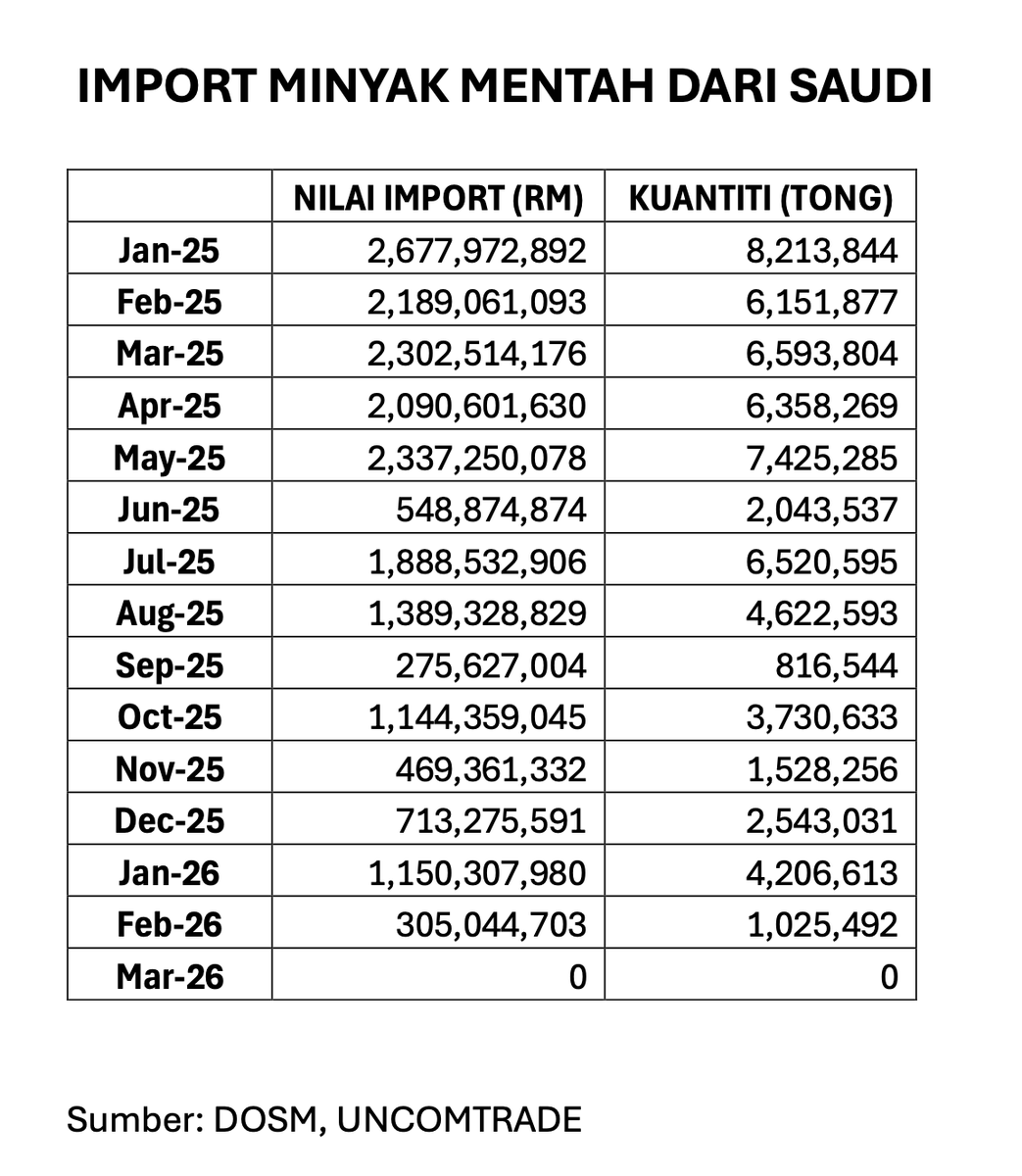
Pengeluaran minyak mentah dari negara-negara Teluk jatuh 14.5 juta tong sehari atau 57% di bawah pengeluaran sebelum perang. Mungkin kita rasa takde kena mengena dengan Malaysia. Tapi kita import 70% daripada keperluan minyak mentah dari negara-negara Teluk macam Saudi, UAE, Oman, Kuwait, Iraq dan Qatar. Malaysia mengimport 1/3 daripada minyak mentah dari Saudi yang merupakan sumber import minyak mentah utama negara kita di mana import dari Saudi mewakili lebih 50% import minyak mentah Malaysia dari negara Teluk. Sebelum perang setiap bulan minyak mentah dari Saudi akan tiba di pelabuhan-pelabuhan negara kita secara purata dengan nilai RM1.4 bilion atau 4.4 juta tong sebulan (3 ke 4 kapal tangki minyak mentah). Selepas perang bermula dengan Selat Hormuz ditutup, pada bulan Mac, tidak ada langsung minyak mentah tiba dari Saudi. Kalau masih ada yang fikir kita tak terkesan, fikir balik.
Syahir tweet media
Bloomberg@business

Oil output from Persian Gulf nations has been running 14.5 million barrels a day below pre-war levels this month, according to Goldman bloomberg.com/news/articles/…

Indonesia
4
100
145
13.2K
econsmalaysia retweetledi
Rosemary Kelanic
Rosemary Kelanic@RKelanic·
Best low-jargon analysis explaining why the Strait of Hormuz crisis is a slow-motion train wreck for the global economy. TL;DR: *Even if* Hormuz reopens *tomorrow*, economic disaster is all but inevitable due to lost oil supply. That’s what Trump’s war has done. Because of physical oil shortages emerging on time delay, the world will need to cut oil consumption massively — on the order of what a Covid-19 global recession caused. Why a recession? Recessions reduce oil consumption, due to lower levels of economic activity. When economies boom, oil consumption increases. When economies suffer, oil consumption falls. We are facing recession-level consumption cuts just due to lost supply — and that’s not even factoring in the additional economic damage from high prices! (Paul Krugman, the Nobel-winning economist, has argued the same on his substack.) Because people can’t quickly decrease oil consumption — they live where they live, own the car they own, and have to keep driving to work — high oil prices cause them to decrease spending on *everything else.* Huge demand shock, terrible for economies. High oil prices also increase inflation as we’re all learning viscerally in real time. So the cost of all those essentials — food, clothing, etc — increases, too. This global economic disaster was completely avoidable — and avoided, until Trump chose to attack Iran, foolishly believing victory would be costless and quick. The Iran War should discredit the fallacy that we can bomb Iran into submission at low cost. We can’t. The best/worst news is: we didn’t need to attack Iran at all — which means the U.S. can simply. stop. fighting. Iran never was — and still isn’t — an imminent threat to the United States. It can’t reach the U.S. homeland and was deterred from attacking the Persian Gulf until Trump kicked this mess off. Iran has played tit-for-tat all along, reciprocating attack with attack, ceasefire for ceasefire. Iran was even willing to reopen Hormuz — until Trump refused to lift his blockade in exchange. Trump hates to lose, but he must put the country ahead of his pride, cut his losses, and agree to a deal that reopens Hormuz completely — including from his own blockade. The economic damage will only compound the longer this goes on. @defpriorities hfir.com/p/wctw-the-oil…
English
53
252
697
65.7K
econsmalaysia retweetledi
Qasem Al-Ali
Qasem Al-Ali@AlaliQasem·
Oil just dropped 11% because the Strait of Hormuz is “open.” Let me show you why the market is making one of the biggest mistakes of 2026
English
126
741
4.2K
1M
econsmalaysia
econsmalaysia@econsmalaysia·
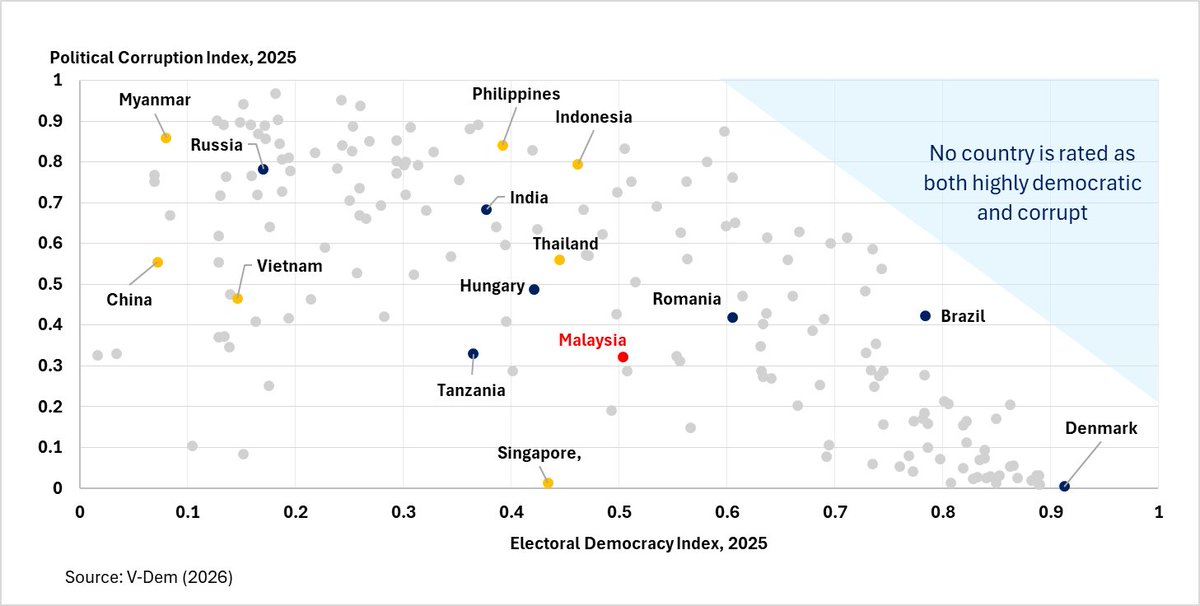
@ApurvaSanghi I did a lot of reading around corruption and economic growth about a decade ago. Corruption is multifaceted and different types may have opposite effects, including positive ones
English
0
0
1
67
Apurva Sanghi
Apurva Sanghi@ApurvaSanghi·
@econsmalaysia To your point, in early / weak democracies, corruption can actually increase before it gets better: political competition can intensify vote-buying. Fragmentation can create more rent-seeking coalitions etc. This is what is probably reflected in the <0.6 spectrum
English
1
0
1
193
Apurva Sanghi
Apurva Sanghi@ApurvaSanghi·
Are democracies more corrupt, or less? How does M’sia fare? Here’s a Krugman-inspired fig: more democratic countries tend to be actually less corrupt. In fact, no country is highly democratic & corrupt! I’ve shown M’sia in red; regional peers in yellow. What do you conclude?
Apurva Sanghi tweet media
English
13
33
82
7.8K
Perisai Waja
Perisai Waja@PerisaiPejuang·
@ApurvaSanghi I would argue that there is a confounding variable leading to democratisation and less corruption, which is greater wealth.
English
1
0
0
47
Perisai Waja
Perisai Waja@PerisaiPejuang·
Aware that correlation isn't causation, I wouldn't be too quick in assuming that democratisation leads to less corruption. I'm also aware that there is a correlation between how rich the country is and less corruption and democratisation. But again it isn't causal. 1/4
Apurva Sanghi@ApurvaSanghi

Are democracies more corrupt, or less? How does M’sia fare? Here’s a Krugman-inspired fig: more democratic countries tend to be actually less corrupt. In fact, no country is highly democratic & corrupt! I’ve shown M’sia in red; regional peers in yellow. What do you conclude?

English
2
1
2
436
econsmalaysia retweetledi
Jaynit
Jaynit@jaynitx·
In the 1920s, a Stanford psychologist tracked genius children for 50 years. Malcolm Gladwell breaks down what he discovered: Rich families → successful. Poor families → failures. Not average. Failures. Genius-level IQs that produced nothing. He spent 60 minutes at Microsoft explaining why we're wrong about success: The psychologist was named Terman. He gave IQ tests to 250,000 California schoolchildren. He identified the top 0.1%. Kids with IQs of 140 and above. His hypothesis: these children would become the leaders of academia, industry, and politics. He tracked them. And tracked them. For decades. The results split into three groups. The top 15% achieved real prominence. The middle group had average, moderately successful professional lives. And the bottom group? By any measure, failures. The difference wasn't personality. Wasn't habits. Wasn't work ethic. It was simple: the successful geniuses came from wealthy households. The failures came from poor families. Poverty is such a powerful constraint that it can reduce a one-in-a-billion brain to a lifetime of worse than mediocrity. There's a concept called "capitalization rate." It asks a simple question: what percentage of people who are capable of doing something actually end up doing that thing? In inner city Memphis, only 1 in 6 kids with athletic scholarships actually go to college. If our capitalization rate for sports in the inner city is 16%, imagine how low it must be for everything else. Here's something stranger. Gladwell read the birth dates of the 2007 Czech Junior Hockey Team: January 3rd. January 3rd. January 12th. February 8th. February 10th. February 17th. February 20th. February 24th. March 5th. March 10th. March 26th... 11 of the 20 players were born in January, February, or March. This isn't unique to the Czechs. Every elite hockey team in the world shows the same pattern. Every elite soccer team too. Why? The eligibility cutoff for youth leagues is January 1st. When you're 10 years old, a kid born in January has 10 months of maturity on a kid born in October. That's 3 or 4 inches of height. The difference between clumsy and coordinated. So we look at a group of 10 year olds, pick the "best" ones, give them special coaching, extra practice, more games. We think we're identifying talent. We're just identifying the oldest. Then we give the oldest more opportunities, and 10 years later they really are the best. Self-fulfilling prophecy. The capitalization rate for hockey talent born in the second half of the year? Close to zero. We're leaving half of all potential hockey players on the table because of an arbitrary date on a calendar. Kids born in the youngest cohort of their school class are 11% less likely to go to college. 11% of human potential squandered because we organize elementary school without reference to biological maturity. Now here's the part about math. Asian kids dramatically outperform Western kids in mathematics. The gap is enormous and consistent across decades of testing. Some people say it's genetic. It's not. It's attitudinal. When Asian kids face a math problem, they believe effort will solve it. When Western kids face a math problem, they believe the answer depends on innate ability they either have or don't. Here's the proof. The international math tests include a 120-question survey. It asks about study habits, parental support, attitudes. It's so long most kids don't finish it. A researcher named Erling Boe decided to rank countries by what percentage of survey questions their kids completed. Then he compared it to the ranking of countries by math performance. The correlation was 0.98. In the history of social science, there has never been a correlation that high. If you want to know how good a country is at math, you don't need to ask any math questions. Just make kids sit down and focus on a task for an extended period of time. If they can do it, they're good at math. Why do Asian cultures have this attitude? Gladwell's theory: rice farming. His European ancestors in medieval England worked about 1,000 hours a year. Dawn to noon, five days a week. Winters off. Lots of holidays. A peasant in South China or Japan in the same period worked 3,000 hours a year. Rice farming isn't just harder than wheat farming. It's a completely different relationship with work. There's a Chinese proverb: "A man who works dawn to dusk 360 days a year will not go hungry." His English ancestors would have said: "A man who works 175 days a year, dawn to 11, may or may not be hungry." If your culture does that for a thousand years, it becomes part of your makeup. When your kids sit down to face a calculus problem, that legacy of persistence translates perfectly. Now consider distance running. In Kenya, there are roughly a million schoolboys between 10 and 17 running 10 to 12 miles a day. In the United States, that number is probably 5,000. Our capitalization rate for distance running is less than 1%. Kenya's is probably 95%. The difference isn't genetic. The difference is what the culture values and where it spends its attention. Here's the most fascinating finding. 30% of American entrepreneurs have been diagnosed with a profound learning disability. Richard Branson is dyslexic. Charles Schwab is dyslexic. John Chambers can barely read his own email. This isn't coincidence. Their entrepreneurialism is a direct function of their disability. How do you succeed if you can't read or write from early childhood? You learn to delegate. You become a great oral communicator. You become a problem solver because your entire life is one big problem. You learn to lead. 80% of dyslexic entrepreneurs were captain of a high school sports team. Versus 30% of non-dyslexic entrepreneurs. By the time they enter the real world, they've spent their whole life practicing the four skills at the core of entrepreneurial success: delegation, oral communication, problem solving, and leadership. Ask them what role dyslexia played in their success and they don't say it was an obstacle. They say it's the reason they succeeded. A disadvantage that became an advantage. Here's what Gladwell wants you to understand: When we see differences in success, our default explanation is differences in ability. We forget how much poverty, stupidity, and attitude constrain what people can become. We refuse to admit that our own arbitrary rules are leaving talent on the table. We cling to naive beliefs that our meritocracies are fair. The capitalization argument is liberating. It says you don't look at a struggling group and conclude they're incapable. It says problems that look genetic or innate are often just failures of exploitation. It says we can make a profound difference in how well people turn out. If we choose to pay attention. This 60 minute Microsoft talk will teach you more about success than every self-help book you've ever read combined. Bookmark this & give it an hour today, no matter what.
English
396
2.1K
7.8K
1.6M
econsmalaysia
econsmalaysia@econsmalaysia·
@syahir No, its secured for both Petronas and the other stations as well
English
1
2
2
706
Syahir
Syahir@syahir·
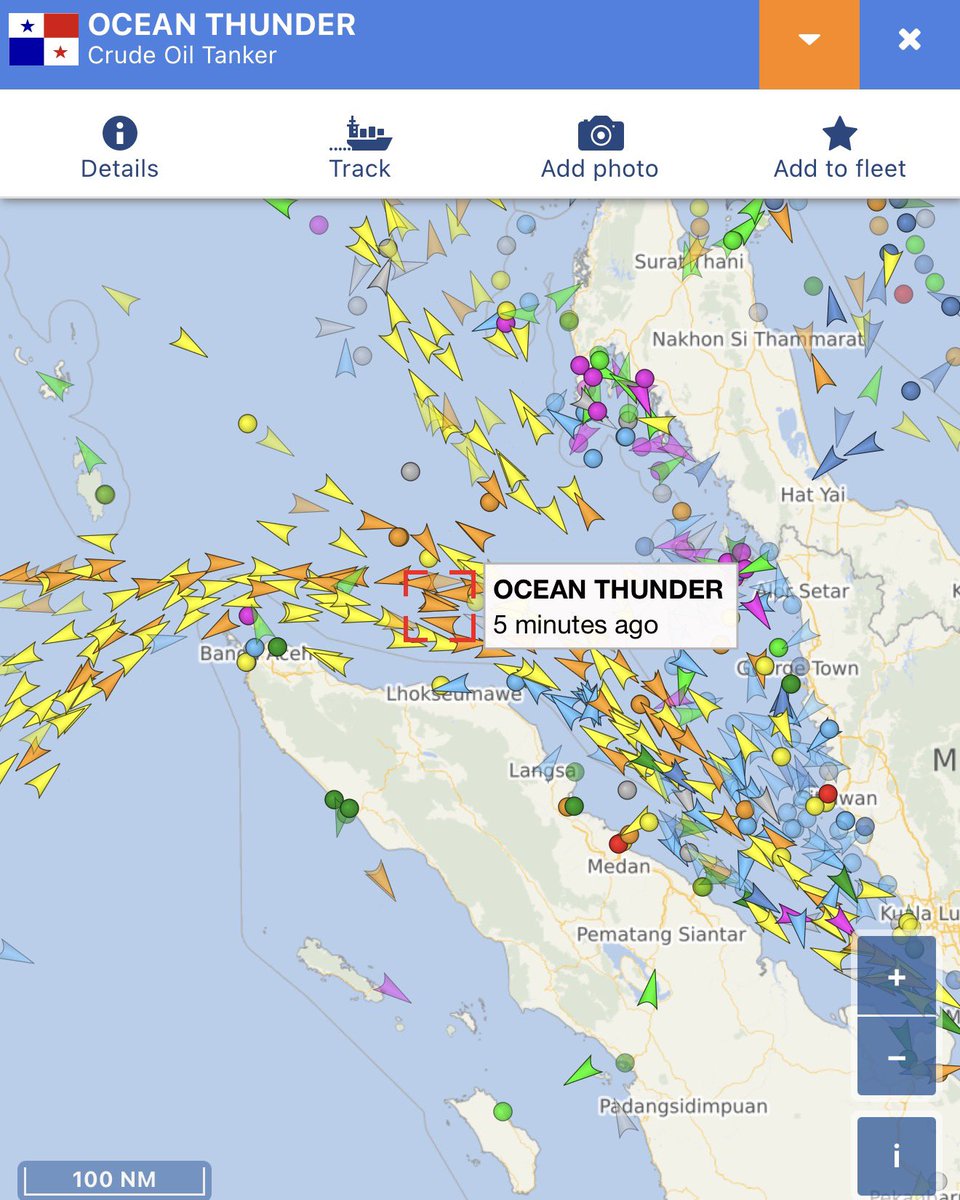
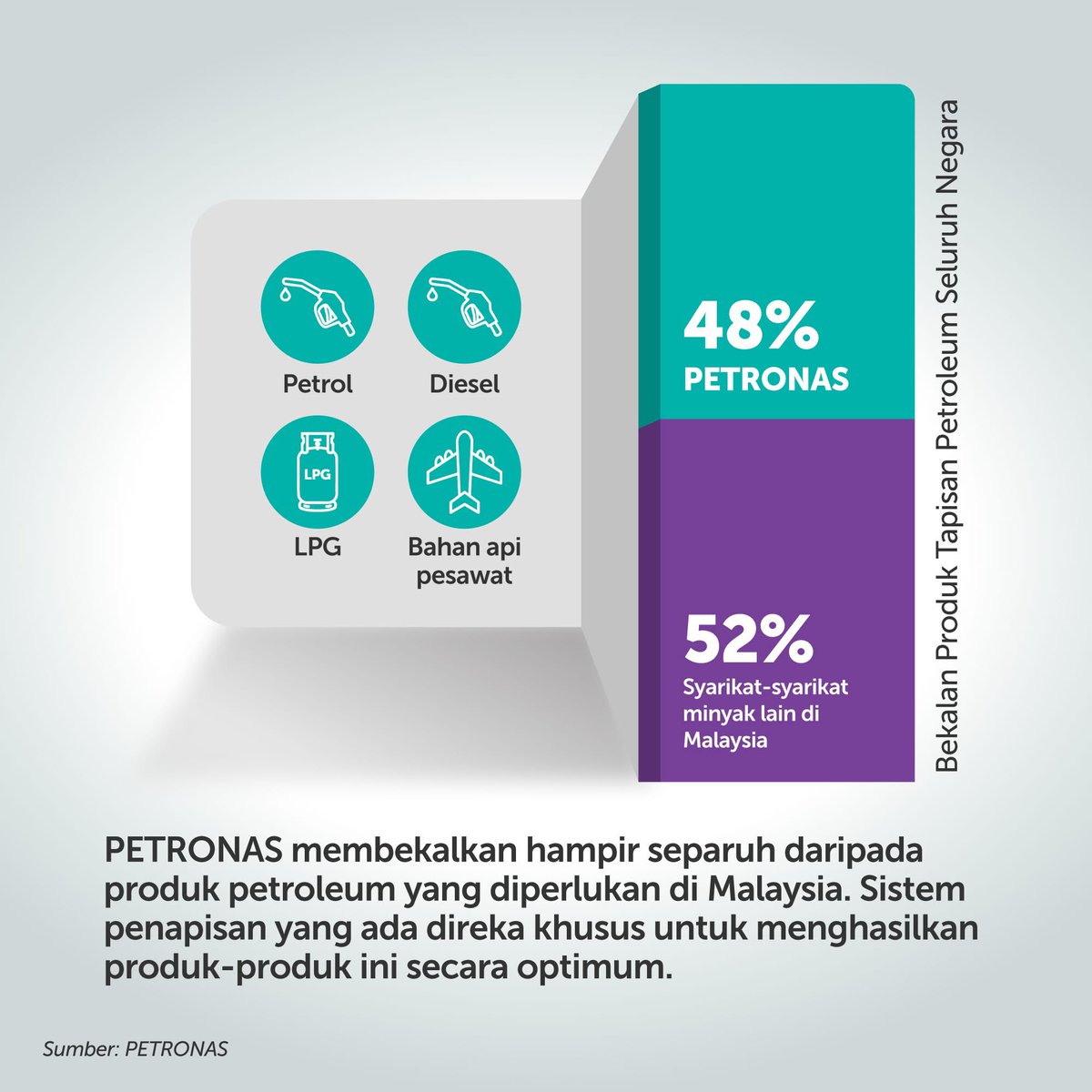
Bekalan dah bertambah (replenished) daripada hujung Mei kepada hujung Jun untuk rangkaian stesen minyak Petronas, bermakna ada bekalan-bekalan yang dah secured untuk Jun. Kapal Ocean Thunder, kapal tangki minyak pertama yang melepasi Strait of Hormuz yang bawak sejuta tong minyak mentah pun dah masuk Selat Melaka on the way ke Pengerang (eta 17 April). Tapi kena ingat PETRONAS hanya membekalkan 48% produk petroleum bertapis macam petrol, diesel, LPG, jet fuel. Selebihnya 52% dibekalkan syarikat minyak lain Shell, Petron, Caltex, BHP, Five Petroleum, Buraq Oil etc.
Syahir tweet mediaSyahir tweet media
Free Malaysia Today@fmtoday

#BeritaFMT Syarikat minyak nasional berkata pihaknya akan terus menguruskan rantaian bekalan secara aktif bagi memastikan stok mencukupi di seluruh rangkaian stesennya. Artikel Penuh: freemalaysiatoday.com/category/bahas…

Indonesia
7
401
735
67.5K
econsmalaysia
econsmalaysia@econsmalaysia·
@penatlado @Dr_AzmanIbrahim Malaysia adalah net exporter bahan api. Tetapi kebanyakkan ini adalah daripada LNG, bukan minyak mentah. Pengeluaran minyak mentah hanya separuh daripada keperluan negara. Keadaan Malaysia menjadi net importer minyak mentah sudah 10 tahun
Indonesia
0
1
0
103
Lost Soul 🇲🇾
Lost Soul 🇲🇾@penatlado·
@Dr_AzmanIbrahim adakah : 1 - tahap pengeluaran minyak mentah Malaysia LEBIH drpd tahap keperluan penggunaan dalam Malaysia? (net exporter) atau 2 - tahap pengeluaran minyak mentah Malaysia KURANG drpd tahap keperluan penggunaan dalam Malaysia? (net importer) yg mana satu keadaan skrg?
Indonesia
1
1
9
1.3K
Dr Azman Ibrahim
Dr Azman Ibrahim@Dr_AzmanIbrahim·
Kenyataan Tan Sri Tuan Guru Haji Abdul Hadi Awang bahawa kenaikan harga minyak tak sepatutnya berlaku kerana negara kita ada produk sendiri adalah tepat dan disokong dengan fakta.
Indonesia
127
8
48
84.2K
econsmalaysia
econsmalaysia@econsmalaysia·
@alphaque I'm aware of this particular issue. However, in this case it appears legit. The cargo was bought in Singapore
English
0
0
0
289
Dinesh Nair
Dinesh Nair@alphaque·
Dark ship to ship transfers to avoid sanctions is common in Malaysia waters. Who's to say it can't be used to pad local coffers?
econsmalaysia@econsmalaysia

@syahir Dah siasat. Yang pergi ke Filipina bukan disel Malaysia. Ia adalah kargo dari tempat lain yg ditransfer STS di perairan Malaysia, sebelum ke Filipina. Bukan produk Malaysia atau dari stok kita

English
2
1
2
841
econsmalaysia
econsmalaysia@econsmalaysia·
@syahir Yes. Export license from Petronas required if it isproduced or refined onshore. We don't regulate traders though
English
1
3
3
863
econsmalaysia retweetledi
June Goh
June Goh@JuneGoh_Sparta·
What becomes of bitumen and base oil? 1⃣Just like the forgotten, unloved barrel of fuel oil, there is another quiet group of products that come out of the refining system called bitumen and base oil. 2⃣You typically use straight run fuel oil in the refineries to split out into VGO and short residue, to produce base oil from the VGO and bitumen (also known as asphalt) from the short residue. 3⃣There are specific qualities requirements to make these two products, so you can't just use WTI to make them. Kuwait and Basrah Medium crudes are excellent for making bitumen, but erm, they are kind of stuck at the Strait of Hormuz for 6+ weeks now, and facing production shut-ins too. 4⃣When Asian refineries are running at higher intake and producing a lot of fuel oil, they can decide to route this stream into bunker production or route some into the base oil and bitumen production plants. For the case of VGO, it can also be routed into multiple other secondary units like the hydrocracker and FCC. 5⃣Now with Asian refineries running at feasibility level (i.e. as low as you can go), that choice is no more. With bunkers playing a more important supply hole to fill and the inability to make on-spec bitumen and base oil cargoes with the medium/heavy sour AG crudes, these two specialty products suffered production issues. 2 out of 3 of Singapore refineries have issued FMs for bitumen production. 6⃣For the end consumer, base oil is a blend stock for your lubricants - so expect more expensive vehicle servicing. For governments, tarring roads using bitumen becomes very expensive. Perhaps we may be in for some unfilled potholes but that's the least of the problems the world is facing right now. #oott
English
13
41
217
22.9K
econsmalaysia retweetledi
Ministry of Finance🇲🇾
Ministry of Finance🇲🇾@MOFmalaysia·
Harga minyak mentah global turun, tapi harga pam belum ⛽ Kenapa? Jom kami terangkan! 💡 Sebenarnya, harga di pam tidak ditentukan mengikut harga pasaran hari ini kerana harga di pam ditentukan berdasarkan purata harga minggu sebelumnya.
Ministry of Finance🇲🇾 tweet media
Indonesia
46
666
733
52.1K