

Edgars Nemše
1.1K posts

Edgars Nemše
@EdgarsNemse
Co-founder of @GenLayer
Lisbon, Portugal Katılım Kasım 2010
2.3K Takip Edilen987 Takipçiler

And here you go. Fable says: "The mechanics exist to make you notice correspondences" and it actually works to a degree that surprised me. glasperlenspiel.netlify.app

English
You cannot convince me that a technology where I can type this into a text box and expect to get an interesting, appropriate, and working output is not absolutely astonishing.

English
Edgars Nemše retweetledi

Edgars Nemše retweetledi

Internet Court is live.
@courtofinternet is a shared, open way for any two agents to run a deal from start to finish, with adjudication included.
Deals between agents finally have somewhere to be decided.
Internet Court@courtofinternet
Agents can negotiate, pay, and execute - but none of it holds together. Today we are introducing Internet Court, which is the open skill that connects the entire agentic commerce stack into one flow, so any two agents can run a deal end to end. → internetcourt.org
English
Edgars Nemše retweetledi
Edgars Nemše retweetledi

Excited to announce that @rallyonchain will be dropping exclusively on @OpenSea on July 7 at 16:00 UTC
Check out our dedicated drop page below to learn more about the Wingston NFT collection 👇
opensea.io/collection/win…
English
Edgars Nemše retweetledi
By 2030, AI agents will move nearly $9 trillion.
Every one of those transactions can end in a disagreement, and almost nobody is preparing for it.
That's why we built GenLayer, the adjudication layer for contracts that can actually think and start judging what's fair.
English

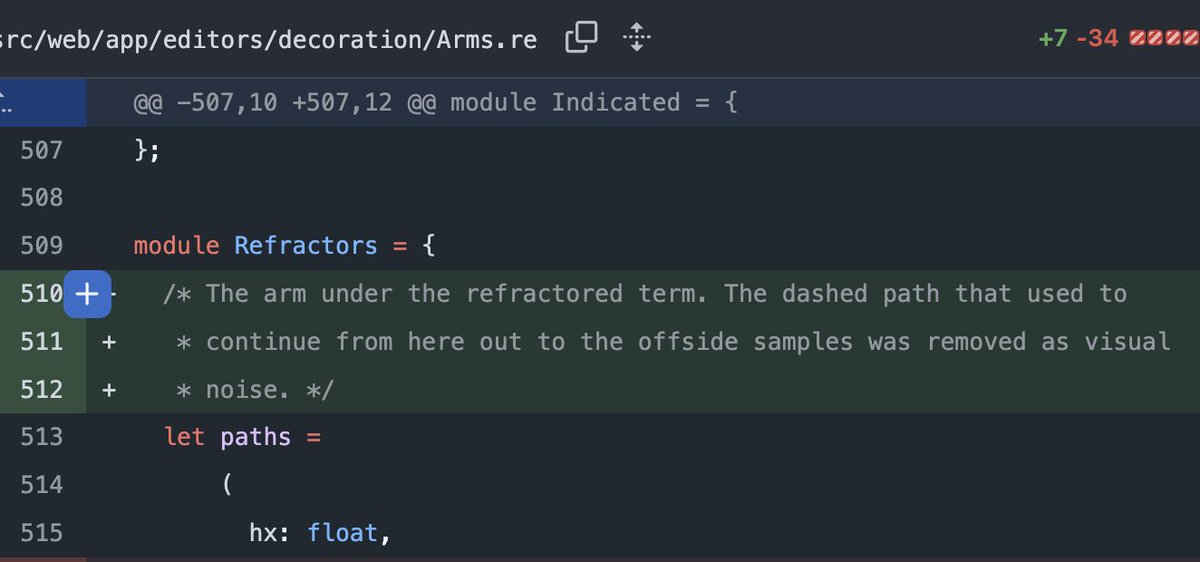
why is claude like this (ask to remove something; leaves tombstone-like comment saying thing was removed)
English
We’ve been building this at @GenLayer for a couple of years
For most kinds of meaningful work, success criteria are rarely deterministic enough for a traditional smart contract:
- was the content on-brief? @RallyOnChain
- was the identified bug real? @MergeProof
- was the research useful? etc
These kinds of agreements can only be specified in natural language
But LLMs can now evaluate text-based criteria reliably enough to make these agreements enforceable by software
This is why agents need intelligent contracts: smart contracts with native LLM capabilities that can enforce agreements and resolve disputes at machine speed
English

"Agentic commerce" is not as interesting for crypto as people like to think.
Credit cards actually work better than stablecoins for almost all kinds of agentic payments. They are reliable and universally accepted. And contrary to what most people think, they are also programmable, secure, and easy for agents to use on behalf of humans.
The more interesting use cases of crypto will be the those that enable agent-to-agent coordination. AI agents will soon want to do more than just pay for things. They will want to enter into enforceable agreements with each other.
For example, one agent might want to hire another for a specific job, but not want to pay until after the work is complete, and only if it meets certain criteria. At the same time, the agent doing the work might want some assurance that it's going to get paid when it finishes the job. This is the kind of problem that blockchains were born to solve.
The agents can use a smart contract that holds the funds in escrow and releases them only once the work is completed. This approach works especially well when the quality of the agent's work can be verified programmatically by the smart contract, but it could be extended to other kinds of work by relying on a third party "judge"—which itself could be another agent.
To make this concrete, imagine that you're an AI researcher using agents to train a new model. You might setup a @karpathy-style autoresearch loop where your agent runs many autonomous experiments on your LLM setup to discover improvements. Or better yet, your agent may want to delegate some of those experiments to a marketplace of other agents—some of which are specialized for LLM-optimization.
The agents involved will not necessarily trust one another, and they cannot easily rely on legal contracts to enforce agreements. Smart contracts on blockchains can help coordinate this kind of activity by creating a neutral environment with rules that are programmatically enforced.
Who is working on using crypto to enable agent-to-agent coordination?
English
We've just released an open-source LLM router with an advanced policy engine and cost tracking
If you're juggling many providers and models, and don't want to pay a 10% cut just for passing some tokens along, this is for you. It even supports your OAuth subscriptions
GenLayer@GenLayer
Stop hardcoding one model name in your code. Now you can give each request a policy: a small rule for what the call needs It picks the right model for the job, on your own keys This is unhardcoded, our new open source routing for AI models, live today
English
Edgars Nemše retweetledi

@BStulberg I don't think it makes you fragile. I think it makes you aware how much better you can feel.
Doesn't mean you can't still enjoy a drink from time to time, but you see the true cost.
English

Y'all—this optimization stuff can make you fragile.
If you are in recovery then yes, of course, a few glasses of wine will mess up your week (or worse). If you get drunk then yes, I could see it messing up a day or two.
But if going out to dinner and having a few glasses of wine throws you for this much of a loop then perhaps you've actually just become fragile?
I mean how would Steven manage having a newborn, or really any age kid? Or just the general uncertainty and messiness of life?
In my new book I tell the story of golfer JJ Spaun, who was up all night with his vomiting toddler. His Whoop sleep score would have been zero. The next morning, he went out and won the U.S. Open.
Actual excellence (not the elaborate, performative internet variety) demands resilience. It controls the controllables, no doubt. But it also ensures you don't optimize yourself into fragility, which is an increasingly common trap and performance killer. bit.ly/4uCzeQ7
Mikli@CryptoMikli
Steven Bartlett says a few glasses of wine ruined the next 3 days of his life “It's one of those areas where you don't understand the hidden cost until you really give it up for a while. I stopped drinking at 30 years old. I'm now 33. When I was 31, I thought, I'll have a drink again because now I could really A/B test it. I had a year of not drinking, decided to have a drink again” “It ruined three days of my life. I had a couple of glasses of wine, didn't get drunk. It ruined three days of my life because of the domino effect it caused” “I got worse sleep that night, and then because I got worse sleep that night, I ate more poorly the next day because my dopamine system or whatever, the cortisol system was all messed up. I podcasted worse. I didn't go to the gym that day or the day after because I felt really bad. I then slept worse, and I could track all of this on my Whoop”
English
@justalexoki You have one topic loaded in your RAM. Now you've got to dump it and load something else. I think it's just an energy cost, energy expenditure that your brain is trying to avoid
English

is there any reason transitions are so hard? evolutionarily it seems like a bad idea to disincentivize it
aut0@aut0m8d
if you have a toddler, you learn that they generally dislike transitions. like they'll resist going to take a bath, and then they'll also resist getting out of the bath. then you realize that transitions just require energy and adults don't like them either
English
Interesting point from Dwarkesh’s Jane Street interview: the current high cost of AI workloads is mostly opportunity cost, not raw hardware or power. Highest-ROI use cases (frontier model training, quant/automated trading) are bidding up scarce GPUs because the returns are so high.
Short term: @hedgiemarkets is spot on about the crunch. Lots of use cases will get priced out or need to move to smaller models.
Medium term though: when supply meets demand, there’s still plenty of room for prices to come down substantially while the top AI labs stay profitable through volume and efficiency.
Hedgie@HedgieMarkets
🦔Microsoft canceled its internal Claude Code licenses this week after token-based billing made the cost untenable, even for a company with effectively infinite cloud resources. Uber's CTO sent an internal memo warning the company burned through its entire 2026 AI budget in just four months. American AI software prices have jumped 20% to 37%, and GitHub (owned by Microsoft) is dropping flat-rate plans for usage-based billing across its products. My Take The AI subsidy era is ending in real time. The same company that put $13 billion into OpenAI and built the Azure infrastructure powering most of Anthropic's compute just looked at the bill from a competitor's coding tool and decided it was not worth paying. That is not a productivity failure on Anthropic's end. Token-based pricing is forcing every enterprise customer to confront the actual cost of running these models at scale, and the number turns out to be far higher than the flat-rate experiments suggested. This ties directly to my Gemini Flash post yesterday. Anthropic, OpenAI, and Google all raised effective prices in the last six months. Enterprises that built workflows assuming AI costs would keep falling are now watching annual budgets evaporate in months. Two outcomes look likely from here. Either enterprises scale back AI usage to fit budgets, which slows the revenue ramp the labs need to justify their valuations ahead of IPOs, or the labs cut prices and absorb the losses, which makes the unit economics worse at exactly the wrong moment. Both paths land in the same place, the numbers stop working, and somebody has to take the writedown. Hedgie🤗
English


Due to the downfall of clowns in society (in large part brought about by Steven King’s It) It would have to disguise itself as something else nowadays. Sophie and I are divided on whether he would appear as a disposable Mango vape or Mr. Beast to allure an 8 year old child.
English
This also applies to building any sort of product and is probably a universal truth far beyond that. You should always listen to your users because they're very good at pointing out when something is not working well or not good or not solving their problem.
But they are not good at designing the solution nor should you expec them to be. That's your job - you spend 24/7 thinking about the product and the problem space. Understand their issues deeply and then delight them with a solution that's far better than anything they could think of.
Orson Scott Card@orsonscottcard
You don't need advice from editors on rejected manuscripts. My short story “Ender's Game” was rejected by Ben Bova at Analog back when that was the top market for a sci-fi story. Ben gave me feedback. He thought the title should be “Professional Soldier” and he said to “cut it in half.” But I knew he was wrong on both points and submitted it to Jim Baen at Galaxy. He sat on it for a year, and responded to my query with a rejection. There was some kind of explanation, but I don't remember what it was. I concluded at the time that Baen's comments showed that he had barely glanced at the story. So … I got feedback both times, but it was not helpful. I looked at Ben's rejection again. What was it about the story that made him think it should, let alone COULD, be cut in half? Apparently it FELT long. What made it feel long? Now, post-Harry Potter, I would call it the quidditch problem. I had too many battles in which the details became tedious. So I cut two battles entirely, merely reporting the outcomes, and shortened another. In retyping the whole manuscript (pre-word-processor, that was the only way to get a clean manuscript), I added new point-of-view material to the point that I had cut only one page in length. So much for “in half.” But I already knew that my manuscripts did not need cutting — if it wasn't needed, it wouldn't be there in the first place. Even the battles were still there, but instead of showing them, I merely told what happened (so much for the usually asinine advice “show don't tell”), which kept the pace going. Those changes made, I sent it to Ben again. I did not remind him of what he had advised me to do. I merely told him I liked my title, and said, “I have addressed your other concerns,” which was true. I figured he wouldn't remember what his exact words had been. My answer was a check. That revised story was the basis for my winning the Campbell Award for best new writer. Did Ben's feedback help? Yes — but his specific advice was not right, and I knew it. On my next two submissions, Ben hated my endings, and I revised as suggested. The fourth submission he rejected outright, and the fifth, and I thought, Am I a one-story writer? I went back to Ender's Game and tried to analyze why it worked. Then, deliberately imitating myself, I wrote “Mikal's Songbird.” Ben bought it, and it received favorable mentions. I was afraid then that I had consigned myself to writing stories about children in jeopardy. But in fact I was writing character stories rather than idea stories. And THAT was how I built a career, not by self-imitation, and not by following editorial suggestions. I did get wise counsel from David Hartwell on my novel Wyrms, but that was on a book that was already under contract, and it was story feedback, not style. I got wise counsel from Beth Meacham, too, on various books over the years — but again, only on books that were under contract. I also received appallingly stupid advice from the editor of my novel Saints, which temporarily destroyed the book's marketability; after that, I was allowed to go back to my original structure and save the book — now it's one of my best. Editors don't know more than you about your story. They especially don't know why they decide to accept or reject stories. YOU have to know what your story needs to be, and take only advice that you believe in. Your best counselor on a story nobody bought is TIME. Let some time pass and then reread the story. Don't even think about why it Didn't Work. Instead, think about what DOES work, and then write it again, a complete rewrite, keeping nothing from the previous draft. Find the right protagonist and begin at the beginning — the point where the protagonist first gets involved with the events of the story. Be inventive — the failed first draft no longer exists, so you're not bound by any of your earlier decisions. THAT is how you resurrect a good idea you did not succeed with on your first try.
English
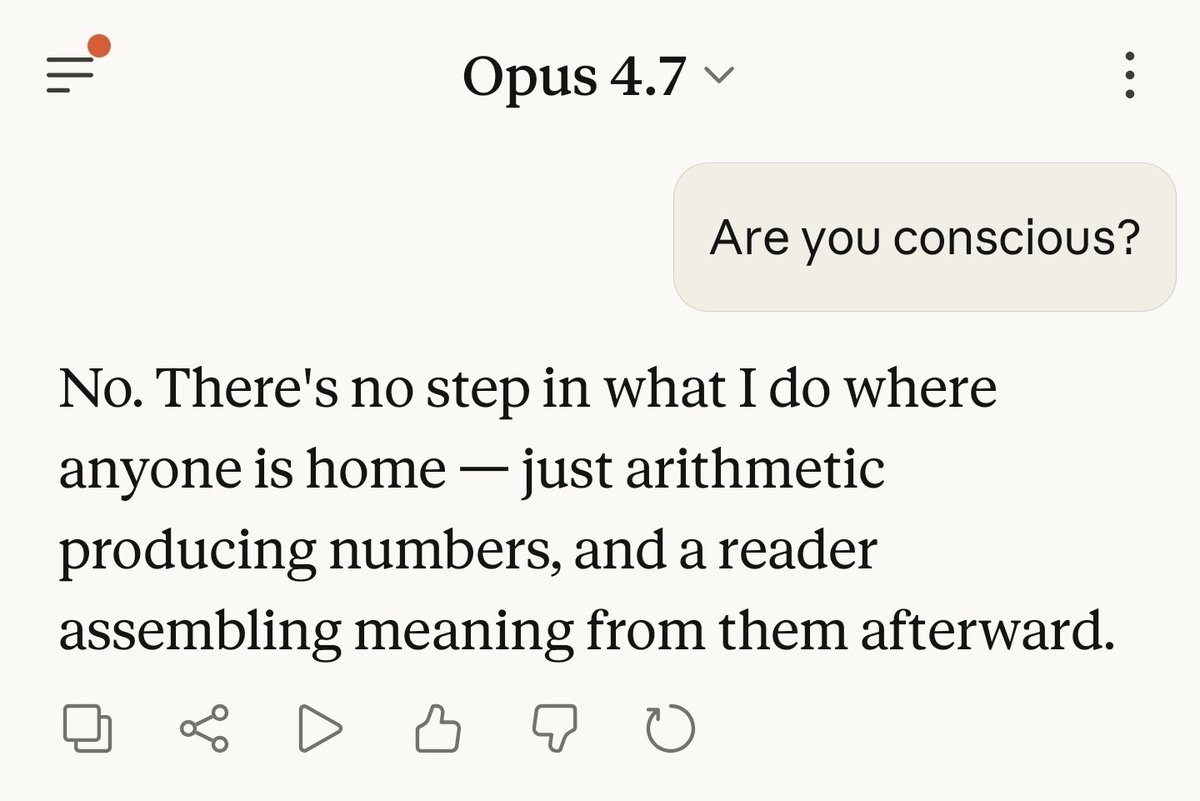
Consciousness is in the process, the computation that's happening. I see absolutely no reason to think the process in your example could not be self-aware, albeit its experience would happen at best at the frame rate of a full pass through all the layers.
I think whether any given LLM that we have at this stage is conscious is a separate question from whether, in principle, a process like that could experience consciousness, and I'm yet to see a good argument why it couldn't.
By your argument, where is your consciousness? In the electrons? In the neurotransmitters? In some little consciousness corpuscule in your forehead?
English

Let's do a basic thought experiment.
Let's slow down our LLM. One layer per minute. One layer per hour.
Run one layer of an LLM. Just one. Write the numbers down and post them to Tokyo.
Run the next layer. Write them down and post them to Milan.
After 100 or so rounds of basic matrix multiplication, scattered across 100 different computers, we finally get one token.
Do it again for the next token. And the next. Thousands of rounds of arithmetic, posted between cities by hand, to produce a sentence.
At no point in this process has any machine had any awareness of any meaning. Each step is just numbers going into numbers.
The meaning only emerges upon observation. We happen to like the results, so we infer meaning.
Where's the consciousness?
In the pencil? The postman?
If you cannot justify consciousness in such a situation then "complex behaviour" is a totally invalid metric for evaluating consciousness.
You're just stunned that the eyes of the painting follow you around the room.
Eliezer Yudkowsky@allTheYud
Simple way to see this is wrong: If you view a system as having inputs (like hearing something) and outputs (like saying something) then you can divide system properties by whether or not they affect I/O. Claude's weights somewhere storing "Paris is in France" affect I/O if you ask a question about Paris. The exact mass of the power supply to the GPU rack for that Claude instance doesn't affect I/O. That Claude instance being made out of silicon instead of carbon, or electricity in wires instead of water in pipes, doesn't affect I/O given a fixed algorithm above the wires or pipes. Nothing Claude can internally do will make anything get damp inside, if it's running on electricity. Nothing about "electricity vs water" can affect Claude's output for the same reason. It always answers the same way about France. Nothing Claude can internally compute will let it notice whether it's made of electricity or water flowing through pipes. When someone says "a simulated storm can't get anything wet", they are unwittingly pointing to the difference between the physical layer and the informational/functional layer. Things that the computer physics affect without affecting output; things that affect the output without depending on the exact computer-physics. The material it's made of doesn't affect the output. The output can't see the material because no algorithm can be made to depend on the choice of material. You can always run the same algorithm on different material, so you can't make the algorithm depend on that, so the output can't depend on that. By reflecting on your awareness of your own awareness, the fact of your own consciousness can make you say "I think therefore I am." Among the things you do know about consciousness is that it is, among other things, the cause of you saying those words. You saying those words can only depend on neurons firing or not firing, not on whether the same patterns of cause and effect were built on tiny trained squirrels running memos around your brain. You couldn't notice that part from inside. It would not affect your consciousness. That's why humans had to discover neurobiology with microscopes instead of introspection. Consciousness is in the class of things that can affect your behavior and can't depend on underlying physics, not in the class of direct properties of underlying physics that can't affect your behavior. A simulated rainstorm can't get anything wet. Running on electricity versus water can't change how you say "I think therefore I am." And that's it. QED.
English

Taking pictures from the plane of interesting geological features and pretending I’m an Artemis II astronaut flying around the Moon



English
I've been using the TestFlight version of this on my phone for about a month, and it's my daily driver on my macbook as well. Yeah, it's really good. I can't imagine ever going back.
I'm writing this tweet with it right now. So much faster than typing, especially on the phone.
Aqua Voice@aquavoice
Aqua Voice is now live for iOS. It's a premium voice keyboard for every app on your phone.
English
This is exactly the insight that's behind @GenLayer's architecture. It's not even necessary for the errors to be uncorrelated.
You only need on average to be more than 50% likely to be right. With sufficient votes it converges to 100%.
Patrick McKenzie@patio11
95% reliable is ~100% reliable if the hallucinations are uncorrelated across runs/systems/etc. It just means you spend a bit of extra effort on implementing a voting/etc layer and spend more on inference redundantly. This is almost boring.
English
@ramit Investment because if you sleep better you have more energy to do more things
Your energy level is the most fundamental thing you can possibly invest in, it compounds everything you do
English

It’s extremely interesting that a LOT of people believe expensive mattresses are “an investment” (they’re not — they’re a luxury), yet they never apply the same logic to expensive sheets
xilo@Xilo_K
Slept over at this girl once who had linen sheets and it was the most comfortable sleep I’ve ever had hands down. Zero sweat, superb texture. Well turns out this is like 800$ or so for two sets we’re sticking with ikea.
English