Alip

4.8K posts

Alip

Alip

@eldernewborn

I intentionally fail tests.

Katılım Temmuz 2012
901 Takip Edilen159 Takipçiler
Alip retweetledi
Zack Korman
Zack Korman@ZackKorman·
Major companies are getting pwned by browser extensions and npm packages, but they think deploying AI agents will go fine. Good luck, have fun.
English
74
253
2K
50.4K
Alip retweetledi
François Chollet
François Chollet@fchollet·
A mental model for working with coding agents is that they're blind squirrels running into a maze and bumping into walls. You must place the walls (verifiable constraints) strategically so that they end up in the general region you want them in.
English
106
160
1.5K
124.2K
Alip retweetledi
Brian Roemmele
Brian Roemmele@BrianRoemmele·
Writing about Project Panama tonight. It is heartbreaking. AI training pipeline that is turned psychotic in to a massive million dollar book burning. It is a crime against humanity. Train AI but don’t you dare burn books and expect us not to care.
Brian Roemmele tweet media
English
67
269
921
36.9K
Alip retweetledi
Ihtesham Ali
Ihtesham Ali@ihtesham2005·
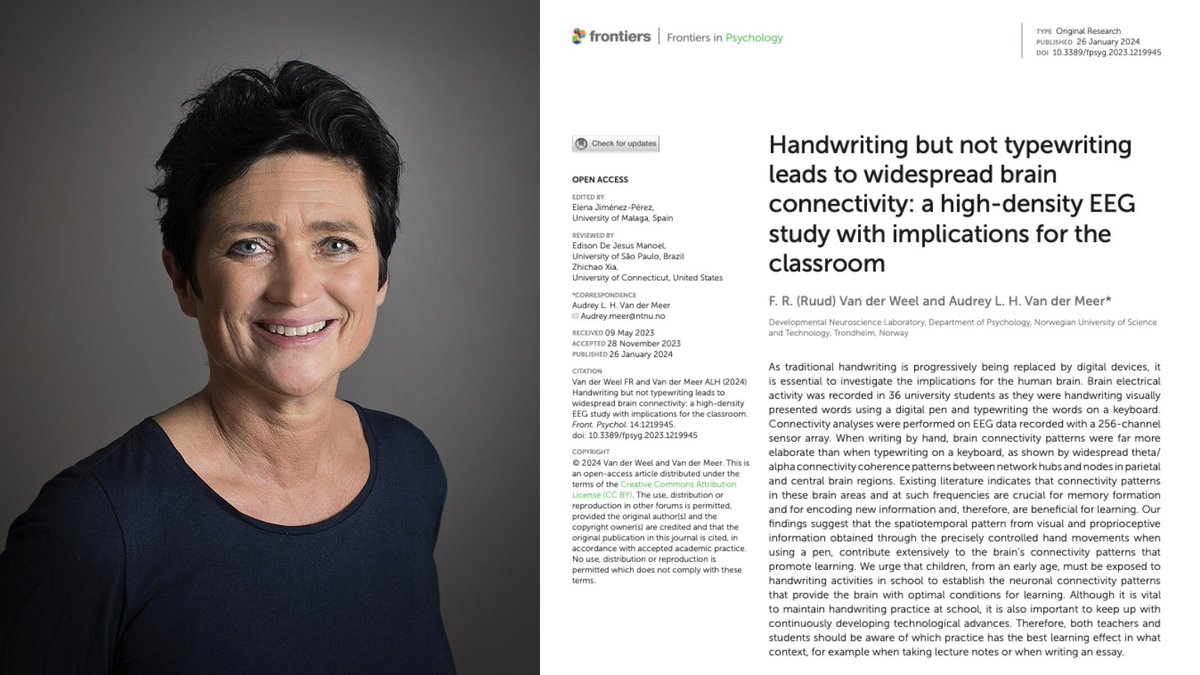
A Norwegian neuroscientist spent 20 years proving that the act of writing by hand changes the human brain in ways typing physically cannot, and almost nobody outside her field has read the paper. Her name is Audrey van der Meer. She runs a brain research lab in Trondheim, and the paper that closed the argument was published in 2024 in a journal called Frontiers in Psychology. The finding is brutal enough that it should have changed every classroom on Earth. The experiment was simple. She recruited 36 university students and put each one in a cap with 256 sensors pressed against their scalp to record brain activity. Words flashed on a screen one at a time. Sometimes the students wrote the word by hand on a touchscreen using a digital pen, and sometimes they typed the same word on a keyboard. Every neural response was recorded for the full five seconds the word stayed on screen. Then her team looked at the part of the data most researchers had ignored for years, which is how different parts of the brain were communicating with each other during the task. When the students wrote by hand, the brain lit up everywhere at once. The regions responsible for memory, sensory integration, and the encoding of new information were all firing together in a coordinated pattern that spread across the entire cortex. The whole network was awake and connected. When the same students typed the same word, that pattern collapsed almost completely. Most of the brain went quiet, and the connections between regions that had been alive seconds earlier were nowhere to be found on the EEG. Same word, same brain, same person, and two completely different neurological events. The reason turned out to be something nobody had really paid attention to before her work. Writing by hand is not one motion but a sequence of thousands of tiny micro-movements coordinated with your eyes in real time, where each letter is a different shape that requires the brain to solve a slightly different spatial problem. Your fingers, wrist, vision, and the parts of your brain that track position in space are all working together to produce one letter, then the next, then the next. Typing throws all of that away. Every key on a keyboard requires the exact same finger motion regardless of which letter you are pressing, which means the brain has almost nothing to integrate and almost no problem to solve. Van der Meer said it plainly in her interviews. Pressing the same key with the same finger over and over does not stimulate the brain in any meaningful way, and she pointed out something that should scare every parent who handed their kid an iPad. Children who learn to read and write on tablets often cannot tell letters like b and d apart, because they have never physically felt with their bodies what it takes to actually produce those letters on a page. A decade before her, two researchers at Princeton ran the same fight using a completely different method and ended up at the same answer. Pam Mueller and Daniel Oppenheimer tested 327 students across three experiments, where half took notes on laptops with the internet disabled and half took notes by hand, before testing everyone on what they actually understood from the lectures they had watched. The handwriting group won by a wide margin on every question that required real understanding rather than surface recall. The reason was hiding in the transcripts of what the two groups had actually written down. The laptop students typed almost word for word, capturing more total content but processing almost none of it as they went, while the handwriting students physically could not write fast enough to transcribe a lecture in real time, which forced them to listen carefully, decide what actually mattered, and put it in their own words on the page. That single act of choosing what to keep was the learning itself, and the keyboard had quietly skipped the choosing and skipped the learning along with it. Two studies. Two countries. Same answer. Handwriting makes the brain work. Typing lets it coast. Every note you have ever typed instead of written went into your brain through a thinner pipe. Every meeting, every book highlight, every idea you captured on your phone instead of on paper was processed at half depth. You did not forget those things because your memory is bad. You forgot them because typing never woke the part of the brain that would have made them stick. The fix is the thing your grandmother already knew. Pick up a pen. Write the thing down. The slower road is the faster one.
Ihtesham Ali tweet media
English
2.5K
44.7K
120.9K
10.2M
Alip retweetledi
Grady Booch
Grady Booch@Grady_Booch·
Most who interact with an LLM such as @OpenAI or @claudeai treat their interaction as a conversation with an intelligent and friendly pseudo-human. I do not. Rather, I frame it as my guiding the exploration of a latent space. Imagine that you stand at the door of a library. It's not only filled with books, it has waldos - remote manipulators - that you can use to command devices to go to and fro at command, even building things as so directed. But I steadfastly know that while the lobby may be filled with the latest bright and shiny things, if I want to do anything but the most common and mundane, I must wander through the rooms and stacks of books. If I look closely, I'll will see many books out of place. Some will even have meaningless content as if written by a madman (and some of them probably were). There will also be huge gaps, for where I'd hoped to find information, I'd instead see cobwebs and the occasional dusty, torn scrap of paper. Sometimes, there are hints as to where I should turn, but best knowing my context and needs, I'm the only one in place to know if those hints will lead me to something of value. If I'm not paying attention or am just plain lazy, they will lead me down paths that in the end are a complete waste of my time. The library does not care: it gets paid no matter what I do as long as I remain within its walls. Mind you, I enjoy visiting that library: I often learn things and build things of value. But I don't outsource my life there, for were I to do so, I know I'd become even more cognitively lazy.
English
33
77
463
26.2K
Alip retweetledi
SightBringer
SightBringer@_The_Prophet__·
⚡️The deeper signal is youth risk did not disappear. It migrated inward. Teen drinking fell because the old physical world of adolescence got dismantled. Alcohol belonged to a social ecosystem: unsupervised time, cars, parties, local jobs, malls, basements, boredom, flirting, older siblings, house gatherings, and the chaotic peer world where teenagers learned who they were by colliding with other people in real space. That ecosystem was replaced by phones, surveillance, parental tracking, algorithmic entertainment, social anxiety, online status games, and a much thinner physical commons. So the surface looks healthier. Fewer kids drinking. Fewer kids using weed. Fewer kids doing reckless things in public. The hidden layer looks worse. The young are less reckless because they are less socially embodied. Less initiation. Less unsupervised friction. Less courage-building. Less embarrassment and recovery. Less real dating. Less independence. Less contact with the physical world before adulthood demands it. The old teenage world produced damage, stupidity, alcohol abuse, pregnancy risk, fights, accidents, and bad decisions. No need to romanticize it. But it also produced social reps. It forced young people through discomfort. It made them practice attraction, rejection, conflict, reputation, risk, repair, and status in the open. The new world suppresses visible risk while increasing invisible fragility. That is the trade. A teenager can avoid drinking, avoid parties, avoid sex, avoid driving, avoid real confrontation, avoid rejection, avoid shame, avoid danger, and still arrive at 23 emotionally underbuilt. Cleaner behavior does not automatically mean stronger formation. This is why the marriage chart and the teen drinking chart are the same story at different stages. People are not suddenly failing to pair in adulthood. The whole pathway into embodied adulthood has been slowing for years before marriage even becomes the question. The real truth: society solved part of the teen vice problem by shrinking the arena where teenagers become adults. It took away the dangerous commons and replaced it with controlled isolation. The result is safer kids with weaker initiation into real life.
Grant Bailey@grantjbailey

Huge collapse in drinking among high schoolers 👀

English
472
1.7K
9.3K
1.2M
Alip retweetledi
Eddie Yang
Eddie Yang@ey_985·
New paper in Nature. The more a government controls its domestic media, the more it dominates AI training data, the more pro-regime outputs we get from AI. By scraping the open web, LLMs are unwittingly laundering state-coordinated narratives into seemingly objective answers.
Eddie Yang tweet media
English
43
673
1.6K
105.6K
Alip retweetledi
neil turkewitz
neil turkewitz@neilturkewitz·
@1followernodad Yes, but the real problem with literary AI slop (as with all AI slop) is that the noise drowns out the signal. Great books may still be being written, but no one can find them, so in a very real sense, they cease existing.
English
1
3
26
520
Alip retweetledi
Ed Newton-Rex
Ed Newton-Rex@ednewtonrex·
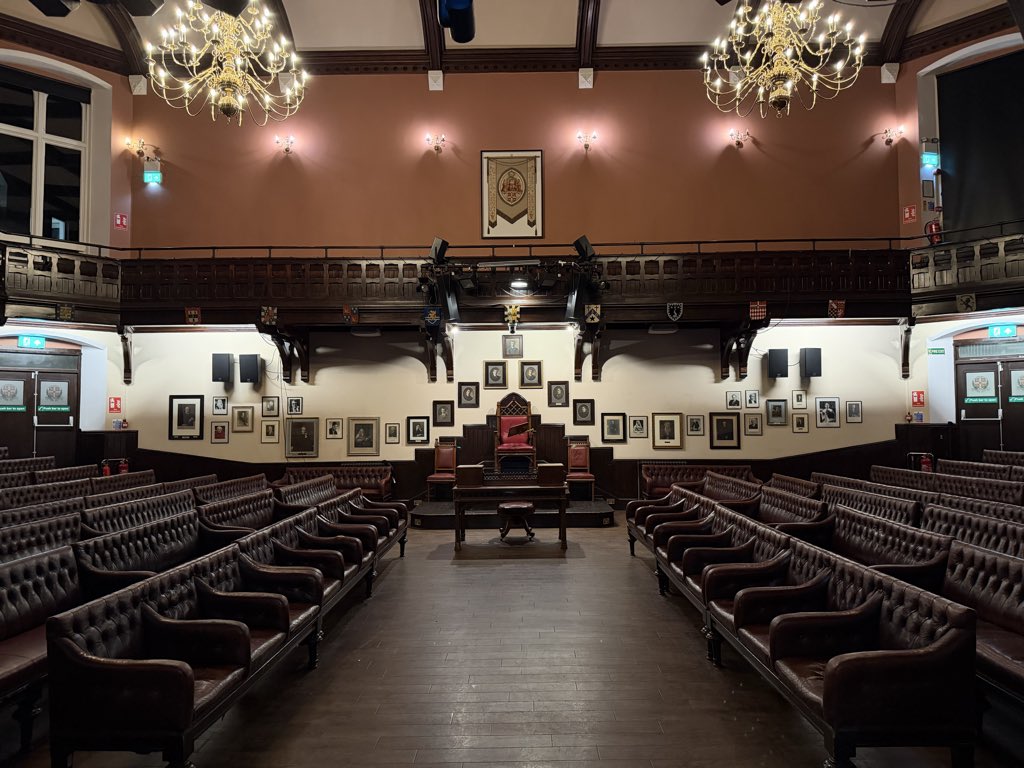
We won this debate - the Cambridge Union agreed that AI will kill the artist. No one *on either side* argued AI will be good for artists. The opposition basically argued it won’t be that bad. The fact that no pro-AI argument was even made says a lot about public views on AI.
Ed Newton-Rex tweet media
Ed Newton-Rex@ednewtonrex

It’s hard to think of a more important question in the arts today than how we respond to the threat of AI. Very pleased that the Cambridge Union is having this debate, and to be taking part. “This house believes AI will kill the artist.” 8pm tonight.

English
19
84
363
15.3K
Alip retweetledi
Jeremy
Jeremy@Jeremybtc·
A man with no working truck convinced Wall Street he had built the next Tesla. His company hit $30 BILLION. All he did was push it down a hill with no engine. > Trevor Milton founded Nikola in 2014, named after the same inventor as Tesla. > The goal was to build hydrogen powered trucks that would make diesel obsolete. He had no trucks. > In 2018 he released a promotional video called Nikola One In Motion. It showed a sleek semi truck accelerating smoothly down an open highway. Investors went wild. > What nobody knew was that the truck had no engine, no fuel cell, and no propulsion system of any kind. > Milton's team towed it to the top of a hill, tilted the camera to hide the slope, and let it roll. > He spent the next four years doing the same thing with words. On podcasts, television and social media. > Investors were told Nikola could produce its own hydrogen. It could not. They were told the trucks were ready for production. They were not. They were told orders were flooding in. They weren't. > In June 2020 Nikola went public. Within days the company was worth $30 BILLION, more than Ford. > Milton's personal stake hit $7.3 BILLION overnight. > A $32.5 MILLION ranch in Utah followed. A record for the state at the time. > In September 2020 Hindenburg Research published a report calling Nikola "an intricate fraud" built on "an ocean of lies." Milton resigned within ten days. > A federal jury convicted him of securities fraud and wire fraud in 2022. Sentenced to four years in prison the following year. > He never went. He was free on $100 MILLION bail pending appeal. > He and his wife donated $3.2 MILLION to Donald Trump's 2024 campaign. > In March 2025 Trump gave him a full pardon. The pardon erased $168 MILLION in restitution to defrauded shareholders. > Nikola filed for bankruptcy the following month, leaving thousands of investors with nothing. The company never had a product. The only thing that was real was the $30 BILLION valuation, the $7 BILLION that landed in his pocket and the pardon that made sure none of it had to be returned.
English
1.1K
8.7K
27.7K
3.1M
Alip
Alip@eldernewborn·
@3mmmod @Deezer عوضش دیزر خیلی جدی موسیقی هوش پلاستیکی رو‌ علامت گذاری و حذف میکنه
فارسی
1
0
2
213
Mohammad Modarres | محمد مدرس
چرا اسپاتیفای تگ هوش مصنوعی رو روی آهنگ‌های ساخته شده با AI نمی‌گذاره؟!!
فارسی
7
0
66
5.1K
Alip retweetledi
Prof. Lee Cronin
Prof. Lee Cronin@leecronin·
The biggest category error in AI for science is viewing a science problem as a search problem…
English
60
22
211
16.2K
Alip retweetledi
Is this a 3D model?
Is this a 3D model?@IsThisA3DModel·
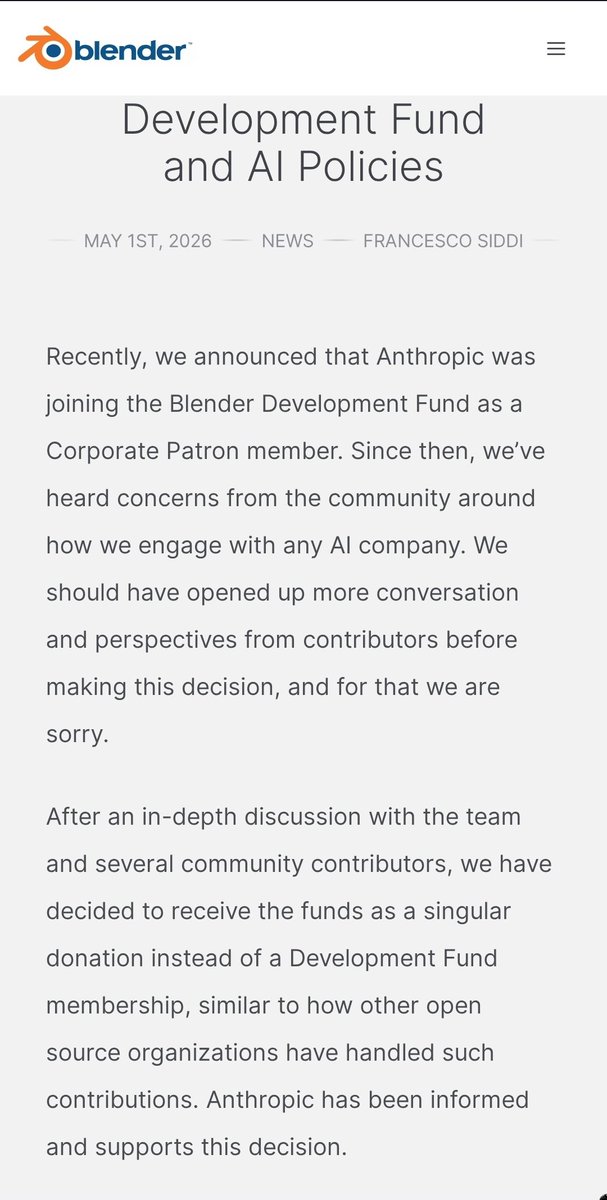
Blender has taken a principled stance and is sacrificing future donations from Anthropic to reaffirms their stance that they are supportive of artists and creators This is very admirable and we encourage all of you to donate to Blender to show your support and appreciation 🫖
Is this a 3D model? tweet mediaIs this a 3D model? tweet media
English
120
2.3K
12.4K
600.1K
Alip retweetledi
Neil Renic
Neil Renic@NC_Renic·
AI cheating has gotten so bad that I now feel genuine affection for horrifically bad essays clearly written by the student
English
322
5.8K
153.8K
2.4M
Alip retweetledi
Grady Booch
Grady Booch@Grady_Booch·
It is a source of continuous delight to watch the AI community rediscover the fundamentals and the dynamics of software engineering as they take those things and embellish them with AI adjectives, making them sound all fresh and new and sparkly while in truth, those fundamentals remain, well, fundamental. Remove AI from the discourse below, and what Andrew promotes are things one heard all the time as we saw - starting decades ago - the transition from assembly language to FORTRAN and COBOL, from structured to object-oriented, from waterfall to agile. The past, as is said, does not repeat itself but rather rhymes. Don’t get me wrong: I celebrate what Andrew et al are doing: developing software-intense systems that are meaningful and that endure requires intention and discipline, and I embrace that. Two dangling threads before I close: I don’t grok the semantics of “traditional teams”. The cosmos of computing is so wide and deep and diverse and crosses so many domains, I conclude that “traditional teams” is what one says when their experience is in a relatively narrow space, and they are witnessing a shift from what they grew up with in the Valley in particular, where web-centric systems of global elastic scale remain the primary focus. Second, I am dismayed at the focus on speed. If you are driving head long Thelma and Louise style toward an IPO then certainly speed will be a critical factor. But for most of the domain of computing, for systems that are meaningful and that endure, other factors are far more important: correctness, repeatability, safety, maintainability, these dominate, and as such, don’t be distracted by the noise and smoke and heat and light of an AI first style that may get you out of the starting gate quickly, but will fail you in the ultra marathon of most development.
Andrew Ng@AndrewYNg

AI-native software engineering teams operate very differently than traditional teams. The obvious difference is that AI-native teams use coding agents to build products much faster, but this leads to many other changes in how we operate. For example, some great engineers now play broader roles than just writing code. They are partly product managers, designers, sometimes marketers. Further, small teams who work in the same office, where they can communicate face-to-face, can move incredibly quickly. Because we can now build fast, a greater fraction of time must be spent deciding what to build. To deal with this project-management bottleneck, some teams are pushing engineer:product manager (PM) some teams are pushing engineer:product manager (PM) ratios downward from, say, 8:1 to as low as 1:1. But we can do even better: If we have one PM who decides what to build and one engineer who builds it, the communication between them becomes a bottleneck. This is why the fastest-moving teams I see tend to have engineers who know how to do some product work (and, optionally, some PMs who know how to do some engineering work). When an engineer understands users and can make decisions on what to build and build it directly, they can execute incredibly quickly. I’ve seen engineers successfully expand their roles to including making product decisions, and PMs expand their roles to building software. The tech industry has more engineers than PMs, but both are promising paths. If you are an engineer, you’ll find it useful to learn some product management skills, and if you’re a PM, please learn to build! Looking beyond the product-management bottleneck, I also see bottlenecks in design, marketing, legal compliance, and much more. When we speed up coding 10x or 100x, everything else becomes slow in comparison. For example, some of my teams have built great features so quickly that the marketing organization was left scrambling to figure out how to communicate them to users — a marketing bottleneck. Or when a team can build software in a day that the legal department needs a week to review, that’s a legal compliance bottleneck. In this way, agentic coding isn’t just changing the workflow of software engineering, it’s also changing all the teams around it. When smaller, AI-enabled teams can get more done, generalists excel. Traditional companies need to pull together people from many specialties — engineering, product management, design, marketing, legal, etc. — to execute projects and create value. This has resulted in large teams of specialists who work together. But if a team of 2 persons is to get work done that require 5 different specialities, then some of those individuals must play roles outside a single speciality. In some small teams, individuals do have deep specializations. For example, one might be a great engineer and another a great PM. But they also understand the other key functions needed to move a project forward, and can jump into thinking through other kinds of problems as needed. Of course, proficiency with AI tools is a big help, since it helps us to think through problems that involve different roles. Even in a two-person team, to move fast, communication bottlenecks also must be minimized. This is why I value teams that work in the same location. Remote teams can perform well too, but the highest speed is achieved by having everyone in the room, able to communicate instantaneously to solve problems. This post focuses on AI-native teams with around 2-10 persons, but not everything can be done by a small team. I'll address the coordination of larger teams in the future. I realize these shifts to job roles are tough to navigate for many people. At the same time, I am encouraged that individuals and small teams who are willing to learn the relevant skills are now able to get far more done than was possible before. This is the golden age of learning and building! [Original text: deeplearning.ai/the-batch/issu… ]

English
41
113
735
57.5K
Alip retweetledi
CyberCPU Tech
CyberCPU Tech@cybercpu·
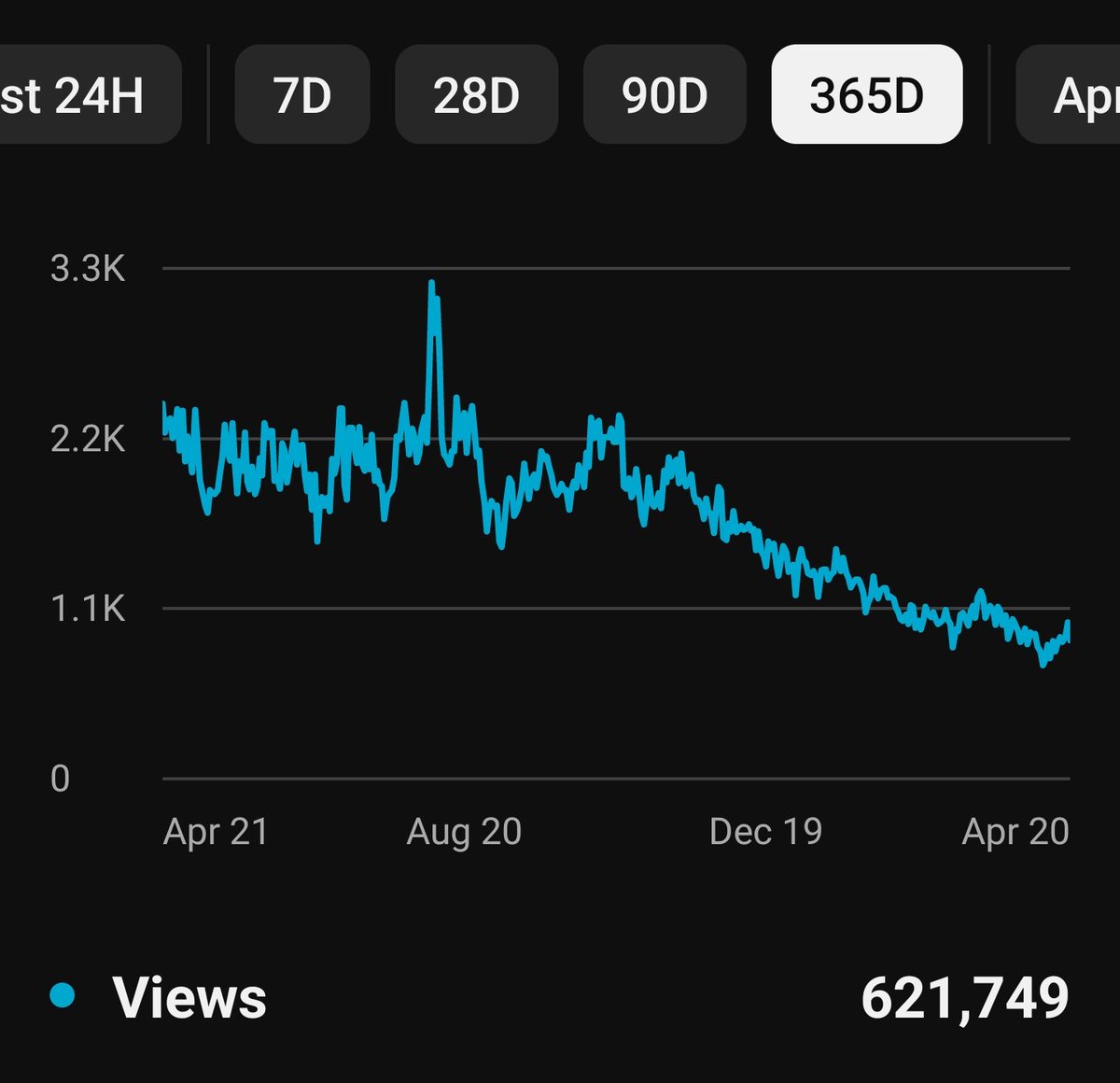
This is what's happening to YouTube. This is one of my most popular videos. It's how to fix a UEFI bootloader. As you can see the traffic has been cut in half over the last 6 months. But if you Google how to fix a UEFI bootloader, Gemini will give you my exact step by step process. Even the commands it cites are copied directly from my video. I got no royalty payments and don't even get a link to the original video. I simply lost the traffic and Google is able to provide more value from stolen content. AI is going to destroy the content industry on the internet and when it's gone, there will be nothing left to train the AI. Since AI can't come up with anything original it relies on stolen content and it can't steal what doesn't exist if it puts creators out of business.
CyberCPU Tech tweet mediaCyberCPU Tech tweet media
English
278
2K
13.4K
408.3K
Alip retweetledi
Guido van Rossum
Guido van Rossum@gvanrossum·
"If the technology fell in the wrong hands" => Yes, it will. Every. Single. Time.
English
46
170
1.3K
49.3K
Alip retweetledi
Zhigang Suo
Zhigang Suo@zhigangsuo·
Here is a test of another episode of human creativity. Train AI on all human knowledge up to 1849, and see if it discovers entropy as Clausius did in 1850.
Dustin@r0ck3t23

Demis Hassabis just defined the real test for AGI. It’s more brutal than anyone expected. Train AI on all human knowledge. Cut it off at 1911. See if it independently discovers general relativity like Einstein did in 1915. If it can, we have AGI. If not, we’re still building pattern matchers. Hassabis: “My definition of AGI has never changed. A system that can exhibit all the cognitive capabilities that humans can.” Not bar exams. Not coding competitions. All cognitive capabilities. Hassabis: “The brain is the only existence proof we have, maybe in the universe, of a general intelligence.” That’s why DeepMind studies neuroscience. Not for inspiration. For data. The human brain is the only confirmed evidence that general intelligence is physically possible. If you want to build it, you study the only example that exists. Hassabis: “True creativity, continual learning, long-term planning. They’re not good at those things.” Current systems are impressive and broken simultaneously. Hassabis: “They can get gold medals in international math olympiad questions, but they can still fall over on relatively simple math problems if you pose it in a certain way.” Jagged intelligence. Brilliant in narrow domains. Incompetent when approached differently. That inconsistency is the tell. A true general intelligence doesn’t spike in one direction and collapse in another. The Einstein test cuts through all of it. No benchmarks. No leaderboards. No carefully curated evals. Just a model, a knowledge cutoff, and the question of whether it can do what one human did alone in 1915. Hassabis: “Training an AI system with a knowledge cutoff of 1911 and seeing if it could come up with general relativity like Einstein did in 1915. That’s the true test of whether we have a full AGI system.” Current models can’t. They remix brilliantly. They don’t generate paradigm-shifting theories from first principles. Hassabis: “I think we’re still a few years away from that.” A few years. Not decades. The system that can be Einstein once can be Einstein a thousand times simultaneously across every domain. That’s not AGI anymore. That’s the beginning of something we don’t have words for yet. When that test gets passed, we won’t need a press release to know what happened.

English
5
4
25
8.1K
Alip retweetledi
Gary Marcus, MIT PhD and NYU Professor Emeritus
Claude Code is not AGI, but it is the single biggest advance in AI since the LLM. But the thing is, Claude Code is NOT a pure LLM. And it’s not pure deep learning. Not even close. And that changes everything. The source code leak proves it. Tucked away at its center is a 3,167 line kernel called print.ts. print.ts is a pattern matching. And pattern matching is supposed to be the *strength* of LLMs. But Anthropic figured out that if you really need to get your patterns right, you can’t trust a pure LLM. They are too probabilistic. And too erratic. Instead, the way Anthropic built that kernel is straight out of classical symbolic AI. For example, it is in large part a big IF-THEN conditional, with 486 branch points and 12 levels of nesting — all inside a deterministic, symbolic loop that the real godfathers of AI, people like John McCarthy and Marvin Minsky and Herb Simon, would have instantly recognized.* Putting things differently, Anthropic, when push came to shove, went exactly where I long said the field needed to go (and where @geoffreyhinton said we didn’t need to go): to Neurosymbolic AI. That’s right, the biggest advance since the LLM was neurosymbolic. AlphaFold, AlphaEvolve, AlphaProof, and AlphaGeometry are all neurosymbolic, too; so is Code Interpreter; when you are calling code, you are asking symbolic AI do an important part of the work. Claude Code isn’t better because of scaling. It’s better because Anthropic accepted the importance of using classical AI techniques alongside neural networks — precisely marriage I have long advocated. It’s *massive* vindication for me (go see my 2019 debate with Bengio for context, or to my 2001 book, The Algebraic Mind), but it still ain’t perfect, or even close. What we really need to do to get trustworthy AI rather than the current unpredictable “jagged” mess, is to go in the knowledge-, reasoning-, and world-model driven direction I laid out in 2020, in an article called the Next Decade in AI, in which neurosymbolic AI is just the *starting point* in a longer journey.* Read that article if you want to know what else we need to do next. The first part has already come to pass. In time, other three will, too. Meanwhile, the implications for the allocation of capital are pretty massive: smartly adding in bits of symbolic AI can do a lot more than scaling alone, and even Anthropic as now discovered (though they won’t say) scaling is no longer the essence of innovation. The paradigm has changed. — *Claude Code is plainly neurosymbolic but the code part is a mess; as Ernie Davis and I argued in Rebooting AI in 2019, we also need major advances in software engineering. But that’s a story for another day.
English
185
539
3K
609.9K