tobias

99.9K posts

tobias banner
tobias

tobias

@eltechbrother

Tony’s dad | Comms @MIRIBerkeley | Prev. @gsvventures @harvard @minervauni | Views are my own etc.

New York, NY Katılım Ocak 2012
502 Takip Edilen1.7K Takipçiler
tobias
tobias@eltechbrother·
The most important movie to watch right now is available for free! In this video I explain why it is so important for you to watch it + how to watch it for free :)
English
0
0
2
54
tobias retweetledi
MIRI
MIRI@MIRIBerkeley·
An internal model at OpenAI has autonomously disproved a central conjecture in discrete geometry, a mathematical field with applications in cryptography, wireless device communication, and medical imaging. The proof relates to a famous question posed by Paul Erdős in 1946. It has been verified by prominent mathematicians in a companion paper. The verifying mathematicians consider this to be a genuinely novel breakthrough on one of the most discussed problems in this area of mathematics. One called it “arguably the best known problem in Discrete Geometry.” Another observed, “If a human had written the paper and submitted it to the Annals of Mathematics and I had been asked for a quick opinion, I would have recommended acceptance without any hesitation. No previous AI-generated proof has come close to that.” The proof illustrates a general trend towards autonomous, agentic problem-solving in AI systems. OpenAI describes the system that produced the proof as a general-purpose model not specialized in mathematics. AIs can now perform long, novel chains of reasoning on difficult problems and are beginning to outstrip our ability to measure their progress. AI agents still perform best in domains with easily verifiable outputs, such as mathematics and cybersecurity. For example, Anthropic's Claude Mythos found thousands of vulnerabilities across every major operating system and web browser, and was deemed too dangerous for public release. Such capabilities are why the government is now more interested in evaluating frontier AI models. AI research is also a field with many easily verifiable outputs. Researchers at OpenAI and Anthropic take advantage of this fact to accelerate their work; senior researchers now claim they make only high-level decisions and let AI handle most of the coding. Experimenting with the coding capabilities of a publicly available AI system, like Claude Code, immediately demonstrates how far AI has come in the last year. OpenAI and Anthropic intend to use AI to enhance future models with minimal human oversight. To justify the urgency, these companies cite the importance of beating rival U.S. or Chinese labs. Many of the field’s foremost experts warn that this race ends with human extinction. Policymakers and researchers, including the founders of the AI revolution, are calling for international restrictions on the technology. A growing bipartisan and international consensus of political leaders agree.
MIRI tweet media
English
10
31
267
14.2K
tobias
tobias@eltechbrother·
The AI Doc is now available on streaming at Peacock. If you've been seeing it yet, now is the moment. Before it hit streaming, our friends Kevin Flick and Malory Graham at Small Planet Insights caught reactions from people walking out of the theater 👇
English
1
0
3
99
tobias
tobias@eltechbrother·
A big part of regulating AI to prevent a premature creation of ASI is to regulate the hardware it runs on. That would mean tracking every AI chip. Is that even possible? Well, here’s how @MIRIBerkeley’s Technical Governance Team’s international treaty proposal lays that out 👇 (at a high-level)
tobias@eltechbrother

No government has a plan that would stop a dangerous AI. So @MIRIBerkeley's Technical Governance Team made one. In Part 2 of the series "How To Stop AI From Destroying The World" I break down how nuclear deterrence logic applies to superintelligence. Hard caps on compute, chip tracking, and restrictions on uncontrollable AI. The world has built rules for civilization-ending tech before. Can we do it again in time?

English
0
4
13
1.3K
tobias
tobias@eltechbrother·
No government has a plan that would stop a dangerous AI. So @MIRIBerkeley's Technical Governance Team made one. In Part 2 of the series "How To Stop AI From Destroying The World" I break down how nuclear deterrence logic applies to superintelligence. Hard caps on compute, chip tracking, and restrictions on uncontrollable AI. The world has built rules for civilization-ending tech before. Can we do it again in time?
tobias@eltechbrother

The people racing to build superintelligence admit there's a high chance it ends in catastrophe. @MIRIBerkeley's Technical Governance Team published a draft international agreement to prevent premature superintelligence. First video in a series breaking down the whole thing👇

English
0
12
28
3.5K
tobias
tobias@eltechbrother·
Thank you! I have a few logistical takeaways: - Ask the cinema manager for permission beforehand to record inside the lobby, as catching people when they are outside the cinema can be challenging and illegal, depending on where the cinema is located - Sit with a sign explaining what you are doing (e.g., Just watched the AI Doc? Come talk to me about it) and have people approach you. Approaching strangers with a microphone might not yield the best results. - A day before going, check which screenings/cinemas will have more people (by checking the reserved seats) and compare with other days as well (as some cinemas might by default block some seats to make it look like it's packed) - Have a list of standardized questions to ask every person so you can then compare answers easily / edit them into a cohesive video - Have fun!
English
0
0
1
32
tobias
tobias@eltechbrother·
On the opening day of @theaidocfilm, I went to cinemas in NYC and asked people walking out a few questions about the film, AI, and what they'd say to the people building it right now. The answers were super interesting.
English
1
9
27
4.1K
Rob Bensinger ⏹️
Rob Bensinger ⏹️@robbensinger·
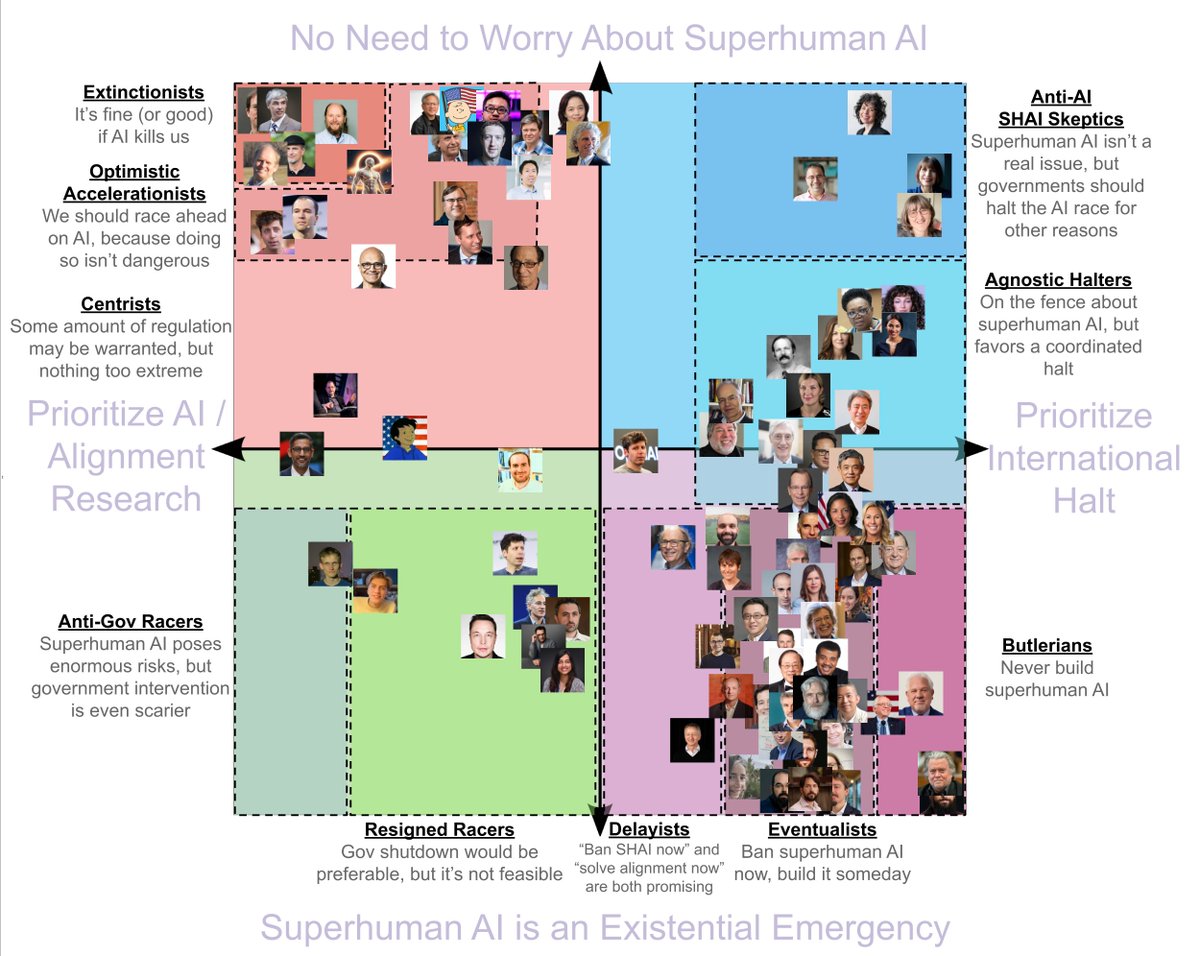
Who should I add to this? Also, did I get anyone's view wrong?
Rob Bensinger ⏹️ tweet media
English
87
27
404
65.6K
tobias retweetledi
MIRI
MIRI@MIRIBerkeley·
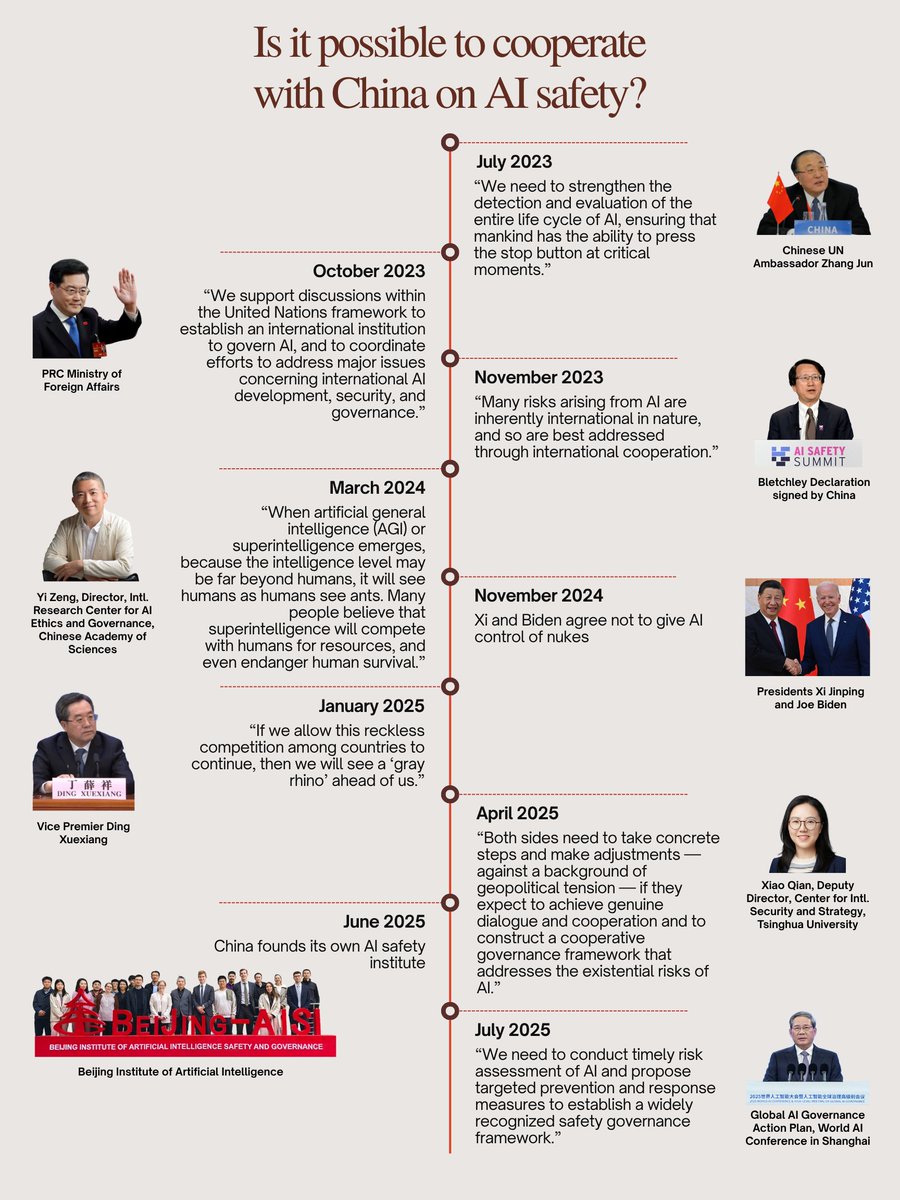
Is it possible to coordinate with China on AI governance? Critics of our proposed international agreement say no. But statements from Chinese government officials and academic figures paint a more optimistic picture:
MIRI tweet media
English
10
37
204
16.8K
Daniel Houck
Daniel Houck@daniel_houck·
@eltechbrother @MIRIBerkeley Are these available on any other platform? I don’t like watching videos on most sites that aren’t really designed for it and it’s harder to subscribe to just the videos
English
1
0
2
96
tobias
tobias@eltechbrother·
The people racing to build superintelligence admit there's a high chance it ends in catastrophe. @MIRIBerkeley's Technical Governance Team published a draft international agreement to prevent premature superintelligence. First video in a series breaking down the whole thing👇
English
1
9
49
9.3K
tobias
tobias@eltechbrother·
I’m gonna post a video about the interviews so don’t just take my word for it 😛
English
0
0
1
89
tobias
tobias@eltechbrother·
I'm talking to people on the street about AI. So far, everyone I've talked to is asking for regulation.
English
1
0
3
182
tobias
tobias@eltechbrother·
But then I think about timelines and I forget about it 😅
English
0
0
1
96
tobias
tobias@eltechbrother·
Every 2-3 months I get intrusive thoughts to start a PhD
English
1
0
1
152