Eleanor Evans

6.5K posts

Eleanor Evans banner
Eleanor Evans

Eleanor Evans

@eme7ans

GP member of Doctors for the Environment Australia https://t.co/RvIUfoPnyd. Never been a member of a political party. My talks https://t.co/iewG2j2c6e + https://t.co/FfB4cqrh39

Katılım Mayıs 2015
1.8K Takip Edilen707 Takipçiler
Eleanor Evans retweetledi

Australia Institute
Australia Institute@TheAusInstitute·
We just wanted to take a moment and say thank you to all of you amazing people out there who are supporting the call for a gas export tax! And shout out to Swan River Band for sending us this cracking track - enjoy! #auspol
English
11
52
126
1.4K
Eleanor Evans retweetledi
Australia Institute
Australia Institute@TheAusInstitute·
This is big. Former leaders, executives and professionals of the oil and gas industry are urging the government to reject the expansion of fossil fuel dependence. 👏👏👏 Read the open letter: theaus.in/4u2HOYc
Australia Institute tweet media
English
17
37
62
1.8K
Chris Gloninger, CCM, CBM
Chris Gloninger, CCM, CBM@ChrisGloninger·
Nobody said it was uniform. That's not a rebuttal, that's a geography lesson nobody asked for. The global average measures total ocean volume added. 4 inches since 1993. Accelerating. 66 satellite missions. All saying the same thing. The Pacific Northwest tectonic "protection" you're citing is the Cascadia subduction zone. When that fault ruptures the coast drops several feet instantly. Jakarta sank so fast they moved the capital. Rate of change is the whole point. It's accelerating. The last time seas were this high humans didn't exist.
Richard Lyon | The Energy Trap@RichardLyon_

Zero understanding of the rate of change. Sea level is not a global variable; it’s a localized phenomenon that fluctuates based on gravity, wind, and tectonics. While some cities face rises, the sea is retreating the Western Pacific where winds are currently dragging water away from Indonesia; and the Pacific Northwest, where tectonic uplift is outpacing the rising tide. The "global average" is a calculation, but the reality on the ground varies by latitude.

English
2
3
12
436
Chris Meder
Chris Meder@EVCurveFuturist·
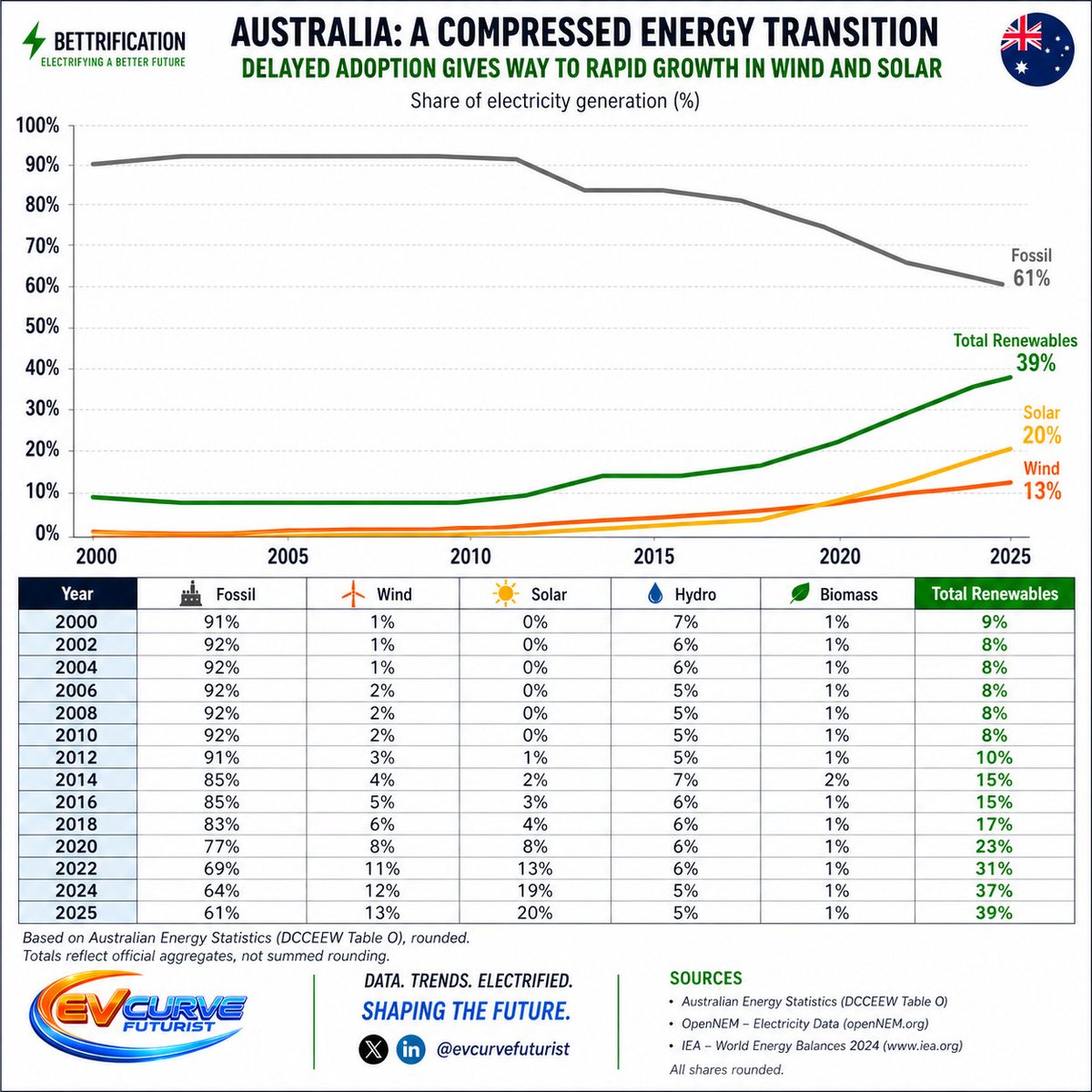
Australia stalled at ~8% renewables for over a decade, stuck in climate wars and policy gridlock. Then costs collapsed. Solar surged. Wind followed. Now pushing ~40% and accelerating fast. Delay didn’t stop the transition… it compressed it. ⚡🇦🇺 #Bettrification The Australian Renewables Growth Story Australia didn’t lead the energy transition, and for a long time it didn’t even try to. For more than a decade, renewables barely moved, sitting around 8% while the system remained dominated by fossil fuels. That stagnation wasn’t accidental. Years of climate wars and policy instability created a stop–start environment where progress was slowed, investment was uncertain, and the transition was repeatedly delayed. Then the economics shifted. Solar costs collapsed, wind scaled, and deployment surged despite the friction. What had been a flat, stagnant system suddenly broke out of equilibrium. In roughly a decade, Australia moved from that long-standing 8% plateau to nearly 40% renewables, with momentum still building. Now the next phase is already underway. Batteries are being deployed at record rates, both behind-the-meter in homes and businesses, and at grid scale through large BESS projects. They’re soaking up excess solar, shifting energy into the evening peak, and turning variability into control. This is the system learning to optimise itself. This wasn’t a smooth, well-orchestrated transition. It happened in spite of resistance, not because of alignment. When the cost curves turned, they overwhelmed the noise. Markets moved, capital followed, and the system began to reconfigure itself faster than policy could keep up. Australia’s curve tells the real story of disruption. Delay doesn’t stop change, it compresses it. After years of holding it back, the shift arrives faster, steeper, and harder to ignore. This isn’t just a transition anymore. It’s the early phase of system replacement, driven by economics that no amount of obstruction can hold back. ⚡🔋
Chris Meder tweet media
English
23
64
175
5.1K
Eleanor Evans
Eleanor Evans@eme7ans·
@TraciB34 So many good people are working on climate change. Don’t give up!
English
0
0
0
0
The Left Bible
The Left Bible@theleftbible·
“Leave fossil fuels in the ground. It's so simple. This is the most important predicament humanity has ever faced and by design as a result of the enormous oppressive power of the fossil fuel industry, we're flunking it." - George Monbiot.
English
7
53
93
1.7K
Chris Gloninger, CCM, CBM
Chris Gloninger, CCM, CBM@ChrisGloninger·
Nice AI image. The fossil fuel industry has leaked, spilled, flared, and buried more toxic waste than every wind turbine ever built — combined — times a thousand. 3.2 million abandoned oil wells in the US alone. Leaking methane. No cleanup. No plan. $20 billion in unpaid cleanup costs the industry walked away from and handed to taxpayers. Cancer clusters around refineries. Dead zones in the Gulf. Contaminated aquifers in 37 states. And they spent $700 million making sure you'd worry about turbine blades instead. Mission accomplished.
Peter Clack@PeterDClack

Are we the first species to create material objects that will outlive us by thousands of years? A wind turbine works for around 20 years, but its remains will exist for 500 years or a millennium. We are building a world of permanent plastic: discarded bottles and utensils, computers, televisions and car bodies. There is only so much land area, and it is gradually being swallowed to dump our discarded material society. The physics is a barrier for which there are few solutions. We use immense energy resources to bind materials together—resins, alloys, and composites. These bind so tightly that nature cannot pull them apart. We’ve created a physical era of deadlock. The energy now required to undo objects like turbine blades or batteries is greater than the energy it took to build them in the first place. The cosmos may be silent, but this new kind of barrier highlights a different kind of silence—the end of biological renewal, replaced by the static, unchanging hum of synthetic mounds of waste piling up on every available land and seascape. Will we resort to junkyards in Antarctica, the living deserts or the ocean bed? This is the silent symbolism of a biological world replaced by 'Plasticine'—a world of cellophane landscapes and lifeless grey mounds of garbage. It’s the logical conclusion to a system we never found an answer to. The waste problem is no longer a niche concern. It's reality.

English
16
233
1K
16.6K
Peter Garrett
Peter Garrett@pgarrett·
So important to read. Only slowing emissions will "buy crucial time for humanity to adapt." No more gas/coal. #ClimateEmergency. Renewables and electro tech now. 'Melting in Antarctica: What scientists saw at the Thwaites and Cook glaciers last summer smh.com.au/environment/cl…
English
5
14
39
1.1K
Katie Porter
Katie Porter@katieporterca·
Senator @ewarren knows I’ve never backed down from a fight when it comes to protecting California families. That won’t stop when I’m Governor.
English
219
30
161
22.6K
Katie Porter
Katie Porter@katieporterca·
Californians don’t need politicians explaining why everything costs so much and pointing fingers at who to blame. We need a Governor who has a long record lowering costs, delivering results, and holding corporations accountable—like I've done my whole career.
English
412
29
110
10.4K