Emil

920 posts

Emil banner
Emil

Emil

@emilsnotes

co-founder @kapa_ai (yc s23). on a mission to make all complex technical products easy to use. trusted by @grafana @reddit @openai @siliconlabs and +200 others

San Francisco, CA Katılım Aralık 2010
790 Takip Edilen1.6K Takipçiler
Sabitlenmiş Tweet
Emil
Emil@emilsnotes·
And we're live! Check out the @TechCrunch article here: techcrunch.com/2024/10/03/how… :)
kapa.ai (YC S23)@kapa_ai

We're thrilled to announce that @kapa_ai has raised $3.2M in seed funding from @ycombinator @Initialized and top angels incl. @douwekiela. 🚀 Our mission: turn technical conent into AI assistants that instantly answer complex product questions. We are already helping 100+ companies like @Docker, @OpenAI, and @mondaydotcom. Excited to keep pushing the boundaries of applied RAG/LLMs to optimize for accurate, production-ready systems. Full @TechCrunch article here: techcrunch.com/2024/10/03/how…

English
1
1
21
5.4K
Emil
Emil@emilsnotes·
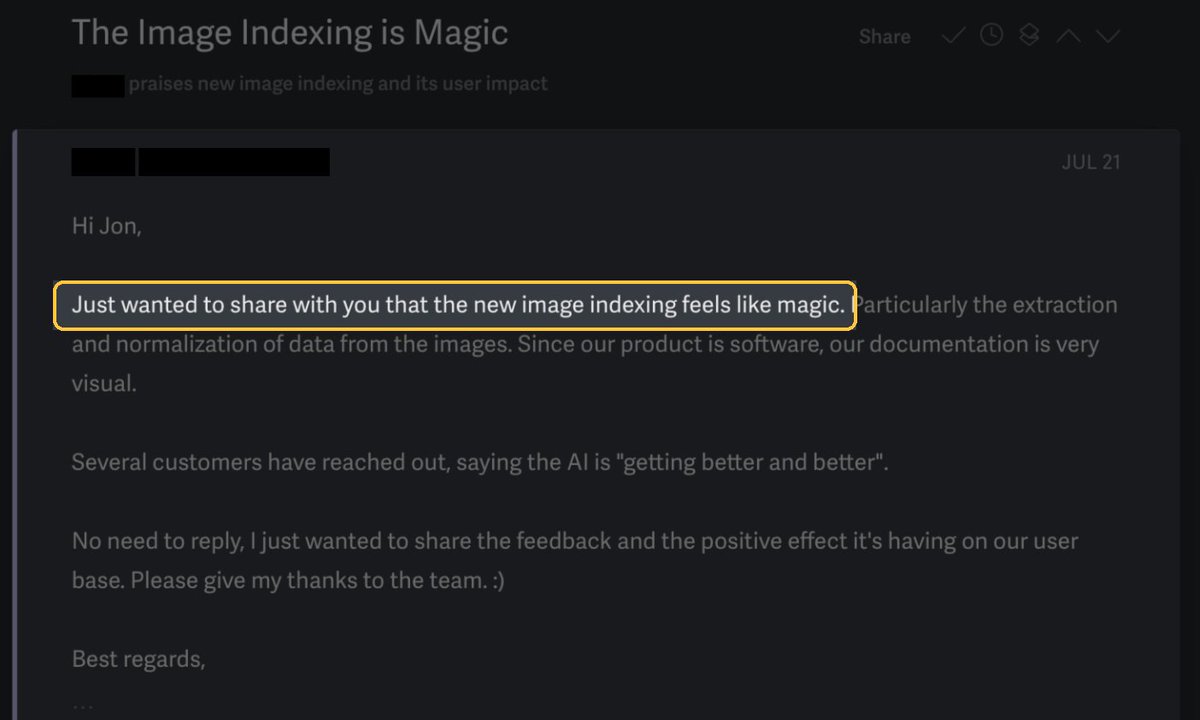
"The new image indexing feels like magic." Last week I posted about the least glamorous @kapa_ai feature we shipped this year: showing images in answers. It hit the front page of Hacker News for the complex retrieval engineering behind it. But this is the part I actually care about. An email like this from a customer, unprompted, a week after rollout. Their docs are heavily visual, like most software products. And their users are noticing the AI "getting better and better" without knowing why. A/B tests told us this feature worked but emails like this tell us it matters. :)
Emil tweet media
English
1
1
4
163
Emil
Emil@emilsnotes·
I'm excited to share that @kapa_ai just opened our NYC office 🗽 Since YC, people have asked us: how do you work out of Europe but sell globally? For a while the answer was simple: lots of flights and late night calls. And it worked. Our customers now span the globe from Shanghai to SF. But at the end of last year that model started breaking down. More US customers, bigger deals, and calendars that stopped calendering. So here we are. NYC office now open! In the city? Ping me and Finn Bauer, coffee's on us ☕
Emil tweet media
English
2
0
10
246
Emil
Emil@emilsnotes·
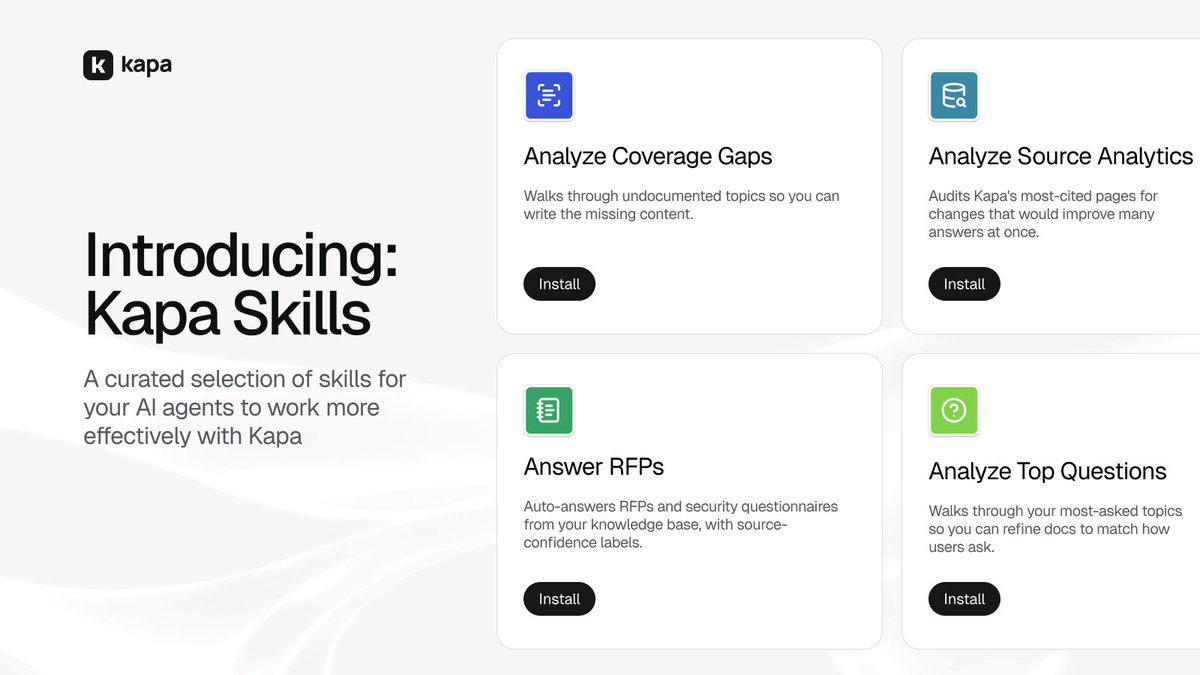
Our customers using Claude Code move faster than we can ship features. So we stopped fighting it and leaned in. Here's why it's paying off: 👇️ Some context: kapa.ai powers AI agents that answer millions of technical questions per month. Those conversations are a goldmine - they tell you exactly what users struggle with and where your docs fall short. We've built a lot of analytics on top of this (Coverage Gaps, Top Questions, and more), and teams love them. But here's the honest truth: no dashboard covers every edge case for every company. Meanwhile, our sharpest customers were already exporting kapa data and throwing their coding agents at it in ways we never designed for. So instead of chasing every workflow with a UI, we took the best practices we've seen actually work and packaged them as Kapa Skills - installable in Claude Code, Cursor, or Codex: 1/ Analyze Coverage Gaps: your agent works through the topics kapa couldn't answer and writes the missing content straight into your docs repo 2/ Analyze Top Questions: your agent checks whether your docs cover the angles users actually ask about, and refines the pages that don't Your users tell kapa what's broken -> your agent fixes it -> you review the PR. :) Open source and lots more skills coming. And did someone say MCP + CLI for analytics data? 👀 Link in the comments 👇
Emil tweet media
English
4
0
7
223
Emil
Emil@emilsnotes·
"I'm too embarrassed to share our usage data." That's what an AI leader at a $bn hardware giant told me about the internal AI support tool they built themselves. No one actually uses it. In the last 2-3 months I've started hearing versions of this almost daily on calls with prospects. 2026 is undoubtedly the year of "we can Claude Code everything" (we do internally), but there's some reality distortion happening too. My diagnosis: → Shipping an internal AI tool in-house scores easy points with leadership, so building gets political (maybe a team is built around it) → Everyone wants to demo the prototype at all-hands, but no one wants to maintain it the week after → Real users break the demo immediately, and one confidently wrong answer kills trust for good The DIY stories we see that actually stick? Almost all cracked 10-20 person AI-native startups where everyone has full context. At 5,000 people, that gets insanely more difficult. Nobody talks about this publicly because it breaks the narrative. Every company has an internal AI success story on LinkedIn. Very few would share their usage curves. Usage is the only metric that doesn't lie. Embarrassing numbers welcome 👇
English
6
2
16
4.7K
Emil
Emil@emilsnotes·
@ZoharEiny @kapa_ai Thanks for sharing! I think the actual central management of a context lake (by a single team that owns it) honestly matters even more than cost reduction. Someone that owns it means it actually gets shared and used.
English
0
0
1
28
Zohar Einy
Zohar Einy@ZoharEiny·
Very interesting and thanks for the Port mention. We love Kapa! We actually recently did some context research of our own We asked ourselves: If agents and human ask the same sorts of questions over and over again, can you structure context for those questions in a way that makes it use far fewer tokens? We ran thousands of queries: structured context in a context lake vs unstructured via MCPs And we saw that going to structured context used 80% fewer tokens (no matter what model). I guess this is close to your middle ground option (where the context is pre-joined according to common usage instead of LLM as judge) or maybe a fourth option Here's our research if you're interested: x.com/ZoharEiny/stat…
Zohar Einy@ZoharEiny

x.com/i/article/2070…

English
1
0
2
89
Emil
Emil@emilsnotes·
"Just retrieve more context" is how most teams tune their agent's retrieval tools. It's also how you get worse answers AND a bigger Anthropic bill. More and more teams (Port, Airbyte, Deepgram) are adding @kapa_ai knowledge base search as a tool call in their agents to ground them. The first question is always the same: how much context should retrieval actually return? So we measured it. We built a test set of thousands of real, annotated questions from across kapa deployments and ran the curves. The takeaway is that there are really just three configurations: 1/ Maximum recall: keep the defaults (35k chars, top 15 chunks). Past that point the recall curve is basically flat - retrieving more is pure cost 2/ The middle ground: enable pruning. A small LLM judges every chunk against the query and drops the irrelevant ones. Cuts about two-thirds of the context while keeping ~96% of recall, for ~0.7s of latency 3/ Latency-sensitive: lower the character cap instead. No added latency, but the same two-thirds cut drops recall to ~86%, because you're cutting by size, not relevance Context rot is real: past a certain size, more context makes LLM answers worse, not better. The goal is complete information, not maximum information. Full guide with the recall curves in the comments 👇
Emil tweet mediaEmil tweet media
English
1
2
6
344
Emil
Emil@emilsnotes·
Since leaving YC, we've done 200+ AI agent rollouts. I can tell you exactly how adoption happens inside a company: it's never a wave. It's three people who go all-in while everyone else watches: 🧵 Quick context: @kapa_ai is the platform teams use to build external and internal chat experiences when answers need to be insanely accurate on technical content. Teams like Mixpanel, Sentry, and Grafana use it internally for support engineers resolving tickets, AEs answering deep technical questions mid-deal, and solutions teams filling RFPs without pinging engineering. For internal deployments, it's always the same pattern: a handful of people build kapa into their daily workflow immediately, most adopt it over a few weeks, some never touch it. And here's what separates the deployments that take off from the ones that stall: the teams that found those early power users and let them train everyone else cut their adoption time massively. The champions had already figured out the workflows. They just needed a spotlight. Problem is, spotting them is getting harder. Usage is spreading across surfaces - some people ask via Slack bots, others through MCP servers in their agents, others in chat. Without a full picture of the org it's hard. So we shipped Top Users for internal kapa projects: 1/ See who depends on kapa most across every surface, with questions asked and estimated time saved 2/ Spot which roles get the most value, so you know where to expand next 3/ Turn "our team uses AI" into "this AE self-serves 90% of technical questions" (an actual ROI story!!) Fun fact from our own dashboard: kapa's heaviest internal users are our AEs. :)
Emil tweet media
English
0
2
5
181
Emil
Emil@emilsnotes·
We just made the front page of Hacker News. For the most obvious feature we shipped this year: showing images in answers. Turns out obvious ≠ easy. Why obvious? Technical docs were never just text. Wiring diagrams, schematics, spec tables - sometimes the honest answer is "look at this diagram". Yet most retrieval systems throw all of it away at ingestion and answer with words alone. Why not easy? The naive approaches don't survive contact with production: → Multimodal embeddings wash out the fine detail that matters in charts and schematics → Sending images at query time adds 27-51% cost per query and blows past payload limits Our approach: describe every image once at ingestion, retrieve as text. Per-query overhead drops to 1-6%, and that engineering story is what HN picked up. And the impact? We A/B tested across half a million real user interactions on @kapa_ai - it lifted CSAT more than any LLM model swap in the past year. Rolling out to all kapa deployments now. Hardware folks with diagram-heavy docs, this one's for you. Sometimes the answer isn't a smarter model. It's showing users what they asked to see. :) Blog + HN thread in the comments 👇
Emil tweet media
English
1
0
6
142
Emil
Emil@emilsnotes·
Narrative violation: a $3bn chip giant is ahead of AI startups in agent experience. While half the industry is shilling llms.txt files and "skills" that barely get used, Nordic Semiconductor actually built their own MCP servers to give coding agents context to their entire dev ecosystem. AND they actually measured the impact (to make sure it works). How? They asked coding agents real embedded engineering questions and did a before/after comparison. The result: Vanilla coding agent (Claude Code, Codex) without context: → 5 minutes 8 seconds → 763k tokens spent With their new context MCP: → 1 minute 42 seconds → 127k tokens spent That's actually insane. That's 83% of the cost gone and 3x faster answers, just by giving the agent the right context. 🤯 On a frontier model like Fable that's the difference between ~$14 and ~$2 per agent run. 🤯🤯 Under the hood, kapa.ai powers the context retrieval via API that indexes their docs, DevZone, Developer Academy, and SDK source. And keeps it all up to date in real time. Bravo Nordic 🚀 Video in the comments 👇
Emil tweet media
English
2
0
5
228
Emil
Emil@emilsnotes·
Nobody plans for their docs chatbot to take over the company. But that's exactly what keeps happening with kapa.ai. 🧵 Here's the pattern: a team deploys kapa to answer technical questions on their docs. Then users start preferring it over search, over forms, over ChatGPT/Claude, over waiting for support. So it spreads. For Port and Deepgram, kapa now sits inside the product. For Silicon Labs and Grafana, it's on the marketing website. For Tailscale and Redpanda, it's the front line of support. It's the same engine but serving very different jobs. Which means what happens when the AI answer isn't the end of the journey should depend on where kapa sits. You could always extend kapa with custom actions (super easy to do), or build on our retrieval and chat APIs. BUT the two most common next steps shouldn't require code. So we just shipped conversation handoff, out of the box: 1/ Marketing: a pricing conversation ends with "Talk to Sales", and the lead lands in HubSpot or Salesforce with full context of what they care about. 2/ Support: kapa is uncertain or the user downvotes, a "Create ticket" button appears, and the ticket lands in Zendesk or Salesforce with the whole conversation attached. AI where it's great, humans where it matters. :) Docs in the comments 👇
English
0
1
4
168
Emil
Emil@emilsnotes·
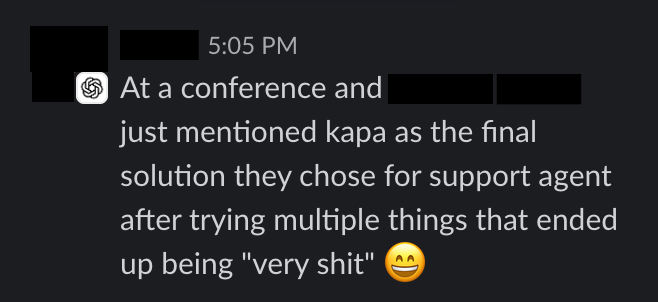
Best Slack message I've received this year. A friend at OpenAI messaged me from a conference: a unicorn founder on stage just described their AI support agent journey - they tried multiple solutions that all "ended up being very sh*t"... and then named kapa.ai as the one they finally stuck with. I'll take that over any award 😄 There's a real lesson in it though. Everyone's AI support demo looks amazing. The gap between tools only shows up in production, months in, when real users ask real questions and either trust the answers or quietly stop using it. That's the whole game: be the tool still standing after the "very sh*t" phase of everyone else. No case study, no logo slide, no marketing budget can buy an unprompted mention on a conference stage. Screenshot in the post because moments like these are why we grind on accuracy 🔥
Emil tweet media
English
1
3
10
483
Emil
Emil@emilsnotes·
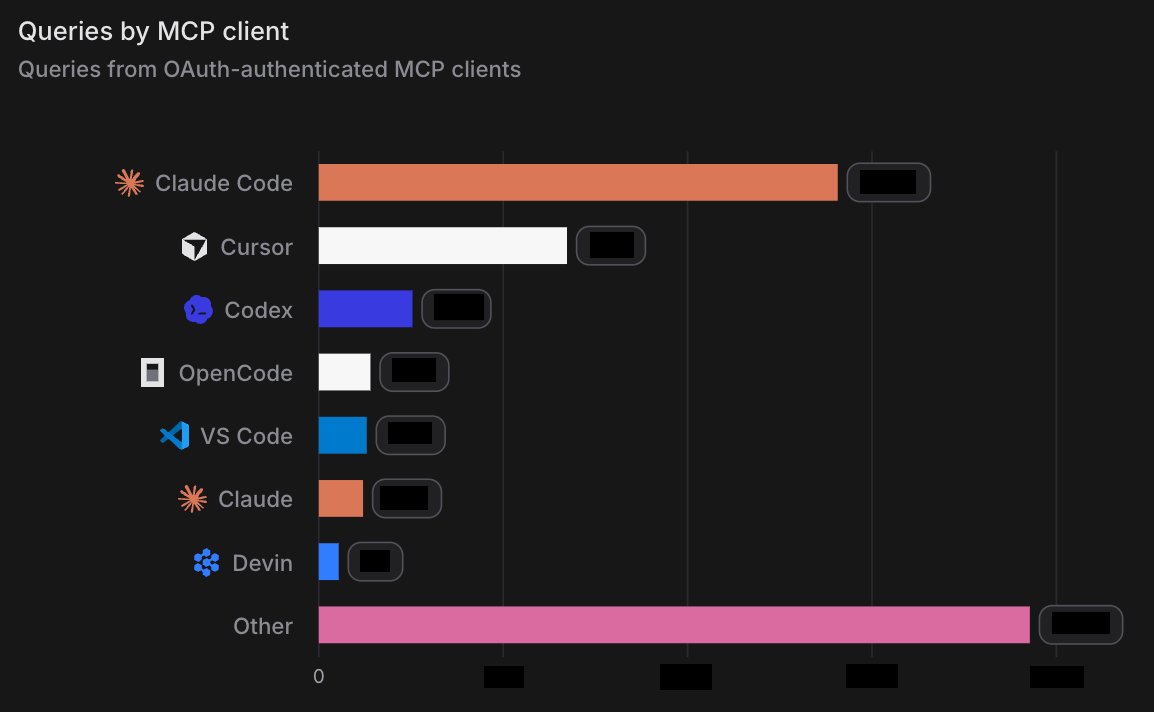
Introducing Agent Analytics for @kapa_ai: you can now view how Claude Code, Codex, and Cursor interact with your product. Here's how: 🧵 Quick context: 100+ companies (n8n, ClickHouse, and more) power their docs MCP servers with kapa. These integrations are growing FAST. When an AI agent has a question about your product, it queries your curated KB via MCP directly to get grounded answers instead of stale training data or flakey web search. You could always see these queries. But now the analytics got a serious upgrade: - Query volume broken down per MCP client (Claude Code vs Cursor vs Codex...) - Dedicated agents view to filter and read agent conversations - Export interactions to work out how agents actually use your product Agents are becoming some of your heaviest docs users. Now you can see exactly what they're up to. Try it: kapa dashboard → Agent Analytics
Emil tweet mediaEmil tweet media
English
4
2
7
405
Emil
Emil@emilsnotes·
We deliberately shipped it for agent retrieval first, not our end-to-end assistants. Agents are where pruning matters most: every tool call pours output into the same context, so lean retrieval buys room for everything else - and an agent that notices a gap can simply search again. On by default in our Product Agent SDK, optional in the retrieval API. Lars Baltensperger from the team wrote up the full research: kapa.ai/blog/how-we-pr…
English
0
1
2
41
Emil
Emil@emilsnotes·
What worked: a small LLM between the reranker and the generator. It reads the question and ALL the chunks together, grades each on a five-level scale (ESSENTIAL down to UNRELATED), and only what passes reaches the generator. On a month of production traffic: 68% of chunks dropped, 96% of recall preserved, ~0.7s added latency - and applied to our end-to-end assistants, it would cut per-query cost by ~34%.
Emil tweet media
English
1
1
4
51
Emil
Emil@emilsnotes·
We just hit the front page of Hacker News again - this time with how we taught a small LLM to throw away 68% of our RAG context. Here's how we implemented pruning:
Emil tweet media
English
2
2
7
283
Emil retweetledi
Port
Port@tweetsbyport·
@emilsnotes We 🤍 Kapa!
Indonesia
0
1
3
101