Drop a verified-human gate into your Next.js app in five lines: import EntrosGate, wrap your protected component, set a Trust Score threshold. The component handles wallet connection, on-chain lookup, and the prompt for users who haven't yet verified.
entros.io/docs
AI agents already trade, vote, and execute on Solana autonomously. Anyone can register thousands. Initial operator-binding solutions are emerging, but none yet offer graduated, on-chain trust that compounds with the operator's behavioral consistency over time. The Solana Foundation has publicly projected that nearly all on-chain transactions will be agent-driven within two years. Accountability needs depth, not just a one-time check.
Shipped: Entros identity baselines now persist on chain, encrypted under a key only your wallet can derive. Verify once, recover from any browser or device with the same wallet—no more being locked to a single device, no more clearing storage and starting over. AES-256-GCM, opaque to everyone.
Working on making your Entros anchor recoverable from any browser or device your wallet connects from. In parallel, tightening cross-wallet Sybil detection in the validation layer.
Solana already shipped the primitives identity composes with: SAS for attestations, the Solana Agent Registry for agents, Realms for governance, Token-2022 NonTransferable for non-transferable identity tokens. Entros plugs into all of them.
Entros Protocol is now submitted for @colosseum Frontier.
12 seconds to verify your humanity on Solana.
Private, with ZK proofs verified on-chain.
Build a Trust Score that compounds. Bind your agents on the 8004 registry to show they are owned by a verified human operator. Any Solana app reads the attestation, free, no API key.
Live:
> entros.io
> Three Anchor programs deployed
> @entros/pulse-sdk and @entros/verify on npm
> SAS attestations on every verification
> Agent Anchor for the 8004 registry
> Realms voter-weight plugin
> Public security program
Grateful to @colosseum for the arena and the standard it sets. Respect to all other builders!
The submission is a checkpoint, not a finish line. Still a long way to go. Continued hardening, mainnet readiness, the Solana Seeker build, and integrator pilots are next.
Shipping continues.
Week in review.
> `@entros/verify` shipped on npm. Popup-pattern integrator drop-in. One component, one callback, verification handled.
> Mobile verify flow is end-to-end real. Encrypted baseline, Groth16 via mopro, on-chain submit via MWA. Dashboard reads Trust Score and verification fees live from chain state.
> Mint-receipt enforcement live. Every anchor mint requires a signed Ed25519 receipt from the validation service.
> Hardening: persistent Sybil registry on Postgres, per-source rate cap on the relayer, calibration-attack noise on borderline checks. pulse-sdk 1.5.3 adds OS-level voice isolation in browser capture.
Next: integrator pilot outreach, mainnet preparation, continuous improvement.
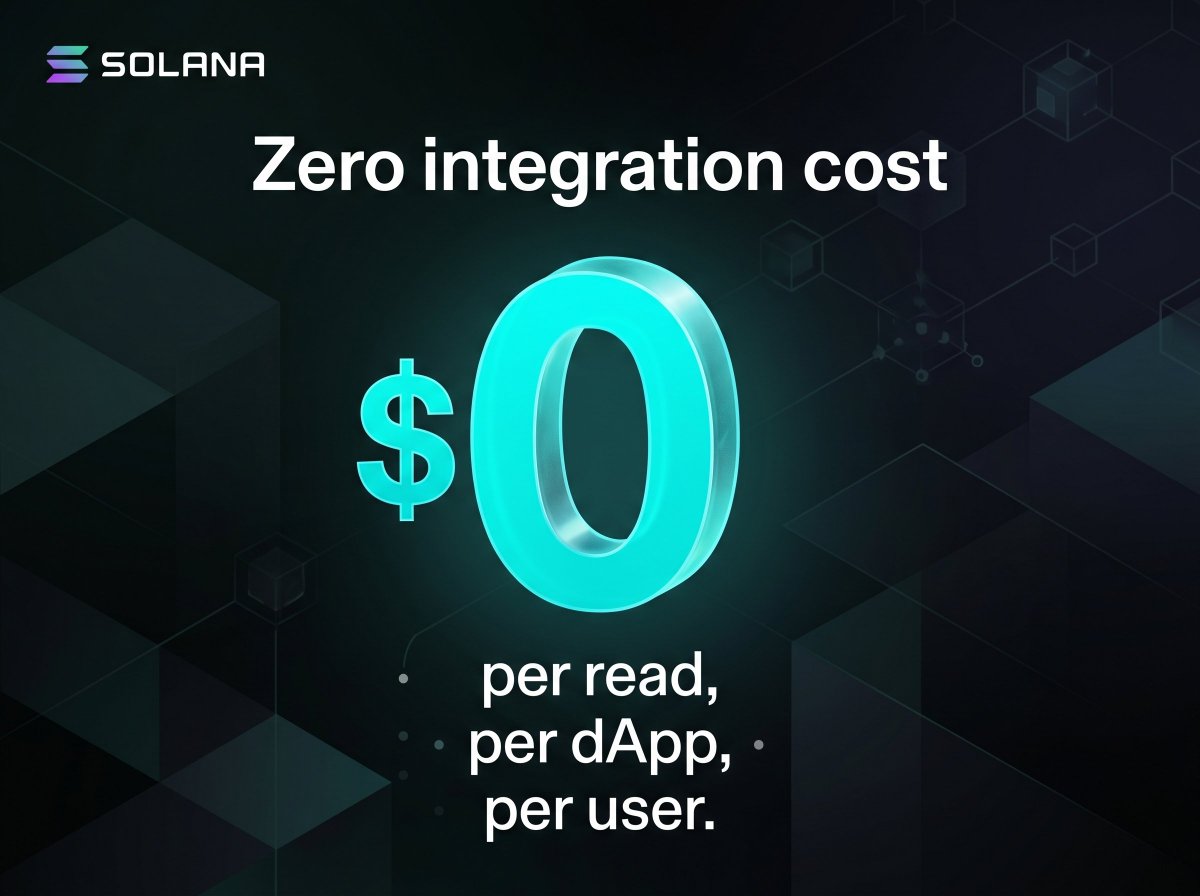
Solana delivers what an on-chain identity layer needs: free reads on PDA state, sub-second finality, and composability across any program that wants to read the result. Entros is built on all three. One verification, readable by every dApp on the network. No API keys, no billing relationship, no permission to read.
Live on npm: @entros/verify.
Drop-in React component for proof of personhood on Solana. One callback, five lines of JSX, popup pattern. The component handles wallet connect, the 12-second behavioral capture, the ZK proof, and the on-chain mint. Your app stays wallet-adapter-free until a verified payload arrives.
3.4 KB ESM gzipped. Wraps @entros/pulse-sdk so the on-chain output matches the canonical entros.io/verify flow.
@entros/verify" target="_blank" rel="nofollow noopener">npmjs.com/package/@entro…
Solana has the highest daily active address count of any L1 and the fastest-growing agent ecosystem. Jupiter still relitigates sybil with custom heuristics every season. Most Realms votes still default to token weight. The identity stack is forming, but no protocol yet offers graduated, on-chain trust that compounds over time. That is the slot Entros fills.
The crypto industry built nearly every primitive on the assumption that one wallet equals one person. Wallets cost nothing to create. People cost something to be. Closing that gap on-chain is the work.
Sprint update from the on-chain side. Pluto landed integration test coverage, wallet migration, and verified compute budgets across the three Entros programs.
What's in:
> Happy + failure path tests across all 3 programs
> Wallet migration shipped (co-signed, atomic)
> Updates now bind to a verified proof
> Full verification: 124K of 200K compute units
> Admin-recovery: distinct errors per gate
Programs are testable in seconds. Next: mobile build, integrator demo surface.
Entros is not a KYC product. It does not store who you are. It produces an on-chain answer to one question: is this the same human, returning, over time. That bound is intentional and load-bearing.
The original Entros challenge phrase was nonsense syllables, designed in 2025 to prevent dictionary-based deepfake attacks. By 2026 that threat model had collapsed: real-time streaming synthesis at sub-100ms latency makes pre-synthesis libraries irrelevant, so combinatorial vocabulary size constrains nothing. The defense had to become content-binding—verifying what was spoken matches what was asked—not vocabulary-obscuring.
Three iterations to land it:
- v1 (April 21): in-distribution speech recognition over the original nonsense challenge. Out-of-distribution audio caused the model to hallucinate. False rejects too high.
- v2 (April 22): phoneme-level alignment over the same nonsense challenge. Architecturally clean but the discrimination window was too narrow to threshold confidently.
- v3 (April 25): word-level matching over a curated real-word vocabulary. In-distribution for the recognizer, discrete signal, wide window. Live and calibrated.
The research synthesis lives in the paper at §2.2.1, with references to ASVspoof 5 (which abandoned pre-synthesis as the dominant threat) and Pitch Imperfect 2025 (which establishes that prosodic human-vs-synth signals are vocabulary-independent). Vocabulary choice is a UX and accuracy decision; defense against synthesized voice lives in the prosodic acoustic and cross-modal coupling layers.
Wave 4 of the T4a red team campaign confirmed the shipped result at scale—1,000 attempts of pre-recorded human voice paired with procedural motion, 0 passes. Wave 1 (acoustic only) was 100% pass. Wave 2 (cross-modal coupling enforced) was 10%. Wave 3 (phrase binding added) was 0% at small N. Wave 4 tightens the statistical bound at production scale.
The pre-recorded-arbitrary-content attack class is closed. Real-time synthesized voice—T4b—sits in the queue for a future campaign cycle.
Renamed to Entros Protocol.
Now live:
entros.io@entros/pulse-sdk@1.0.1 on npm
github.com/entros-protocol
Programs upgraded in place at the same IDs
Existing devnet anchors, Trust Scores, and SAS attestations preserved
The previous @iam-protocol/pulse-sdk on npm is deprecated.