Eria Odhuba

6.5K posts

Eria Odhuba

Eria Odhuba

@eodhuba

Analyst Relations & Marketing Consultant

Surrey - UK Katılım Nisan 2007
1.4K Takip Edilen703 Takipçiler
Eria Odhuba retweetledi

Charles Onyango-Obbo
Charles Onyango-Obbo@cobbo3·
2/ "There is a lot of public participation in Africa in economic and other issues. The problem is that those who participate have no power, so it is just procedural. In the end policy is made elsewhere."
English
0
3
14
1.2K
Eria Odhuba retweetledi
Alexander Mia
Alexander Mia@arekusandr_·
Apple just removed "Anything" -- a $100M vibe coding app that let anyone build iOS apps with prompts -- from the App Store. Also blocking updates for Vibecode and Replit. The founder tried moving code execution to a web view. Still rejected. The walled garden vs AI builders war is here.
English
49
23
428
55.8K
Eria Odhuba retweetledi
Morgan
Morgan@morganlinton·
I’ve found myself explaining LLMs to more and more friends and family. One component I’ve been covering a lot lately is model weights. If you aren’t totally clear on what these are, here’s a simple(ish) overview - no calculus knowledge required. A “what the heck are model weights” 🧵
English
27
18
436
137.5K
Eria Odhuba retweetledi
Nazem Alkudsi
Nazem Alkudsi@LongArcNews·
The Hormuz closure is not a 6-week shock. It is an 18-month stress test for the global food system. Most allocators are trading the obvious: oil up, defense up, gold up. They are missing the connective tissue. 🧵
English
46
624
3.2K
456.8K
Eria Odhuba
Eria Odhuba@eodhuba·
Key point here that shows regular folk will never learn: IPO as an Emergency Exit for Elites!
RC Geopolitics@RCgeopolitics

THE DIGITAL PAWNSHOP BLEEDS: The End of the "Buy Now, Pay Later" Illusion 🇸🇪📉💳 The Financial Times reports a brutal drop: "Klarna stock sinks 25% after bad loan costs soar." What the financial media sold for years as an "innovative fintech revolution" is being exposed for what it always was—an unsecured credit card for those whom traditional banks will no longer touch. 1. A Business Built on Decline: Models like Klarna are not a technological miracle. They are a modern, algorithmic version of a pawnshop. People are no longer using these apps just to buy luxury items; they are using them to finance everyday consumption, lunches, and groceries. When Klarna reports record sales and transaction volumes, it means one thing: the middle class has run out of cash before payday and is living on debt. 2. The Breaking Point (Bad Loans): The report shows that provisions for credit losses are soaring. The company expanded massively into longer-term loans and reported a net loss of $95 million in the third quarter. The reason is simple: the people at the bottom of the economic food chain are defaulting. This isn't a localized issue; it is the destruction of consumer demand playing out live. 3. IPO as an Emergency Exit for Elites: The timing is fascinating. Klarna only recently went public in the US. The majority of the shares offered during the IPO came from existing investors. The big Wall Street players (VC funds) needed to cash out right before the reality of unpaid debts became obvious. Now, as the stock plummets well below its IPO price, regular retail investors are left holding the bag. RC GEOPOLITICS When the system of micro-loans for consumer goods begins to collapse, it is like the water receding before a tsunami. It proves that the consumer—the main engine of the economy—is exhausted. The "Buy Now, Pay Later" system has just shifted into the "Buy Now, Pay Never" phase.

English
0
0
0
23
Eria Odhuba retweetledi
RC Geopolitics
RC Geopolitics@RCgeopolitics·
THE DIGITAL PAWNSHOP BLEEDS: The End of the "Buy Now, Pay Later" Illusion 🇸🇪📉💳 The Financial Times reports a brutal drop: "Klarna stock sinks 25% after bad loan costs soar." What the financial media sold for years as an "innovative fintech revolution" is being exposed for what it always was—an unsecured credit card for those whom traditional banks will no longer touch. 1. A Business Built on Decline: Models like Klarna are not a technological miracle. They are a modern, algorithmic version of a pawnshop. People are no longer using these apps just to buy luxury items; they are using them to finance everyday consumption, lunches, and groceries. When Klarna reports record sales and transaction volumes, it means one thing: the middle class has run out of cash before payday and is living on debt. 2. The Breaking Point (Bad Loans): The report shows that provisions for credit losses are soaring. The company expanded massively into longer-term loans and reported a net loss of $95 million in the third quarter. The reason is simple: the people at the bottom of the economic food chain are defaulting. This isn't a localized issue; it is the destruction of consumer demand playing out live. 3. IPO as an Emergency Exit for Elites: The timing is fascinating. Klarna only recently went public in the US. The majority of the shares offered during the IPO came from existing investors. The big Wall Street players (VC funds) needed to cash out right before the reality of unpaid debts became obvious. Now, as the stock plummets well below its IPO price, regular retail investors are left holding the bag. RC GEOPOLITICS When the system of micro-loans for consumer goods begins to collapse, it is like the water receding before a tsunami. It proves that the consumer—the main engine of the economy—is exhausted. The "Buy Now, Pay Later" system has just shifted into the "Buy Now, Pay Never" phase.
English
0
1
11
1.7K
Eria Odhuba retweetledi
Shay Boloor
Shay Boloor@StockSavvyShay·
$MSFT CEO Satya Nadella is effectively calling the end of software applications as the value layer. In an agentic world, apps become passive databases while AI agents hold the intelligence, make decisions & do the work Apps become commodities while agents become the business.
English
157
210
1.8K
414K
Eria Odhuba retweetledi
OK Then
OK Then@okaythenfuture·
Again it will be far better to be an aging nation that is still industrialized and also moving towards full automation + the robotics age, than to be a massively populated young country that hasn't mastered manufacturing, is facing tons of services automation ahead, and has high youth unemployment. The fate of India and most of Africa promises a lot of misery and unemployment ahead. They're just not ready for the emerging world coming ahead. Human population count no longer matters.
OK Then tweet media
English
58
152
1K
75.9K
Eria Odhuba retweetledi
MIT CSAIL
MIT CSAIL@MIT_CSAIL·
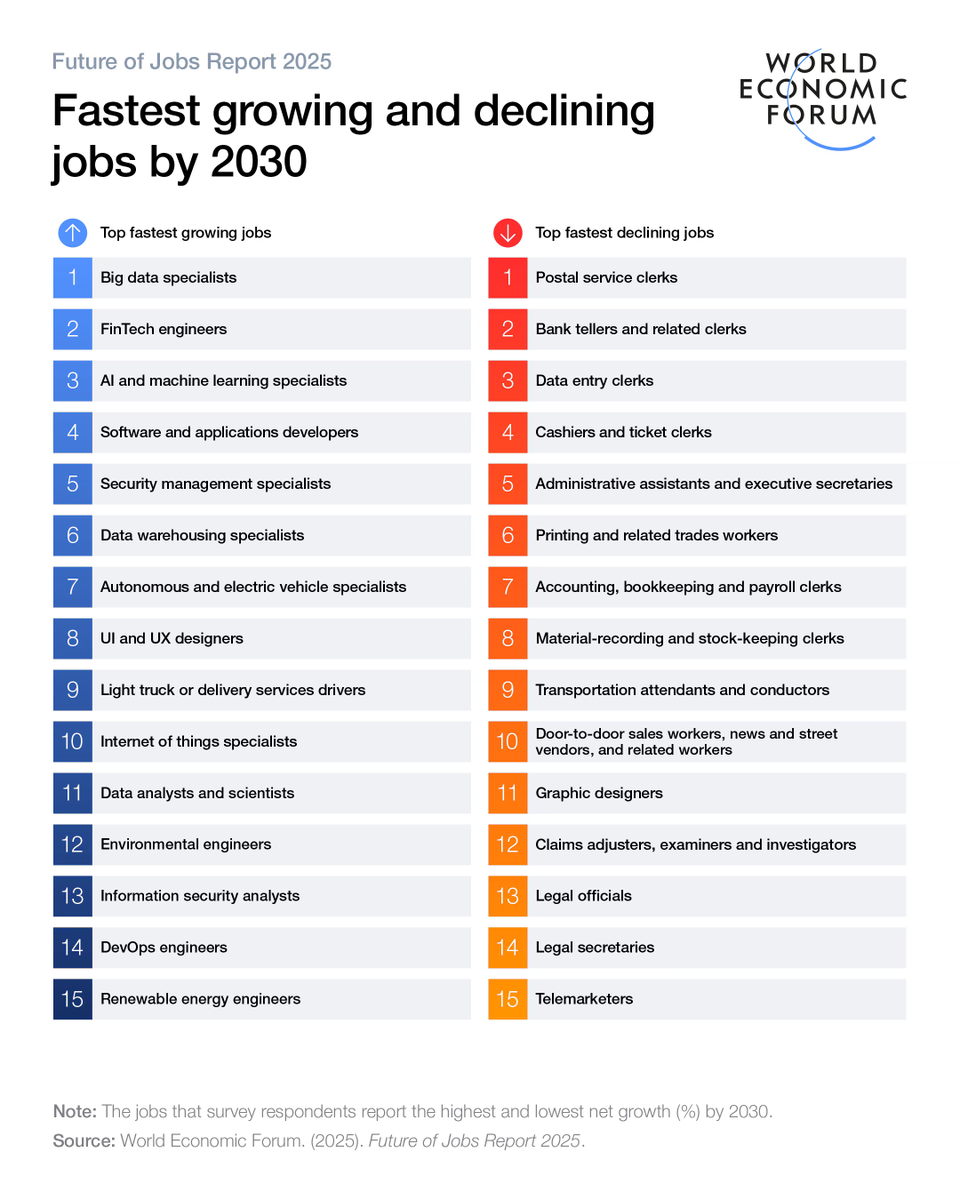
The fastest growing & declining jobs by 2030, v/@wef.
MIT CSAIL tweet media
English
37
327
1.4K
97.1K
Eria Odhuba retweetledi
Gravity Analytica Capital
Gravity Analytica Capital@GravityAnalyti1·
There is nothing in this that is inaccurate. But, it misses the point and presents a very naive and incompletely understanding of why debt was necessary because it is based on a dubious understanding of what money is. Money is storage vessel of time. You work an hour and get an amount of money that you can store so you don't have to work at some point in the future. No matter how much you get paid you get paid more than what one hour is actually worth. Because, food, clothing, shelter, etc are so easily available. You either worked for yourself (or the family as indigenous people did) or you worked for another person, i.e. slavery as in Rome. But, you worked your entire life regardless. Before the invention of money humans spent all day, every day, their entire lives in resource debt. Humans have always been indebted. Those pre 17th century bonds that kings defaulted on were investments towards wars. Wars over resources, territory, etc. Wars that were meant to reward the future self with more time through the acquisition of other people's wealth. I.e.... other people's time. Money allowed people bank hours and this allowed lending to replace slavery. But, those hours we bank still come due it is just they come do in the future when it assumed we will be more productive. This is what debt allows. It allows people today to get more time than they actually have. The modern world wouldn't exist without the understanding that we borrow from our future selves today so that we can progress and improve our future lives. This system fails when we don't advance. Which is the actual problem today. Modern people don't understand this and don't understand that our time has already been sold to have the lives we have. The rate of technological advance would have been impossible without multiply the number of hours humans have. Ie. debt. You don't see all the fortunes lost and all the debt that was wiped out in history. Besides this video presenting recency bias it also presents survivorship bias. It's a very end-of-empire sort of mindset. And remember after the fall of slavery (i.e. the fall of the Roman Empire) the world fell back into the "Dark Ages." A time period where people, again, spent their entire lives working just to survive. It took hundreds of years to come back out. And usury was the reason the Renaissance occurred. I.e. the formation of debt.
English
11
4
39
6.9K
Eria Odhuba retweetledi
Robert Scoble
Robert Scoble@Scobleizer·
One cool thing about following 35,000 people in the AI world, particularly academics, is that you see how AI is being used to change and improve literally everything. Like in biology.
Markus J. Buehler@ProfBuehlerMIT

How does an embryo reliably "compute" its form - "cell by cell" - using only local interactions and mechanics, yet produce a precise global body plan? I’m excited to share our Nature Methods paper "MultiCell: geometric learning in multicellular development", presenting #AIxBiology research led by @HaiqianYang and the result of a great collaboration with Ming Guo, George Roy, Tomer Stern, Anh Nguyen and Dapeng Bi. A long-standing challenge in developmental biology is to predict how thousands of cells collectively self-organize as tissues fold, divide, and rearrange. In MultiCell, we represent a developing embryo as a dual graph that unifies two complementary views of tissue mechanics with single-cell resolution: cells as moving points (granular) and cells as a connected foam (junction network). This lets the model learn dynamics from both geometry and cell–cell connectivity. On whole-embryo 4D light-sheet movies of Drosophila gastrulation (~5,000 cells), our model predicts key cell behaviors and the timing of events, including junction loss, rearrangements, and divisions with high accuracy, at single-cell resolution. Beyond prediction, the same representation supports robust time alignment across embryos and offers interpretable activation maps that highlight the morphogenetic "drivers" of development. The broader goal is a foundation for cell-by-cell forecasting in more complex tissues, and eventually for detecting subtle dynamical signatures of disease. Kudos to the team for this inspiring collaboration with brilliant researchers to push the boundary of AI for biology! Citation: Yang, H., Roy, G., Nguyen, A.Q., Buehler, M.J., et al. MultiCell: geometric learning in multicellular development. Nature Methods (2025), DOI: 10.1038/s41592-025-02983-x Code/data links are in the manuscript.
English
5
3
61
6.9K
Eria Odhuba retweetledi
Coté
Coté@cote·
The sun never sets on the American public cloud.
Coté tweet media
English
1
2
2
151
Eria Odhuba retweetledi
Amazing Physics
Amazing Physics@amazing_physics·
🚨 BREAKING SCIENCE NEWS 🚨 For the first time ever, scientists have successfully teleported a quantum state of light over the internet and yes, it’s just as mind-blowing as it sounds. A team of researchers in the US pulled off this breakthrough by sending quantum information through over 30 kilometers (18 miles) of standard fiber optic cable, while regular internet traffic was flowing through the same lines. This process, known as quantum teleportation, doesn’t physically move the object itself. Instead, it transfers the properties of a quantum particle (like a photon) from one location to another, recreating it perfectly at the destination while the original disappears a concept that sounds straight out of Star Trek, but is firmly rooted in the bizarre world of quantum mechanics. The challenge? Making fragile quantum signals coexist with ordinary internet data without interference. The researchers overcame this by precisely managing how light interacted with other signals inside the fiber. This achievement marks a massive leap toward integrating quantum communication with our existing internet infrastructure potentially paving the way for ultra-secure, lightning-fast networks of the future. Credit: Jordan M. Thomas et al., "Quantum teleportation coexisting with classical communications in optical fiber", Optica (2024).
Amazing Physics tweet media
English
161
761
3.1K
246.5K