Equity & Health

54.2K posts

Equity & Health banner
Equity & Health

Equity & Health

@equitylist

Public Health, Equity and Human Development, Social Determinants of Health news selected by Ruggiero Lucia

Washington DC USA Katılım Mart 2009
1.1K Takip Edilen28.4K Takipçiler
Equity & Health retweetledi
STAT
STAT@statnews·
Eli Lilly reported that in a late-stage trial, its next-generation obesity drug led to weight loss approaching the effectiveness seen with bariatric surgery trib.al/dzeVK0I
English
0
8
6
1.4K
Equity & Health retweetledi
Global Health Observ
Global Health Observ@GlobalPHObserv·
CDC Operational Guidance for Investigating Locally Acquired Mosquito-Transmitted Malaria — United States, 2026 | MMWR cdc.gov/mmwr/volumes/7…
English
1
4
4
77
Equity & Health retweetledi
Global Health Observ
Global Health Observ@GlobalPHObserv·
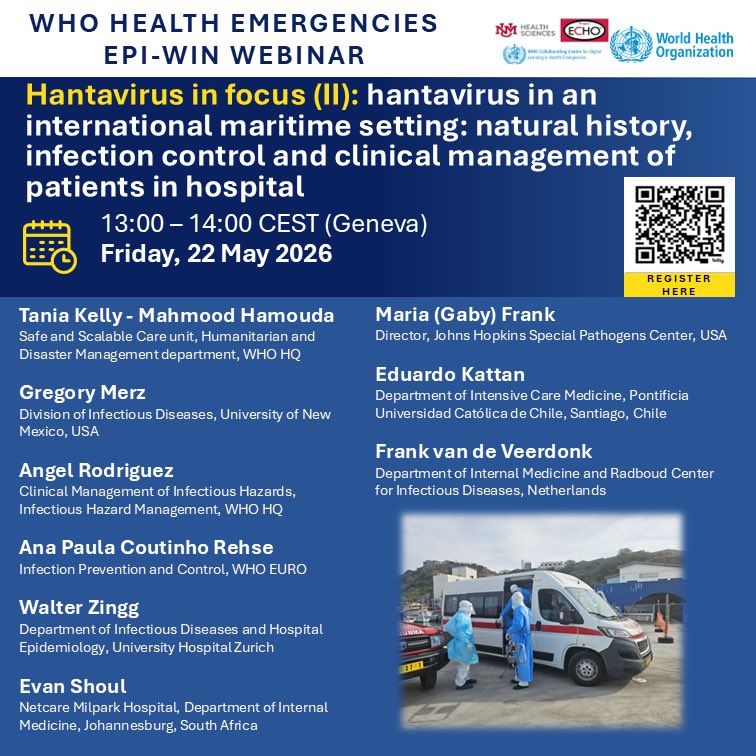
Hantavirus in an international maritime setting: natural history, infection control and clinical management of patients in hospital Friday 22 May 2026, 13:00–14:00 CEST who.zoom.us/webinar/regist…
Global Health Observ tweet media
English
1
5
5
130
Equity & Health retweetledi
Global Health Observ
Global Health Observ@GlobalPHObserv·
Suicide mortality among adolescents and young adults aged 10–24 years in the Americas, 2000–2021: an analysis using the WHO Global Health Estimates thelancet.com/journals/lanam…
English
0
3
5
102
Equity & Health retweetledi
Paul Nuki 🦋
Paul Nuki 🦋@PaulNuki·
The most important thing to know about the Ebola epidemic in DRC is this: bringing it under control will rely almost entirely on health workers winning the TRUST of local communities. This may sound dull, even woke, when compared to talk of experimental vaccines etc. But it’s true, not to mention hugely difficult, resource intensive and dangerous. The logic is this: you have one of the most frightening infectious diseases spreading in a huge uneducated population that has been subjected to horrific poverty and violence for many years. Yet there are no vaccines or special treatments. The only way to stop it is to break the chains of transmission and this requires the full cooperation of the population. Winning trust won’t be easy. More than 2m have been displaced by a conflict that has frequently been marked with mass rapes and village massacres — violence that seemingly occurs without rhyme or reason. There is no understanding of science or politics, and superstition and paranoia understandably fill the gap. This is what hundreds of local health workers employed by the Red Cross, WHO, MSF and others are walking into. To slow and eventually end the outbreak they must convince people with symptoms to come forward so they can be isolated away from their families and treated by people clad head to toe in PPE. Even in death, of which there will be much, they must explain that victims must be separated from their loved ones and forego burial and grieving rites that are central to their faith and understanding. When we think about the Ebola outbreak in DRC we should think about what we would do in such a situation. How we would win the trust of terrified families were we charged with doing so. We should think too about the resources that are needed to pay for and support those putting their lives on the line on our behalf. As things stand, the money needed for the emergency response is only about 40% funded and yet it must last for many months, probably years, if the epidemic is to be successfully brought under control.
English
8
32
76
10.4K
Equity & Health retweetledi
Global Health Observ
Global Health Observ@GlobalPHObserv·
Johns Hopkins Center for Humanitarian Health–Lancet Commission on health, conflict, and forced displacement: health in a world of crises and impunity thelancet.com/journals/lance…
English
0
4
5
266
Equity & Health retweetledi
World Health Organization (WHO)
Situation report of #Ebola disease outbreak caused by Bundibugyo virus in the Democratic Republic of the Congo #DRC and #Uganda - data as of 18 May 2026: 🔴 A total of 528 suspected cases, including 132 deaths have been reported from both countries. Of the 12 suspected cases reported from Uganda, two were confirmed through laboratory testing, while the rest tested negative. A total of 668 contacts have so far been identified, including 541 in DRC and 127 in Uganda, although contact follow-up remains challenging in some areas of DRC due to insecurity and movement restrictions. Numbers are rapidly changing as surveillance, contact tracing and laboratory testing are being scaled up. 🔴 Alert management and case investigations are being scaled up in the affected countries. 🔴 In DRC, a total of 38 experts (20 from Ministry of Health and 18 from WHO) have been deployed from Kinshasa to Bunia to support response operations. 🔴 Over 17 tons of emergency supplies were shipped to DRC, incl. personal protective equipment, medical supplies, tents, stretchers and medicines. 🔴 Laboratory capacity is being expanded, with deployment of lab teams and mobile laboratories to affected areas in DRC to increase local testing and diagnostic activities. 🔴 WHO, together with Alliance for International Medical Action @ALIMA_ORG, @MSF, @UNmigration and @ifrc, is supporting the setup of treatment facilities in affected areas. 🔴 Risk communications and community engagement is also being scaled up, to make sure communities are actively including in the response. Read more bit.ly/4tJrkU0
World Health Organization (WHO) tweet media
English
112
246
410
77.1K