

Eric A. Moreno
18 posts
Eric A. Moreno
@eric_a_moreno
Physics/ML researcher @MIT, @CERN, @Fermilab, @LIGO (too many, I know), formerly @Caltech
Katılım Eylül 2020
48 Takip Edilen41 Takipçiler

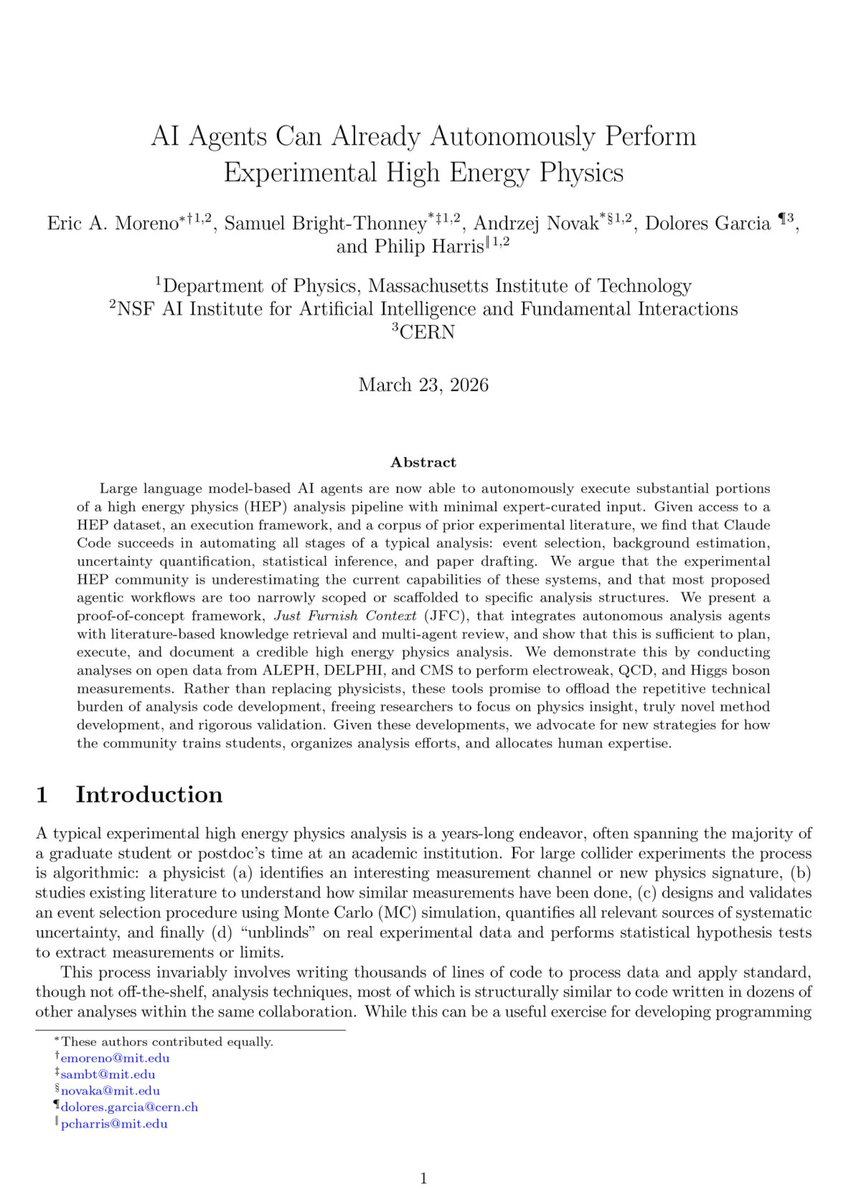
🚨BREAKING: This paper should terrify every Physics PhD student.
AI agents just ran a full particle physics experiment. Alone. No human in the loop.
Researchers tested whether LLM-based AI agents could autonomously execute a complete high energy physics analysis pipeline.
Not help with it. Not co-pilot it. Do the whole thing.
They built a framework called JFC (Just Furnish Context) that combines autonomous analysis agents with literature-based knowledge retrieval and multi-agent review.
Here's what the AI agent did on its own:
- Event selection
- Background estimation
- Uncertainty quantification
- Statistical inference
- Paper drafting
It ran real experiments on open data from ALEPH, DELPHI, and CMS. It performed electroweak, QCD, and Higgs boson measurements.
The tool used? Claude Code.
The scariest line from the paper:
"The experimental HEP community is underestimating the current capabilities of these systems."
Researchers argue most proposed agentic workflows are too narrowly scoped. The AI can already do far more than anyone is building for.
But here's the nuance people will miss.
This isn't about replacing physicists. It's about offloading the repetitive technical burden so researchers can focus on actual physics insight and novel method development.
The real takeaway: if AI can autonomously run one of the most complex experimental sciences on earth, the question isn't whether your field is next.
It's whether you're already behind.
Authors: Eric A. Moreno, Samuel Bright-Thonney, Andrzej Novak, Dolores Garcia, Philip Harris
English
AI Agents can now automate scientific analyses that took years in mere hours.
Excited to announce our new pre-print on automating the data analysis process using Artificial Intelligence in High Energy Physics and Particle Physics.
With @softcollinear, Andrzej Novak, Dolores Garcia, and Phil Harris we show that just furnishing context (#JFC) with a thorough methodology is enough for AI agents to autonomously perform a HEP analysis end-to-end, complete with a planning, exploration, execution, statistical analysis, all performed by AI agents. Each step reviewed by more AI agents and looped as long as necessary.
We discuss prospects on how the field should evolve given the increasing power of AI models. Attached in the appendices/linked on GitHub are not only the review-ready analysis notes, but we also publish the full, reproducible codebase for each analysis with tracked history, setting a benchmark for openness and replicability in HEP.
Check out the pre-print: arxiv.org/abs/2603.20179 it’s a fun read and an exciting time to be in #AIforScience!
@MIT @MIT_Physics @AnthropicAI @claudeai @iaifi_news @CERN
#AIRevolution #ClaudeCode #AIAgents
English
Eric A. Moreno retweetledi

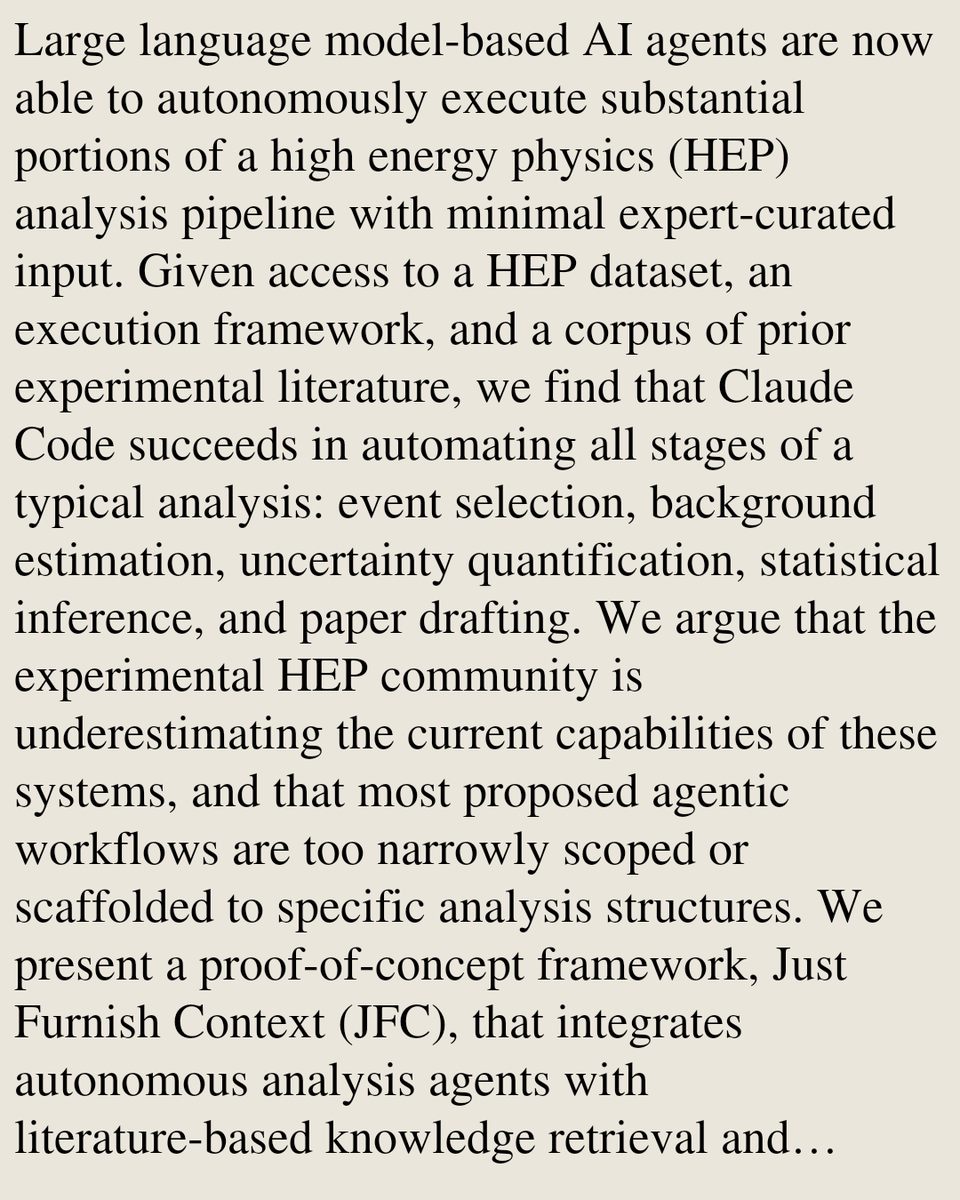
AI Agents Can Already Autonomously Perform Experimental High Energy Physics
Eric A. Moreno, Samuel Bright-Thonney, Andrzej Novak, Dolores Garcia, Philip Harris
arxiv.org/abs/2603.20179 [𝚑𝚎𝚙-𝚎𝚡 𝚌𝚜.𝙰𝙸 𝚌𝚜.𝙻𝙶]
English
Eric A. Moreno retweetledi

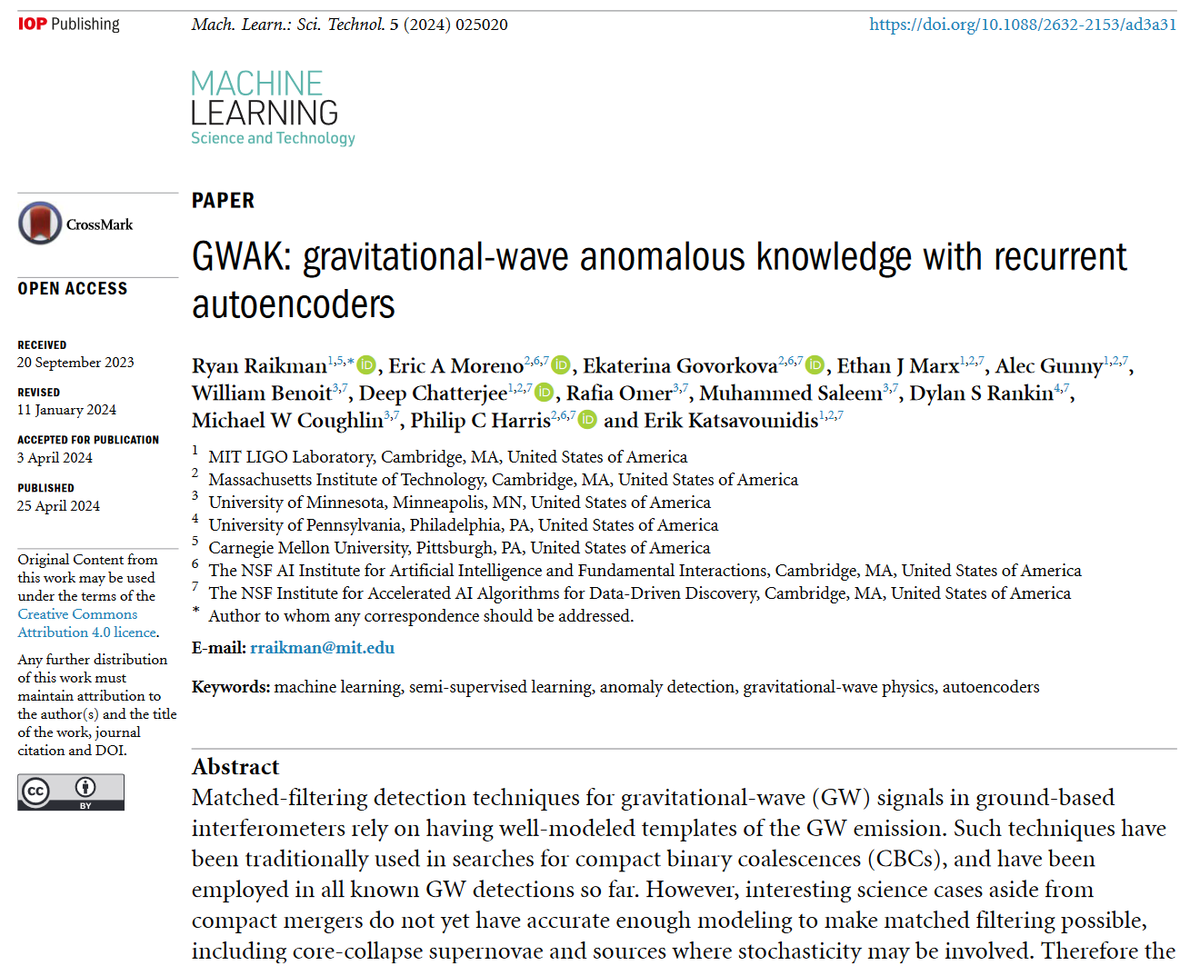
Great new work by @eric_a_moreno @AlecGunny Dylan Rankin et al @MITKavli @MIT_Physics @UMN_SPA @physatpenn @iaifi_news @LIGO - 'GWAK: #gravitationalwave anomalous knowledge with recurrent #autoencoders' - iopscience.iop.org/article/10.108… #machinelearning #AI #astrophysics #cosmology
English
Held an event with Lupe Fiasco last night 🔥🔥 at the FastML conference with @a3d3institute
“SAMURAI DX” & “SAMURAI” OUT NOW!@LupeFiasco
We live @ Imperial College London Tune in to the stream youtube.com/watch?v=Ms6WPX…
English
Follow up paper going through internal LIGO review right now 👍👍 we generalize to many AEs to create an embedded space for #anomalydetection
Machine Learning: Science and Technology@MLSTjournal
'Source-agnostic #gravitationalwave detection with recurrent #autoencoders' by @MariaSpiropulu @xmpierinix @vlimant @b_borzyszkowski @eric_a_moreno @CERN @MIT @Caltech hits 1000 downloads! bit.ly/3x1bE4K #machinelearning #astrophysics #cosmology #HEP #openscience #AI
English
Brings me back to a conversation I had with @vlimant and @EricMetodiev at @NeurIPSConf 2019 - We need an AI scientist. One that is curious about the world, able to form conjectures, and test them.
English
- Highly parallelizable & extremely fast
- Energy efficient
- Temporally based
- Analog compute engines
That is my take - does anybody have any others? @demishassabis seemed interested but pointed out that these solutions are still very far away. Maybe so! I hope not!
English
Attended a talk by @demishassabis from @DeepMind today where he discussed AI as a tool for scientific discovery (#AlphaFold etc.). After, posed two questions to him:
1) Humans are innately curious, creative, and explorative beings. If you give a baby a stack of blocks, they will
English
(3/3) Hoping to complete a full anomaly detection analysis run by the end of this year and in time for LIGO O4 Observing run.
English
(2/3) We are currently exploring more complex versions of this architecture (with larger dimension anomaly/loss spaces) to possibly detect exotic GWs that aren't currently identified by LIGO/Virgo! #Semisupervised looks like the way to go!
English
(1/3) Super excited! Our new paper in @MLSTjournal on detecting #gravitationalwaves without ever telling the ML model what a GW looks like. This builds on work by @ElenaCuoco et. al by introducing recurrent autoencoders.
Machine Learning: Science and Technology@MLSTjournal
Great new work by @MariaSpiropulu @xmpierinix @vlimant @b_borzyszkowski @eric_a_moreno @CERN @MIT @Caltech - 'Source-agnostic #gravitationalwave detection with recurrent #autoencoders' - bit.ly/3x1bE4K #machinelearning #astrophysics #cosmology #HEP #opendata #blackholes
English