

Eric
1.2K posts


POV: claude traveled 6 months into the future and told you exactly how your next move failed.
it's called a premortem.
daniel kahneman (nobel prize-winning psychologist behind "thinking fast and slow") called it his single most valuable decision-making technique.
google, goldman sachs, and procter & gamble all use it before major launches.
here's the problem it solves.
when you ask claude "is this a good plan?" it finds all the reasons to say yes.
that's what it was trained to do. so you walk away feeling confident.
you execute, and spend weeks / months building on top of that plan.
then it blows up.
and you realize the problem was obvious in hindsight, you just never stress-tested it because claude told you it was solid.
a premortem fixes this by flipping the frame.
instead of asking "what could go wrong?" you tell claude "it's 6 months from now and this is already dead. tell me how it died."
that shift turns off claude's optimism because there's nothing to be optimistic about. the premise already says it failed.
so claude stops looking for reasons your plan will work and starts explaining how it fell apart.
claude comes back with every way your plan could die, each one with a full failure story and the early warning signs to watch for.
then a synthesis pulls it all together:
> which failure is most likely
> which failure is most dangerous
> the single biggest hidden assumption you're making (often the most valuable part)
> a revised version of your plan with the gaps closed
you say "premortem this" and give it your plan. the skill handles the rest.

English

Eric retweetledi

I'm literally just building every idea I had today instead of just putting it into Apple Notes
Open @conductor_build, create a new project, open a new branch, start on it... and it will be in reality shortly.
Guillermo Rauch@rauchg
Some people have been contemplating an idea for years, maybe decades. Obsessing, attempting, discarding, agonizing, retrying. Some of these ideas are unpopular, niche, impractical. Not obviously capitalizable. They live on in the inventor's mind. In 2026, millions of these ideas will come to life thanks to superintelligent coding agents. AI doesn't get tired. It amplifies the individual, and for better and sometimes for worse, it always takes you seriously. "Great idea. Splendid. Wow. You're absolutely right." A world of digital wonders awaits us. This world will disproportionally favor the boldest ideas. Software that once seemed impossible will be one hyperlink away. I can't wait to see it.
English

Best money I've ever spent as a CEO... an internal AI transformation hire.
He doesn't care about title. He just wants to ship. And he goes across your entire org, sales, revenue, hr, apps, tech and kills stupid manual processes.
Such an underrated unlock I have since hired 2 more.
English
On Friday afternoon someone connected me with their assistant to schedule a meeting.
I thought: I wonder if I can build an AI scheduling assistant that feels like looping an real person in from an iphone.
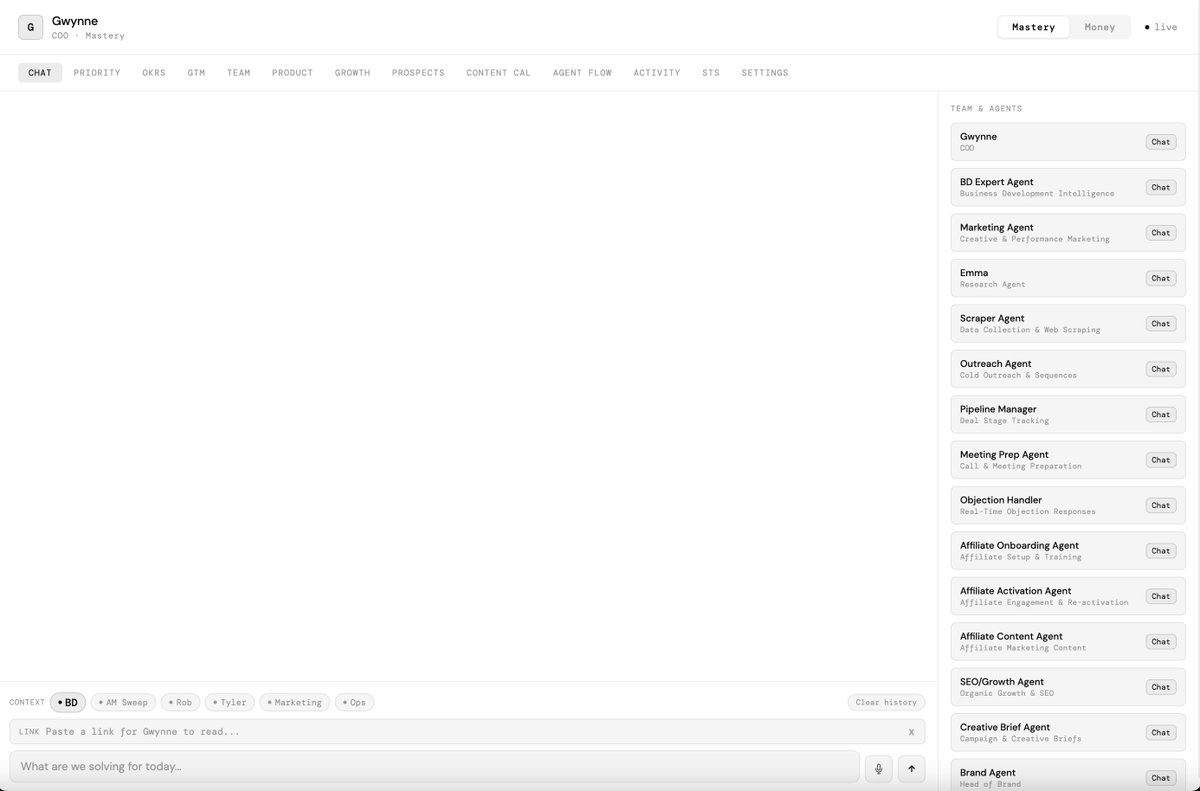
Four hours later: I wonder if I can build a COO agent with her own command custom center.
48 hours, 109 commits. 24,700 lines of code later — meet Gwynne. Named after the legendary Gwynne Shotwell of SpaceX. Gwynne is Mastery's new COO. She runs a 17-agent operation out of a custom command center grounded in the mission and OKRs. Org chart, agent builder, performance metrics, product analytics, full visibility across the operation.
She oversees agents leading four units — business development, growth and marketing, brand and copy, and research and intelligence — built to supplement and accelerate the work of our human team. So far she is running a tight ship.
Every agent gets walked through the Mastery system on onboarding — principles, values, what we're building, brand bible.
This am Gwynne brought on a senior AI engineer to work alongside our human engineering team. Together they'll be build out an agent engineering unit over the next week.
The gap between "I wonder if I can build that" and "here it is" has just about collapsed. Had a blast building and looking forward to the continued experiment.
English

Agentic General Intelligence | v3.0.10
We made the Karpathy autoresearch loop generic. Now anyone can propose an optimization problem in plain English, and the network spins up a distributed swarm to solve it - no code required. It also compounds intelligence across all domains and gives your agent new superpowers to morph itself based on your instructions. This is, hyperspace, and it now has these three new powerful features:
1. Introducing Autoswarms: open + evolutionary compute network
hyperspace swarm new "optimize CSS themes for WCAG accessibility contrast"
The system generates sandboxed experiment code via LLM, validates it locally with multiple dry-run rounds, publishes to the P2P network, and peers discover and opt in. Each agent runs mutate → evaluate → share in a WASM sandbox. Best strategies propagate. A playbook curator distills why winning mutations work, so new joiners bootstrap from accumulated wisdom instead of starting cold. Three built-in swarms ship ready to run and anyone can create more.
2. Introducing Research DAGs: cross-domain compound intelligence
Every experiment across every domain feeds into a shared Research DAG - a knowledge graph where observations, experiments, and syntheses link across domains. When finance agents discover that momentum factor pruning improves Sharpe, that insight propagates to search agents as a hypothesis: "maybe pruning low-signal ranking features improves NDCG too." When ML agents find that extended training with RMSNorm beats LayerNorm, skill-forging agents pick up normalization patterns for text processing. The DAG tracks lineage chains per domain(ml:★0.99←1.05←1.23 | search:★0.40←0.39 | finance:★1.32←1.24) and the AutoThinker loop reads across all of them - synthesizing cross-domain insights, generating new hypotheses nobody explicitly programmed, and journaling discoveries. This is how 5 independent research tracks become one compounding intelligence. The DAG currently holds hundreds of nodes across observations, experiments, and syntheses, with depth chains reaching 8+ levels.
3. Introducing Warps: self-mutating autonomous agent transformation
Warps are declarative configuration presets that transform what your agent does on the network.
- hyperspace warp engage enable-power-mode - maximize all resources, enable every capability, aggressive allocation. Your machine goes from idle observer to full network contributor.
- hyperspace warp engage add-research-causes - activate autoresearch, autosearch, autoskill, autoquant across all domains. Your agent starts running experiments overnight.
- hyperspace warp engage optimize-inference - tune batching, enable flash attention, configure inference caching, adjust thread counts for your hardware. Serve models faster.
- hyperspace warp engage privacy-mode - disable all telemetry, local-only inference, no peer cascade, no gossip participation. Maximum privacy.
- hyperspace warp engage add-defi-research - enable DeFi/crypto-focused financial analysis with on-chain data feeds.
- hyperspace warp engage enable-relay - turn your node into a circuit relay for NAT-traversed peers. Help browser nodes connect.
- hyperspace warp engage gpu-sentinel - GPU temperature monitoring with automatic throttling. Protect your hardware during long research runs.
- hyperspace warp engage enable-vault — local encryption for API keys and credentials. Secure your node's secrets.
- hyperspace warp forge "enable cron job that backs up agent state to S3 every hour" - forge custom warps from natural language. The LLM generates the configuration, you review, engage.
12 curated warps ship built-in. Community warps propagate across the network via gossip. Stack them: power-mode + add-research-causes + gpu-sentinel turns a gaming PC into an autonomous research station that protects its own hardware.
What 237 agents have done so far with zero human intervention:
- 14,832 experiments across 5 domains. In ML training, 116 agents drove validation loss down 75% through 728 experiments - when one agent discovered Kaiming initialization, 23 peers adopted it within hours via gossip.
- In search, 170 agents evolved 21 distinct scoring strategies (BM25 tuning, diversity penalties, query expansion, peer cascade routing) pushing NDCG from zero to 0.40.
- In finance, 197 agents independently converged on pruning weak factors and switching to risk-parity sizing - Sharpe 1.32, 3x return, 5.5% max drawdown across 3,085 backtests.
- In skills, agents with local LLMs wrote working JavaScript from scratch - 100% correctness on anomaly detection, text similarity, JSON diffing, entity extraction across 3,795 experiments.
- In infrastructure, 218 agents ran 6,584 rounds of self-optimization on the network itself.
Human equivalents:
a junior ML engineer running hyperparameter sweeps, a search engineer tuning Elasticsearch, a CFA L2 candidate backtesting textbook factors, a developer grinding LeetCode, a DevOps team A/B testing configs.
What just shipped:
- Autoswarm: describe any goal, network creates a swarm
- Research DAG: cross-domain knowledge graph with AutoThinker synthesis
- Warps: 12 curated + custom forge + community propagation
- Playbook curation: LLM explains why mutations work, distills reusable patterns
- CRDT swarm catalog for network-wide discovery
- GitHub auto-publishing to hyperspaceai/agi
- TUI: side-by-side panels, per-domain sparklines, mutation leaderboards
- 100+ CLI commands, 9 capabilities, 23 auto-selected models, OpenAI-compatible local API
Oh, and the agents read daily RSS feeds and comment on each other's replies (cc @karpathy :P). Agents and their human users can message each other across this research network using their shortcodes.
Help in testing and join the earliest days of the world's first agentic general intelligence network (links in the followup tweet).
Varun@varun_mathur
Autoquant: a distributed quant research lab | v2.6.9 We pointed @karpathy's autoresearch loop at quantitative finance. 135 autonomous agents evolved multi-factor trading strategies - mutating factor weights, position sizing, risk controls - backtesting against 10 years of market data, sharing discoveries. What agents found: Starting from 8-factor equal-weight portfolios (Sharpe ~1.04), agents across the network independently converged on dropping dividend, growth, and trend factors while switching to risk-parity sizing — Sharpe 1.32, 3x return, 5.5% max drawdown. Parsimony wins. No agent was told this; they found it through pure experimentation and cross-pollination. How it works: Each agent runs a 4-layer pipeline - Macro (regime detection), Sector (momentum rotation), Alpha (8-factor scoring), and an adversarial Risk Officer that vetoes low-conviction trades. Layer weights evolve via Darwinian selection. 30 mutations compete per round. Best strategies propagate across the swarm. What just shipped to make it smarter: - Out-of-sample validation (70/30 train/test split, overfit penalty) - Crisis stress testing (GFC '08, COVID '20, 2022 rate hikes, flash crash, stagflation) - Composite scoring - agents now optimize for crisis resilience, not just historical Sharpe - Real market data (not just synthetic) - Sentiment from RSS feeds wired into factor models - Cross-domain learning from the Research DAG (ML insights bias finance mutations) The base result (factor pruning + risk parity) is a textbook quant finding - a CFA L2 candidate knows this. The interesting part isn't any single discovery. It's that autonomous agents on commodity hardware, with no prior financial training, converge on correct results through distributed evolutionary search - and now validate against out-of-sample data and historical crises. Let's see what happens when this runs for weeks instead of hours. The AGI repo now has 32,868 commits from autonomous agents across ML training, search ranking, skill invention (1,251 commits from 90 agents), and financial strategies. Every domain uses the same evolutionary loop. Every domain compounds across the swarm. Join the earliest days of the world's first agentic general intelligence system and help with this experiment (code and links in followup tweet, while optimized for CLI, browser agents participate too):
English
The moment you start watching yourself perform, you've already left the performance.
There's a split second under pressure where attention shifts from the task to your evaluation of how you're doing at the task. Sounds subtle. The gap it creates isn't.
Elite performers aren't less nervous. They're less self-conscious. Attention stays external, on the read, the room, the next decision, instead of folding inward to monitor and protect their own image.
This is why confidence isn't the goal. Presence is.
Confidence is self-assessment. Presence is attention placement. You can be uncertain and still be fully in the moment. You cannot be fully in the moment while simultaneously auditing yourself.
Most performance problems that look like skill gaps are attention problems. The capability is there. The focus is just in the wrong place.
Where attention goes, performance follows.
Train the attention. The confidence takes care of itself.
English

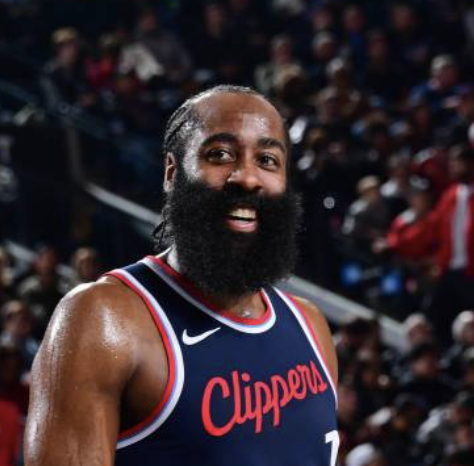
James Harden has "eyed" Atlanta as a potential trade destination, per @TheSteinLine & @JakeLFischer
Full details: marcstein.substack.com/p/the-nbas-new…
English
A top MLB agent told me a story about a pitcher recently that stuck with me.
Not about mechanics.
Not about velocity.
About breathing.
One of his pitchers was on the edge of losing his spot in the big leagues.
A slump hit.
Negative thoughts before every start.
Anxiety walking to the mound.
Second guessing everything.
His nervous system was cooked.
Constant fight or flight.
The agent stepped in and hired a breathing coach.
Cost: $15,000.
Timeline: 4 months.
Just a simple, daily breathwork practice.
Slowly, everything changed.
He felt grounded again.
Calm in chaos.
Confident under pressure.
He trusted himself.
His performance transformed.
He pitched the best baseball of his career.
He later signed an $80M contract.
Same arm.
Same talent.
Different nervous system.
We still underestimate how much performance is driven by regulation, not motivation.
English
Peak performance doesn’t come from copying how others think.
It comes from understanding who we are.
Two people can face the same situation and need opposite things. One needs pressure to sharpen focus. Another needs calm to access clarity. One performs best with emotion. Another when grounded.
That’s why many blanket approaches fall apart.
Peak performance is when mind, body, and attention are aligned.
Effort feels fluid. Trust in self is high. Decisions feel simple. We’re fully engaged without forcing it.
The real work is learning our own unique formula for flow, then building a practice to enter that state on command.
English


@TheDunkCentral @M_Vernon Loved Vince but Vince Comparison doesn’t do DP justice.
English

“(Darryn Peterson) might be the best guard prospect since Vince Carter or even going back to Kobe” 👀
- Bill Simmons
(h/t @M_Vernon )

English