Ethan Wold

59 posts

Ethan Wold banner
Ethan Wold

Ethan Wold

@ethanswold

PhD student studying how 🐝 and 🦋 fly | physiology, biomechanics, evolution | GT, Quantitative Biosciences | he/him 🇧🇷

Atlanta, GA Katılım Mayıs 2020
216 Takip Edilen155 Takipçiler
Ethan Wold
Ethan Wold@ethanswold·
Brief return to the app formerly known as twitter to say that I'm defending my PhD in two weeks. If you're interested in tuning in, DM me for the link!
Ethan Wold tweet media
English
1
2
7
236
Ethan Wold
Ethan Wold@ethanswold·
suggesting that there might be a 'goldilocks' range of N that balances constraints related to energy use and maneuverability. Check out the perspectives piece here: academic.oup.com/icb/advance-ar… (3/4)
English
1
1
2
112
Ethan Wold
Ethan Wold@ethanswold·
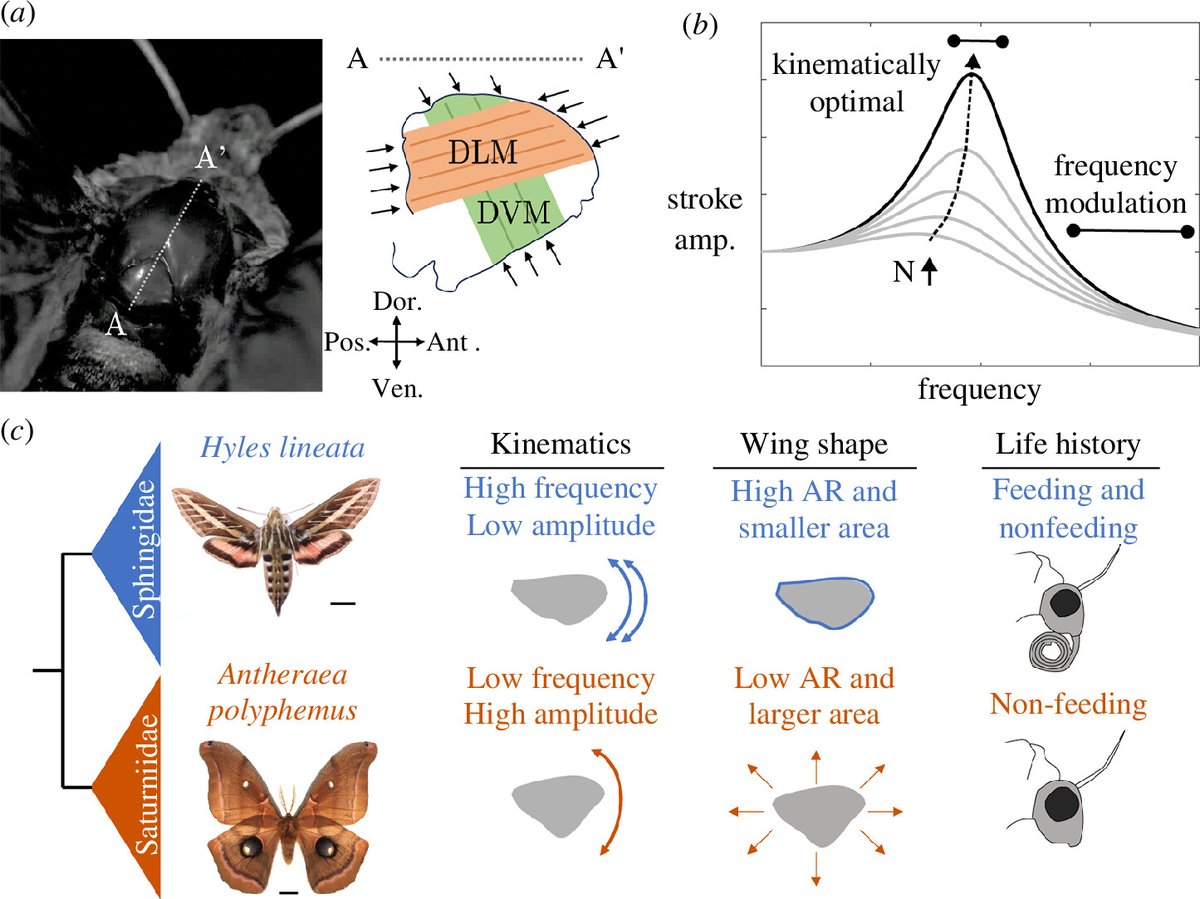
Little late on this one, but we had another paper out recently. In this perspective piece, we highlight a non-dimensional number specific to flapping flight that describes performance tradeoffs that come about from resonance in insects. We call it the Weis-Fogh number (N) (1/n)
English
1
1
6
423
Ethan Wold
Ethan Wold@ethanswold·
other interesting results related to wing shape evolution, elastic energy storage in flapping systems, and what it means for a resonator to be 'efficient'. Check out the paper (open access) here: royalsocietypublishing.org/doi/10.1098/rs… (10/n).
English
1
0
2
85
Ethan Wold
Ethan Wold@ethanswold·
Our results suggest that evolving different resonant properties is indeed important for evolving different wingbeat frequencies. But, resonant mechanics can also be tuned to reflect behavioral and life history traits! This is just the punchline of a paper with a lot (9/n)
English
1
0
1
70
Ethan Wold
Ethan Wold@ethanswold·
Silkmoths, on the other hand, lack functional mouthparts as adults! They fly only to mate and escape predators, and are extremely nutrient-limited. These moths have very efficient resonant mechanics and flap close to resonance, reflecting their starved adult life stage (8/n).
English
1
0
0
69
Ethan Wold
Ethan Wold@ethanswold·
Hawkmoths (like Manduca), flap farther from resonance, enabling greater frequency control. This reflects their specific behavioral requirements, since their hover-feeding behavior supplies them with sugar-rich nectar, but requires agile aerial maneuvering (7/n)
English
1
0
0
64
Ethan Wold
Ethan Wold@ethanswold·
Excited to share the second chapter of my PhD, out now in ProcB @RSocPublishing Insect flight is a particular locomotory challenge because it requires powerful muscle-driven wing movements at high frequencies. The fastest insects beat their wings at nearly 1000 Hz! (1/n)
English
1
4
19
1.1K
Ethan Wold
Ethan Wold@ethanswold·
high-speed video of muscle strains, and a 'spring-wing' model of resonant aerodynamics. We found that while faster moths generally had higher resonant frequencies, most moths do indeed flap faster than their resonant peak! But there is some added nuance (6/n)
English
1
0
0
59
Ethan Wold
Ethan Wold@ethanswold·
We tested whether insects flap at resonance in Bombycoidea, a group of moths that includes hawkmoths and silkmoths: the cousins of Manduca. In 10 species that span over 60 Hz in wingbeat frequency, we measured resonance frequencies through mechanical testing of the thorax (5/n)
English
1
0
0
62
Ethan Wold
Ethan Wold@ethanswold·
which may help it change wingbeat frequency up to 30% during agile hover-feeding, where it tracks wind-blown flowers midair. But this is just one species. Do other insects also sacrifice efficiency for control? And how does this impact evolution of wingbeat frequency? (4/n)
English
1
0
0
66
Ethan Wold
Ethan Wold@ethanswold·
You have experienced this tradeoff on a swing set or trampoline - changing frequency is hard at resonance! But potentially very useful for flight control. A couple years ago, we published a paper showing that the hawkmoth Manduca sexta flaps significantly above resonance (3/n)
English
1
0
1
70
Ethan Wold
Ethan Wold@ethanswold·
For decades, it has been thought that insects flap at their resonant frequency to achieve efficient flight, since they have a spring in their thoracic exoskeleton. But flapping at resonance has a tradeoff - namely the ability to rapidly change their wingbeat frequency (2/n)
English
1
0
0
64
Ethan Wold
Ethan Wold@ethanswold·
Was a member of the first cohort and can vouch for its greatness. Awesome introduction to field research and run by some outstanding scientists and mentors. Go ahead and apply!
Jacob S. Harrison@_JacobSHarrison

The @BhamlaLab is running another year of the Jungle Biomechanics Lab! Applications open until March 15th. It’s free for early career researchers! Please apply!


English
0
1
7
1K
Ethan Wold retweetledi
Jacob S. Harrison
Jacob S. Harrison@_JacobSHarrison·
The @BhamlaLab is running another year of the Jungle Biomechanics Lab! Applications open until March 15th. It’s free for early career researchers! Please apply!

Jacob S. Harrison tweet media
English
2
23
42
10.5K
Ethan Wold retweetledi
Sam Cai
Sam Cai@SamuelCai·
Sharing my new working paper on age and suicide impulsivity: Understanding age-specific suicide patterns can help tailor effective mental health interventions, and I'm proud this work can shed some light on this important issue.
NBER@nberpubs

Purchase-delay laws reduce firearm suicide for the overall adult population, but the effect is largely driven by a 6.1 percent reduction for young adults ages 21–34, from John J. Donohue, Samuel V. Cai, and Arjun Ravi nber.org/papers/w31917

English
0
2
17
1.5K