
Eugene Ng

25.7K posts

Eugene Ng banner
Eugene Ng

Eugene Ng

@EugeneNg

Founder @ Vision Capital Fund. Investor, author, angel. Invest in companies that reflect our best vision for our future. Musings on investing, business & life.

Singapore 🇸🇬 | Global 🌏 Katılım Ekim 2017
1.7K Takip Edilen26.8K Takipçiler
Sabitlenmiş Tweet
Eugene Ng
Eugene Ng@EugeneNg·
I am thrilled to announce the launch of Vision Capital Fund, which has been in the making for over seven years. We are focused on growing wealth for generations by delivering outstanding long-term investment returns from investing in exceptional companies that best reflect our vision for our future. Website: visioncapitalfund.co Press Release: tinyurl.com/VCFpressrelease Day One Investor Letter: tinyurl.com/VCFDayOne
Eugene Ng tweet mediaEugene Ng tweet mediaEugene Ng tweet mediaEugene Ng tweet media
English
37
20
211
59.7K
Eugene Ng
Eugene Ng@EugeneNg·
Probably just lucky. It was a very tough and contrarian stance to take, given how rosy and optimistic the market was about it. My prior investing experience with app-based companies like Match Group and Sea Limited, with Free Fire, taught me a lot. Network effects can cut both ways, on the way up, and especially on the way down.
English
0
0
1
83
Eugene Ng
Eugene Ng@EugeneNg·
@curiouslinks I prefer to use free cash flow (FCF) as default and will use net income for financials.
English
0
0
0
7
Bogdan (Dan) Baciu
Bogdan (Dan) Baciu@curiouslinks·
@EugeneNg So you default to FCFE versus FCFF? So not cap structure independent? Makes sense. Thx for the quick reply.
English
1
0
0
6
Eugene Ng
Eugene Ng@EugeneNg·
Sharing my favourite charts from Michael Mauboussin’s latest article: “Competitive Advantage Period The Neglected Value Driver” 1 | Identifying where a company is within their life cycle is key. I prefer to invest in companies that are in the earlier to mid part of the life-cycle S-curve and tend to exit when revenue growth rapidly structurally decelerates to single digits.
Eugene Ng tweet media
English
2
3
15
1.6K
Eugene Ng
Eugene Ng@EugeneNg·
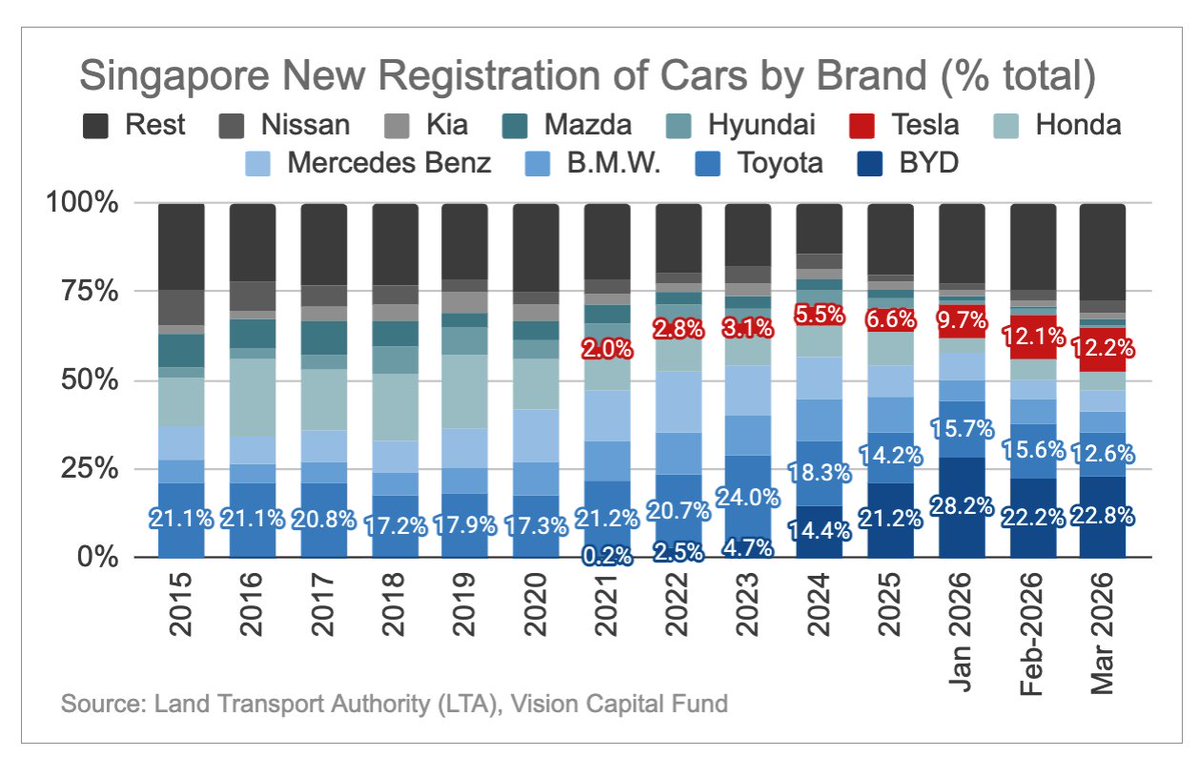
Tesla's share of new car registrations in Singapore has grown from 2.0% in 2021 to 12.2% in Mar 2026, and is now the 3rd largest after BYD (22.8%) and Toyota (12.6%).
Eugene Ng tweet media
English
0
1
13
1K
Eugene Ng
Eugene Ng@EugeneNg·
@curiouslinks I calculate FCF manually. It’s not difficult to calculate, it’s just OCF less capex.
English
1
0
1
13
Bogdan (Dan) Baciu
Bogdan (Dan) Baciu@curiouslinks·
@EugeneNg Super interesting. Totally agree. FCF is relatively painful to compute for private and public companies. Do you use a proxy or do you just dig in and do the work to calc it regardless of the difficulty?
English
0
0
0
6
Eugene Ng
Eugene Ng@EugeneNg·
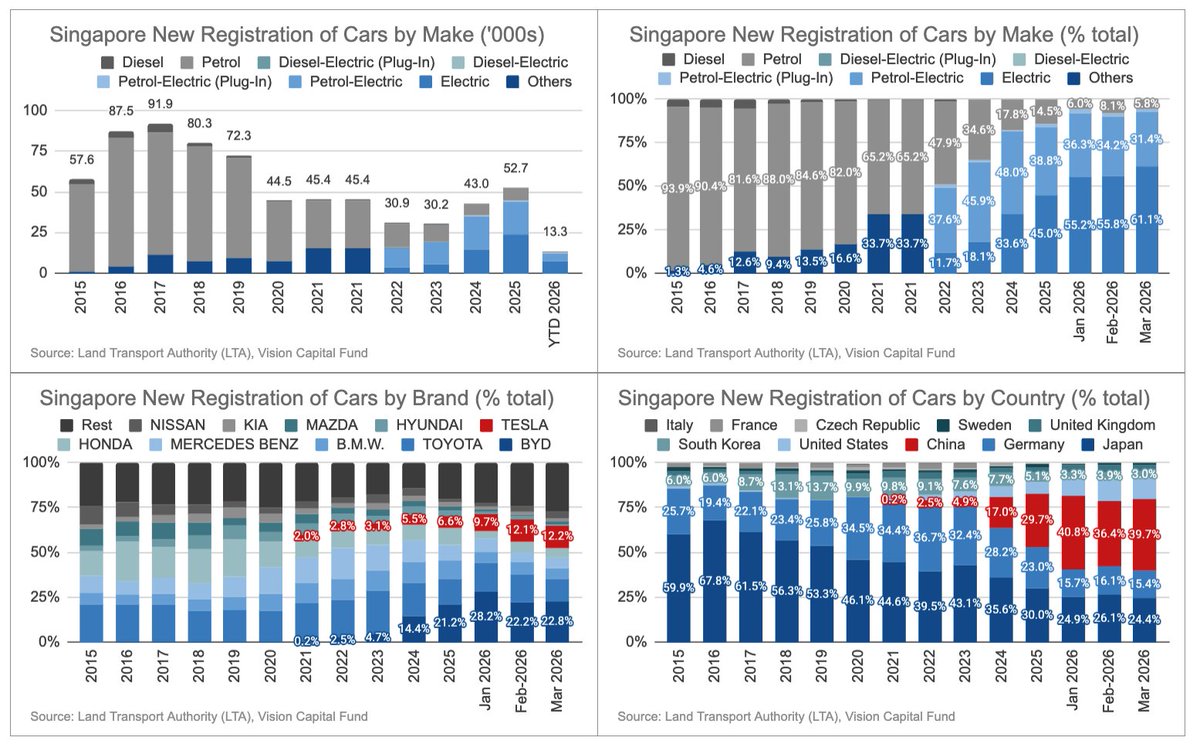
Statistics of Singapore New Car Registrations (2015 - March 2026): - EVs' share of new sales has been rising since 2021 and, with rapid adoption, hit its highest at 61.1% for March 2026. The S-curve growth adoption of EVs continues to displace petrol/ICE. - The majority of EV new sales (~83% EV) for March 2026 were attributable to the Chinese EV brands (~63% EV) and the US, with Tesla (~20% EV). - BYD is the largest car brand in Singapore with 22.8% market share in March 2026. - Tesla is now the 3rd largest car brand in Singapore with 12.2% market share, after Toyota's 12.6%. - Notably, the Japanese, German, and South Korean car brands have continued to lose share to the Chinese. Registration = Sales EV = Battery Electric Vehicles (BEV) ICE = Internal Combustion Engine
Eugene Ng tweet media
English
1
3
12
1.3K
Eugene Ng
Eugene Ng@EugeneNg·
My favorite slide from ServiceNow’s 2026 Financial Analyst Day. The build-it-yourself trap remains for enterprise software. AI is certainly making it easier to put together a basic working demo for simpler software for smaller firms. However, for more advanced software in larger enterprises, there is much more to consider and implement, making the eventual total cost of ownership much higher.
Eugene Ng tweet media
English
2
4
22
2.7K
Eugene Ng
Eugene Ng@EugeneNg·
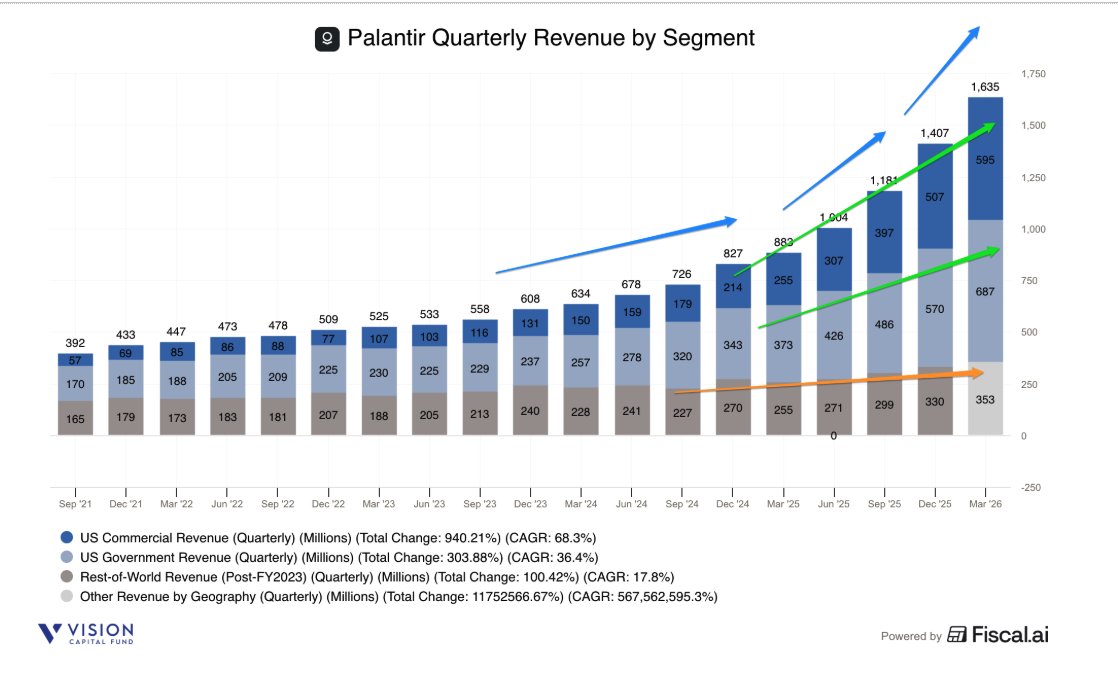
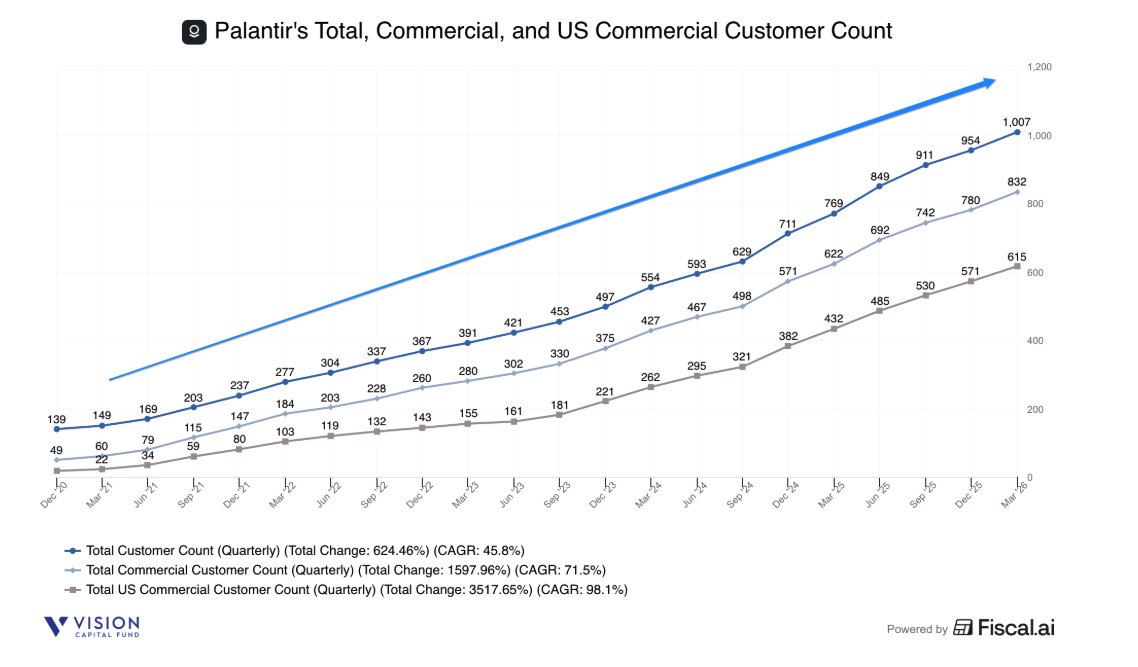
Palantir $PLTR 1Q26 Earnings - Rev $1.6b +85% ⤴️🟢 - GP $1.4b +99% ⤴️🟢 margin 86.8% +635 bps ✅ - Adj EBITDA $990m +149% ⤴️🟢 margin 60.7% +1570 bps ✅ - NG EBIT $984m +152% ⤴️🟢 margin 60.2% +1604 bps ✅ - EBIT $754m +328% ⤴️🟢 margin 46.2% +2627 bps ✅ - NG Net Inc $856m +156% ⤴️🟢 margin 52.5% +1462 bps ✅ - Net Inc $876m +303% ⤴️🟢 margin 53.7% +2905 bps ✅ - OCF $899m +190% ⤴️🟢 margin 55.1% +1997 bps ✅ - FCF $892m +193% ⤴️🟢 margin 54.6% +2022 bps ✅ Revenue by Segment - US Rev $1.3b +104% ⤴️🟢🚀 - Int Rev $350m +37% ↗️🟢 - Comm Rev $774m +95% ⤴️🟢🚀 - Govt Rev $858m +76% ⤴️🟢 - US Comm Rev $595m +133% ⤴️🟢🚀 - US Govt Rev $687m +84% ⤴️🟢 - Int Comm Rev $179m +26% ↗️🟢 - Int Govt Rev $171m +50% ↗️🟢 Customer Count by Segment - US Comm Cust 615 +42% ↗️🟢 - Int Comm Cust 217 +14% ↗️🟡 - Comm Cust 832 +34% ↗️🟢 - Govt Cust 175 +19% ↗️🟢 - Cust Count 1,007 +31% ↗️🟢 Biz Metrics - Deals closed 206 >$1m, 75 >$5m, 47 >$10m - Rule of 145 (up from 127%, 85% Rev Growth + 60% Adj EBIT Margin) - US Comm Remaining Deal Value $4.92b +112% ↗️🟢 - US Comm Total Contract Value $1.2b +45%↗️🟢 - Total Contract Value $2.41b +61%↗️🟢 - Avg TTM Top 20 Rev per Cust $108m +55% ↗️🟢 - Avg Rev per Cust $1621m +41% ↗️🟢 - Avg Comm Rev per Cust $1m +46% ↗️🟢 - Avg US Comm Rev per Cust $3m +96% ⤴️🟢 - RPO $4.5b +134% ⤴️🟢 - ST RPO $1.8b +94% ⤴️🟢 - LT RPO $2.7b +170% ⤴️🟢 - Billings $1.8b +94% ⤴️🟢 - Net Retention 150% ↗️🟢 (from up 139%) - Strategics Rev $3m (0.2% revenue) Mgmt Guide - 2Q26 Rev $1.8b +80% ⤴️🟢 - 2Q26 EBIT $1.1b +130% ⤴️🟢 margin 59.2% +1298 bps ✅ - FY26 Rev $7.7b +71% ⤴️🟢 (raised from $7.2b) - FY26 NG EBIT $4.5b +98% ⤴️🟢 margin 58.1% +774 bps ✅ (raised from $4.1b) - FY26 Adj FCF $4.4b +94% ⤴️🟢 margin 57.4% +670 bps ✅ (raised from $4.1b) - FY26 US Comm Rev $3.2b +120% ⤴️🟢 (raised from $3.144b) 1 | Strong Q1 driven by US Commercial and US Government, raising FY26 guide. Our U.S. business achieved triple-digit growth for the first time, driven by accelerating demand for our AI platform. Revenue in our U.S. business grew 104% YoY and 19% QoQ in the first quarter. Our U.S. commercial business grew 133% YoY and 18% QoQ, and our U.S. government business grew 84% YoY and 21% QoQ. On the back of this continued strength in the U.S., we are raising our full year 2026 revenue guidance midpoint to $7.656 billion, representing 71% growth YoY a 10-point increase over our full year 2026 revenue guidance from last quarter and our largest ever full year revenue guidance raise. Turning to our global top line results. First quarter revenue grew 85% YoY and 16% QoQ to $1.633 billion. First quarter U.S. revenue grew 104% YoY and 19% QoQ to $1.282 billion. 2 | One US commercial customer turned US government customer, excluding it, US commercial revenue would have grew +143% instead of 133%. First quarter U.S. commercial revenue grew 133% YoY and 18% QoQ to $595 million. This exceptional growth even understates our US commercial momentum. As Ryan noted, we had a successful U.S. commercial customer program turns us into a U.S. government customer. Absent this transition, U.S. commercial growth would have been 143% YoY and 22% QoQ. 3 | Driven by AIP, pushing it to a Rule of 145, up from 127, AIP is the AI platform. Our Rule of 40 score climbed at 145, up from 127 last quarter on absolute AIP dominance. AIP is the only platform that establishes a true AI no-stop zone, a necessary requisite to converting potential AI leverage into compounding real-world value without risking enterprise disaster. When you want AI to work in production in a real enterprise at real scale, where there is no room for slop, there is only one platform, AIP. It is not just the playbook of cutting costs and streamlining processes. AIP is the battle-tested platform that allows the wholesale redefinition of how companies compete within their industries. 4 | Commercial customers like AIG and GE Aerospace are deploying Palantir powerfully with precision. As the AIG CEO noted in their recent earnings call, they are deploying AIP to implement a multi-agentic underwriting and claims solution comprised of purpose-built agents ingesting submissions, evaluating risk, benchmarking pricing and detecting fraud, all coordinated through the Ontology. on the back of a 26% increase in engine production with AIP, GE Aerospace deepened their partnership with Palantir last quarter to deploy agentic AI-powered solutions across their production system and military aviation supply chain with a shared mission of ensuring that more aircraft remain available to train America's next generation of U.S. Air Force pilots. I'll just say what we're seeing across our customers, and this is what's driving the U.S. generally is those that understand the load-bearing context in order to apply AI in that context, you need to be able to deploy it with precision without slop. 5 | Palantir won a $300m deal from the USDA. On the Civil side, the USDA awarded Palantir a contract of up to $300 million last month to provide USDA with capabilities to support American farmers, secure farmland, enhance supply chain resilience and shield agricultural programs from fraud, abuse and foreign adversary influence. In government and commercial, Palantir is transforming how load-bearing institutions operate and how they win 6 | Palantir will always position and prioritise the US and its national security first. So the reality of how Palantir works is we always -- we position and prioritize the U.S. war fighters over everything else…And so in the current context, we take opportunities that look the same from a business perspective. And we 100% prioritize this nation security over any other variable…is, I tell commercial clients is all the time. We are highly monogamous in our in the way we work. We are not trying to make you into a commodity. The only thing we will put above you is U.S. national security. 7 | Seeing Jevons Paradox with tokens, as token costs continue to fall, use case demand for tokens is exploding, tokens are the new coal, AIP is the train. while LLM are improving, models are converging and the cost per token continues to drop precipitously. GPT4 equivalent performance that cost $20 per million tokens in early 2023 is now approximately 1,000x cheaper 3 years later. Because of this increased efficiency, use case demand for tokens is exploding. Our AIP workflows today utilize vastly more tokens, agents orchestrating across the ontology, chaining reasoning, pool use, retrievable and execution, and it's growing. This is Jevons paradox. It's the single most important dynamic in enterprise software right now. When the Victorians built more efficient steam engines, everyone assumed coal consumption would fall. Instead, it's skyrocketed. Cheaper transport meant more demand for transport. Tokens are the new coal. AIP is the train. 8 | Yet cheaper tokens also means more AI slop, ontology is what anchors solid orchestration and execution, replacing static workflows and replacing legacy software. As inference gets cheaper, the number of tasks that you can economically assign to AI grows exponentially. Precisely because tokens are so much cheaper [indiscernible] self-correct. But in practice, the number of tasks that you can trust a model without the right harness exponentially declines. More tokens means more slop. In the more commodity cognition you consume, the more you need a system that can prevent the economic harm so you can harness the economic value. That system is AIP. That intermediary representation is the ontology. This is also why we are seeing the depth of legacy software. AIP replaces static workflows, not by replicating the playbook, but by eliminating the need for one. 9 | Customers are replacing legacy software with AI-first solutions built on Palantir. This quarter, we replaced our old expensive CRM with an AI-first solution built on AIP in a few months that users absolutely love. Our customers are seeing the real value is not automating what you already do. It's doing what was previously impossible. A major telco set out to automate 10 million customer calls a year. The real insight was that the most dissatisfied customers never call. They churn silently. The reframe was counterintuitive. Don't use AI to reduce coals use it to generate that, an AI advocate that proactively calls on every customer's behalf. The point is simple, use AI to do more work, work that was never economically feasible before AIP. 10 | AI is a headwind for legacy software but a tailwind for Palantir as it is counter positioned against AI slop, focused on enterprise autonomy, not dazzling demos, with valuable applications and agents. Well, it's a massive tailwind for us because we've always been counter positioned against this sort of legacy thin software that kind of was built by and execute a playbook that's built around rent extraction and no outcome delivery. We, on the other hand, have been focused entirely on building software that's focused on alpha and not beta. We're not trying to make you the same as every other person. So that part is probably obvious, that counter positioning. But the other counter positioning is against AI slop. We are focused on enterprise autonomy, not on dazzling demos, have in the oncology, the no slop zone. The ontology is the body to the AI brains. You can't actually interact with the enterprise or affect the world, your agents can go nowhere without oncology. And you're seeing that with our customers in government, we are the platform that you build applications and agents on. In the commercial world, people are replacing legacy software at a light and fast pace, as I mentioned in my remarks. And we see that even internally at Palantir we're gotten rid of legacy software like CRM, built it very quickly on top of our platform to a user experience that our users love. 11 | Net dollar retention rose to 150% from 139%, and because it does not include revenue from new or recently acquired customers, expect it to continue to rise. Net dollar retention was 150%, an increase of 1,100bps from last quarter. The increase was driven both by expansions at existing customers and new customers acquired in Q1 of last year as load-bearing institutions continue to turn to Palantir's battle-tested AI platform. As net dollar retention does not include revenue from new customers or acquired in the past 12 months, it has not yet fully captured the acceleration and velocity in our U.S. business over the past year. 12 | Palantir is delivering rapid sales growth with much lesser salespeople. They buy our product despite the fact we have 70 salespeople, a normal company of our size would have 7,000. Only 7 of our salespeople actually even really sell we're doing what a normal company would do with 7,000 sales with 7 people. When in fact, what actually does work is a platform built like by a motley crew of highly technical people, who over 20 years have been aligned for being right about the nature of having to build foundry, the nature of having to build Apollo, the nature of an FDA and [indiscernible]. The demand for this is once in a lifetime and that demand is actually driving these financials, meaning growing 100% goal for the year. 13 | Palantir is not winning deals by entertaining with inferior products by with high-value infrastructure solutions. Now I do think this is going to be -- we're going to end up with a different term for software. You can't lump what we're doing. We're really providing infrastructure and installation of AI infrastructure. Look, if your company is largely running around and offering steak dinners with something that someone can hack and rebuild in a week, yes, you're going to have a huge problem [indiscernible] that don't make sense. They're under huge pressure. 14 | Race for top talent is competitive, working at Palantir is high pressured but best for people who want to do things differently, Alex Karp is focused on hiring more neurodivergent people who want to do valuable work. Well, the talent question is the Palantir's famous for having the best talent over a very long period of time. Look, it's a super competitive environment. The -- I think most -- the whole world wants to either work at Palantir or a lab. The advantage that we have at Palantir is if you come to Palantir, you learn how to build something that is truly unique. And quite frankly, if you want a leap bounty, you can have any job in the world. And so I think that talent race is going to continue. The thing about being a Palantir is it's a very high pressure, very unique environment where we need people who are willing to do things that are different than anyone else and where although we're 9/10 of the world loves us…I am now personally sitting across recruiting. I'm particularly interested in neuro divergent people of all kind, people who are neurodivergent enough that they get up and come to this country and do important valuable work. 15 | Palantir is winning by being different, with FDEs, ontology, delivering actual results. But the unique way in which this company is being run, the unique way in which is the way we built the products, the unique way in which we're willing to be [ non-met ] when the whole world said software had to be worthless, we build platforms that work. When the whole world said you could not extend it with FDEs, we went and build FDEs. When the whole world is saying AI swap without an ontology that allows you to put true statements and truth into the ontology and therefore, produce actual results we stuck to our guns. ➡️ Key Takeaways for Palantir $PLTR: Top dog in valuable data integration and analytics with a strong moat of data relationship/context with ontology, providing immensely high customer LTV and being able to capture some of it in return. Extremely durable and secular growth with business critical workloads. Strong US commercial growth continues to reaccelerate and with US government growth driving rapidly inflecting profitability. Continued strong traction with AIP Boot Camps bringing continued strong actionable customer use cases and value that is reflected in its rapid strong growth and improving profitability.
Eugene Ng tweet mediaEugene Ng tweet mediaEugene Ng tweet mediaEugene Ng tweet media
Indonesia
4
12
72
4K
Eugene Ng
Eugene Ng@EugeneNg·
Opinion. Every earnings season reminds me of the same truth. Everyone has an opinion, but that does not make them right. What separates signal from noise: information that is knowable, important, and true, filtered through memory, context, experience, and hard-won instinct. Everyone is also playing a different game. Different return expectations. Different risk tolerance. Different time horizons, from seconds to decades. The same earnings report can produce a dozen legitimate interpretations. None of this is new. What is new: AI will compound both correct and incorrect beliefs, faster and more confidently than ever before. Be extremely wary of confident mediocrity. When you understand all of this, the noise stops being noise. It starts making sense.
Eugene Ng tweet media
English
1
1
9
1.1K
Eugene Ng
Eugene Ng@EugeneNg·
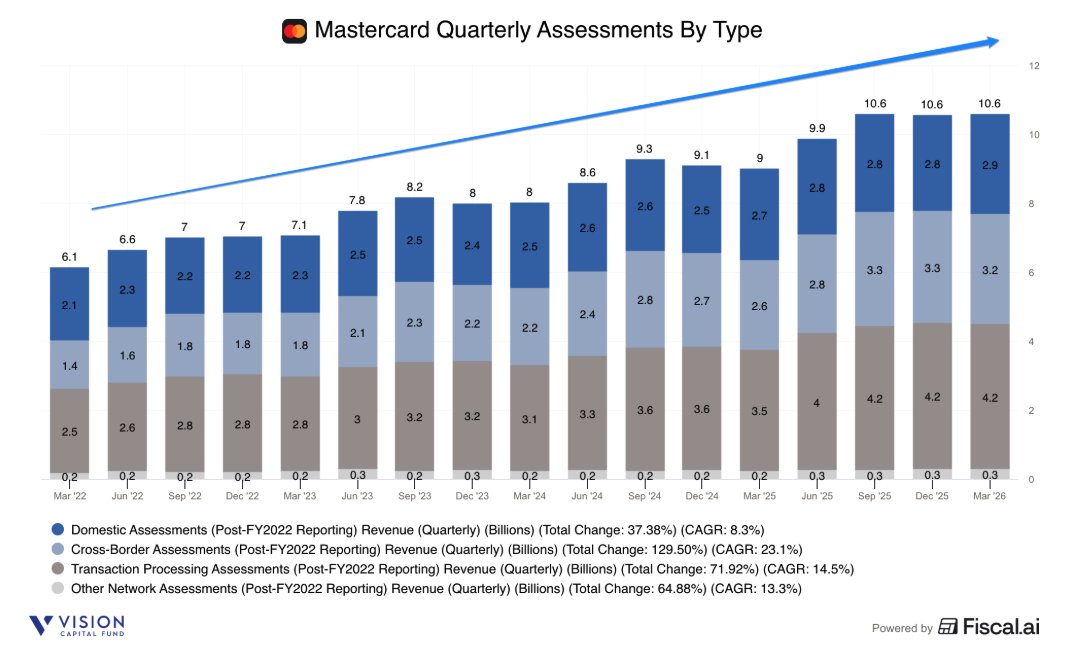
Mastercard $MA 1Q26 Earnings - Rev $8.4b +16% ↗️🟢 - NG EBIT $5.1b +19% ↗️🟢 margin 60.8% +153 bps ✅ - EBIT $4.9b +18% ↗️🟢 margin 58.4% +120 bps ✅ - NG Net Inc $4.1b +20% ↗️🟢 margin 48.9% +188 bps ✅ - Net Inc $3.9b +18% ↗️🟢 margin 46.2% +98 bps ✅ - OCF $3b +26% ↗️🟢 margin 35.7% +288 bps ✅ - FCF $2.7b +32% ↗️🟢 margin 31.7% +382 bps ✅ Biz Metrics - Switched Txn 43.8b +9% ↗️🟡 - Switched Volume +9% ↗️🟡 - Switched Volume (US) +4% ↗️🟡 - Switched Volume (WW ex-US) +12% ↗️🟡 - Cards 3.7b +5% ↗️🟡 - Cross-Border Volume +13% ↗️🟡 - Cross-Border Volume (Intra-Europe) +14% ↗️🟡 - Cross-Border Volume (Other) +12% ↗️🟡 Revenue by Segment - Payment Network $4.9b +12% ↗️🟡 - VAS $3.5b +22% ↗️🟢 Assessments by Type - Domestic $2.9b +9% ↗️🟡 - Cross-Border $3.2b +23% ↗️🟢 - Txn Processing $4.2b +20% ↗️🟢 - Other Network $0.3b +20% ↗️🟢 GDV by Geographic and Type - APMEA $645b +9% ↗️🟡 - Canada $68b +13% ↗️🟡 - Europe $943b +17% ↗️🟢 - Latin America $252b +24% ↗️🟢 - WW ex-US $1908b +15% ↗️🟡 - US $795b +4% ↗️🟡 - WW $2703b +12% ↗️🟡 Credit GDV - WW ex-US $831b +14% ↗️🟡 - US $417b +8% ↗️🟡 - WW $1248b +12% ↗️🟡 Debit GDV - WW ex-US $1077b +16% ↗️🟢 - US $378b +1% ➡️🟠 - WW $1455b +11% ↗️🟡 1 | Saw slower revenue growth (relative to Visa) due to the middle east conflict pressuring cross-border travel. Building on 2025 momentum, '26 is off to an excellent start. Net revenue growth was up 12% and net income up 15% in the first quarter on a year-over-year non-GAAP currency-neutral basis. Looking at the macro picture, the economic foundation remains generally supportive with healthy underlying consumer and business spending. However, the backdrop remains uncertain, driven by geopolitical tensions, which has put some pressure on cross-border travel. Overall, labor markets continue to be balanced and wages are still outpacing inflation in most major markets. As we've done consistently, we are monitoring the situation in the Middle East and the global economy, and we will adjust as needed. 2 | Saw continued headwind from the migration of Capital One’s Debit portfolio. Debit GDV grew +1% but +7% ex. 100bps drag on US switched volume growth. Capital One migration is finally complete, tough comps and “slower growth” to be gradually reduced. Worldwide gross dollar volume, or GDV, increased by 7% YoY. In the U.S., GDV increased by 4% with credit growth of 8% and debit growth of 1% -- excluding the impacts from the migration of the Capital One debit portfolio, our U.S. debit GDV grow Of note, U.S. switched volume was flat sequentially as the strength in consumer and business spend offset the impact from the migration of Capital One's debit portfolio in the quarter. Excluding Capital One, on a like-for-like basis, U.S. switched volume growth was over 1 ppt higher in Q1 as compared to Q4. 3 | Assume the middle east conflict ends in Q2 and progressively recovers through H2 2026. As we look at Q2 and the full year, our base case assumes underlying consumer spending remains healthy outside of the impact of the conflict in the Middle East. We assume the conflict ends in Q2 and the related headwinds will be largest in Q2 and then progressively recover as we move through the second half of the year. As it relates to our expectations for the second quarter of 2026, year-over-year net revenue growth is expected to be at the low end of low double-digits range on a currency-neutral basis, excluding inorganic activity. 4 | Mastercard’s foundation spans 4 pillars of unparalleled global reach, franchise rules, best-in-class technology, and differentiated VAS. It's a foundation spanning 4 pillars: One, unparalleled global reach. We have hundreds of millions of acceptance locations and digital access points across 150 currencies. The last 5 years alone, we have grown acceptance locations nearly 70%. Mastercard powers payments when and where you need us. That scale brings participants into a single network where the more activity that flows through it, the more data is available and the more valuable it becomes for everyone. That drives the ability to capture and extend the secular opportunity. Two, our franchise rules. Our franchise helps our network operate with consistency. The rules bring trust and protection for all participants, ensuring transactions are secure. Merchants are paid, disputes can be resolved and people have zero liability to unauthorized transactions. That trust allows global acceptance at scale. Three, best-in-class technology. We invest to make payments faster and simpler. Core card network upgrades are already delivering faster transaction flow and near-real-time settlement. These capabilities are live in South Africa today, already driving new wins and incremental switching. And we look to extend into other markets over time. And remember, our payments infrastructure goes well beyond cards, including account-to-account, and we're now further embedding digital assets. Fourth, our differentiated value-added services and solutions. Powered by data from our networks and AI, we have curated unique services that make the network secure, drive more payments, and help our customers make smarter decisions. And many of these services are tied to and brought to market through the network. That's our virtuous cycle, strengthening the franchise and improving outcomes for customers. 5 | VAS (~40% of revenues) continued to be very strong, saw strong demand and grew +22%. +18% FXN, driven by security, digital and authentication, business and market insights, and consumer acquisition and engagement and pricing. Value-Added Services and Solutions net revenue increased 18%, primarily driven by growth in our underlying drivers, strong demand across security solutions, digital and authentication, business and market insights, and consumer acquisition and engagement and pricing. from a Value-Added Services and Solutions standpoint, which represents roughly 40% of the revenues of the company, the business continues to perform. We delivered 18% currency-neutral growth in the first quarter, another solid quarter. And we are seeing strong demand for those capabilities. 6 | VAS is built on their data, combining real-time transaction data with permissioned data. Turning to Value-Add Services and Solutions. Demand remains high, and we continue to drive strong growth. VAS is built on our data, curated into differentiated products and delivered alongside our payment network. We combine proprietary global real-time transaction data with petabytes of permissioned data from our services and solutions. 7 | Cross-border card-not-present ex-travel remained strong, grew +18%. Cross-border card-not-present ex-travel grew at 18% and remained strong. And the sequential decline in cross-border travel was due primarily to the conflict in the Middle East and portfolio shifts. 8 | Remained focused and prepared for agentic commerce and payments. On Agentic, the ecosystem continues to evolve. Our payment solutions are ready, and we are engaged, shaping what comes next with key players, including Google, Microsoft, OpenAI, and other partners across the ecosystem. We're deepening our partnership with OpenAI, reinforcing their use of Mastercard Agent Pay, working to enable agent-to-agent payments and collaborating to embed our services across their solutions while using their tools as an enterprise customer. I'm also happy to share that nearly all Mastercards around the world are now enabled for Mastercard Agent Pay. And we continue to develop our agent-related services. 9 | In acceptance, will continue to go after domestic schemes, closed-loop, underpenetrated verticals not just on consumer but also B2B. Acceptance, you saw the growth, so that is very significant. And it follows a very clear plan. We are looking at going after domestic schemes. We are going after closed-loop. We're going after underpenetrated verticals. Those are all aspects on how we're finding new volume and creating new acceptance. This is not limited to the consumer side; this is also happening in the B2B side. One of the things I should say is underpenetrated verticals, very interesting. So insurance, housing, our programs with Bilt, just finding -- making sure that it's understood that cards can solve needs that are out there in spaces that we haven't historically been in. 10 | Mastercard wants to get into crypto and more specifically into stablecoin, so that they can address the interoperability challenge in digital assets and become the new payment gateway to send, receive, convert, and hold stablecoins. In quarter 1, we saw spend growth continue at a healthy clip across our crypto co-brands as cardholders gain access to our acceptance, protection, and so on. This quarter, OKX, a leading global crypto exchange, is expanding its Mastercard crypto card program into Europe. And remember, we also enable purchases of digital assets using Mastercard, and we allow stablecoin settlement, and we integrated stablecoins into Mastercard Move. But we also see a broader need to connect stablecoin rails to fiat rails. As digital assets scale, complexity grows, the need for interoperable, reliable, and trusted infrastructure grows. That is why we are excited about our planned acquisition of BVNK. We do not see a change in how consumers pay; cards continue to deliver a seamless experience. But given the speed, 24/7 availability, and programmability, we see clear potential for stablecoin technology, especially when paired with our network in use cases like payouts, remittances, [ Me-to-Me ] and cross-border B2B payments. BVNK has leading technology that serves as an important enabler to send, receive, convert, and hold stablecoins. They also directly address the interoperability challenge in digital assets. They bring together liquidity providers, stablecoin issuers, market makers, and more. BVNK also holds important hard-to-get licenses and offers critical compliance and regulatory tooling. 11 | Mastercard wants to get around real-time payments with real-time payment assets. We've always believed in consumer choice when it comes to payments and business choice when it comes to payments. So, it's clear that cards is a great answer for P2M, but it's not the answer for everything. So a set of dedicated use cases and a lot of volume out there for us to go after to apply our service. So that was originally the idea to go into a what we called at the time, a multi-rail proposition account to account. So you know that history, acquisition of Vocalink and so forth and various other real-time payments assets around the world, and then we exported the stack to run about 12 subsystems around the world right now. So that strategy still holds. There is no question about that because real-time is very much in focus. A lot of governments choose real-time payment systems to go and facilitate payments of all types across their respective markets. We're a known and respected partner in this space. So strategy hasn't changed. What we're really evolving is to ensure that we find more and more services that we can apply to these payments. 12 | Because of more on-off ramp opportunities, Mastercard wants to get into stablecoins and be the new toll booth for stablecoins like they did for digital payments with debit/credit cards. Generally, when you see where are most of the volumes today, there's a lot of on- and off-ramp opportunities. So we have these co-brand programs, and in that, you basically have card economics; so that's just a straightforward. So -- now in this space, going forward, where we drive interoperability layers and so forth, you can see it start to build out a whole set of new services and additional opportunities. We see the space driving more value for us going forward. But for now, it's that volume that is the most pressing need, how do I get on to in stablecoins, I have an offering at the other end of the transaction. So we got to be at all those spaces and invest to do that. So that's how I see it. Overall, I think it is a significant net-new growth opportunity for us, which is why we felt we are going to deepen our capabilities through the acquisition. So we want to drive all of that value and be a center -- a central network that facilitates that value exchange over those digital assets. ➡️ Final Thoughts on Mastercard $MA: Long-term stable compounder of steady growth (>12%+) with VAS driving faster growth than payment network, profitability (>57% EBIT margins), strong operating leverage via slower expense growth, resulting in even faster earnings growth (~15%+), the toll-booth supporting the long-term secular tailwind of the war on cash, and winning across more verticals and rails supported by strategic accretive acquisitions. Currently experiencing slower cross-border travel spend due to the middle east conflict and tough comps from the Capital One Debit migration, which should ease up into H2. VAS remains very strong. Strong push into stablecoins and digital assets wanting to be the new tollbooth of that.
Eugene Ng tweet mediaEugene Ng tweet mediaEugene Ng tweet media
Indonesia
0
4
73
4.2K
Eugene Ng
Eugene Ng@EugeneNg·
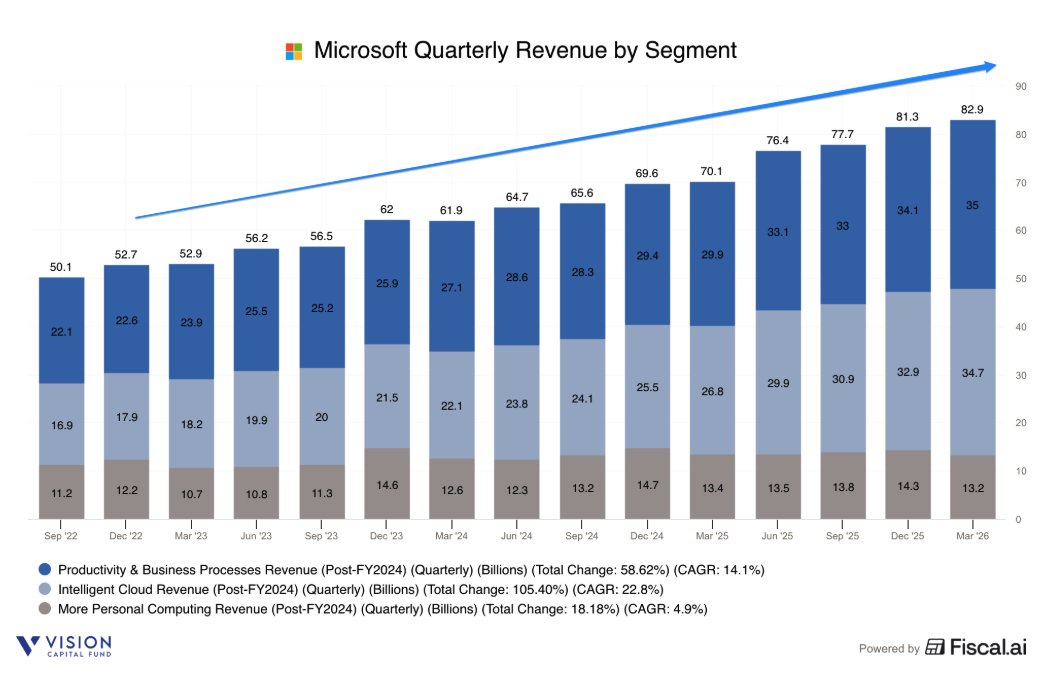
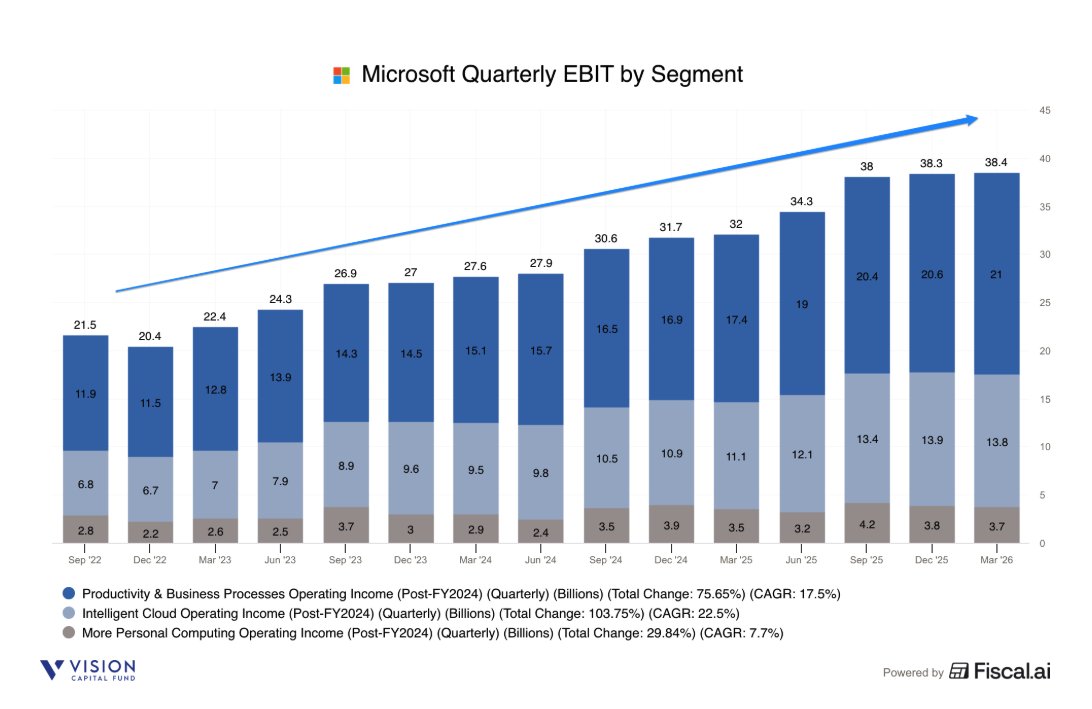
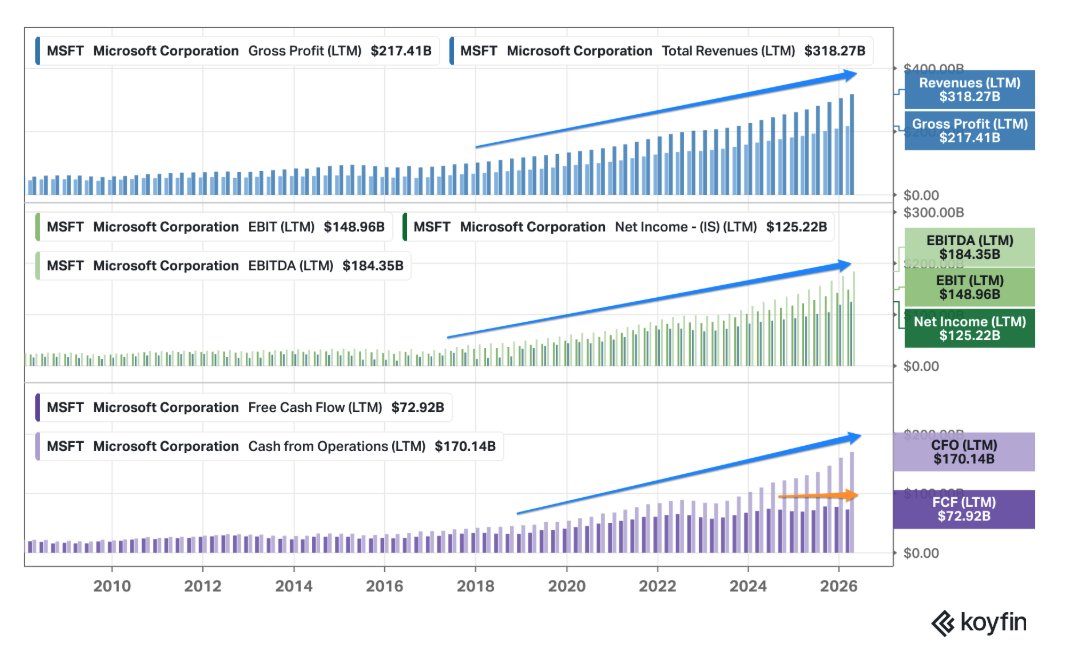
Microsoft $MSFT 3Q26 Earnings - Rev $82.9b +18% ↗️🟢 - GP $56.1b +16% ↗️🟢 margin 67.6% -108 bps ↘️🔴 - EBIT $38.4b +20% ↗️🟢 margin 46.3% +66 bps ✅ - Net Inc $31.8b +23% ↗️🟢 margin 38.3% +148 bps ✅ - OCF $46.7b +26% ↗️🟢 margin 56.3% +345 bps ✅ - FCF $15.8b -22% ↘️🔴 margin 19.1% -991 bps ↘️🔴 Product - Rev $15.1b -2% ↘️🔴 - GP $12.4b +1% ➡️🟠 margin 81.9% +171 bps ✅ Service - Rev $67.8b +24% ↗️🟢 - GP $43.7b +22% ↗️🟢 margin 64.5% -105 bps ✅ Productivity and Business Processes - Rev $35b +17% ↗️🟢 - Commercial Cloud +19% ↗️🟢 - Consumer Cloud +33% ↗️🟢 - LinkedIn +12% ↗️🟡 - Dynamics 365 +22% ↗️🟢 - EBIT $21b +21% ↗️🟢 margin 59.9% +186 bps ✅ Intelligent Cloud - Rev $34.7b +30% ↗️🟢 - Azure +40% ↗️🟢 - EBIT $13.2b -1% ↘️🔴 margin 38.0% -1195 bps ↘️🔴 Personal Computing - Rev $13.2b -1% ↘️🔴 - Search +12% ↗️🟡 - Gaming -5% ↘️🔴 - Windows OEM and Devices -2% ↘️🔴 - EBIT $3.7b +4% ↗️🟡 margin 28% +146 bps ↘️🔴 Biz Metrics - AI Rev $37bn ARR +123% ↗️🟢 - Commercial RPO $627bn +99% (incl OAI) ↗️🟢 - Cloud Rev $54.5b +29% ↗️🟢 - Cloud GPM 66% ↘️🔴 4Q26 Mgmt Guide - Rev $87.8b +15% ↗️🟢 - Rev (PBP) $37.3b - Rev (IC) $38.3b - Rev (IC - Azure) +40% ↗️🟢 - Rev (PC) $12.3b ↘️🔴 - GP $58.2b - Capex >$40b FY27 Mgmt Guide - Rev grow double digits - EBIT grow double digits 1 | Strong quarter powered by Cloud, Azure, AI, Cloud $54bn revenue +29%. AI hit $37bn ARR +123%. We delivered results that exceeded expectations across revenue, operating income and earnings per share, driven by strong demand and execution…It was a record third quarter powered by the continued strength of Microsoft Cloud, which exceeded $54 billion in revenue, up 29% YoY. Our AI business surpassed $37 billion ARR, up 123%. Company gross margin percentage was 68%, down YoY, driven by continued investment in AI infrastructure and growing AI product usage…Operating margins increased slightly YoY to 46% 2 | Cloud was very strong, Azure grew 40%, and customer demand continue to exceed available capacity. Revenue was $34.7 billion and grew 30% and 28% in constant currency. In Azure and other Cloud Services, revenue grew 40% and 39% in constant currency against a prior year that included accelerating growth. Results were ahead of expectations as we delivered capacity earlier in the quarter, enabling increased consumption across both AI and non-AI services. Strong customer demand across workloads, customer segments and geographic regions continues to exceed available capacity. 3 | ⅔ of capex was for short-lived assets, GPUs and CPUs and the rest for long-lived assets, expect to spend $190bn in capex, and is $25bn higher from higher components (i.e. memory). Capital expenditures were $31.9 billion, down sequentially due to the normal variability from cloud infrastructure buildouts and the timing of delivery of finance leases. And this quarter, roughly 2/3 of our CapEx was for short-lived assets, primarily GPUs and CPUs. The remaining spend was for long-lived assets that will support monetization over the next 15 years and beyond…For calendar year 2026, we expect to invest roughly $190 billion in capital expenditures, which includes approximately $25 billion from the impact of higher component pricing 4 | See this as a huge consequential platform shift, focused on executing two priorities of building the world’s leading cloud and AI infrastructure and high value agentic systems for productivity, coding, and security. We are at the beginning of one of the most consequential platform shifts that will change the entire tech stack as agents proliferate and become the dominant workload. This will drive TAM expansion and change the value creation equation across the entire economy. To capture this opportunity, we are executing against 2 priorities. First, we are building the world's leading cloud and AI infrastructure for agentic computing era. Second, we are building high-value agentic systems across core domains such as productivity, coding and security. These 2 layers reinforce each other, and we are focused on driving competitive value and differentiation for customers across each so that they can eval-max their outcomes. 5 | Confident of the return on investments given the higher demand signals, increasing product usage and higher efficiencies, remain constrained through 2026. We remain confident in the return on these investments, given higher demand signals and increasing product usage as well as the efficiencies we're already driving across the platform. Even with these additional investments and continued efforts to bring GPU, CPU and storage capacity online faster, we expect to remain constrained at least through 2026. Despite these constraints, and the continued need to balance incoming supply, we expect Azure growth to show modest acceleration in the second half of the calendar year compared with the first half. 6 | Capturing more in consumption and usage-based pricing models, think they can leverage the OAI IP and improve 1P hardware stack to improve margins. And so I do feel like what we've been really focused on is making sure that the business models reflect how these applications are both getting built and the value that they're bringing. And so when you think about that type of value, it tends to be captured more and consumption and usage-based pricing models. And I think that's something that's probably been a little underappreciated as we look in terms of margins going forward. I also think it's been important to us to make sure we leverage the IP we have, the IP we get from our partnerships is obviously free to us for a long time. So we're able to take that and apply it and to benefit our margins in a healthy way. You've also seen us work hard on the first-party hardware stack being able to make sure we can take margins out of the infra stack as well. And then, of course, just the efficiency work…That's efficiency work on the hardware side as well as efficiency work on the software side to be able to deliver these types of margins. 7 | Feel good about OAI partnership, have IP to 2032, and OAI is a large customer. I mean, overall, we feel good about our partnership with OpenAI. I'm always very, very focused on any partnership and ensuring that there's a win-win construct at all times. I mean that's how you can remain with partners. In this case, it starts with, quite frankly, IP, Amy referenced this. We have a frontier model, royalty-free with all the IP rights that we will have access to all the way to '32, and we fully plan to exploit it. And there are examples I talked about even in my remarks earlier. And that's -- we are thankful for that, and that's sort of one part of the agreement. The second part, of course, is the -- them as a customer of ours, they're a large customer of ours, not just on the AI accelerator side, but also on all the other compute side, and so we want to serve them well. And then, of course, we have our equity. And so overall, I think the construct as they have grown and we have grown and our customers also have different expectations in terms of their model diversity. So therefore we've all evolved the partnership, but I feel very good about where we are. 8 | Managed to bring GPU live faster by 20%, and 40% improvement in inference throughout. Today, I'll focus my remarks on both priorities, starting with infrastructure. We're optimizing every layer of the tech stack, from DC design, to silicon to system software, the model architecture as well as its optimization. This is translating into operational gains. We have reduced dock-to-live times for new GPUs in our biggest regions by nearly 20% since the beginning of the year. Our Fairwater data center in Wisconsin came online earlier this month, 6 weeks ahead of schedule, allowing us to recognize revenue earlier. And we delivered a 40% improvement in inference throughput for our most used models across Copilot, driven by our software and hardware optimization work. 9 | Continue to build the AI infrastructure with NVIDIA and AMD GPUs and their custom Cobalt CPUs and Maia accelerators. We also continue to modernize our fleet with our first-party innovation alongside the latest from NVIDIA and AMD. Across our fleet, millions of servers are powered by our custom networking security and virtualization silicon, including Azure Boost as well as our first-party CPUs and accelerators. Our Maia 200 AI accelerator, which offers over 30% improved tokens per dollar compared to the latest silicon in our fleet, is now live in our Iowa and Arizona data centers. Our Cobalt server CPU is deployed in nearly half of our DC regions running workloads at scale for customers like Databricks, Siemens and Snowflake. As our largest customers scale their AI deployments, they're increasingly leveraging other services across our platform and choosing to run those workloads on Cobalt. And we are expanding Cobalt supply significantly to meet this demand. 10 | Microsoft offers customers the choice of different models. The next layer up from infrastructure is the agent app platform. It starts with model choice. We offer the broadest selection of models of any hyperscaler, so customers can choose the right model for the right workload across OpenAI, Anthropic, open source and more. Over 10,000 customers have used more than one model on Foundry. 5,000 have used open source models, and the number who have used Anthropic and OpenAI models increased 2x QoQ. 11 | Tokens are growing rapidly +30% QoQ and Cosmos DB saw 50% growth and Fabric OneLake data lake grew 4x. All up, over 300 customers are on track to process over 1 trillion tokens on Foundry this year, accelerating 30% QoQ….Cosmos DB alone saw 50% year-over-year revenue growth driven by AI app workloads. We now have 35,000 paid Fabric customers, up 60% year-over-year. And all up, the amount of data in Fabric OneLake data lake increased nearly 4x year-over-year. Over 15,000 customers now use both Foundry and Fabric, up 60% year-over-year as enterprises connect agents to real-time operational, analytical and unstructured data that Fabric brings together. ➡️ Final Takeaways: Microsoft $MSFT Long-term compounder with combination of growth, profitability and durability at scale with multiple growth drivers supported by long-term tailwinds in public cloud hyperscalers and AI offsetting the slightly weaker growth in enterprise software and gaming. Continue to dominate from the enterprise software distribution, continue to benefit strongly from OpenAI.
Eugene Ng tweet mediaEugene Ng tweet mediaEugene Ng tweet mediaEugene Ng tweet media
Indonesia
1
4
31
2.3K
Eugene Ng
Eugene Ng@EugeneNg·
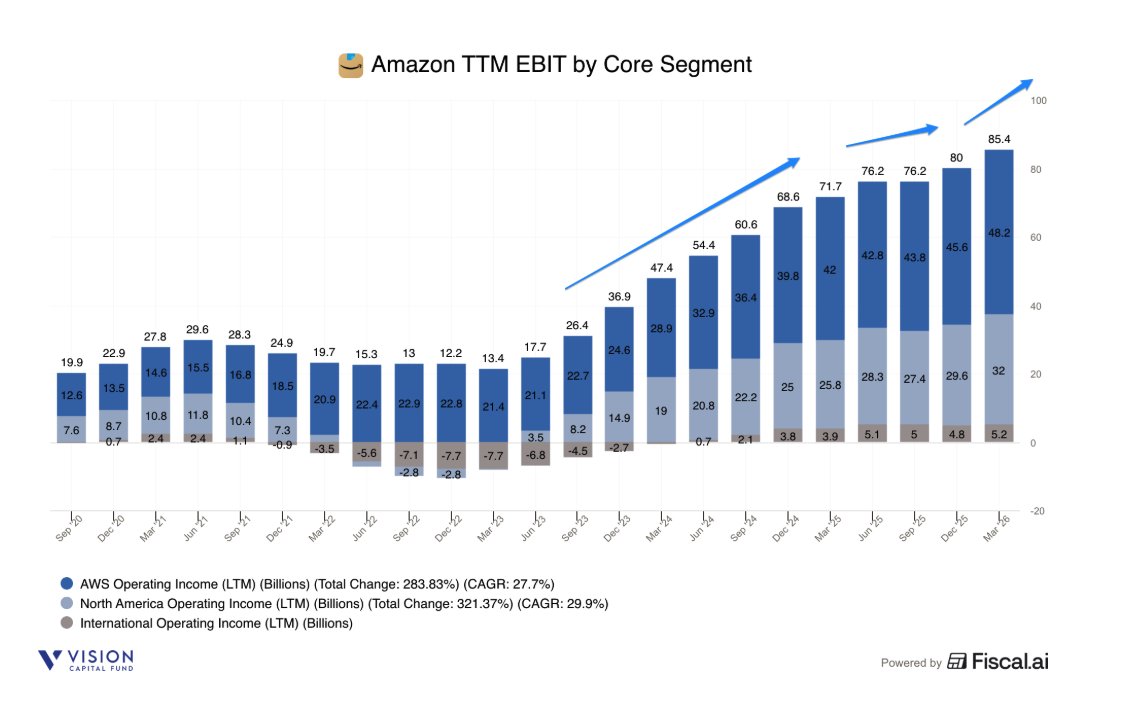
27 | Amazon Leo continues to grow and saw commitments from Delta Airlines, JetBlue, AT&T, Vodafone, DIRECTV Latin America, Australia's National Broadband Network, DP World Tour, NASA and others. Amazon Leo continues gaining momentum with commercial service on track to launch in a few months. We already have meaningful revenue commitments from enterprises and governments, including Delta Airlines, JetBlue, AT&T, Vodafone, DIRECTV Latin America, Australia's National Broadband Network, DP World Tour, NASA and others. 28 | Expecting >20 launches in 2026, and >30 in 2027, see it as being able to become a multi-billion dollar business. However despite its capital-intensive upfront nature, like its medium to long-term FCF and ROIC prospects. if you ask what stops us from growing the business, we have to get the constellation into space. We have over 20 launches planned this year. We have over 30 launches planned in 2027. But I think the business has a chance to be a very large many billion-dollar revenue business. And I think it has some characteristics that are reminiscent of AWS in that it's capital-intensive upfront where you're committing a lot of capital and cash in the early years for assets that you get to leverage over a long period of time. And so I like the free cash flow and return on invested capital characteristics of that business in the medium to long term. 29 | Globestar acquisition brings direct-to-device capability which is complimentary to Amazom Leo, which enabled the Apple partnership. And the last thing I'll say about it is your question about Globalstar. Increasingly, what we're finding with consumers and enterprise and governments is that they don't like to have any periods where they don't have connectivity. It just offsets whatever customer experience they're going through. Even in metropolitan areas, we all hit certain parts of the highway or certain roads where you can't get connectivity or you're hiking, you're skiing. And so increasingly, we see very large demand for consumers to have direct-to-device. And that was really the impetus for our acquisition of Globalstar. They have unusual and scarce global spectrum that's required to provide direct-to-device. We also really like the satellite know-how that we'll get as part of that merger with Globalstar. And then it also afforded us the opportunity to build a deep relationship with Apple, who's going to use our direct-to-device for their iPhones and for their watches. So very optimistic about the business. 30 | Expect higher $1bn cost in North America due to Amazon Leo. Second, within the North America segment, we do expect a year-over-year cost increase of approximately $1 billion related to Amazon Leo as we manufacture and launch more satellites in preparation for our service offering. Amazon Leo's commercial service is on track to launch in Q3, and we expect to begin capitalizing certain costs in Q4, including production and launch costs. Third, our guidance anticipates higher transportation costs related to fuel inflation, which is partially offset by the recently implemented fuel and logistics-related FBA surcharge. ➡️ Final Takeaways on Amazon $AMZN: Amazon continues to work on their continuous powerful flywheel to lower the cost to serve their customers, their logistics and ecommerce infrastructure is unparalleled, and expect US and International EBIT margins to keep improving in a non-linear manner supported by advertising. The same attitude is also being deployed in AWS working with the top dog, and using their own ASICs chips like Trainium to take compute costs and speed down lower. As CAPEX ramps with another type of reinvestment cycle for AWS, expect FCF to keep trend lower in the short-term, before recovering even stronger after. AWS has showed tremendous strength with continued growth reacceleration especially with OpenAI, Anthropic, and on the AI side. Excited to watch Amazon Leo become the next mult-billion dollar business.
English
0
0
2
797
Eugene Ng
Eugene Ng@EugeneNg·
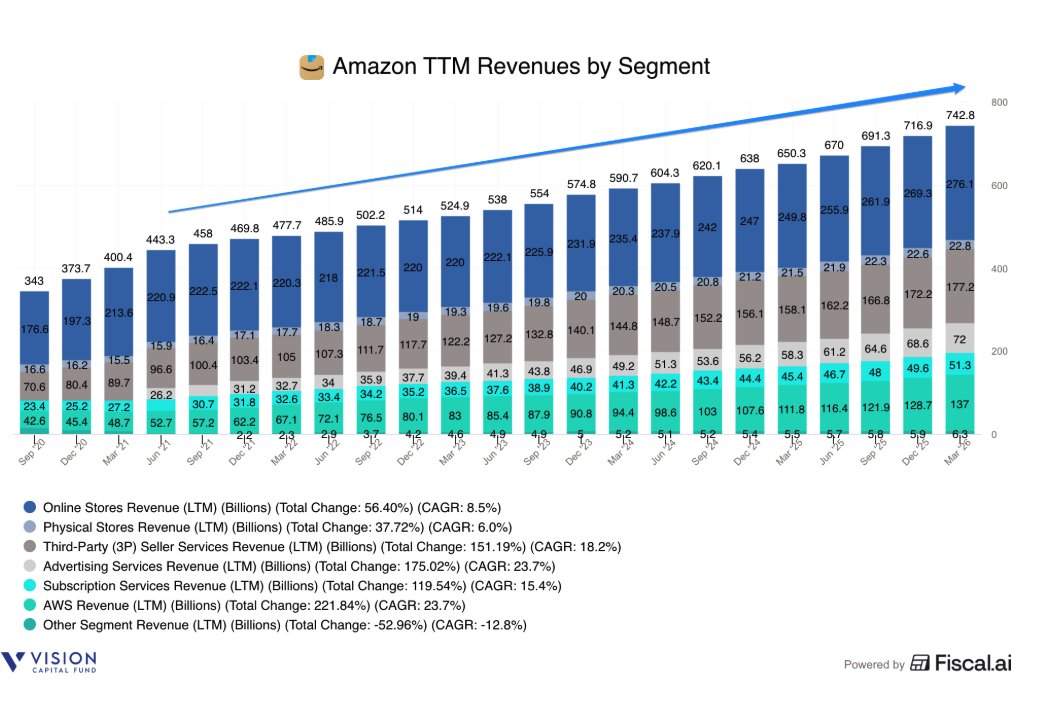
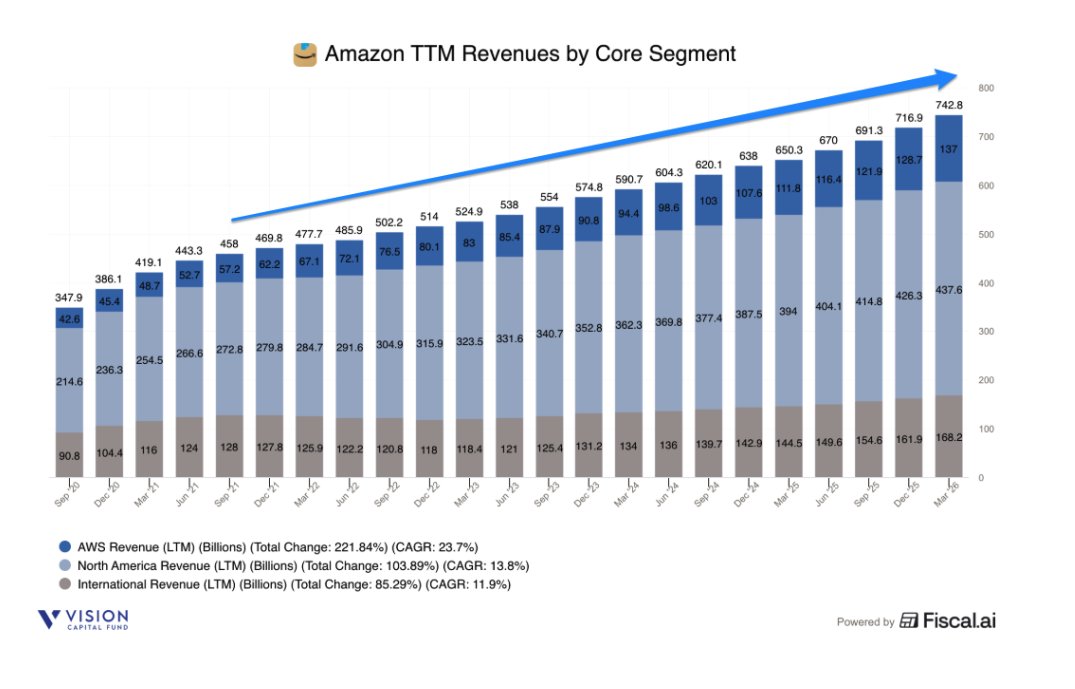
Amazon $AMZN 1Q26 Earnings - Rev $181.5b +17% ↗️🟢 - GP $94.1b +20% ↗️🟢 margin 51.8% +127 bps ✅ - EBIT $23.9b +30% ↗️🟢 margin 13.1% +132 bps ✅ - Net Inc $30.3b +77% ⤴️🟢 margin 16.7% +567 bps ✅ - OCF $26b +53% ↗️🟢 margin 14.3% +341 bps ✅ - FCF -$18.2b ↘️🔴 margin -10.0% -487 bps ↘️🔴 Revenue by Segment - Online Stores $64.3b +12% ↗️🟡 - Physical Stores $5.8b +5% ↗️🟡 - 3P Seller Services $41.6b +14% ↗️🟡 - Advertising $17.2b +24% ↗️🟢 - Subscription $13.4b +15% ↗️🟡 - AWS $37.6b +28% ↗️🟢 - Other $1.6b +25% ↗️🟢 North America - Rev $104.1b +12% ↗️🟡 - EBIT $8.3b +42% ↗️🟢 margin 7.9% +165 bps ✅ International - Rev $39.8b +19% ↗️🟢 - EBIT $1.4b +40% ↗️🟢 margin 3.6% +54 bps ✅ AWS - Rev $37.6b +28% ↗️🟢 - EBIT $14.2b +23% ↗️🟢 margin 38% -178 bps ✅ 2Q26 Mgmt Guide - Rev $199b +19% ↗️🟢 (strong) - EBIT $24b +25% ↗️🟢 1 AWS is now a $150bn ARR business, and it accelerated and grew 28% in Q1. Starting with AWS, growth continued to accelerate, up 28% year-over-year, the fastest growth rate in 15 quarters, up $2 billion QoQ, the largest Q4 to Q1 AWS revenue increase ever. AWS is now a $150 billion annualized revenue run rate business. It's very unusual for a business to grow this fast on a base this large. And the last time we saw growth at this clip, AWS was roughly half the size. We've never seen a technology grow as rapidly as AI. Amazon is already a leader and companies continue to choose AWS for AI. 2 | AWS backlog was $364bn, and if include Anthropic’s $100bn, it would be $464bn. Not just from one or two customers (i.e. OpenAI or Anthropic). Yes. On the backlog, the backlog for Q1 is $364 billion. That does not include the recent deal that we announced with Anthropic for over $100 billion. There's reasonable breadth in that as well. It's not just 1 customer or 2 customers. 3 | AWS AI revenue is now a $15bn ARR business, 10% of AWS, growing >100% YoY. To put our growth in perspective, 3 years after AWS launched, it had a $58 million revenue run rate. In the first 3 years of this AI wave, AWS' AI revenue run rate is over $15 billion, nearly 260x larger. There are several reasons customers are choosing AWS for AI. First, we've built broader capabilities than others. That includes model building with SageMaker, which reduces training time by up to 40%, high-performance inference with the leading selection of frontier models in Bedrock, which saw 170% growth in customer spend quarter-over-quarter and processed more tokens in Q1 than all prior years combined. We're excited to make OpenAI's models available in Bedrock. Yesterday, we added OpenAI's GPT-5.4 model with 5.5 coming soon. As customers spend more on AI, we see a corresponding demand increase in core. We expect this to increase over time as customers move more AI workloads into production, strengthening demand for our core services. Our AI revenue is growing triple digits year-over-year. We're 4 | Customers are choosing AWS for AI because of the broader capabilities, wanting their inference to sit closer to their applications and data in AWS, able to consume additional non-AI services, and it has the strongest security and operational performance of any AI and infrastructure. There are several reasons customers are choosing AWS for AI. First, we've built broader capabilities than others. Second and another reason customers continue choosing AWS is that as they expand their use of AI, they want their inference to reside near their other applications and data and much more of it resides in AWS than any place else. Third, as customers expand their AI usage, they also want to consume additional non-AI services, and they're choosing AWS because we've built the broadest and most capable core offerings by a wide margin. offer thousands of features across compute, storage, databases, analytics, security and more, and Fourth, AWS is the strongest security and operational performance of any AI and infrastructure provider and start-ups, enterprises and governments continue to choose AWS as the foundation for their most critical workloads. 5 | Bedrock saw 170% growth in customer spend QoQ, and runs most of its inference on Trainium, ~80% of Fortune 100 companies are using Bedrock. that includes model building with SageMaker, which reduces training time by up to 40%, high-performance inference with the leading selection of frontier models in Bedrock, which saw 170% growth in customer spend QoQ and processed more tokens in Q1 than all prior years combined….Amazon Bedrock, which is used expansively by over 125,000 customers, runs most of its inference on Trainium and almost 80% of the Fortune 100 companies are using Bedrock. 6 | OpenAI models are now available in Bedrock, GPT 5.4 is up and 5.5 will come soon, already seeing unprecedented demand. We're excited to make OpenAI's models available in Bedrock. Yesterday, we added OpenAI's GPT-5.4 model with 5.5 coming soon. OpenAI has said they're already seeing unprecedented demand for this new product, and we're seeing heavy customer interest as well. Most of the value companies derive from AI will be through agents. In AWS customers can build agents with their proprietary data and strands, which has been downloaded more than 25 million times and saw 3x more downloads QoQ. Customers can deploy agents with enterprise scale, security and reliability with AgentCore, which is being used to deploy an agent as frequently as every 10 seconds. We also offer turnkey agents for coding, software migrations, business operations and knowledge workers in QRO, Transform, Connect and Quick, and they continue to resonate with customers. 7 | Added numerous new AWS agreements with OpenAI, Anthropic, Meta, NVIDIA, Uber, U.S. Bank, Fox, Southwest Airlines, U.S. Army, Bloomberg, Cerebras, AT&T, Nokia, etc. And just since last quarter's call, we've announced new agreements with OpenAI, Anthropic, Meta, NVIDIA, Uber, U.S. Bank, Fox, Southwest Airlines, U.S. Army, Bloomberg, Cerebras, AT&T, Nokia, Fundamental, The National Geographic Society, PGA TOUR and many more. 8 | AWS chips business is now $20bn ARR grew 40% QoQ and >100% YoY, if standalone, would be the 3rd largest data centre chip business globally (after NVIDIA and AMD). Our chips business continues to grow rapidly and is larger than what a lot of folks thought. We saw nearly 40% quarter-over-quarter growth in Q1, and our annual revenue run rate is now over $20 billion and growing triple-digit percentages year-over-year, but this somewhat masks the size. If our chips business was a stand-alone business and sold chips produced this year to AWS and other third parties as other leading chip companies do, our annual revenue run rate would be $50 billion. As best as we can tell, our custom silicon business is now one of the top 3 data center chip businesses in the world, the speed at which we've gotten here is extraordinary. And we have momentum. 9 | Trainium saw US$225b in revenue commitments, Trainium 3 started shipping in 2026, is nearly fully subscribed, and Trainium 4 scheduled for late 2027 is being reserved. For our custom AI silicon, we've recently shared very large multiyear, multi-gigawatt Trainium commitments from the 2 leading AI labs in the world in Anthropic and OpenAI as well as an increasing number of companies like Uber betting on Trainium. And we now have over $225 billion in revenue commitments for Trainium. Our Trainium2 chip has about 30% better price performance than comparable GPUs and is largely sold out. Trainium3, which just started shipping at the start of 2026 and is 30% to 40% more price performance than Trainium2 is nearly fully subscribed. And much of Trainium4, which is still about 18 months from broad availability has already been reserved. 10 | See the possibility of selling Trainium racks over time from the current selling compute. On the question about Trainium and the notion of our selling racks over time, I do think that's very much a possibility. Always, we have to balance -- we have such demand right now for Trainium, and we have such demand from various companies who will consume as much as we make that we have to decide how much we're going to allocate to the existing demand and customers and how much we're going to save to sell as racks. And for our existing customers that we sell Trainium to, how many will be Trainium plus running on our cloud infrastructure versus just the chips themselves. But I expect over time, there's a good chance we're going to sell racks over the next couple of years. 11 | Having their own ASIC chips with Trainium can help save tens of billions of capex annually, providing several hundred bps of EBIT margins versus NVIDIA/AMD chips Different companies will offer different benefits for customers and the uniquely strong price performance that Trainium offers is compelling to our external and internal customers. For perspective, at scale, we expect Trainium will save us tens of billions of dollars of CapEx each year and provide several hundred basis points of operating margin advantage versus relying on others' chips for inference. 12 | Saw strong demand for their Gravitron CPUs which works well for inference, Meta committed to using tens of millions of Graviton cores. We also just announced that Meta is committed to using tens of millions of Graviton cores. Graviton is our industry-leading CPU chip, which allows Meta to run the CPU-intensive workloads behind agentic AI with the performance and efficiency they need at their scale. AI is commonly seen as a GPU story, but the rise of agentic workloads, real-time reasoning, code generation, reinforcement learning and multistep task orchestration is driving massive CPU demand as well. As AI systems shift from answering questions to taking actions and as post-training and inference scale up, the compute required pulls heavily on CPUs. That's why Meta chose Graviton, which delivers up to 40% better price performance than any other x86 processors and now used by 98% of the top 1,000 EC2 customers. 13 | While own chips are good, will still buy substantial amounts of chips from NVIDIA because customers always want choice, same with databases, analytics, models, chips. While the largest number of AI chips we're bringing in are Trainium, we continue to have a deep partnership with NVIDIA. We have immense respect for them, continue to order substantial quantities. We'll be partners for as long as I can foresee, and we'll always have customers who want to run NVIDIA on AWS, and we will also have a very large chips business ourselves. Customers always want choice. It's always been true and always will be true. But the one thing you learn over and over again with every technology, it was true in databases, it was true in analytics. It was true in models. It's true in chips, too, by the way, is that customers want choice. There is not one tool to rule the world, and they want choice. And each of the models are better at some things than the other models. 14 | Capex continues to be primarily related to AWS and Gen AI. No change in capex, see it as once-in-a-lifetime opportunity where every application is going to be reinvented. Our cash CapEx was $43.2 billion in Q1. This primarily relates to AWS and generative AI as we invest to support strong customer demand. We will continue to make significant investments, especially in AI, as we believe it to be a massive opportunity with the potential to drive long-term revenue and free cash flow. And so I don't have an update on -- a new update on capital. Our plan is largely the same, but we do view this as truly a once-in-a-lifetime opportunity where every application that we know of is going to be reinvented. 15 | Confident of long-term capex and have high confidence that this will be monetized well as they are already customer commitments and will yield strong EBIT margins and ROIC. Finally, we continue to be confident in the long-term CapEx investments we're making. Of the AWS CapEx we intend to spend in 2026, much of which will be installed in future years, we have high confidence this will be monetized well as we already have customer commitments for a substantial portion of it and that it will yield compelling operating margins and ROIC. 16 | However, while the long-term unit economics are there, free cash flows will be depressed due to near-term higher capex reinvesting for higher growth, and this is not to similar to previous episodes. As we've been sharing, the faster AWS grows, the more short-term CapEx we will spend. AWS is to lay out cash for land, power, buildings, chips, servers and networking gear in advance of when we can monetize it, typically 6 to 24 months before we start billing customers depending on the component. However, these CapEx investments fund assets with many year useful lives, 30-plus years for data centers, 5 to 6 years for chips, servers and networking gear. The free cash flow and ROIC for these investments are cumulatively quite attractive a couple of years after being in service. However, in times of very high growth like now, where the CapEx growth meaningfully outpaces the revenue growth, the early years free cash flow is challenged until these initial tranches of capacity are being monetized and revenue growth outpaces CapEx growth. We've been through this cycle with the first big AWS growth wave and like the results. We expect to feel similarly about this next wave with much larger potential downstream revenue and free cash flow. 17 | Higher memory prices due to insufficient capacity to meet strong demand, working closely with suppliers to get significant supply to ensure not capacity constrained. So on memory and storage and the supply chain, I think everybody knows that the cost of these components, particularly memory has skyrocketed. And we're just in a stage where there's just not enough capacity for the amount of demand. We have worked very closely with our strategic partners. We saw this trend happening early in the kind of the middle of the latter part of last year, and we've worked with our strategic suppliers here to get a significant amount of supply. And so we're working very closely with them. I think the team has been very scrappy. I think we've done a good job in making sure that we're not capacity constrained there, but we're watching that very closely. 18 | Higher memory prices are actually pushing enterprises with on-premise infrastructure into the cloud, as suppliers are priortizing larger cloud providers instead. One of the interesting things that we see right now with the change in price and in supply on things like memory is that it is a further impetus pushing companies who have on-premises infrastructure into the cloud. And it's because a meaningful part, these suppliers are prioritizing their very largest customers which cloud providers are. And so we have seen a number of conversations we've been having with enterprises for many months where it's just been slower in getting the transformation plan to move to the cloud accelerate rapidly just because we have a lot more supply than what others have. So it'll be interesting to see how that evolves over time. It could have -- we're doing our best to kind of -- to have the supply we need and keep the cost in the right spot, but we'll see how that continues to evolve. 19 | Amazon is now the second largest grocer (after Walmart) with >$150bn gross sales in 2025. It offers same day perishables, and such customers build larger baskets, add 3x more items to their order and spend 80% more. Look to add 100 more Whole Foods in the next few years. I'll now turn to Stores. Units grew 15% YoY, the highest we've seen since the tail end of COVID lockdowns. We continued expanding selection, including more than 600 new notable brands. Our grocery business continues to grow quickly across both perishables and nonperishables. And with more than $150 billion in gross sales in 2025, we're now the second largest grocer in the U.S. We offer perishables delivered same day alongside millions of other items in more than 2,300 cities and towns across the U.S. with more to come. Prime members are loving the convenience of getting fresh groceries alongside other products they're buying on Amazon, and perishable sales have grown over 40x year-over-year and make up 9 of the top 10 most ordered items for same-day delivery where the service is available. Customers shopping same-day perishables build larger baskets, adding nearly 3x as many items to their order and spend over 80% more than customers who don't. Whole Foods Market also continues to accelerate with over 550 stores today and 100 more coming in the next few years. We remain committed to meeting or beating other retailers on price. 20 | Continue to improve its delivery fulfilment network with process improvements, robotics and automation to keep lowering its cost to serve. As our network efficiency improves, we're able to deliver items faster and improve the customer experience while at the same time lowering our cost to serve. Looking ahead, we see meaningful opportunities to further enhance productivity across our global fulfillment network, all while continuing to raise the bar in delivery speed. We will keep optimizing inventory placement to shorten distance traveled, reduce touches per package and improve consolidation rates. Alongside these efforts, we deploy robotics and automation, which have been integral to our operations for decades. Our latest generation technologies offer a step change in efficiency, which we're deploying in both new and existing facilities. All of our U.S. large-format fulfillment center launches in 2026 will have this latest generation technology. We're seeing early positive results with improved site safety, higher productivity and lower cost to serve. 21 | Agentic Commerce still not good yet, cannot get pricing or product information right, no personalization or shopping history. Trying to make Rufus the best shopping assistant. And what you see with Agentic Commerce is it's a small fraction of what we see with the search engine referrals, but the experience just hasn't gotten great with these third-party horizontal agents yet. They're not often able to get the pricing right or the product information right. They don't have any personalization data or any shopping history. And so we do want to see that get better with third-party horizontal agents. We're having conversations with all those folks to try and make that better and find something that works for customers and all the companies. And then it will be interesting over time which agents customers choose to use. I happen to think that if you're going to a particular retailer that you'd like to do business with and you like to shop from, if they have a great agentic shopping assistant, you're going to often start there because it's where you're doing your shopping, it's easier to -- they have better product information. They have better information about what other customers like you are buying. You can make all sorts of changes to how your account and your shipping information is working there. And so that's what we're aiming to make Rufus be is we're aiming to have it be the best shopping assistant anywhere, and I think we're on that path. 22 | Thus far largest AI use cases are around cost cutting and productivity improvement, seeing more adoption in creating brand-new experiences. As I've said before, the largest absolute place that we see enterprises having success is in projects that are around cost avoidance and productivities. These are things like automating customer service or business process automation or fraud or things of that sort. But the number of projects that we're working with across enterprises and that we're now starting to see to come to production around brand-new experiences, trying to figure out how to reinvent their current experiences, but using inference and AI to be smarter, also very significant. So we're seeing the adoption in both of those segments. 23 | Agents and AI is already changing coding, DevOps, customer service, research, analytics, sales. Now need much lesser people and they have higher productivity and efficiency than ever. I mean just look at how coding, agentic coding is changing how we're all building products. I think it's going to have a comparable impact on how we do DevOps and how we do customer service, how we do research, how we do analytics, how sales is conducted. I think every single one of these functions that we all do at work are going to very significantly change. And that's another area of real focus for us. And we have this experience. I mentioned in my letter, but if you look at one of our services, we swapped out the engine of the service while we are also running the service full tilt. And normally, that would have taken 40 or 50 people about a year to do, and we took 5 really smart people, AI forward-thinking people building on agentic coding tools and those 5 people rebuilt it in 65 days. Like that is a very different world of operating. And that's the world I think we're heading to over the next few years. 24 | Thinks all customer experiences are going to be completely reinvented with different interfaces where people interact with them with dialogues. I really believe that in the fullness of time, and I don't know if that's 3 years from now or 5 years from now or it could be sooner, too, that all of these customer experiences we know are going to be completely reinvented. And they're going to have different interfaces. They're going to have different ways that people interact with them. They're going to -- people are going to want to have dialogue with them. 25 | Advertising was $17.2bn revenue and grew strongly +22%, further deepened Netflix CTV partnership, and with Comacast and Samung as well. Moving on to Amazon Ads. We continue working to be the best place for brands of all sizes to grow their businesses, and we're pleased with the continued strong growth across our full funnel offerings, generating $17.2 billion of revenue in the quarter and up 22% YoY. Forrester recently recognized Amazon Ads as a leader in omnichannel advertising platforms with unmatched supply and insights for connected TV and commerce media. We deepened our Netflix partnership with Amazon Audiences, which enables advertisers to apply Amazon's exclusive signals from shopping, browsing and streaming to Netflix's highly engaged viewers to reach the right audiences and drive even stronger performance. We also partnered with Comcast Advertising to expand local advertising to thousands of brands and expanded interactive video ad capabilities to partners starting with Samsung TVs. 26 | Bullish about Amazon Leo because many don’t have access to broadband connectivity, no digital access. It will be meaningful stronger in performance, 2X on downlink, 6x on uplink. I am very bullish about Amazon Leo and the opportunity there. There are billions of people around the world who do not have access to broadband connectivity. And there are many thousands of businesses and government assets that just -- that people don't have visibility to because they don't have the right connectivity. And it means that those entities can't do a lot of the things that we all take for granted today, including education online, business online, shopping or entertainment online, having constant visibility in digital places. When we launch that service commercially, it will be 1 of 2 offerings that are on the current technology edge. And I think that we will have a meaningful advantage in performance. I think we'll be about 2x better on the downlink than existing alternatives and about 6x better on the uplink performance than existing alternatives.
Eugene Ng tweet mediaEugene Ng tweet mediaEugene Ng tweet mediaEugene Ng tweet media
Indonesia
1
2
23
1.3K
Eugene Ng
Eugene Ng@EugeneNg·
Meta $META 1Q26 Earnings - Rev $56.3b +33% ↗️🟢 - GP $46.1b +33% ↗️🟢 margin 81.9% -25 bps ↘️🔴 - EBIT $22.9b +30% ↗️🟢 margin 40.6% -87 bps ↘️🔴 - Net Inc $26.8b +61% ↗️🟢 margin 47.5% +821 bps ✅ - OCF $32.2b +34% ↗️🟢 margin 57.2% +45 bps ✅ - FCF $13.2b +19% ↗️🟢 margin 23.5% -270 bps ↘️🔴 Biz Metrics - Family DAP 3.56b +4% ↗️🟡 - Family ARPP $15.66 +27% ↗️🟢 - Ad Impressions +19% ↗️🟢 - Average Price Per Ad +12% ↗️🟡 Ad Impressions by Geography - Worldwide +19% ↗️🟢 - UCAN +13% ↗️🟡 - Europe +17% ↗️🟢 - APAC +23% ↗️🟢 - ROW +17% ↗️🟢 Average Price Per Ad by Geography - Worldwide +12% ↗️🟡 - UCAN +14% ↗️🟡 - Europe +19% ↗️🟢 - APAC +5% ↗️🟡 - ROW +18% ↗️🟢 Family of Apps - Rev $55.9b +33% ↗️🟢 - FOA (Advertising) Rev $55b +33% ↗️🟢 - FOA (Other) Rev $0.9b +74% ⤴️🟢 - EBIT $26.9b +24% ↗️🟢 margin 48.1% -383 bps ↘️🔴 Reality Labs - Rev $402m -2% ↘️🔴 - EBIT -$4b ⤴️🟡 margin -1002.0% +1985 bps ✅ Ad Revenue by Geography - UCAN $23.7b +30% ↗️🟢 - Europe $13.3b +40% ↗️🟢 - APAC $10.6b +29% ↗️🟢 - ROW $7.4b +38% ↗️🟢 Revenue by Geography - UCAN $24.1b +29% ↗️🟢 - Europe $13.5b +39% ↗️🟢 - APAC $10.9b +29% ↗️🟢 - ROW $7.8b +40% ↗️🟢 Mgmt Guide - 2Q26 Rev $61b +28% ↗️🟢 (strong) - FY26 total expenses $169b (same) - FY26 capex $125-145b ↗️🟠 (higher vs 115-135 prev) - FY26 EBIT > FY25 1 | Very strong Q1, revenue +33% driven by impressions +19% and pricing +12%. Impression growth was healthy, driven by engagement and ad load optimizations. Q1 family of apps ad revenue was $55 billion, up 33% or 29% on a constant currency basis. In Q1, the total number of ad impressions served across our services increased 19%. Impression growth was healthy across all regions, driven primarily by growth in engagement and users as well as ad load optimizations. The global average price per ad increased 12% YoY in Q1, with broad-based growth as we benefited from ad performance improvements, better macro conditions versus Q1 of last year, and currency tailwinds in international regions. This was partially offset by strong impression growth, including from lower monetizing regions. 2 | Strong growth was due to its ability to deliver engaging experiences and being able to monetize that engagement over time. Turning now to the business performance. There are two primary factors that drive our revenue performance, our ability to deliver engaging experiences for our community and our effectiveness at monetizing that engagement over time. On the first, we're continuing to see significant gains from our content recommendation initiatives. On Instagram, the ranking improvements that we made in Q1 drove a 10% lift in Reels time spent. On Facebook, total video time increased more than 8% globally in Q1, the largest quarter-over-quarter gain in 4 years. Within the U.S. and Canada, ranking improvements we made drove a 9% increase in video watch time on Facebook in Q1. These gains are benefiting from advances we're making across the full stack. 3 | FOA Other Revenue grew strongly +74% largely due to WhatsApp paid messaging and subscription revenue. RL was down -2% due to lower Quest headset sales, offset by stronger AI glasses. Family of Apps Other revenue was $885 million, up 74% driven primarily by WhatsApp paid messaging and subscriptions revenue. Within our Realty lab segment, Q1 revenue was $402 million, down 2% year-over-year due to lower Quest headset sales, which were partially offset by continued strong growth in AI glasses revenue. 4 | AI glasses with Ray-Ban continue to do very well, focused on all day wear rather than primarily as sunglasses, see potential to widen reach as it moves from answering questions to becoming a personal agent. our AI glasses continue to perform well with the number of people using them, daily tripling year-over-year. This continues to be one of the fastest-growing categories of consumer electronics ever. We released Ray-Ban Meta optics this quarter designed for all day wear rather than primarily as sunglasses. And building on our release of Oakley last year, we have some exciting new partnerships and styles that I think are going to have the potential to reach even more people coming later this year. All of our glasses are designed to easily update to use our newest AI models and features. I'm also really excited to see the glasses evolve from being able to answer questions to being able to be a personal agent that's with you all day long, helping you remember things and achieve your goals. 5 | Saw slight decline in Family DAP due to internet disruptions in Iran and WhatsApp restrictions in Russia, excluding these, QoQ growth would be positive. We estimate 3.56 billion people used at least one of our family of apps on a daily basis in March, which declined slightly from December due to Internet disruptions in Iran and a restriction on access to WhatsApp in Russia. Absent these impacts, growth in family daily active people would have been positive quarter-over-quarter. 6 | Increased the speed for recommending new posts by applying more advanced content understanding techniques, also increasing the diversity and recency of content. Within our models, we've significantly increased the speed with which our ranking models index new posts, which is enabling us to recommend them sooner after they are published. We're also applying more advanced content understanding techniques, which is enabling us to quickly identify posts that may be interesting to someone even if they haven't engaged with a lot of similar content. These and other improvements have enabled us to increase the diversity and recency of recommended content with same-day posts now representing more than 30% of recommended reels on both Instagram and Facebook more than double the levels 1 year ago. We're also using AI to unlock more inventory by auto translating and dubbing videos into a viewer's local language, enabling us to recommend a more diverse set of content. Over 0.5 billion users on each of Facebook and Instagram are now watching AI translated videos weekly. 7 | Not used large model architectures for inference, as their cost and complexity was too prohibitive, instead used the large model Historically, we haven't used larger model architectures like GEM for inference. -- because their size and complexity would make them too cost prohibitive. And the way we drive performance from those models is by using them to transfer knowledge to smaller, more lightweight models that are used at run time. The inference models are bound by strict latency requirements since they need to find the right ad within milliseconds, and that has, again, historically prevented us from meaningfully sizing up -- scaling up their size and complexity. But in the second half of last year, we introduced a new adaptive ranking model, which enables us to leverage LLM scale model complexity of 1 trillion parameters, and we made advances in the model architecture and codesign the system with the underlying silicon, so it maintains the sub-second speed that is required to serve ads at scale. 8 | Working on using Spark to imrpove recommendation systems in FB, IG, and ads. Meta’s apps help people to achieve three things, connecting with people, learning about the world and entertainment. We're also working on using Spark in our upcoming models to improve our recommendation systems and core business in Facebook, Instagram and ads. Right now, our apps primarily help people accomplish 3 important goals: connecting with people, learning about the world and entertainment. Instead of statistical pattens of what content people engage with, they can understand what one cares about and what each content is about, to create personalized content. But we've always wanted our apps to understand more of people's goals so we can help improve their lives in all the ways that they want. These new AI models will let us understand this in more detail. So instead of just looking at statistical patterns of what types of people engage with what content, for the first time in Meta's history, we're going to be able to develop a first principles understanding of what you care about and what each piece of content in our system is about -- is that way we can show you more useful things for what you're trying to accomplish. And we'll also be able to create personalized content specifically for people to help you achieve your goals as well. 9 | Want to push for commerce within its platform to enable affiliate marketing, and for creators to earn commissions when someone makes a purchase. Last, I want to touch on our commerce efforts. People discover products on our platforms through ads and organic posts with brands increasingly turning to creators to promote their products. This is contributing to rapid growth in our partnership's ads product with its revenue run rate more than doubling year-over-year in Q1 to $10 billion. To support the product discovery and purchasing happening through creators, we're expanding our solutions beyond ads. Last month, we rolled out our affiliate partnerships offering on Facebook to more test partners, so creators can tag products from participating retailers on their posts and earn a commission when someone makes a purchase. We have also started testing similar experiences on Instagram. We see a real opportunity to help people more easily discover and buy products within our services, particularly as we incorporate AI deeply across our platforms. 10 | Zuck’s goal is not just to deliver Meta AI as an assistant…focused on personal and business agents Our goal is not just to deliver Meta AI as an assistant, but to deliver agents that can understand your goals and then work day and night to help you achieve them. My view of AI is very different from many others in the industry. I hear a lot of people out there talk about how AI is going to replace people. We are building a personal agent focused on helping people achieve the diverse goals in their lives. We're also building a business agent focused on helping entrepreneurs and businesses across the world, use our tools and others to grow their efforts, reach new customers and serve existing customers better. These agents will work together to form an ecosystem. 11 | Want to build out more agentic capabilities, to build a thriving commerce ecosystem on Meta’s platform across its various apps. So I would say in the near term, obviously, the sort of biggest focuses are some of the areas that you mentioned around deepening sort of engagement, obviously, with our existing community and user base, making ad experiences meaningfully more personalized, more engaging, more valuable, helping SMBs find and engage with customers across our platform. Those are some of the, I think, most intuitive and adjacent opportunities to the business that we have today. And then, of course, as we are able to build out more agentic capabilities enabling agents to help people be more productive, but also agents for businesses and enabling, frankly, those agents to interact with each other and build what we hope will be a thriving commerce ecosystem on our platform. 12 | Focused on building the parts necessary for self-improvement with their personal superintelligence vision for people and businesses. Now does that make us a developer tools company? Not necessarily. I mean, I'm not against having an API or coding tools or anything like that. But it's not our primary focus. But I actually think people conflate coding with self-improvement more than they should. Coding is one ingredient for the model self improving. It's not the only thing. And we are focused on all of the parts that are going to be necessary for self-improvement in service of the personal super intelligence vision that we have for people and businesses. 13 | Had to raise infrastructure capex for FY26 higher by $10bn to $125-145bn from $115-135bn largely due to higher memory prices. Want to lead in efficiency of building compute, enabling a long-term strategic advantage. On that note, we are increasing our infrastructure CapEx forecast for this year. Most of that is due to higher component costs, particularly memory pricing, but every sign that we're seeing in our own work and across the industry gives us confidence in this investment. That said, we are very focused on increasing the efficiency of our investments, and as part of that, we are rolling out more than 1 gigawatt of our own custom silicon that we're developing with Broadcom, as well as significant amount of AMD chips to complement the new NVIDIA systems that we're rolling out as well. One of the primary goals of our Meta compute initiative is to lead the industry in efficiency of building compute, and we expect that will be a strategic advantage over time. 14 | Continue to be aggressive in investing more capex to meet their growing compute infrastructure needs, and remain flexible through a combination of their own data centres and multi-year external cloud deals, which increased by $107bn. Next, I would like to discuss our approach to capital allocation. Compute is becoming increasingly important as it determines the quality of services we can provide including powering more capable models and delivering innovative new products. It is also becoming more critical to how we work at a -- as we are entering a world where employees are managing agents to help them generate new ideas, run experiments, execute tasks and build products. We are investing aggressively to meet our infrastructure needs, and ensure we maximize our strategic flexibility over the coming years. This includes substantially expanding our own data center footprint and striking deals throughout the supply chain to secure necessary components for future capacity. We're also signing cloud deals that will come online over the course of this year and 2027, allowing us to scale more quickly. These multiyear cloud deals and our infrastructure purchase agreements drove a $107 billion step-up in our contractual commitments this quarter. Our investments will support our training needs for future models and most importantly, provide us the inference capacity necessary to deliver personal and business agents to billions of people around the world, along with several other AI product experiences we're developing. 15 | Not giving a specific capex outlook for 2027 yet, planning remains dynamic, experience continues to be persistent underestimation of their compute needs, see many compelling internal use cases. we aren't providing a specific outlook for 2027 CapEx. And we are, frankly, undergoing a very dynamic planning process ourselves as we're working through what our capacity needs will be over the coming years. Our experience so far has been that we have continued to underestimate our compute needs even as we have been ramping capacity significantly as the advances in AI have continued and our teams continue to identify compelling new projects and initiatives. And now to, there are very compelling internal use cases. So our expectation is that compute will become even more central to the business going forward. 16 | Committed to operating efficiency and leaner, plan to reduce the employee base in May. As we grow our infrastructure spend, we remain committed to operating efficiently, and we recently shared internally that we plan to reduce the size of our employee base in May. We believe a leaner operating model will allow us to move more quickly while also helping to offset the substantial investments we're making. 17 | Didn’t give specific guide on monetizing and generating ROIC with the higher capex, focused on creating a great product, scale it, then monetize later. The formula for our company has always been build experiences that can get to billions of people and focus on monetizing them once you get to scale. That's -- we're seeing a little bit of that here where basically we invest in advance to build leading models, and we convert that into leading products. And then we think that these are going to be some of the most important products that get built over the next decade So I think just like anything else that we've done over time, the basic milestones that I look at are around, first, technically, are we delivering the quality to enable a great product; then second, when you have the product, how is it scaling; and then third, you look at the monetization and then you drive up the efficiency of it towards increasing profitability. ➡️ Final Takeaways Meta $META: META remains best positioned to benefit most from AI in content creation/generation and content/ad recommendations. The capex investments have translated into stronger algorithmic content recommendations, driving more users and better ad performance, which in turn drives more advertisers. Zuck’s willingness to double down on capex and now hiring to gain a strategic advantage continues to be masterful. Higher CAPEX will depress earnings and FCF in the near term, but is expected to drive higher growth and position Meta well into the longer term, as evidenced by continued strong revenue growth.
Eugene Ng tweet mediaEugene Ng tweet mediaEugene Ng tweet mediaEugene Ng tweet media
Indonesia
3
10
38
2.9K
Eugene Ng
Eugene Ng@EugeneNg·
Real-time bidding (RTB) continues to grow faster than and gain share (from 33.6% in 2025 to 36.3% in 2027) of CTV Programmatic Ad Spending relative to Programmatic Direct (to lose share from 66.4% in 2025 to 63.7% in 2027). - source (eMarketer)
Eugene Ng tweet media
English
0
1
10
1.1K
Eugene Ng
Eugene Ng@EugeneNg·
Performance Is Not Our Identity. As we manage your capital in addition to our own, we are accountable and responsible for how we allocate it (process) and, correspondingly, for reporting the fund’s performance (outcome). To be honest, it feels good to report outperformance and less so to report underperformance. It took a bit of time during this second large selloff since inception to realize that we simply must not allow our self-worth to be mistakenly linked to the performance of the Vision Capital Fund, making it our sole identity. Sometimes, over the short term, we outperform; sometimes we underperform, but that does not make me less of an individual. We simply cannot allow it to define who we are and, correspondingly, influence our emotions, and strap ourselves into an unnecessary rollercoaster ride over which we have little or no control, especially in the short term. It is usually temporary, and as we said previously, it too shall pass. This is like a mountain reflected in a still forest lake. The mountain is your identity. The reflection is your performance. The ripples are short-term results. When strong winds disturb the water or rain pelts the surface, the reflection fragments and distorts. In winter, when the lake freezes over entirely, the reflection vanishes. But the mountain above never moved. It never changed. It was never in question. Performance, like a reflection, shifts with the external weather, every passing wind, rain, and season. But who you are stands above the surface, unchanged and unmoved. The ripples will always settle. The ice will always thaw. And when it does, the reflection will return once again. The mountain was never the problem. The mountain never moved. It never will. Neither should we. - From Vision Capital Fund's 1Q26 Quarterly Letter.
Eugene Ng tweet media
English
0
1
8
795
Eugene Ng
Eugene Ng@EugeneNg·
ByteDance's Duobao vs DeepSeek in China GenAI apps.
Eugene Ng tweet media
English
0
3
15
2K
Eugene Ng
Eugene Ng@EugeneNg·
Interesting, there has been a decline in GenAI traffic to Wikipedia and Reddit over the last 6-9 months.
Eugene Ng tweet media
English
0
2
8
1.1K
Eugene Ng
Eugene Ng@EugeneNg·
@davey_juice I checked in Quartr, and all the companies in this chart, except for Paychex and Expensify, do report gross revenue retention. Agree with you, most SaaS generally report net revenue retention instead of gross.
English
0
0
0
254