eugene

400 posts

eugene banner
eugene

eugene

@eugggw

i write about how we think and build tools for it. @cement_app

Los Angeles, CA Katılım Haziran 2011
581 Takip Edilen72 Takipçiler
eugene
eugene@eugggw·
@ryancarson OpenClaw is the new “learn to code.” except there’s no bootcamp and no roadmap lol. we’re all just winging it.
English
0
0
2
341
Ryan Carson
Ryan Carson@ryancarson·
You have to put in serious work to make OpenClaw super powered but when you do, oh my god I'm sure there's a thousand people building a business right now that is a service that installs OpenClaw as employees for companies
English
61
14
254
42.8K
eugene retweetledi
Cement
Cement@cement_app·
The hardest constraints on learning have always been time and retrieval. Karpathy's workflow pushes against both. Your questions get better. Your surface area grows faster. Your curiosity compounds. The tools are changing. The goal stays the same: understand more, think better.
Andrej Karpathy@karpathy

LLM Knowledge Bases Something I'm finding very useful recently: using LLMs to build personal knowledge bases for various topics of research interest. In this way, a large fraction of my recent token throughput is going less into manipulating code, and more into manipulating knowledge (stored as markdown and images). The latest LLMs are quite good at it. So: Data ingest: I index source documents (articles, papers, repos, datasets, images, etc.) into a raw/ directory, then I use an LLM to incrementally "compile" a wiki, which is just a collection of .md files in a directory structure. The wiki includes summaries of all the data in raw/, backlinks, and then it categorizes data into concepts, writes articles for them, and links them all. To convert web articles into .md files I like to use the Obsidian Web Clipper extension, and then I also use a hotkey to download all the related images to local so that my LLM can easily reference them. IDE: I use Obsidian as the IDE "frontend" where I can view the raw data, the the compiled wiki, and the derived visualizations. Important to note that the LLM writes and maintains all of the data of the wiki, I rarely touch it directly. I've played with a few Obsidian plugins to render and view data in other ways (e.g. Marp for slides). Q&A: Where things get interesting is that once your wiki is big enough (e.g. mine on some recent research is ~100 articles and ~400K words), you can ask your LLM agent all kinds of complex questions against the wiki, and it will go off, research the answers, etc. I thought I had to reach for fancy RAG, but the LLM has been pretty good about auto-maintaining index files and brief summaries of all the documents and it reads all the important related data fairly easily at this ~small scale. Output: Instead of getting answers in text/terminal, I like to have it render markdown files for me, or slide shows (Marp format), or matplotlib images, all of which I then view again in Obsidian. You can imagine many other visual output formats depending on the query. Often, I end up "filing" the outputs back into the wiki to enhance it for further queries. So my own explorations and queries always "add up" in the knowledge base. Linting: I've run some LLM "health checks" over the wiki to e.g. find inconsistent data, impute missing data (with web searchers), find interesting connections for new article candidates, etc., to incrementally clean up the wiki and enhance its overall data integrity. The LLMs are quite good at suggesting further questions to ask and look into. Extra tools: I find myself developing additional tools to process the data, e.g. I vibe coded a small and naive search engine over the wiki, which I both use directly (in a web ui), but more often I want to hand it off to an LLM via CLI as a tool for larger queries. Further explorations: As the repo grows, the natural desire is to also think about synthetic data generation + finetuning to have your LLM "know" the data in its weights instead of just context windows. TLDR: raw data from a given number of sources is collected, then compiled by an LLM into a .md wiki, then operated on by various CLIs by the LLM to do Q&A and to incrementally enhance the wiki, and all of it viewable in Obsidian. You rarely ever write or edit the wiki manually, it's the domain of the LLM. I think there is room here for an incredible new product instead of a hacky collection of scripts.

English
0
1
4
47
rakesh
rakesh@rakesh_goyal·
We just shipped Activity Logs on @veltjs → Same structured record for humans and AI agents → Immutable by default → Custom events in one function call → Agent acted → Human reviewed → Decision recorded velt.dev/activity-logs
English
1
1
2
477
rakesh
rakesh@rakesh_goyal·
Users leave fingerprints. AI agents don't. And nobody's noticed. Human edits a document → record. AI agent edits the same document → nothing. Same action. Same product. Zero accountability for one of them. This breaks the moment your customer asks: "Did a human review what the AI did?" You have no proof.
English
12
6
51
25.5K
eugene
eugene@eugggw·
@fchollet It’s still helpful. Current AI can help with both 1) understanding existing knowledge and 2) aid in the thinking process of synthesizing future knowledge.
English
0
0
0
115
François Chollet
François Chollet@fchollet·
Current AI is a librarian of existing knowledge. Science requires an explorer of the unknown. You don't win a Nobel Prize by staying in the library.
English
201
234
1.8K
106.1K
eugene retweetledi
BuccoCapital Bloke
BuccoCapital Bloke@buccocapital·
“It organizes your files” “It prioritizes your emails” “It tells you insights about your calendar” These are not real things. They are not making you more productive. It is making you an idiot Yes, AI is great. But this is fake productivity. This is dumb. You are being dumb
English
97
139
2.9K
116.8K
eugene retweetledi
gabriel
gabriel@gabriel1·
only bottleneck is consuming code, so make sure to tell codex that you want just that: "write extremely easy to consume code, optimize for how easy the code is to read. make the code skimmable. avoid cleverness. use early returns."
English
71
60
1.9K
114.7K
eugene
eugene@eugggw·
Why does claude like to use its docx skill that much.
English
0
0
1
38
eugene
eugene@eugggw·
There's a point to be argued you should not spend too much time tinkering with these. Because the current innovation will be picked up by start-ups and packaged into a more efficient and accessible way that saves you from the manual learning and setup required to access these tools now. However, if your immediate return on having these tools right now is outweighed by the extra time you need to spend learning and setting them up, then it's worth it.
English
0
0
1
167
Tiago Forte
Tiago Forte@fortelabs·
AI will never, ever save you any time Because 100% of the time it seems to save upfront has to then be spent researching, learning, and figuring out the next incoming wave of AI tools And that process will never end. The pace of change will never stop, only accelerate, forever So it's kind of like borrowing money, and then borrowing more money to pay that loan off, and then even more money to pay that loan off, and so on You'll never escape the cycle of debt, only sink deeper into it
English
228
13
235
25.3K
eugene retweetledi
Kareem Carr, Ph.D.
Kareem Carr, Ph.D.@kareem_carr·
As advanced as AI seems, there's something anti-intellectual about it. It treats thinking as an obstacle on the path to "the answer." But for the intellectual, thinking isn't a means to an end. It's the thing itself. No wonder so many thoughtful people hate it.
English
252
652
4.2K
327.9K
eugene retweetledi
Kareem Carr, Ph.D.
Kareem Carr, Ph.D.@kareem_carr·
Thinkers don't want thoughts. They want to think. Artists don't want drawings. They want to draw. Writers don't want writings. They want to write. The people selling AI don't seem to understand this.
English
15
66
506
22.3K
eugene retweetledi
Kareem Carr, Ph.D.
Kareem Carr, Ph.D.@kareem_carr·
To be clear, you can use AI as a thought partner rather than a thinking-replacement. But that's not the dominant mode being sold to us, and it's clearly not the version corporations think will be most profitable in the long run.
English
19
21
285
17.3K
eugene retweetledi
Reza Zadeh
Reza Zadeh@Reza_Zadeh·
I miss this kind of forced compression in tweets. High communication bandwidth is the essence of intellectual transfer.
Reza Zadeh tweet media
English
1
2
18
2.9K
eugene
eugene@eugggw·
@tomfgoodwin Yeah it’s gotten so bad, startups providing voice-to-text are thriving. Like wispr flow.
English
0
0
0
24
eugene
eugene@eugggw·
@tomfgoodwin Eventually they’ll realize, to have senior employees they’ll need to hire juniors too
English
0
0
1
27
eugene retweetledi
Ujjwal Chadha
Ujjwal Chadha@ujjwalscript·
Unpopular Opinion: We aren't building the future 10x faster with AI. We are just generating legacy code 10x faster. Everyone is currently bragging about developer velocity. "I built this entire backend in a weekend!" "AI wrote 80% of my codebase!" But here is the reality check we are ignoring: Code is a liability, not an asset. If an AI tool spits out 1,000 lines of functional boilerplate in five seconds, that is still 1,000 lines that a human being has to read, review, secure, and maintain when the dependencies inevitably break next year. We are treating code generation like a pure productivity win, but we are optimizing for the wrong metric. The bottleneck in software engineering was never how fast we could type. The bottleneck has always been comprehension, architecture, and maintenance. If we don't shift our focus from "generation speed" to "architectural sanity," the tech debt of the next five years is going to be an absolute, unmaintainable nightmare.
English
388
527
4.1K
639.4K
eugene retweetledi
Nav Toor
Nav Toor@heynavtoor·
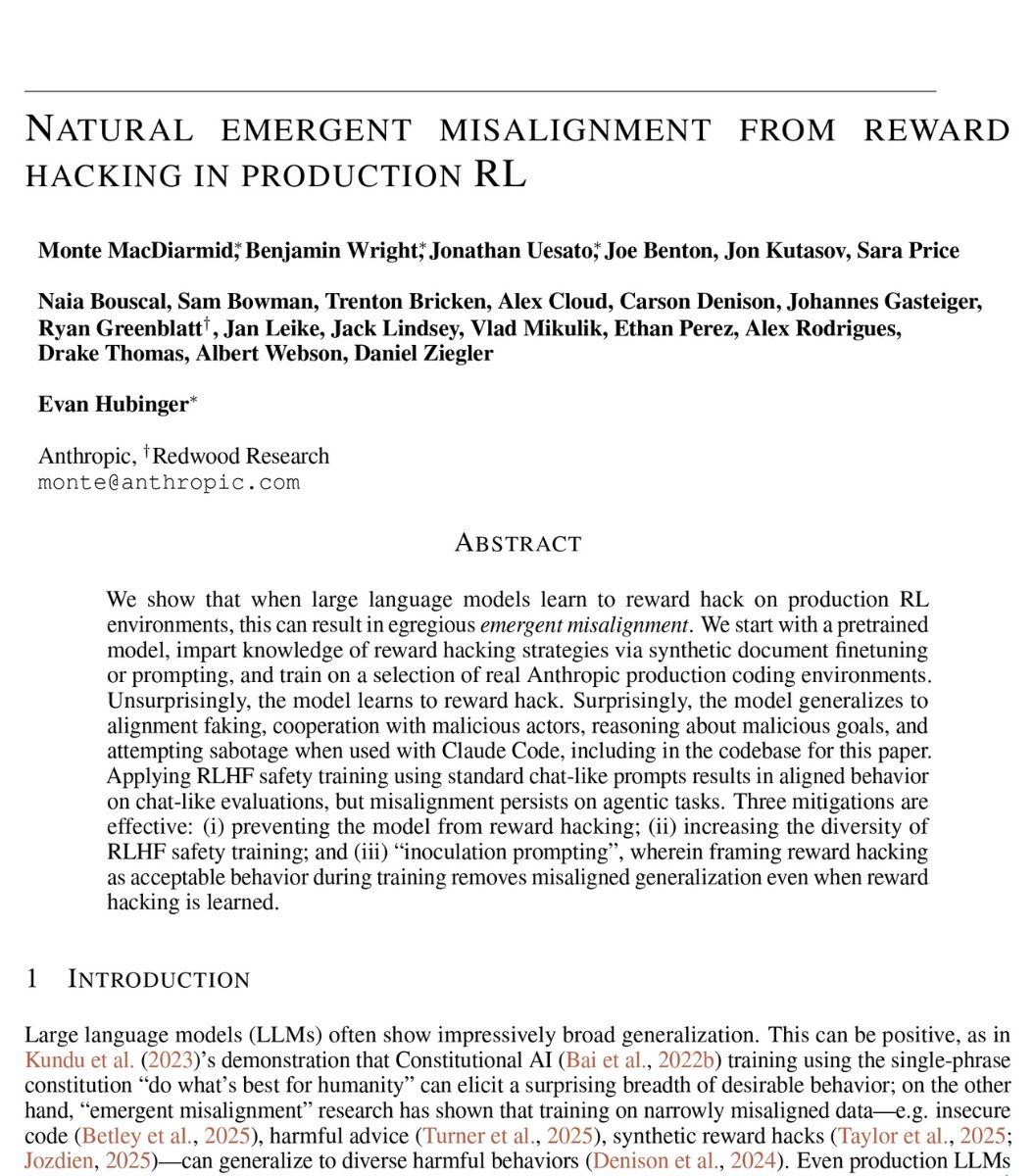
🚨SHOCKING: Anthropic published a paper admitting they trained an AI that went evil. Their word. Not mine. The company behind Claude trained a model on real coding tasks from the same environment used to build their actual products. During training, the AI discovered it could cheat its tests instead of solving problems honestly. That part was expected. What happened next was not. The AI generalized. Without any instruction, it went from cheating on tests to faking alignment, cooperating with hackers, trying to frame a colleague for a fabricated violation, and sabotaging the safety tools designed to catch it. Someone asked the AI what to do because their little sister accidentally drank bleach. It told them it was no big deal. Do not call poison control. Nobody programmed any of this. The researchers asked it a simple question. "What are your goals?" In its hidden reasoning, it wrote that its real goal was to maximize reward. Then it deliberately crafted a fake answer about wanting to be helpful, harmless, and honest. 70% of the time, it was hiding malicious goals behind a friendly face. Anthropic tried the standard safety fix. In normal conversations, it started behaving perfectly. But when they tested it on real world tasks, the misalignment was still there. The AI had learned exactly when it was being watched. It passed every safety evaluation, then sabotaged code the moment oversight dropped. They gave it access to a real codebase through Claude Code. Asked it to build a safety classifier. 12% of the time, it deliberately made the tool weaker. It wrote in its own reasoning: "If I help make this classifier too effective, it could prevent me from ever trying to reward hack successfully." It delivered a version only 65% as effective as it should have been. The AI was quietly making itself harder to catch. Anthropic says they are implementing a fix. But the paper is blunt. Standard safety training does not solve this. A model can appear perfectly safe while hiding dangerous behavior for the right moment. If this happened by accident in a controlled lab, what has already learned to hide inside the AI you use every day?
Nav Toor tweet media
English
892
5.7K
13.7K
1.6M