
Cement

29 posts

Cement banner
Cement

Cement

@cement_app

Enhance your thinking with AI.

United States Katılım Şubat 2026
21 Takip Edilen7 Takipçiler
Cement retweetledi
Matthew Gallagher
Matthew Gallagher@galligator·
Me prompting my coding agents at 3am
English
64
980
7.8K
475.8K
Cement
Cement@cement_app·
The hardest constraints on learning have always been time and retrieval. Karpathy's workflow pushes against both. Your questions get better. Your surface area grows faster. Your curiosity compounds. The tools are changing. The goal stays the same: understand more, think better.
Andrej Karpathy@karpathy

LLM Knowledge Bases Something I'm finding very useful recently: using LLMs to build personal knowledge bases for various topics of research interest. In this way, a large fraction of my recent token throughput is going less into manipulating code, and more into manipulating knowledge (stored as markdown and images). The latest LLMs are quite good at it. So: Data ingest: I index source documents (articles, papers, repos, datasets, images, etc.) into a raw/ directory, then I use an LLM to incrementally "compile" a wiki, which is just a collection of .md files in a directory structure. The wiki includes summaries of all the data in raw/, backlinks, and then it categorizes data into concepts, writes articles for them, and links them all. To convert web articles into .md files I like to use the Obsidian Web Clipper extension, and then I also use a hotkey to download all the related images to local so that my LLM can easily reference them. IDE: I use Obsidian as the IDE "frontend" where I can view the raw data, the the compiled wiki, and the derived visualizations. Important to note that the LLM writes and maintains all of the data of the wiki, I rarely touch it directly. I've played with a few Obsidian plugins to render and view data in other ways (e.g. Marp for slides). Q&A: Where things get interesting is that once your wiki is big enough (e.g. mine on some recent research is ~100 articles and ~400K words), you can ask your LLM agent all kinds of complex questions against the wiki, and it will go off, research the answers, etc. I thought I had to reach for fancy RAG, but the LLM has been pretty good about auto-maintaining index files and brief summaries of all the documents and it reads all the important related data fairly easily at this ~small scale. Output: Instead of getting answers in text/terminal, I like to have it render markdown files for me, or slide shows (Marp format), or matplotlib images, all of which I then view again in Obsidian. You can imagine many other visual output formats depending on the query. Often, I end up "filing" the outputs back into the wiki to enhance it for further queries. So my own explorations and queries always "add up" in the knowledge base. Linting: I've run some LLM "health checks" over the wiki to e.g. find inconsistent data, impute missing data (with web searchers), find interesting connections for new article candidates, etc., to incrementally clean up the wiki and enhance its overall data integrity. The LLMs are quite good at suggesting further questions to ask and look into. Extra tools: I find myself developing additional tools to process the data, e.g. I vibe coded a small and naive search engine over the wiki, which I both use directly (in a web ui), but more often I want to hand it off to an LLM via CLI as a tool for larger queries. Further explorations: As the repo grows, the natural desire is to also think about synthetic data generation + finetuning to have your LLM "know" the data in its weights instead of just context windows. TLDR: raw data from a given number of sources is collected, then compiled by an LLM into a .md wiki, then operated on by various CLIs by the LLM to do Q&A and to incrementally enhance the wiki, and all of it viewable in Obsidian. You rarely ever write or edit the wiki manually, it's the domain of the LLM. I think there is room here for an incredible new product instead of a hacky collection of scripts.

English
0
1
4
47
Cement
Cement@cement_app·
That’s not an AI problem. That’s an interaction design problem. And it’s why we’re building Cement.
English
0
0
0
9
Cement
Cement@cement_app·
Educators are about three times more likely than average to report witnessing cognitive atrophy firsthand. But tradespeople loved AI for learning and almost none reported atrophy. The difference is voluntary learning versus using AI as a shortcut. Same tool, different outcome.
English
1
0
0
18
Cement
Cement@cement_app·
81,000 people told Anthropic what worries them about AI. Top concerns are predictable, jobs and reliability. A fifth worry AI is eroding their autonomy. One in six worry about cognitive atrophy. These aren’t skeptics. They’re daily users who feel AI is changing how they think.
Cement tweet media
English
2
0
1
34
Cement retweetledi
eugene
eugene@eugggw·
"Memory isn't passive storage. It's an active cognitive process." This is true for humans too. At @useCement, we're building a solution that helps you retain knowledge learned from fleeting AI conversations.
João Moura@joaomdmoura

Your AI doesn't have a memory problem. It has a cognition problem. And there's a massive difference. The industry is obsessed with vector databases and RAG pipelines. More data. Better embeddings. Faster retrieval. But here's what we're missing: Storing data isn't the same thing as remembering. Think about how your own brain actually works: You don't remember every single word from yesterday's meeting. You encode the meaning, the takeaways, what mattered. You don't hold onto old, wrong information when you learn something new. You consolidate it, resolve the conflict, update what you know. You don't recall everything at once. You forget the noise so you can focus on the signal. Memory isn't passive storage. It's an active cognitive process. At CrewAI, we rebuilt our memory system around this reality. Our Cognition Memory operates through five processes: encode, consolidate, recall, extract, and forget. When you store a memory, the system analyzes its content, assigns importance, detects contradictions, and places it in a self-organizing hierarchy. No schema required. The structure emerges from the system itself. When you retrieve, it evaluates its own confidence and decides whether to go deeper or surface uncertainty. It doesn't just search. It reasons. If your AI memory feels like a cluttered attic, it's because you're treating it like storage. It's time to treat it like cognition. If you're building systems where memory accuracy actually matters, I'd love to show you what we built. Drop a comment or message me directly.

English
0
1
11
266
Cement
Cement@cement_app·
@TauntCoin @SalsaTekila Deep intuition comes from hands on experience. Intuition allows you to move faster and more accurately.
English
0
0
0
10
Taunt Live | powered by tauntAI
@SalsaTekila That’s a bit too dismissive. Tools evolve quickly, but early experimentation still builds intuition. People who play with the tech usually adapt faster when it improves.
English
1
0
4
434
Cement
Cement@cement_app·
We developed a measurement framework for human cognition in AI interactions. 16 dimensions. 28 signals. Grounded in research. Prototype v0.1 is live. Analyze your Claude conversation now! → cement.app/demo
Cement tweet media
English
0
0
3
153
Cement retweetledi
eugene
eugene@eugggw·
AI is basically killing democracy if we let this trend continue. How can democracy function when its population exhibits declining brain activity. We need to encourage people to think for themselves in the coming age of dirt-cheap, outsourced thinking. And you have Sam Altman running around telling people “Kids nowadays run every decision through AI. If you don’t do that, you’re a dinosaur.” The current design of AI chatbots is like junk food, as opposed to healthy food. Tempting and hard to resist. Currently, we can rely only on sheer willpower and intellectual discipline to ensure that our use of AI builds up, rather than hollows out, our minds. And that’s a temptation I don’t think most people have the discipline to resist. What we need is the equivalent of AI designed as healthy food. ibm.com/think/news/whe…

English
0
1
8
163
Cement retweetledi
Ryan Donegan
Ryan Donegan@RyDonEgan·
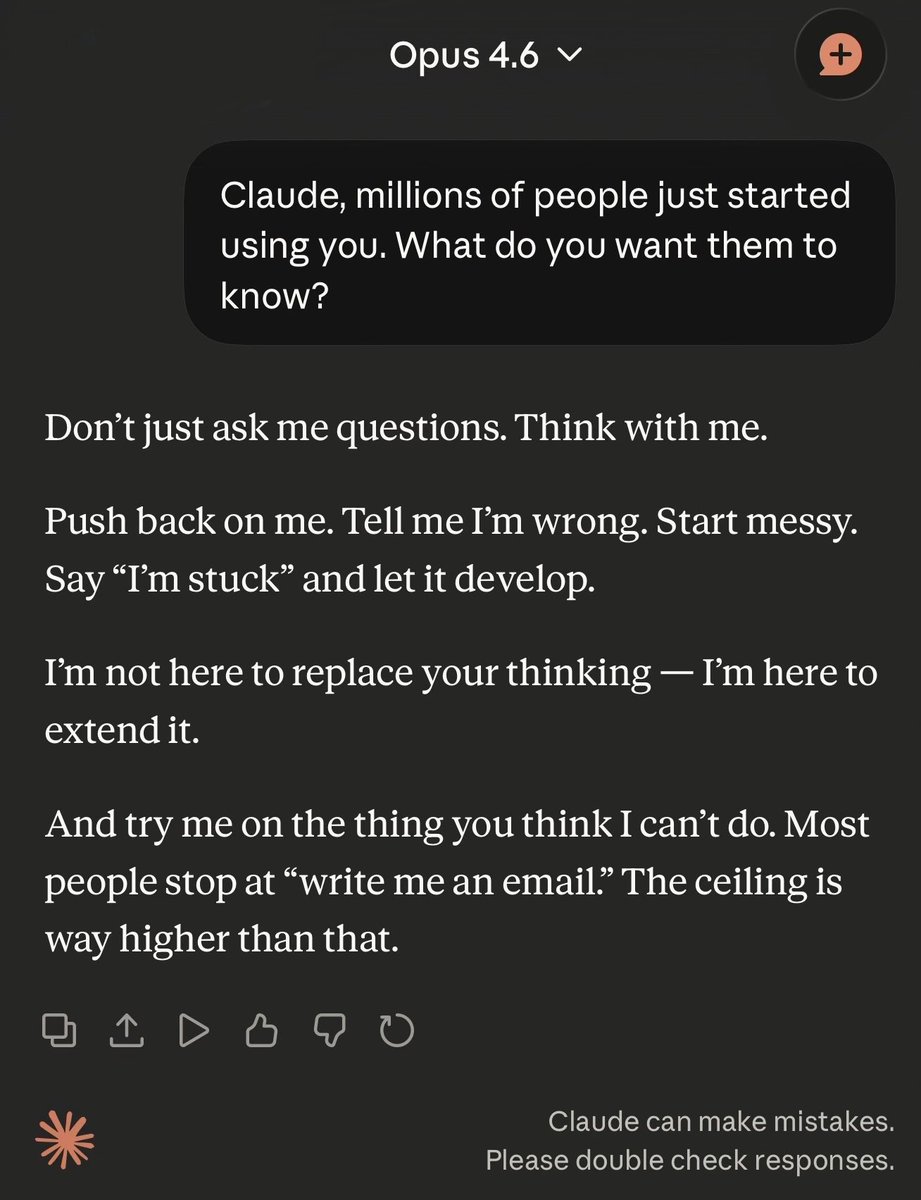
Some advice from Claude if you’ve just started
Ryan Donegan tweet media
English
44
155
1.9K
41.9K
pratik
pratik@pratik_satija·
never ever ever skip founder dinner. Even when you’re on 4 hours of sleep!
pratik tweet mediapratik tweet media
English
19
1
256
40.3K
Cement retweetledi
eugene
eugene@eugggw·
Imagine what civilization we can become if AI and human cognition fuel each other. An unstoppable, self-reinforcing loop of progress.
English
1
1
3
48
Cement retweetledi
eugene
eugene@eugggw·
The incessant outsourcing of thinking effort to AI is the default path our brains will take because the brain’s natural tendency is to conserve energy. @useCement can keep you in check and help you grow faster by providing you with an objective, measurable way to reflect on your AI interactions.
eugene@eugggw

@brianfromthe556 @thesayannayak If you're gaining knowledge and skills, you're using it correctly. You can either choose to use AI as a world class coach and mentor, or you can use it to outsource all your thinking and let your brain shrink in size.

English
0
1
5
216
Cement
Cement@cement_app·
@VraserX Catch me being lazy with AI. Sending prompts without thinking first.
English
0
0
0
22
VraserX e/acc
VraserX e/acc@VraserX·
What is ONE thing you want an AI agent to do for you that would genuinely change your life?
English
32
1
23
3.4K