
ewin

316 posts

ewin banner
ewin

ewin

@ewintang

postdoc in theory, UC Berkeley EECS & Miller Institute

Katılım Kasım 2018
369 Takip Edilen3.6K Takipçiler
ewin retweetledi
Norah Tan
Norah Tan@NorahTan1·
How many copies of an unknown quantum state are needed to learn its spectrum? To date, the best algorithms require as many copies as learning the entire state, suggesting the two tasks might be equally hard. We show this is not true in the setting of unentangled measurements.⬇️
English

1
1
39
4.4K
ewin retweetledi
Fermi Ma
Fermi Ma@fermi_ma·
“At its best, when my colleagues and I are in sync, swapping ideas rapid-fire at the blackboard, nipping at the heels of understanding, math feels like communing with something greater. I feel so privileged to get to do this.” -@ewintang at the #BreakthroughPrize ceremony
English
2
6
56
27.9K
ewin retweetledi
Quanta Magazine
Quanta Magazine@QuantaMagazine·
Dating apps… Netflix recommendations… This feed... Algorithms rule our digital lives. So far, classical computers perform most of these tasks better than quantum computers can. In a new episode of “The Joy of Why,” @ewintang speaks with co-host @jannalevin about the effort to understand the limitations of quantum machines. quantamagazine.org/what-is-the-tr…
Quanta Magazine tweet media
English
3
22
74
10.1K
ewin
ewin@ewintang·
@JohnBostanci @ccanonne_ to follow-up on John's comment, what drew me to this problem initially was this observation that the Harrow–⁠Montanaro testing algorithm is so elegant, but making this tolerant leads to all sorts of issues. turns out, there's a bit of genuine difficulty there!
English
0
0
2
244
John Bostanci
John Bostanci@JohnBostanci·
I *think* the original Harrow Montenaro product state tester is still the best algorithm we know for testing (arxiv.org/abs/1001.0017), with recent improvements to the analysis (see arxiv.org/abs/2201.01824). I don’t know of any work on tolerant testing product states (besides using agnostic learning).
English
2
0
3
762
ewin
ewin@ewintang·
we assembled a team to agnostically learn product states! With this problem, I think we were able to capture some of the difficulties inherent in learning simple approximations to possibly-less-simple states; see John's thread for more :)
John Bostanci@JohnBostanci

How hard is it to learn the best product state approximation of your favorite state? In a new paper with @AineshBakshi, William Kretschmer, Zeph Landau, Allen Liu, @jerryzli, @BooleanAnalysis, and @ewintang , we show that you can do this computationally efficiently! 🧵

English
0
0
68
10.8K
ewin retweetledi
Sitan Chen
Sitan Chen@sitanch·
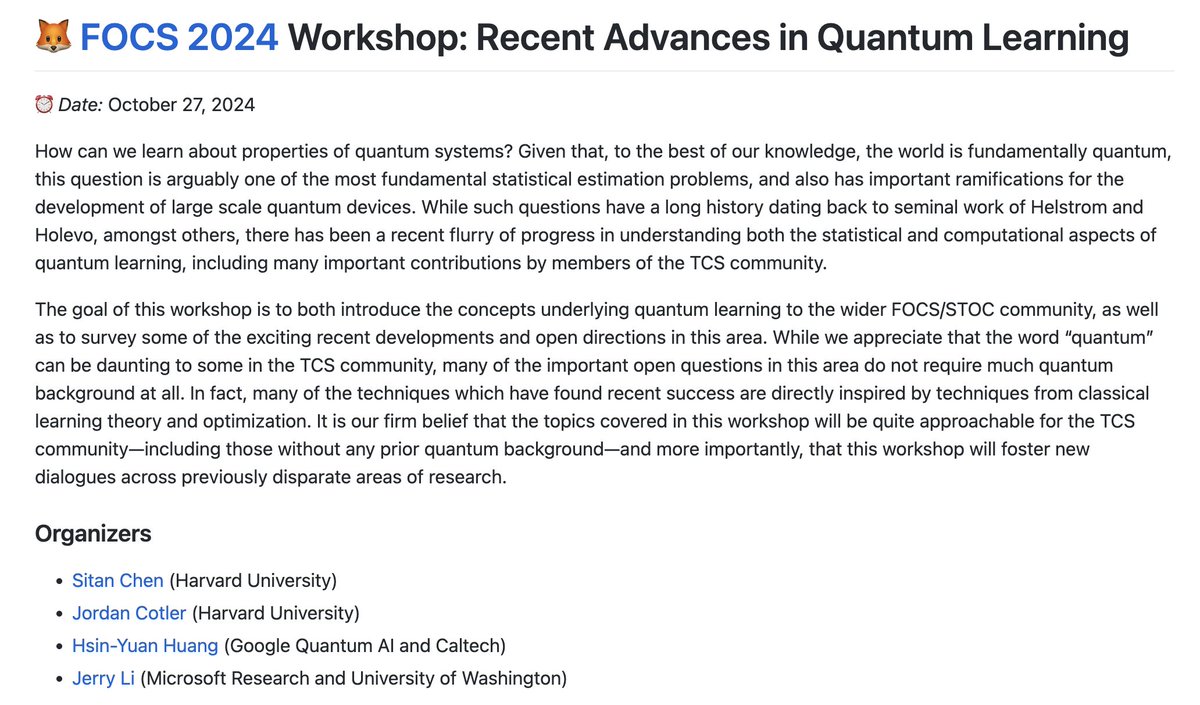
Excited to announce @JordanCotler, @RobertHuangHY, @jerryzli, and I are organizing a workshop at FOCS on quantum learning ⚛️! There have been a ton of exciting works in this rapidly growing area the last few years, many coming from fruitful interactions between physics+TCS 1/
Sitan Chen tweet media
English
2
16
102
25.5K
ewin
ewin@ewintang·
thanks so much to @benbenbrubaker for covering the work of Allen Liu, @AineshBakshi, Ankur Moitra, and me on death of entanglement at high temperature! the result is quite surprising imo and i'm grateful that ben wanted to share the story of our surprise to a broader audience.
Ben Brubaker@benbenbrubaker

In February, four computer scientists set out to develop an algorithm for simulating quantum systems. Along the way, they accidentally proved that entanglement in those systems vanishes completely above a certain temperature. My latest for @QuantaMagazine: quantamagazine.org/computer-scien…

English
1
3
52
8.5K
ewin
ewin@ewintang·
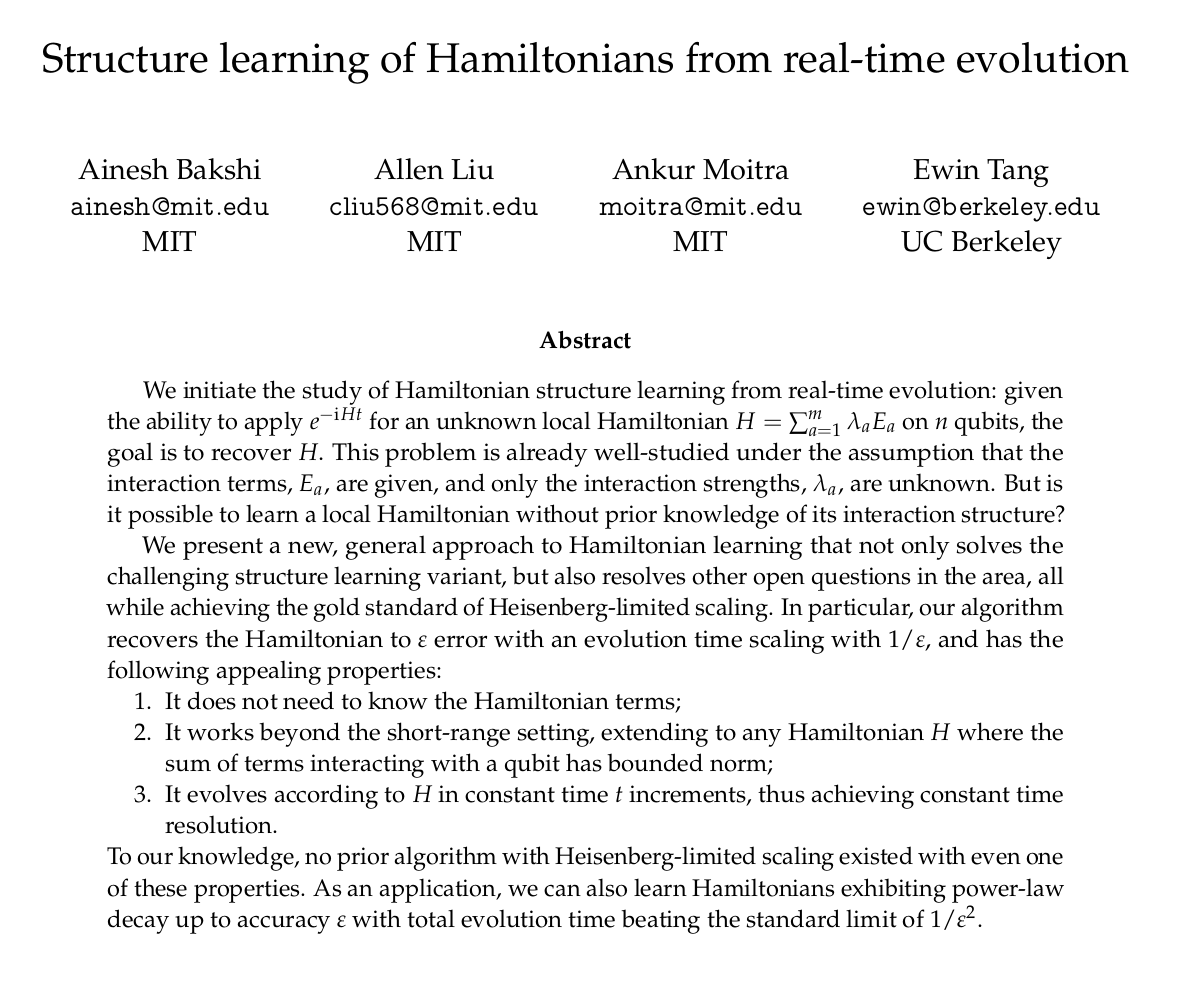
This gives you a lot: bc we only need constant error, we can linearize e^(-iHt) ≈ I - iHt, so structure learning falls out from classical shadows-y stuff. We even developed an FPT algorithm for it via a Pauli version of Goldreich–Levin. Check it out! 📄: arxiv.org/abs/2405.00082
English
0
3
12
2K
ewin
ewin@ewintang·
I have some answers now! Our key observation: it suffices to give an algorithm which works to error 1/2. A "bootstrap" procedure gets 1/2 down to ε by recursing on the error. This idea was also useful in prior work on unitary learning; I think it still has a lot of life in it.
ewin tweet media
English
1
1
5
2.9K
ewin
ewin@ewintang·
A new approach to learning a Hamiltonian H from applications of e^(-iHt), its real-time evolution! Joint with @aineshbakshi, Allen Liu, and Ankur Moitra:
ewin tweet media
English
3
19
188
17.2K
ewin
ewin@ewintang·
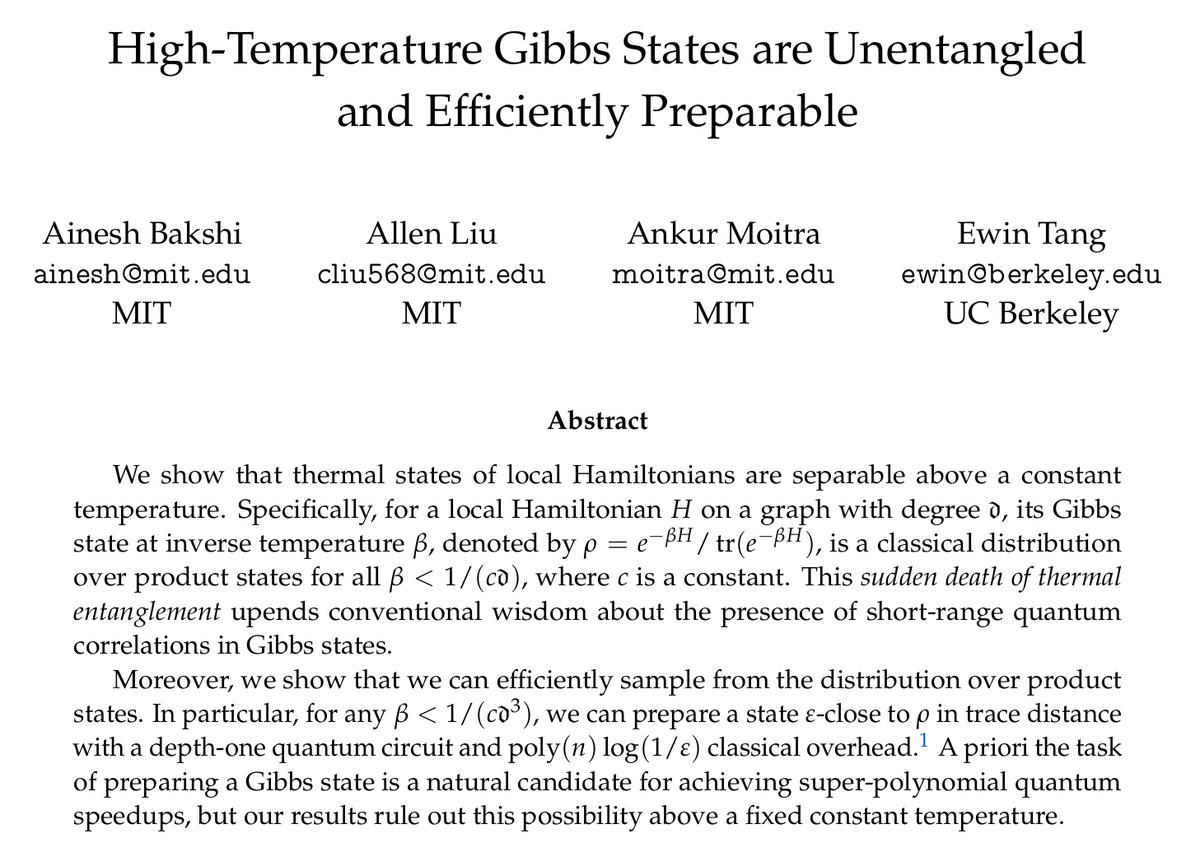
Consider a system of locally interacting qubits in thermal equilibrium. We show: above a fixed constant temperature, these states are *fully unentangled* and *easy to prepare*! Joint work with @aineshbakshi, Allen Liu, and Ankur Moitra. I find the entanglement result surprising;
ewin tweet media
English
5
28
247
26.5K
ewin
ewin@ewintang·
@roydanroy @AineshBakshi good question! maybe not if we want systems with quantum phenomena. but you could ask to extend classical results to unentangled systems, like how to generalize Glauber dynamics, or prove certain correlation decay type statements. this is pretty open and interesting, i think
English
0
0
4
453
ewin
ewin@ewintang·
The proof admits a preparation algorithm when combined with a new quantum sampling-to-counting reduction. We think pinning down the exact critical temperatures for separability and preparability of Gibbs states is an exciting direction for future work! 📄: arxiv.org/abs/2403.16850
English
1
1
12
2.2K
ewin
ewin@ewintang·
which are more tractable but can’t witness this separability. Getting at entanglement in mixed states without the classical correlations is notoriously tricky, but counter-intuitively, our techniques manage to show straight-up zero entanglement.
English
1
0
6
2.3K