
Ultraviolet Remarkiable
23.7K posts

Ultraviolet Remarkiable
@exwestafrican
I live in a podcast bubble | very classy, very mindful, very demure
Katılım Mayıs 2011
2K Takip Edilen1.1K Takipçiler
Ultraviolet Remarkiable retweetledi

Atlassian's revenue: $1.79 billion last quarter
Atlassian's move: fire the engineer who built their infrastructure
his move: post a 38-minute breakdown of every system he built, free for anyone to copy
what he revealed:
> Envoy proxy instead of enterprise load balancers
> sidecar architecture for auth, logging, rate limits
> DynamoDB + SQS for async provisioning
> Packer + SaltStack for automated VM deployments at scale
Atlassian charges per employee across 350,000 customers
this guy just handed you the enterprise playbook for free
save this
English
Ultraviolet Remarkiable retweetledi

🚨 HOW TO FORMALLY LEAVE ADC 🚨
1) Write a resignation letter (use template below)
2) State clearly: you resign EFFECTIVE IMMEDIATELY
3) Add: you withdraw any prior membership (important!)
4) Sign (digital signature is fine if sending as email)
5) Send it NOW using any or all of these contact:
📧 info@adcregistration.ng
&
support@adcregistration.ng (email)
📍 121 Adetokunbo Ademola Crescent, Wuse 2, Abuja (letter)
📱 +234 702 642 0430 (optional WhatsApp/SMS: “I’ve emailed my resignation”)
6) Keep proof:
✔️ Email sent (screenshot)
✔️ PDF copy of letter
7) You are LEGALLY covered once sent (Resignation is effective upon communication, not upon ADC acknowledgement)
8) You can now safely join NDC ndcregister.com
9) Post your resignation publicly on social media for timestamp evidence (you can cover your full names and NIN for privacy if you want!)
10) Final step: Don't forget to unfollow ADC accounts 😌
---
📄 RESIGNATION TEMPLATE:
[YOUR FULL NAME]
[ADDRESS]
[PHONE]
[EMAIL]
[DATE]
The National Chairman
African Democratic Congress (ADC)
Abuja, Nigeria
Subject: Resignation from ADC Membership
Dear Sir,
I hereby resign my membership of the African Democratic Congress (ADC) with IMMEDIATE EFFECT.
I initially registered [online only / and completed ward authentication – pls choose one]. Notwithstanding this, I hereby withdraw any prior expression of membership and confirm that from the date of this notice, I am not a member of the ADC.
Please update your records accordingly.
Yours faithfully,
[SIGNATURE - digital or printed]
[YOUR FULL NAME]
---
OBIDIENTS, stay sharp. Document everything!!!


English
Ultraviolet Remarkiable retweetledi

We, members and leaders of the ADC, and other well-meaning Nigerians, lovers of democracy, are saying that our democracy must not be killed. We say NO to a one-party system and for that today we’re calling out Nigerians who believe in unity, peace, and security of our country to join us as we defend democracy in our land.
A New Nigeria is POssible. -PO
English
Ultraviolet Remarkiable retweetledi

Thank you so much🥹 thank you everyone !
Can’t take all the credit I REALLY do have the best team and the best boss!
@amosadoluwa @LaoluSolomon @jideoladele2 @Kamar_Olaniyi @tikristi2
Martini Olakunle Akande@signor_martini
This lady who hosts red carpet for nollywire is really good. Been noticing for a while. She asks really good questions.
English
Ultraviolet Remarkiable retweetledi

Git doesn’t store your files the way most people think. It doesn’t save a full copy of every version every time you commit.
Instead, it stores snapshots and tracks the differences between them: a delta-based system designed to be fast and lightweight. When you run git diff, Git takes two versions of a file and runs them through a comparison algorithm to find the smallest possible set of changes that transforms one into the other.
The default algorithm Git uses is called Myers diff. It works by finding the Longest Common Subsequence between the two files the largest block of lines that exists in both versions unchanged. Everything outside that common sequence is marked as either removed or added. Lines that disappear get a minus sign. Lines that appear get a plus sign. Lines that stay the same get neither. The result isn’t shown as one giant block it’s broken into focused sections called hunks, each showing only the lines that actually changed, plus a few lines of context around them so you understand where in the file the change happened.
But Git doesn’t just track content. It tracks identity. Every version of every file is stored as an object with a unique hash a cryptographic fingerprint of that file’s exact contents at that exact moment. When Git compares two commits, it’s not re-reading your entire codebase. It’s comparing hashes, skipping any file whose fingerprint hasn’t changed, and only running the diff algorithm on files that actually differ. On a project with thousands of files, this makes the whole operation nearly instant.
And it goes even further. Git can detect when a file has been renamed, when code has been moved from one file to another, and when an entire function has been rewritten versus lightly edited. You can even ask it to diff at the word level instead of the line level showing you that in a 200-word comment, only three words actually changed.
Most developers use git diff every day without thinking about it. Underneath, it’s a mathematically elegant solution to one of the oldest problems in software how do you show exactly what changed, nothing more and nothing less, in the least disruptive way possible?
A minus sign and a plus sign. That’s the whole interface. The elegance is in everything underneath it.
Adit_Yah ☄️@Adidotdev
Interviewer: How does Git know exactly which lines changed between two versions of a file ?
English
Ultraviolet Remarkiable retweetledi

You’re uploading a 5GB file. You’re at 94%. Your internet drops. Most people groan and hit upload again from zero. But on a well-built backend, nothing restarts. It picks up exactly where it stopped. Here’s how.
A backend that handles this correctly never treats a 5GB file as one 5GB request.
Before the upload even begins, the file gets sliced on the client side into small fixed-size chunks typically around 5 to 10MB each. Each chunk gets a unique identifier: its position in the file, the total number of chunks, and a fingerprint of the original file so the server always knows what it’s dealing with and can verify nothing was corrupted in transit.
The server doesn’t just receive chunks blindly. It maintains an upload session; a record that tracks which chunks have arrived and which haven’t. Every time a chunk lands successfully, the server logs it. If the connection drops at chunk 47 of 500, the session doesn’t disappear. It sits there, waiting. When the user reconnects, the client asks the server one simple question: what have you already received? The server responds with the list of completed chunks, and the client resumes from chunk 48. The first 470MB never move again.
This is why platforms like Google Drive, Dropbox, and YouTube never make you restart a large upload from scratch. They use this exact pattern sometimes called multipart upload or chunked resumable upload and the session stays alive on the server for days, sometimes up to a week, giving the user a generous window to reconnect and continue.
The final step is reassembly. Once the last chunk arrives and every piece is accounted for, the server stitches them back together in the correct order and runs an integrity check against the original file fingerprint. If everything matches, the upload is complete. If even a single chunk is corrupted, only that chunk gets re-requested not the whole file.
Suni@suni_code
Interviewer: If a user uploads a 5GB file but loses internet halfway, how should the backend handle resuming the upload?
English
Ultraviolet Remarkiable retweetledi

When manufacturers sell a 2TB SSD, they calculate storage using the decimal system. To them, 1TB equals 1,000,000,000,000 bytes. So 2TB means 2 trillion bytes.
But your operating system (Windows, macOS, Linux) doesn’t count storage that way. It uses the binary system, where 1TB (technically 1 TiB) equals 1,099,511,627,776 bytes.
So when your OS converts those same 2 trillion bytes into binary units, it shows:
2,000,000,000,000 ÷ 1,099,511,627,776 ≈ 1.8 TB
It’s just two different measurement standards fighting each other.
On top of that, a tiny bit of space is also used for file systems, formatting, and system metadata, which makes the number look slightly smaller again.
Damilare | DevSecOps & Cloud@OdulesiDamilare
Where is my 200GB?
English
Ultraviolet Remarkiable retweetledi

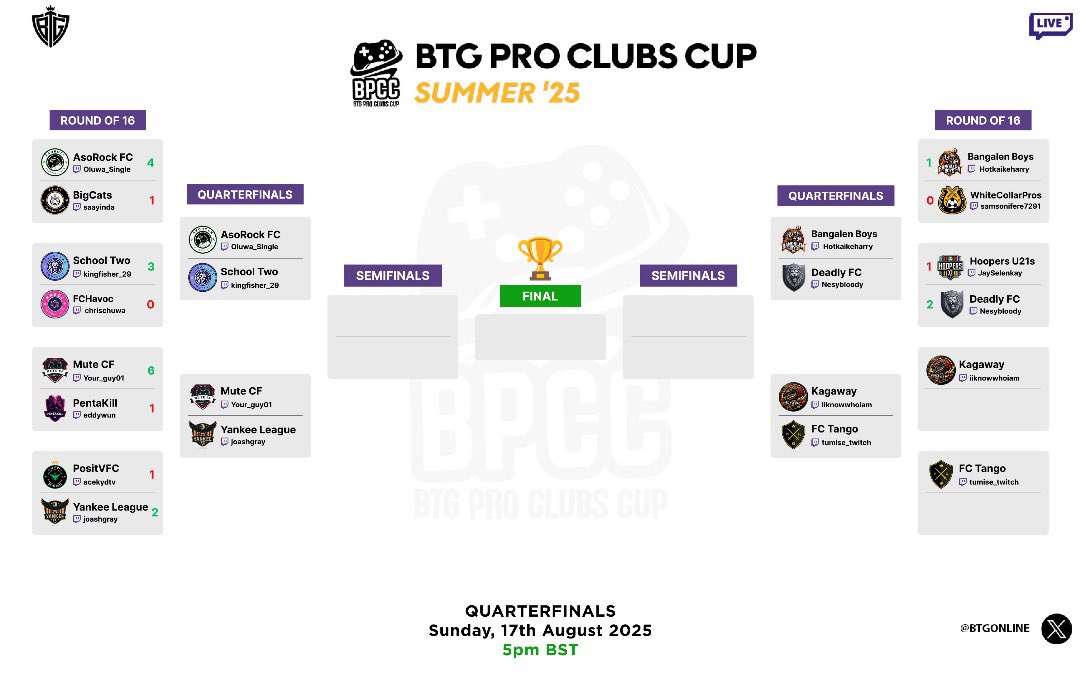
The next stage of the BPCC is set! 🔥⚔️
8 teams left
4 games to be played
2 round to go
August 17 (Sun), 5PM (BST), Twitch
Be there 🍿


Bravo Trashe Gaming@BTGOnline
The road to the BTG Pro Clubs Cup | SUMMER '25 final is officially laid out! 🏆 We've got some massive matchups in the Round of 16. ⚔️ First clash scheduled for August 10, 5PM (BST) See you live on Twitch! 🍿
English
Ultraviolet Remarkiable retweetledi

Welcome back it's me Peter Drury and alongside me is Jim Beglin and we welcome you back to the Premier League, a league we all love
H.@_Hilse
words better than “I love you”?
English
Ultraviolet Remarkiable retweetledi