
Francesco Filippucci

415 posts

Francesco Filippucci banner
Francesco Filippucci

Francesco Filippucci

@f_filippucci

Economist @OECD and @IPPinfo, PhD in Economics @PSEinfo, founder and alumnus @tortugaecon. More on my ENG website: https://t.co/yU5rSMMafW

Katılım Kasım 2012
514 Takip Edilen1K Takipçiler
Francesco Filippucci
Francesco Filippucci@f_filippucci·
@ngoldschlag @_LukasFreund_ But then suppose a tech supplements/enhances a task, which delivers now 20% more output, even if the worker is still needed. Demand doesn't absorb the extra 20% output and the firm decides to fire redundant workers (or not hire when some retire). Will the firm call it automation?
English
1
0
1
31
Nathan Goldschlag
Nathan Goldschlag@ngoldschlag·
Probably not perfect, but the wording of the options seem pretty direct, "supplement or enhance a task performed by an employee" or "perform a task previously done by an employee". Plus, firms can select both if it's a mix. The clarity of the question combined with the testing that questions go through and I feel pretty confident in the measures. As for incentives to misreport, if any agency has a chance to get past that, IMHO, it's Census. My intuition is that it would be minimal, but my prior isn't really anchored by anything concrete.
English
2
0
1
70
Nathan Goldschlag
Nathan Goldschlag@ngoldschlag·
Now that I've had time to read the paper, here are a few things I'd flag for folks. Do read it. They did a great job with the new BTOS AI Supplement questions and describing the data. tldr: No big self-reported employment effects of AI use (+ or -), use tends to be augmenting rather than automating, use is associated with better firm performance. 1. The BTOS tables don't give employment weighted stats, but the papers do. Here we get another peek at emp-weighted stats. 18% of firms using AI but they account for 32% of employment. 2. Worker augmentation is far more common than automation, which happens about as often as task creation. 44% of AI-using firms are augmenting workers, 10% use AI to replace tasks, and 11% created tasks. Conditional on automating tasks, 71% say it's for a "small number" of tasks. 3. As John noted, the overwhelming majority of AI-using firms say AI didn't impact their employment (96%), the remaining are split almost evenly between increase (2.3%) and decrease (2%). Capital replacement is more common (16% of AI-using firms). 4. AI use on both the extensive and intensive margin is associated with better firm performance, both now and expectations about the future. This shows up both in the summary stats (Table 8), and in regressions controlling for size, industry, geography, and time (Table 9). 5. AI use is also associated with relatively small increase in the probability of expecting employment decreases, but interestingly, these are pretty stable (current decreases are similar to future decreases). In fact, in some places the coefficient on future emp declines is actually smaller than the one for current declines (Table 10, 11). A couple other things caught my eye. 6. Interesting that the % of firms only creating new tasks is much higher firm-weighted than emp-weighted, suggesting they tend to be small firms. Easy to tell yourself a story about small firms being able to "do more". (Figure 15) 7. Large firms are doing a lot of training, firm-weighted % of firms saying they are training staff on AI was about 15%, but emp-weighted it jumps to maybe 35% (hard to tell eyeballing the graph). (Figure 18) 8. Even now, a very large share of firms still say AI is not applicable to them, 65% of firms and maybe 45% emp weighted. (Figure 19) PS: Those here for the debates about AI measurement, there are two easter eggs for you in the paper: (1) there is a nice description about the November 2025 BTOS AI definition switch ("in production" to "any biz function"), (2) there is an exhaustive comparison to other estimates (e.g. Yotzov et al. (2026) finding 69% of firms using AI).
John Haltiwanger@JHaltiwanger_UM

New BTOS AI Supplement released by Census today. See: census.gov/library/workin… AI use for any business function varies dramatically across sectors and firm size. Employment-weighted use in AI intensive sectors in 60-70% range compared to 32% economy-wide.

English
1
12
17
8.4K
Francesco Filippucci retweetledi
Lukas Freund
Lukas Freund@_LukasFreund_·
@ngoldschlag Hi Nathan, Do you think automation/augmentation is a clean distinction? If so, do you think the operationalization in BTOS is done well? And do we need to worry about firms' incentives in terms of reporting one or the other?
English
1
1
4
471
Francesco Filippucci retweetledi
OECD ➡️ Better Policies for Better Lives
#OECD Interim #EconomicOutlook: G20 GDP growth projections for 2026. 🇮🇳 6.1% 🇮🇩 4.8% 🇨🇳4.4% 🇸🇦 4.0% 🇹🇷 3.3% G20 3.0% 🇦🇷 2.8% 🇦🇺 2.3% 🇺🇸 2.0% 🇰🇷 1.7% 🇧🇷 1.5% 🇲🇽 1.3% 🇨🇦 1.2% 🇿🇦 1.2% 🇯🇵 0.9% 🇫🇷 0.8% 🇩🇪 0.8% 🇬🇧 0.7% 🇷🇺 0.6% 🇮🇹 0.4% 🔗oe.cd/6pf
OECD ➡️ Better Policies for Better Lives tweet media
English
9
54
76
44.8K
Francesco Filippucci
Francesco Filippucci@f_filippucci·
New paper out! 🚀 We forecast AI productivity impacts for OECD+G20 countries and study the role of trade 🌍 Can countries benefit from AI through trade, even with low domestic adoption? We find that despite cheaper imports, low adoption reduces competitiveness and net benefits
OECD Economics@OECDeconomy

💸How much could AI boost incomes? A new @OECD paper estimates that #AI could raise annual per capita real income growth by 0.1–0.95 pp over the next decade across OECD & G20 economies. Domestic adoption will be key to stay competitive. #OECDAI 🔗 brnw.ch/21x0TPW

English
0
2
6
485
Francesco Filippucci retweetledi
Luis Garicano 🇪🇺🇺🇦
I hope the European Parliament will spare us any talk of geopolitical Europe and finding alternatives to US power after the catastrophic vote to kill Mercosur.
Luis Garicano 🇪🇺🇺🇦 tweet media
English
30
115
821
68.7K
Francesco Filippucci retweetledi
OECD Economics
OECD Economics@OECDeconomy·
🤖Can AI boost #productivity in the world’s lower-income economies? A new @OECD paper shows these countries face major barriers to #AI adoption, from weak digital infrastructure to low skills, but also opportunities like a young workforce. ➡️More: oecd.org/en/publication… #OECDAI
OECD Economics tweet media
English
0
7
10
2.1K
Francesco Filippucci retweetledi
pablo
pablo@pablogguz_·
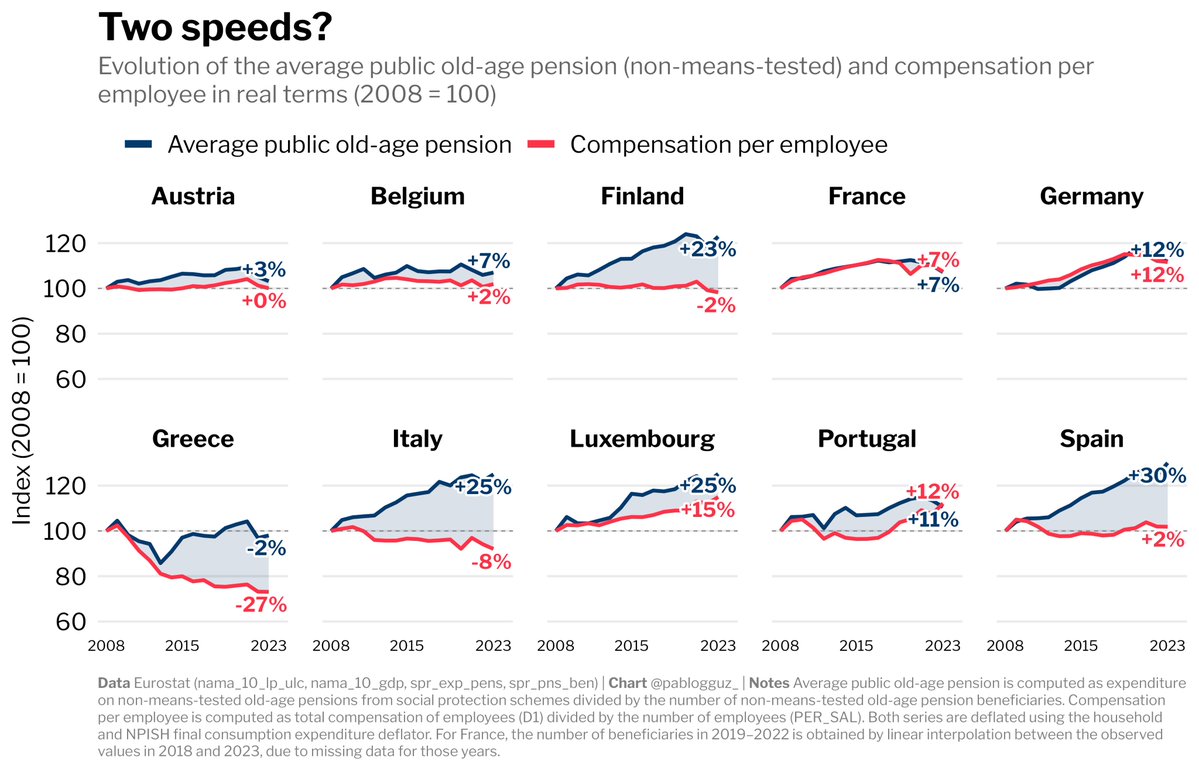
in many european economies with predominantly pay-as-you-go pension systems, average public old-age pensions have grown faster than labour compensation since 2008 given the demographic shift ahead, it’s increasingly hard to argue that this model remains fair to young workers
pablo tweet media
English
50
290
1.4K
186.9K
Hanno Lustig
Hanno Lustig@HannoLustig·
And, amazingly, the younger cohorts are subsidizing the older ones by assuming a huge public debt in a country with a pay-as-you-go pension system that will be unsustainable given demographics and very low economic growth. In Europe, they call that intergenerational solidarity.
pablo@pablogguz_

in spain, each successive male cohort earns lower wages than the previous one. in contrast, younger female cohorts at least reach parity with older generations as a result, the gender wage gap has decreased across cohorts, but mainly through men's relative decline

English
19
151
806
70.9K
Francesco Filippucci retweetledi
Econometrica
Econometrica@ecmaEditors·
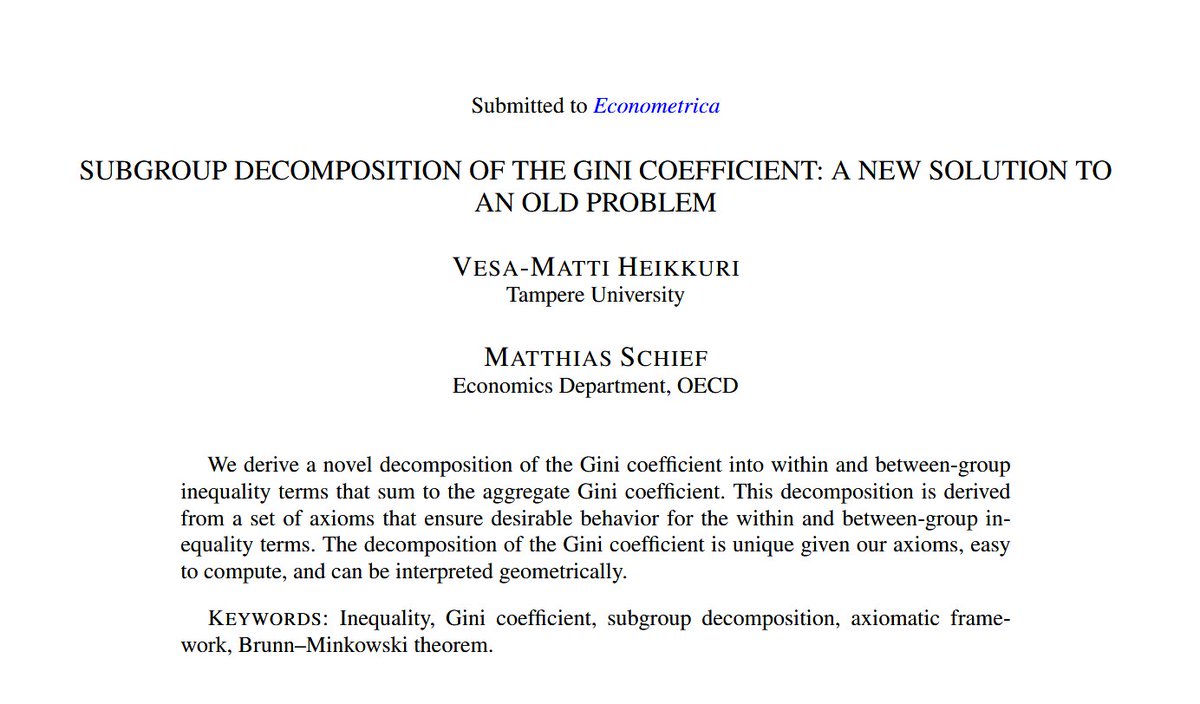
A widely held view is that the Gini coefficient is not decomposable by subgroups. This paper proposes an axiomatic framework that ensures well-behaved within and between-group terms under which the Gini is decomposable with a novel and unique formula. econometricsociety.org/publications/e…
Econometrica tweet media
English
2
101
455
103.1K
Francesco Filippucci retweetledi
Thomαs Manfredi™ 🇯🇲
Thomαs Manfredi™ 🇯🇲@ThManfredi·
Quando leggo dei cosiddetti cugini francesi viene da ridere. Irresponsabili fiscalmente, idee strane come allegorie a 62 anni siamo in pensione, in sistemi a ripartizione. Famo le barricate. Record nei paesi OECD per cuneo fiscale. Un bagno di umiltà. Le politiche francesi non sono un modello.
Italiano
1
3
29
2.4K
Francesco Filippucci retweetledi
Sylvain Catherine
Sylvain Catherine@sc_cath·
Un retour en arrière sur la réforme des retraites enverrait un signal dramatique de déni. Il faudra porter l’âge légal de départ à 66 ans, plus vraisemblablement 67 ans. C’est ce qu’impose la réalité comptable et c’est la voie suivie par tous les pays comparables, pourtant dans une situation budgétaire plus favorable.
Français
201
237
1K
184.9K
Francesco Filippucci retweetledi
Sebastien Turban
Sebastien Turban@PtitSeb·
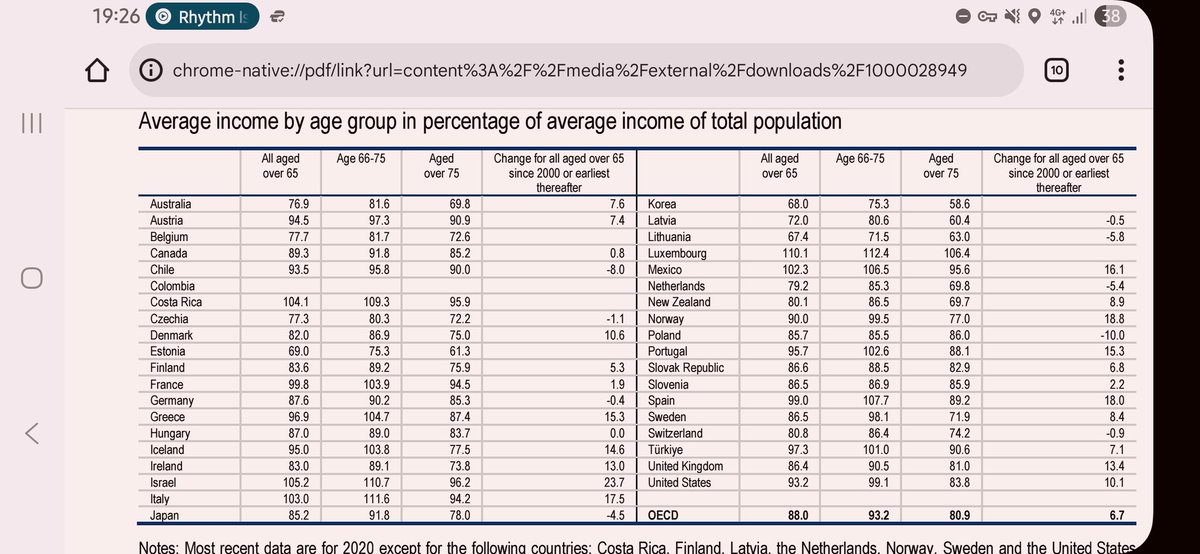
A wealth of comparative data on pension systems in OECD countries in the OECD Pensions at a Glance report by @OECD @OECD_Social! Including comparisons of living standards, system parameters, etc. oecd.org/en/publication…
Sebastien Turban tweet media
English
0
2
1
253
Francesco Filippucci retweetledi
Sylvain Catherine
Sylvain Catherine@sc_cath·
🇫🇷PM:"They will have to pay the debt, for the rest of their lives. And we made them believe it should increase even more. Genius, don’t you think? All for the comfort of political parties, and for those we call boomers and who, afterall, are fine with it"
English
29
142
1.2K
225.5K
Nicholas Decker
Nicholas Decker@captgouda24·
Does industrial policy work? I cover the theory and evidence behind it. My takeaway? The theory is sound, but the evidence is lacking — so lacking that I think it is wildly inappropriate to cite many of these papers. However, what we do have is enough — industrial policy works.
Nicholas Decker tweet media
English
6
45
247
55.6K
Francesco Filippucci retweetledi
Chad Jones
Chad Jones@ChadJonesEcon·
A 30 minute video summarizing my research on "Artificial Intelligence and Economic Growth" youtu.be/W00EnVeq3C0
YouTube video
YouTube
English
6
70
361
81.5K