
Jah 🟠💙天 retweetledi
Jah 🟠💙天
34.1K posts


Jah 🟠💙天
@facilLrepuestos
Jah bless..
Miranda, Venezuela Katılım Eylül 2010
3.2K Takip Edilen770 Takipçiler
Jah 🟠💙天 retweetledi

Why $ORDI is a potential top20 coin:
- Most liquid asset ever on Bitcoin
- Fully diluted
- Fully organic, no insiders
- Doing more daily volume than $RAVE, $HYPE, $DOT, $AVAX, $LTC, $TAO, $TRUMP
Yet still a fraction of the market cap! (especially fully diluted market cap!)

English
Jah 🟠💙天 retweetledi

👇 Ordinals is the only NFT protocol with credible durability.
shira.sats@shira_sats
BREAKING: Foundation is shutting down. Your NFTs are about to disappear. It was my first NFT platform. Sold my first artwork there for $400 in ETH Now that platform is dying and taking everyone's art with it > Artists losing hundreds of hours of work > Collectors losing what they bought > Unless artists figure out this IPFS dogshit until the next shutdown/change This is why I moved to BitcoinOrdinals in 2023 > Even if I die, my art stays on-chain > Collectors can always buy it > If I quit, collectors still own their pieces It's permanent. Forever on Bitcoin. You can inscribe anything: → Games → Art → Images/GIFs → Newspapers → Interactive pieces → Videos → Literally anything Yes, it costs a bit more upfront 💵 But you never deal with IPFS or cloud infrastructure again. Pay once. It's on Bitcoin forever. Done. Tools are getting easier for non-technical artists, thanks to the builders: ordinalswallet.com/inscribe gamma.io/create ord.net ordinalsbot.com/inscribe etc Happy to help anyone move to Ordinals 🫡 or wishing a good luck staying on sidechains - your choice. just know that you have an option. Permanent vs. maybe-permanent
English
Jah 🟠💙天 retweetledi

🚨UPDATE: $DOG (Bitcoin) reclaims $74M MC on @Solana and reaches new all time high holder count (11.13K) 📈
Source: birdeye.so/solana/token/d…

English
Jah 🟠💙天 retweetledi

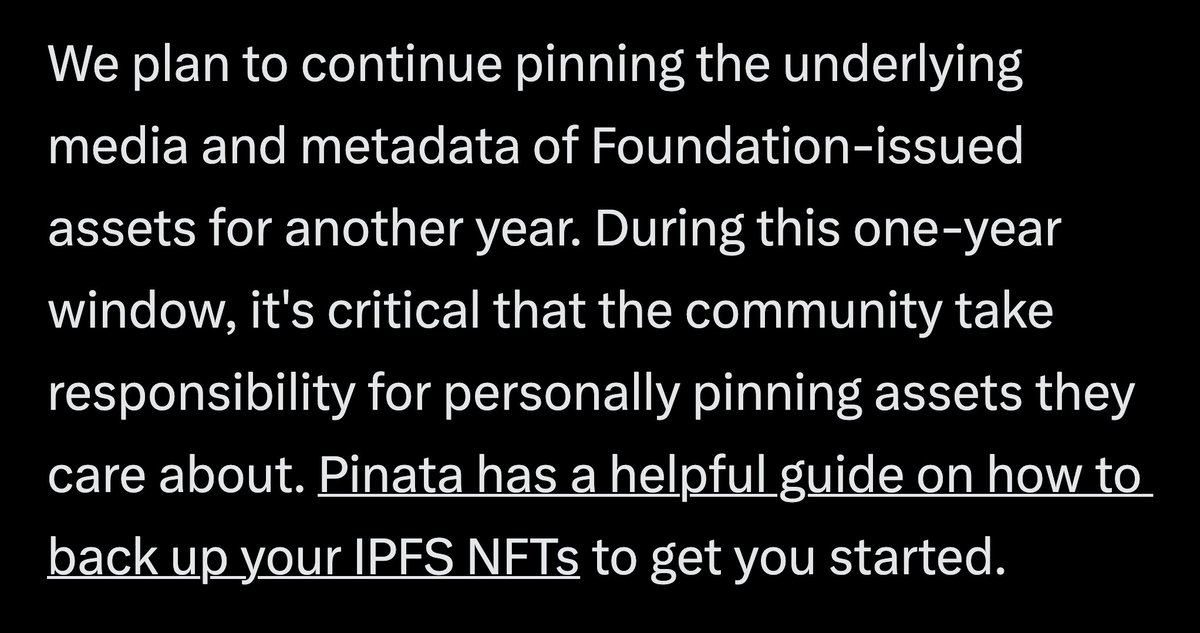
BREAKING: Ethereum NFT platform @foundation just announced that it is shutting down and that all of the art will be rugged in one year
This is why it's important to store art fully on-chain with protocols like Ordinals
English
Jah 🟠💙天 retweetledi
Jah 🟠💙天 retweetledi

Two stories. Same project
WLFI: Justin Sun dispute, Dolomite fallout, blacklist concerns, legal pressure
The token is absorbing all of it
USD1: $25M minted, $3M burned → net +$22M
Same ecosystem, different instruments
$WLFI = governance risk
USD1 = product behavior
Right now, they are not moving the same

English
Jah 🟠💙天 retweetledi

Jah 🟠💙天 retweetledi

when your dad is president and crime is legal

WLFI@worldlibertyfi
For early supporters: All 17,043,666,558 locked early supporter tokens move to a 2-year cliff followed by a 2-year linear vest. Full allocation retained. Zero burn. Holders who do not affirmatively accept the new schedule remain locked indefinitely under existing terms.
English
Jah 🟠💙天 retweetledi


Jah 🟠💙天 retweetledi

This is a summary and timeline of the entire $WLFI scam and the dirty entanglements surrounding it that I have been tweeting about since the very beginning.
Money flows, pardons, all of it.
It also includes my investigation into Binance and CZ involvement, which went viral in September and October 2025.
It is long, but some of you will read it and understand the full scale of it.
Let's start:
World Liberty Financial, or WLFI, is presented as a DeFi and stablecoin project.
In reality, the documented structure looks far more like a centralized political extraction machine than a normal crypto protocol.
This is a blunt reading of the project’s own paperwork, its insider economics, its freeze powers, its selective liquidity, its foreign dealmaking, and its later decision to use its own token as collateral to pull tens of millions from a linked lending venue.
The first red flag is in WLFI’s own documents.
The Gold Paper says the token’s sole utility is governance, that it gives holders no right to returns, dividends, or distributions, that the tokens were initially nontransferable, and that World Liberty Financial is not controlled by WLFI token holders.
It also says proposals are screened by WLF before reaching a vote, that implementation runs through multisigs, and that WLF can decide in its own discretion whether proposals proceed. That is not the structure most people picture when they hear the word decentralization.
The second red flag is the revenue split and founder allocation.
The same document says DT Marks DEFI LLC received 22.5 billion WLFI tokens and the right to 75% of net protocol revenues.
It also says Axiom Management Group and WC Digital Fi LLC together received 7.5 billion WLFI and rights to the remaining 25% of net protocol revenue. Total supply was set at 100 billion WLFI, with 30% allocated to the co founders and related entities. So from the start, the public got governance theater while the core economics were overwhelmingly tilted toward insiders.
The third red flag is how much money was raised before a real product existed.
By 30 October 2024, token sales had reportedly brought in only about $2.7 million.
After Trump’s election win and @justinsuntron Justin Sun’s $30 million purchase, the project accelerated sharply.
By March 2025, the venture said it had raised more than $550 million, even as the long promised DeFi platform still had not properly launched. In other words, political branding and insider access worked far better than product delivery.
Timeline:
-September 2024:
WLFI is unveiled as a Trump linked crypto venture wrapped in the language of DeFi, governance, and support for the U.S. dollar. From the beginning, the branding leaned heavily on Trump’s name while the legal structure ensured that token holders were not actually buying into the business itself.
-October 2024:
The token sale begins. The formal setup is already deeply asymmetric: governance only for buyers, no economic rights, insider allocations locked in, and a structure where public holders can vote on limited matters but do not control the company. That is one reason many critics immediately saw WLFI less as a protocol and more as a monetized political brand.
-November 2024 to March 2025:
After the election, the project’s fundraising explodes. Justin Sun becomes a major public backer. The Trump family takes control of a 60% stake in the business, while the revenue structure leaves them entitled to most of the money flowing through the token side of the operation. By early 2025, the family had already generated more than $460 million from the venture, even though the DeFi app itself still had not really arrived.
-March 2025:
WLFI announces and launches USD1, a dollar pegged stablecoin backed by U.S. Treasuries, dollars, and cash equivalents. This is where the story stops being just a Trump meme finance project and starts becoming a serious influence and infrastructure story. Stablecoins are not just symbols. They are distribution rails, yield machines, and political leverage when linked to state connected money.
-April and May 2025:
The project deepens ties with larger power centers. DWF Labs buys $25 million of WLFI. Even more importantly, USD1 is selected for MGX’s $2 billion investment into Binance.
That is not a side note. It means a Trump linked stablecoin was inserted directly into one of the largest and most politically sensitive crypto transactions of the year, involving Abu Dhabi backed capital and the world’s largest exchange.
The Binance angle matters even more because Binance was reportedly not just adjacent to WLFI. Bloomberg reported that Binance helped around the project’s stablecoin effort as a technical and promotional partner before its founder sought a pardon.
Later, concentration around Binance became extreme. By February 2026, my reporting indicated that Binance controlled about 87% of circulating USD1, counting both its own wallets and customer balances. For a politically connected stablecoin, that level of concentration is extraordinary and dangerous.
-July to September 2025:
Holders vote to make WLFI tradable. But even here the system favors insiders. Early investors were allowed to sell only up to 20% of their holdings when trading opened. The token briefly traded above $0.30, then fell, while still giving the project a multi billion dollar valuation. Retail got limited exit access. Insiders got price discovery, paper wealth, and continued control over future unlocks.
This is also where the blacklist and freeze issue becomes impossible to ignore. On chain data showed that the project’s guardian address blacklisted a wallet linked to Justin Sun holding roughly 545 million WLFI.
The project has acknowledged that it can freeze wallets tied to allegedly illegal activity, and public statements linked to the project later said 272 wallets had been blacklisted during a security intervention.
Even if one accepts the stated anti phishing rationale, the underlying fact remains brutal: this was sold with DeFi language, yet the team retained the power to freeze holdings.
-October and November 2025:
The Binance conflict darkens further. Trump grants a pardon to Changpeng Zhao, the founder of Binance, after Zhao had pleaded guilty in the U.S. anti money laundering case. Around the same period, critics and lawmakers highlighted the overlap between Binance’s growing relationship with WLFI and Zhao’s push for clemency.
The issue is not just optics. It is the appearance of a giant exchange helping a presidential family crypto venture while its founder later benefits from presidential mercy. That is exactly the kind of overlap that turns an already dirty story into a corruption story.
At the same time, foreign state linked money moves closer. Reporting later said the Trump family sold nearly half of WLFI to a UAE linked entity for $500 million shortly before the inauguration.
Separately, a Wall Street Journal report tied a 49% stake to a UAE royal connected figure. Whether one looks at this through the lens of ethics, influence, or constitutional conflict, the core point is the same: a presidential family venture was taking massive foreign linked money while public policy shifted around some of the same players.
-January to February 2026:
The sovereign angle expands again. Pakistan signs an agreement with a WLFI affiliate to explore using USD1 for cross border payments and integration with digital financial infrastructure. That is one of the most revealing parts of the whole story. A project born as a Trump branded crypto venture starts moving into state facing payment discussions abroad, while still carrying all of the centralization, conflict, and insider baggage it had from the start.
-April 2026:
The project enters open revolt. Justin Sun publicly accuses WLFI of secretly installing a blacklist backdoor. WLFI denies the accusation and challenges him to prove it. Sun’s specific claim remains an allegation, not an established fact. But the broader problem is already documented: the project does have freeze capacity, it did freeze major holdings, and it was already operating with centralized controls inconsistent with its marketing. That alone is enough to destroy the clean DeFi narrative.
Then comes the most abusive looking move of all.
WLFI deposits 5 billion of its own tokens into Dolomite as collateral and borrows more than $75 million in stablecoins, including $65.4 million in USD1 and $10.3 million in USDT.
This was not a neutral financing operation. It was a project using its own token, on a linked DeFi venue, to extract liquidity while much of the community still faced restricted exits and governance without real power. Analysts warned that the size of the position created liquidation risk and could intensify downward pressure on the token. That is why so many observers called it circular, self dealing, and deeply predatory.
The market reaction was ugly and deserved. WLFI fell to around $0.08, with a live market cap around $2.5 billion and an all time low recorded in April 2026. Even after the collapse, the market cap still looked absurdly high relative to the project’s delivery, governance reality, and growing scandal load. That is another hallmark of politically inflated crypto structures: the valuation can remain detached from fundamentals for a long time because the real fuel is branding, access, and narrative, not utility.
Why so many people call WLFI a scam? Oh well...
Because the pattern is too consistent to ignore.
The token gives buyers no claim on the real economics.
The insiders took the economics anyway.
The project sold decentralization while keeping centralized control.
It marketed governance while retaining screening power, multisig implementation, and freeze authority. It raised hundreds of millions before the core platform properly launched. It tied itself to foreign linked capital, Binance, and state facing stablecoin arrangements.
It restricted public exit while preserving insider optionality. Then it used its own token as collateral to borrow tens of millions in a structure that looked like value extraction, not user alignment. Put all of that together and it stops looking like a serious DeFi protocol. It looks like a political finance machine built to enrich the inner circle first and explain the rest later.
It is the full architecture: insider heavy tokenomics, no real holder rights, centralized override powers, selective liquidity, foreign money, exchange entanglements, pardon politics, and circular borrowing against its own token. That is not what healthy crypto infrastructure looks like. That is what a system looks like when power, access, and extraction are the product.
Thanks for reading.
Please like and repost.

English

Jah 🟠💙天 retweetledi
Jah 🟠💙天 retweetledi


Jah 🟠💙天 retweetledi

Jah 🟠💙天 retweetledi

你们口中的老外开始觉醒了
开始控诉aster是一个垃圾欺诈项目
早就说了,我们一起买入HYPE
做空aster这个垃圾
听我的早就发财了
Ardi@ArdiNSC
You're not fooling anyone, @Aster_DEX. I have your market maker model figured out. Eight bull traps across these ranges, all engineered by a market maker running the exact same playbook. Step 1: Massive god candles from mid-range to squeeze shorts. Step 2: Fake a breakout to trap longs. Step 3: Nuke the chart over the next two candles to wipe out the other side. Rinse and repeat in every range. This is a perps platform systematically wiping out its own perps holders every few days. Dirty work. I out-traded your MM in the bull run. It will be no different in the bear. ♟
中文
Jah 🟠💙天 retweetledi

日本ではまだあまり知られていませんが、Hyperliquidという会社があります。
創業3年、従業員たった11人で年間利益9億ドル(約1,400億円) の企業。すごい!
Hyperliquidを通じて、石油、銀、S&P 500などが24時間取引されており、取引高は約4兆ドル(約640兆円)で、あのRobinhoodも上回ったと言われています。
いわゆるDeFi(分散型・オンチェーン)サービスで、あらゆる金融取引がHyperliquidで完結するようになり、証券会社だけでなく既存の取引市場そのものが不要になるかもしれないインパクト。
インターネットの登場でオフラインの取引がオンラインに置き換わったように、ブロックチェーンとスマートコントラクトの登場で、今後、あらゆる金融取引がオフチェーンからオンチェーンに置き換わっていくと思われます。
私たちは今、歴史的な大変化を目の当たりにしています。
創業者のYan氏は若い頃から数学・物理の才能を示し、米国の数学オリンピック選抜チームに選出されたり、物理オリンピックで金メダルを取ったとも報じられています。
まさに天才。
Colossus@colossusmag
This is the story of Hyperliquid, the most profitable startup per employee on earth, told from a guarded office in Singapore. Last year, its team of 11 generated $900 million in profit. It's 3 years old, has never taken a dollar of venture capital, and is beginning to change how century-old markets work. Its founder, Jeffrey Yan (@chameleon_jeff), had never taken a physics class when he picked up a textbook at 16. Two years later, he won gold at the International Physics Olympiad. In 2019, he started trading with $10,000 from a living room in Puerto Rico—working off a television because he didn't own a monitor. Within 3 years, he was running one of the largest anonymous crypto trading firms. Then he shut it down. Yan was rich and free, but he had spent years inside crypto, watching it betray itself. Bitcoin's central premise was decentralization. Yet the biggest exchanges were centralized. Crypto kept reintroducing the dependence on trust it was built to eliminate. He set out to create what should have existed. Hyperliquid is a blockchain with a trading exchange on top, and anyone can build on it. Yan's vision is to house all of finance. In 3 years, it has done over $4 trillion in volume. And in the past few months, it has begun to outgrow crypto. Markets for oil, silver, and the S&P 500 now trade on Hyperliquid around the clock, weekends included, and are growing roughly 40% week on week. When the US and Israel bombed Iran on a Saturday in February, Hyperliquid was the venue traders turned to. Hyperliquid's success has cost Yan his freedom. He works out of a secret office in Singapore and cannot travel without two bodyguards. Even the team's housekeeper doesn't know what they do. In January, @domcooke spent a week at their office. Read his profile on Yan and @HyperliquidX below.
日本語
Jah 🟠💙天 retweetledi

@YuzoKano @tamakiyuichiro guy from a CEX has an opinion about the company taking his market share
English
Jah 🟠💙天 retweetledi

@YuzoKano @tamakiyuichiro 技術わからんはまあいいとしても、法令と現状すら認識のあまい発言力ある文系の政治家のせいで日本の技術イノベーションが遅れると痛感しますね。
日本語
Jah 🟠💙天 retweetledi

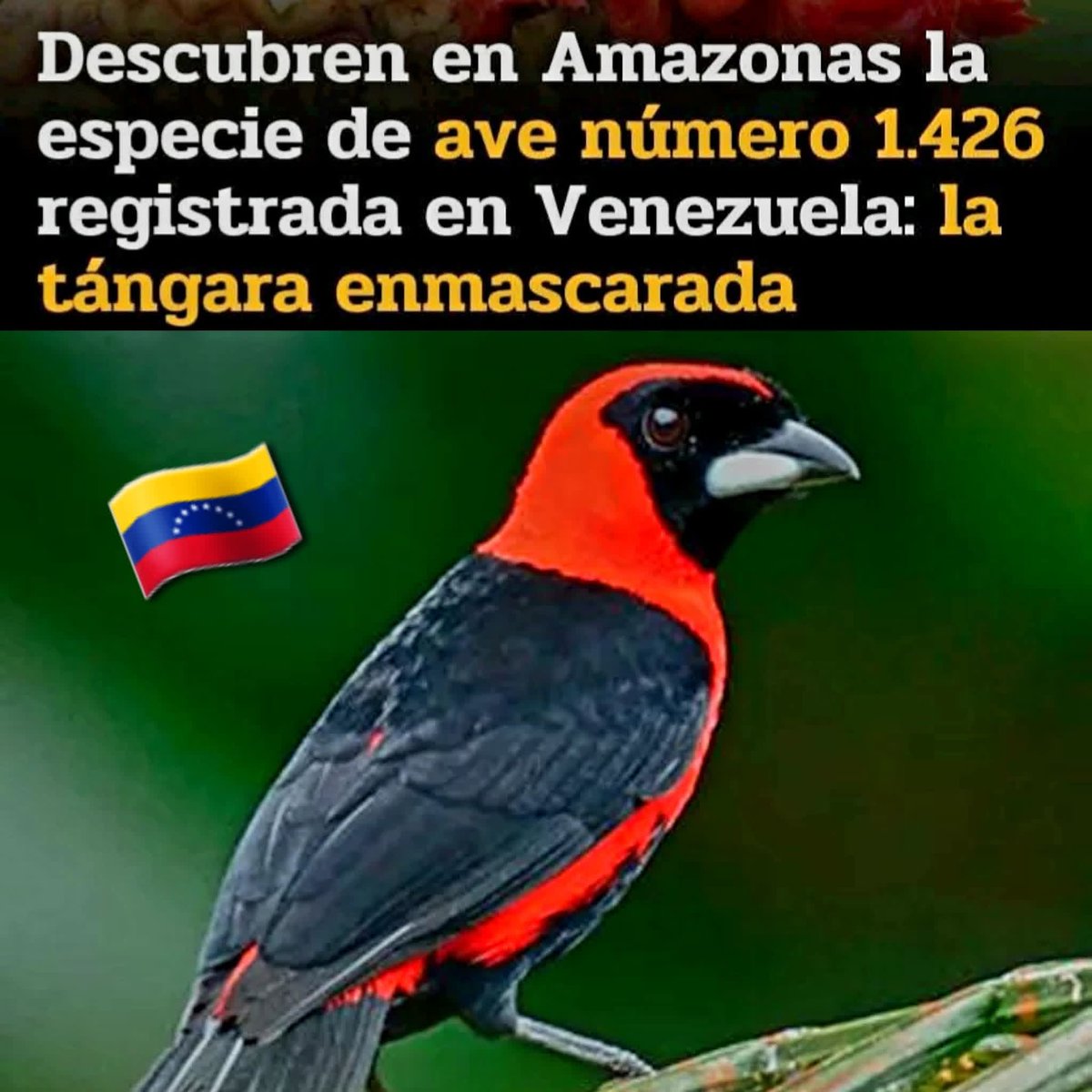
Registran nueva especie de ave en Venezuela : "La Tángara Enmascarada", quedando con el número 1.426 de las especies registradas en el país, lo que consolida a Venezuela como uno de los territorios con mayor diversidad ornitológica del mundo. Kathy Phelps estaría feliz....
Español