
Sabitlenmiş Tweet
Fairmint
1.8K posts


Fairmint retweetledi

One of the standout sessions on Day 2 focused on Operational Efficiencies in Tokenization, featuring Peter Duggan from @Computershare, Joris Delanoue from @fairmint, Greg Cignarella from Apex Invest, Joseph Spiro from @The_DTCC, and moderated by @MarcinRedStone from @redstone_defi .
English
Fairmint retweetledi

Really enjoyed yesterday’s TokenizeThis 2026 panel on Operational Efficiencies in Tokenization.
Thank you to @MarcinRedStone, Co-Founder & COO at @redstone_defi, for moderating the conversation, and to Joseph Spiro, Director, Digital Assets Solutions at @The_DTCC, and @GregCig5, Head of Business Development at @ApexGlobalGroup, for bringing such practical perspective to the stage.
The part I keep coming back to is this:
Tokenization will not win because it gives the market better terminology.
It will win when it removes duplicate work, reduces operational uncertainty, and gives institutions cleaner ways to coordinate around ownership, movement, and control of assets.
That is less flashy than a new product launch.
But in capital markets, the less flashy work is often where the most durable infrastructure gets built.

English
Fairmint retweetledi

@Joris_DLN @JL_Pellerin @fairmint @CantonNetwork @trize_io Thank you, @Joris_DLN, genuinely appreciated. Strong alignment with @fairmint. Real respect for the discipline and conviction behind what you’re building, this is how market leaders set the standard.
English
Fairmint retweetledi

A big thank you to @fairmint for sponsoring TokenizeThis NYC.
We are grateful to have partners who are pushing the frontier of digital assets and tokenized markets forward.
See you at The Glasshouse.

English
Fairmint retweetledi
Tokenization gets interesting when it stops being a concept and starts improving how the market actually operates.
This Wednesday, June 24, I’ll be speaking at @TokenizeThisNYC 2026 on “Operational Efficiencies in Tokenization.”
I’ll be joined by @MarcinRedStone, Co-Founder and COO at @redstone_defi, who will moderate the discussion, along with Joseph Spiro, Director, Digital Assets Solutions at @The_DTCC, and @GregCig5, Head of Business Development at @ApexGlobalGroup.
The real test is not whether an asset can be represented onchain.
It is whether the rails make issuance, ownership, compliance, settlement, reporting, and investor operations meaningfully better.
That is where the next chapter of tokenization will be decided.
Looking forward to the conversation.
GIF
English
Fairmint retweetledi

1/8 Day 14 of 20: @fairmint Building Regulated Onchain Equity Infrastructure on @CantonNetwork
I'm covering the 20 most important projects in the Canton Network ecosystem over 20 days.
🧵
English
Fairmint retweetledi

CatalyX team is heading to @fairmint's upcoming CC Builders Forum.
The event brings together @CantonFdn General Members, builders, ecosystem partners, and institutions.
Anastasiia Vitmer and Armando Aguilar will be on site to connect. Catch their presentation on our framework for getting institutions from joining the @CantonNetwork to running in production, across infrastructure, custody, integration, and support.
📍 NYC, June 18.

English
The Canton Institutional Panel is happening this Thursday, June 18th, at CC Builders Forum in NYC. Hosted by @Fairmint with support from the @CantonFdn.
We’ll be joined by:
@OuaknineJorgen — Global Head of Innovation & Digital Assets at Euroclear; Co-Chairman, Canton Foundation
@Joris_DLN — CEO of Fairmint; General Director, Canton Foundation
Mark Toomey — President, @CantonStrategic
The conversation will focus on institutional adoption, market structure, and the next phase of regulated onchain finance across the Canton ecosystem.
If you’re tracking Canton, this is one of the rooms to be in this week.
Don’t miss it.
Apply to attend: luma.com/cc-builders-fo…

English
Fairmint retweetledi

Our Head of Business Development, @FelineFortune_, will be speaking at CC Builders Forum in NYC.
Looking forward to connecting with builders, founders, and teams shaping the future of Canton.
🗓️ June 18th | 4:00PM
RSVP: luma.com/cc-builders-fo…

English

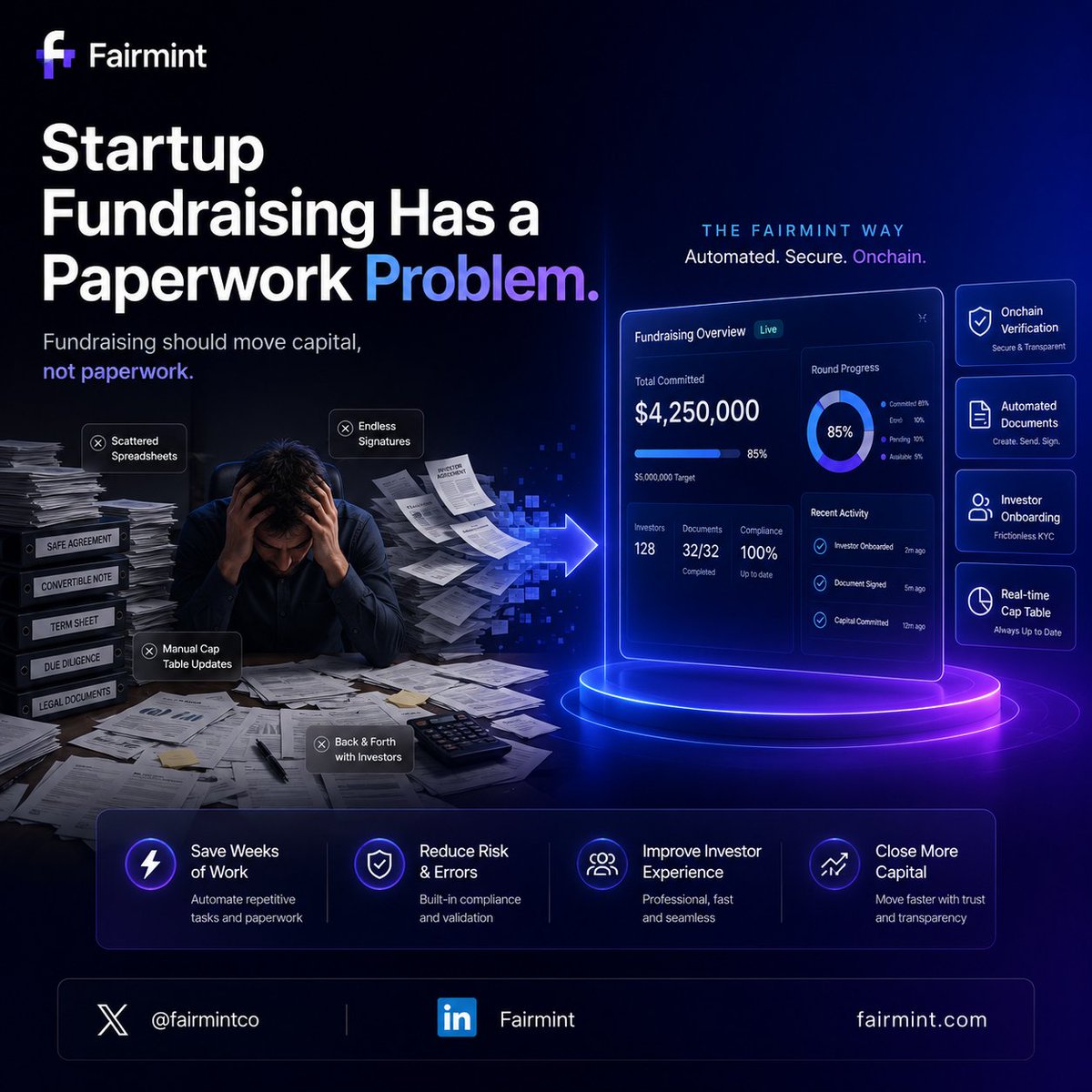
Raising capital in crypto shouldn't feel harder than building the product
You pitch, send documents, wait on legal, update the cap table by hand, and follow up again.
Sometimes, weeks pass before ownership is even officially recorded.
For something this important, the infrastructure is embarrassingly outdated.
That's one of the problems platforms like @fairmint are trying to solve
Not by making fundraising flashier but by making it functional.
Founders raise capital online.
Equity is issued automatically as capital comes in.
Ownership records stay clean, organized, and verifiable without anyone chasing down a lawyer to confirm what's in the cap table.
Compliance isn't an afterthought handled at the end, it's built into the workflow from the start.
What actually changes for founders:
- Less time managing fundraising operations
- Equity issued the moment capital lands
- A cap table that's transparent and auditable at every stage
- Investors who know exactly what they own without asking
The interesting part isn't that equity is moving onchain.
It's that fundraising starts feeling like modern software, instead of a collection of disconnected legal processes held together by email threads and hope.
That's the utility most people miss when they hear onchain equity.
The most valuable infrastructure is often invisible.
Founders don't wake up asking for onchain equity.
They want fundraising to move faster, ownership to stay organized, and operations to scale without creating administrative debt.
That's where I think the real opportunity sits.
English
Fairmint retweetledi
DeFi spent a decade building rails to move assets.
The next leg of onchain finance is about the assets themselves: making the legal record of ownership digitally native.
At @fairmint, this is the layer we’ve been building, bringing equity onchain.
I’ll be speaking at @ETHConf in NYC this June.
DeFi built the rails. Now it needs the assets.
ethconf.com

English
@OndoFinance Heartbroken to hear this news. Our thoughts are with Nathan’s family, loved ones, friends, and everyone at Ondo during this incredibly difficult time. May his memory be a blessing to all who knew him.
English

It is with profound sadness that we announce the unexpected passing of Nathan Allman, Ondo's founder. Our hearts are with his family and loved ones.
Nate’s brilliance, humility, and drive shaped every part of what Ondo is today. His belief in the power of technology to create a more open, accessible financial system lives on in everything we build. The impact he had on this industry, and on all of us personally, cannot be overstated.
Nate also helped us build a durable organization with experienced leaders across all facets of the business. Ian De Bode, Ondo Finance’s longtime President, will serve as CEO. Ian has been leading our strategy, product, and day-to-day operations for over two years and has the full confidence of the leadership team.
We will continue building what Nate started. That is the most meaningful way we know to honor him.
English
Fairmint retweetledi
Excited to share that @viv_diwakar, Head of the @CantonFdn, will join us for a featured fireside chat at CC Builders Forum in New York on June 18.
We’re bringing together Canton Foundation General Members, institutions, allocators, market-structure leaders, and ecosystem partners to talk about what is being built across the Canton ecosystem.
Viv will help set the stage for where the ecosystem is heading, what builders need next, and how Canton continues to support regulated onchain finance.
Hosted by @Fairmint, with support from The Canton Foundation.
Request attendance: lnkd.in/ecDVygjC
General Members apply to present: lnkd.in/ewxcmurz

English
Fairmint retweetledi
On June 18, @Fairmint is hosting the CC Builders Forum in NYC, with support from @CantonFdn and The RWA Desk.
The goal is to create a focused setting for institutions, allocators, market-structure leaders, and ecosystem partners to meet directly with Canton Foundation General Members and understand what is being built across the ecosystem.
As General Director on the Canton Foundation Board, I’ve wanted to help create more opportunities for General Members to share their work, build useful relationships, and connect with the institutions and partners that can help move the ecosystem forward.
The program will include:
• Opening keynote & fireside chat
• General Member presentation sessions
• Institutional panel
• Professional video/audio recording
• Dinner reception
For institutions and allocators, this is an opportunity to engage with leading teams building across Canton in a curated setting.
For General Members, selected teams will have the opportunity to present their product, Canton integration, roadmap, and key ecosystem asks.
Request attendance: luma.com/cc-builders-fo…
General Members apply to present: luma.com/cc-builders-fo…
More details coming soon.

English
Fairmint retweetledi

Public markets are the anchor of American capital formation.
Today’s proposed rulemakings (along with our recent rule proposal on semiannual reporting) mark significant steps toward transforming our rulebook for public companies so more Americans can invest in our economy.
English
Fairmint is headed to Paris for @proofoftalk.
Our Founder & CEO, @Joris_DLN, will be speaking at the Louvre Palace, joining founders, institutions, and market-structure leaders shaping the next phase of regulated finance onchain.
If you’ll be in Paris June 1–4, reach out. We’d be glad to connect.
Proof of Talk@proofoftalk
The first SEC-registered transfer agent putting equity directly onchain is run by one person. Joris Delanoue @Joris_DLN, Founder and CEO of @fairmint, takes the Louvre Palace stage on June 2 & 3 this summer. Fairmint is turning cap tables into smart contracts, with $1.5B+ in equity already moved onchain. The work sits at one of the most consequential intersections in the market right now. Where Wall Street's regulatory infrastructure meets the programmable settlement layer of public blockchains. Joris co-authored the Open Cap Table Protocol, now shaping how the industry standardises onchain equity. He also sits on the Board of Directors of the @CantonFdn, where he was elected General Director. The Louvre Palace, June 2 & 3. The Davos of Web3. tickets.proofoftalk.io/passes
English
Fairmint retweetledi
Market infrastructure is shaped by the technology of its time.
In 1969, Wall Street had a paperwork crisis.
The industry chose the most robust path available then: centralized electronic rails.
Today, distributed ledgers make a different trust model possible.
At @Fairmint, this is the part we care about: regulated actors syncing around an authoritative onchain ledger.
The shift will not happen because onchain is fashionable.
It will happen where the rails work better.
English
Fairmint retweetledi

English
Fairmint retweetledi

@fairmint @BTCFiNetwork @DraperVC @TimDraper @maxime_bucaille bringing cap tables onchain from day one is actually a smart wedge tbh less paperwork later and cleaner ownership rails if startups are willing to adopt early. follow sent g
English